
Reviewed · POMPEII TOURS WITH AN ARCHAEOLOGIST
Pompeii and Herculaneum Private Walking Tour with an Archaeologist
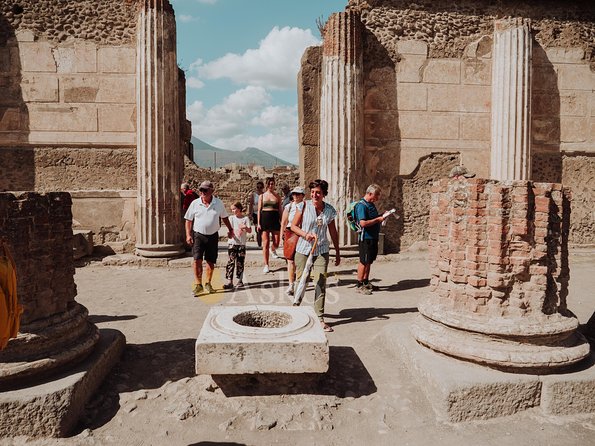
Pompeii and Herculaneum are not interchangeable ruins. Herculaneum feels smaller, sharper, and more intimate, while Pompeii spreads across a much larger ancient city. This private walking tour gives you both in one day, with an archaeologist explaining the houses, baths, public squares, and eruption remains as you move through them.
I like two things right away: you can ask your own questions instead of following a large group, and the guide can connect small details, such as a carbonized wooden door or a household courtyard, to Roman daily life. The main drawback is the price, $597.36 per group, plus both entrance tickets and transportation. It is good value for a family or group of several people, but costly for one or two.
Key points at a glance
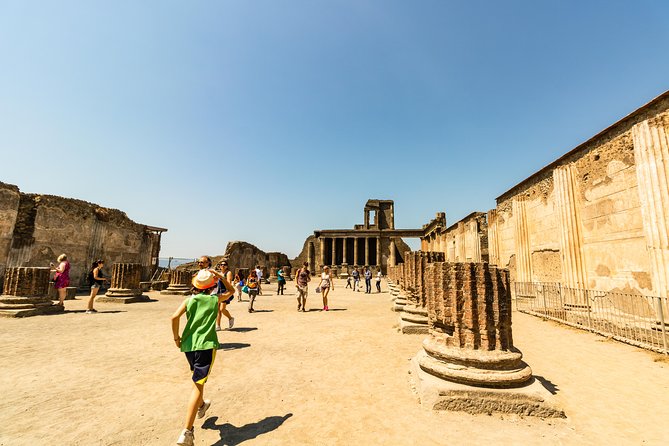
- Two very different Roman cities: Herculaneum offers preserved wood, homes, and fine decoration, while Pompeii provides broad streets, public buildings, theaters, and famous casts.
- A private archaeologist guide: Guides including Mena, Vincenzo, Ivan, Sylvia, and Giancarlo have led this tour, though your assigned guide is not guaranteed.
- About five and a half hours on foot: Plan for steady walking over ancient streets and uneven surfaces. Comfortable shoes are required.
- Tickets cost extra: Herculaneum admission is listed at 16 euros for adults and 2 euros for EU citizens aged 18 to 25. Pompeii tickets are also separate.
- Public transportation is part of the plan: The Herculaneum transfer takes about 30 minutes by train, followed by a walk of about 10 minutes.
- Best for curious families and small groups: The private format lets your guide adjust explanations and answer questions at your pace.
Why seeing Herculaneum and Pompeii together makes sense
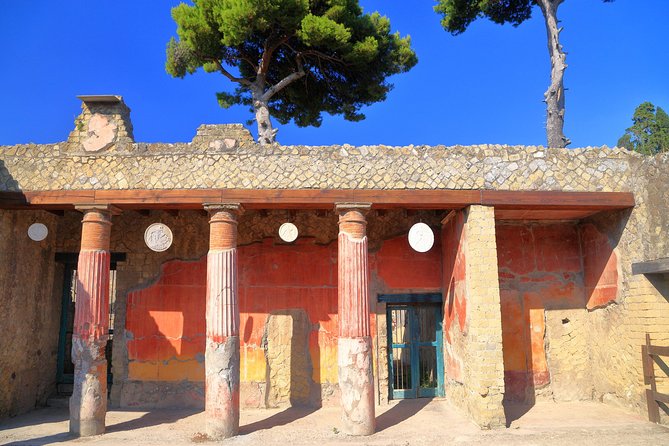
The eruption of Mount Vesuvius in AD 79 buried both towns, but the results are different. Herculaneum was covered by hot volcanic material that preserved striking organic remains, including wood. Pompeii was covered mainly by ash and pumice, leaving a much larger street plan and a broad range of public buildings.
That contrast gives this tour its purpose. At Herculaneum, you look closely at individual houses and their decoration. At Pompeii, you get a stronger sense of an entire Roman city, with its forum, baths, theaters, shops, and major residences.
A guide matters here because the ruins can otherwise look like a long series of walls. An archaeologist can point out how a house was arranged, explain the purpose of a room, and show where decoration or building materials reveal social rank. The best guides on this experience have been praised for bringing the cities to life, answering questions in detail, and adjusting explanations for children as well as adults.
The private setup is especially useful when your group includes several ages or different interests. You can ask about engineering, religion, domestic life, art, or the eruption without waiting for a large group to catch up.
More Herculaneum tours:
- Herculaneum: Skip-the-Line Guided Tour with Archaeologist
★ 4.8 · 3,439 reviews - Herculaneum Small Group Tour and Ticket With an Archaeologist
★ 5.0 · 994 reviews - Herculaneum: Skip-the-Line Entry Ticket with Audio Guide
★ 4.3 · 870 reviews
Beginning at Herculaneum, where wood still survives
The tour begins at the Herculaneum ruins, with the meeting point at the ticket office on Via dei Papiri Ercolanesi. You can reach the area by car, with an unguarded parking area nearby, or by train to the Circumvesuviana station at Corso Resina 1. From the station, allow about 10 minutes to walk to the ruins.
The planned transfer by train takes about 30 minutes, followed by that walk. Transportation is not included in the price, so you should allow for your own train fare and make sure you understand where to meet the guide. One practical warning is worth taking seriously: the meeting point can be hard to identify, and one past guest wished the tour company had given clearer advice about buying tickets online in advance.
Herculaneum entry is not included. The listed price is 16 euros for an adult and 2 euros for an EU citizen aged 18 to 25. Bring sunscreen and sunglasses, and take the footwear rule seriously. Flip-flops are not suitable for a long walk over ancient paving.
The Herculaneum visit is scheduled for about an hour, with a possible quick lunch break if needed. That is not much time for the site, so your guide will focus on selected highlights rather than every visible street and building.
Herculaneum’s houses, woodwork, and seaside setting
The House of the Deer takes its name from marble deer statues found in the peristyle, or columned garden area. It is a good example of how a private home can reveal taste, wealth, and the importance of outdoor space.
At the terrace of Marcus Nonius Balbus, you learn about one of the city’s leading benefactors. He restored and built public structures, and after his death received honors recorded on his funeral altar. This stop links private prosperity to civic life, a useful theme throughout both archaeological parks.
The College of the Augustales was connected with the cult of the emperor Augustus and may also have served as a local civic headquarters. It shows how religion, politics, and public identity overlapped in Roman towns.
The House of the Telephus Relief is unusual because it had private access to the adjoining Suburban Baths. That detail helps you see that Roman houses were not isolated boxes. They connected to streets, bathing facilities, gardens, and public life in ways that can be easy to miss without a guide.
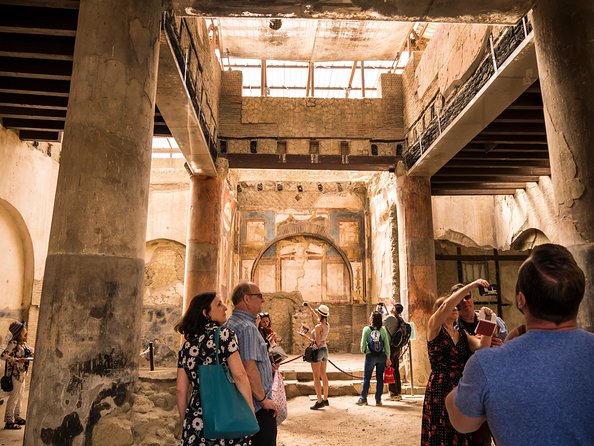
The wooden partition house is one of Herculaneum’s most memorable stops. Its elegant carbonized wooden divider survived the eruption, giving you a rare look at a material that usually vanished from ancient sites. The House of the Skeleton gets its name from human remains found in an upper room in 1831. These details add a more serious edge to the visit and remind you that this was a real town caught in a disaster.
The Central Baths show the practical side of Roman life. Built around the beginning of the first century AD, they had separate entrances and facilities for men and women. The House of the Black Salon, one of the town’s more luxurious homes, retains carbonized doorposts and a lintel at its monumental entrance.
The Samnite House has a handsome atrium surrounded by an Ionic-column gallery, with rooms decorated in fresco. The House of the Beautiful Courtyard differs from the usual plan, replacing a conventional atrium with a courtyard, staircase, and stone balcony. The House of the Grand Portal brings together several features you will see elsewhere at Herculaneum: columned spaces, frescoes, and charred wooden elements.
In a short visit, these houses can blur together. That is where the private archaeologist earns the fee. Ask the guide to compare the homes rather than treating each one as a separate stop. The most useful question is often simple: what does this feature tell us about the people who lived here?
Moving on to Pompeii’s streets and public center
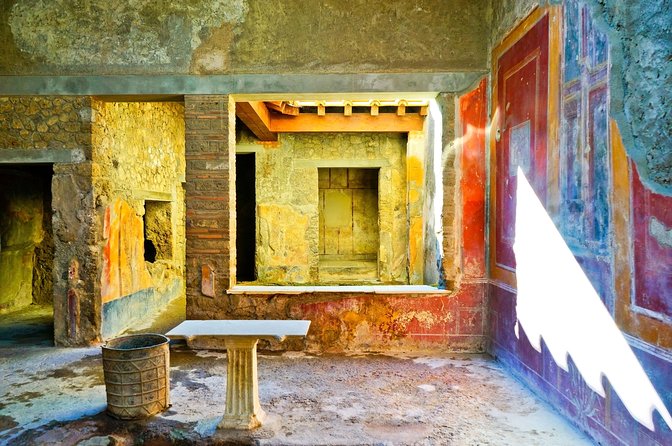
The Pompeii portion begins at Porta Marina Superiore, the main entrance named for the tour company on the guide’s sign. The tour ends inside the Pompeii ruins on Via Villa dei Misteri, rather than returning you to Naples.
The two sites are not connected by tour transport, and the listed price excludes all transportation. The itinerary describes a train transfer to Herculaneum, but you should confirm the exact movement between the sites with the operator before setting out. This matters because an unplanned delay can cut into your time inside Pompeii.
Pompeii is physically broader than Herculaneum, and the walking can feel more demanding. You follow the main street and pass through a city plan that includes residential lanes, public squares, baths, theaters, and commercial spaces. The ancient paving is part of the experience, but it can be uneven.
The first major stop is the Lupanar, Pompeii’s most famous brothel. Its small rooms and surviving painted images offer a direct, less polished look at Roman commercial and sexual life. It is a popular stop, so having a private guide helps you understand what you are seeing without lingering unnecessarily in a crowded doorway.
From there, the route reaches the Forum, the city’s main square. This was the civic heart of Pompeii, where public, religious, and commercial activity came together. The Forum makes more sense after Herculaneum because you have already seen how private homes connected to wider civic life.
More Pompeii tours led by an archaeologist:
- From Naples: Pompeii & Herculaneum with Archaeologist Guide
★ 4.8 · 665 reviews - Pompeii: Private Tour with an Archaeologist
★ 4.9 · 168 reviews - Herculaneum Private Tour with an Archaeologist
★ 5.0 · 132 reviews - Pompeii and Herculaneum led by an Archaeologist with private transport
★ 5.0 · 78 reviews
Forum buildings, casts, and Roman bathing
The Forum granaries now hold marble tables, fountain baths, architectural pieces, and casts connected with the eruption. You may also see casts of victims, a dog, and a tree. This stop can be emotionally difficult, but it is important. The casts show the human cost of the eruption in a way that walls and pottery cannot.
The Basilica was an open portico used for merchants and other public business. In Roman cities, a basilica was not primarily a church. Your guide can help you separate the later Christian meaning of the word from its earlier civic role.
The Stabian Baths occupy a large area near the Brothel Lane, the Holconius crossroads, and Via Stabiana. They are considered the oldest thermal complex in Pompeii, and they help you see bathing as a central part of Roman social life, not just a private chore.
This portion is likely to appeal to anyone interested in Roman engineering. Your guide may point out how the baths were arranged, how different rooms served different purposes, and how public facilities reflected the city’s wealth and organization. The walking between sites also gives you a chance to ask about water, heating, sanitation, and construction.
The House of the Faun and House of Menander
The House of the Faun was one of Pompeii’s largest and most impressive private residences. Its size alone tells you that Pompeii contained very wealthy households, not only modest shops and working homes.
The House of Menander is another major residence, known for its architecture, decoration, and contents. These houses are useful comparisons with Herculaneum’s domestic buildings. Ask your guide how the layout, decoration, and scale differ between an ordinary Roman home and a mansion designed to display status.
The route then reaches the Great Theater, Pompeii’s most important theater, followed by a look at the smaller theater, often called the Little Theater. The two spaces show that entertainment was not an afterthought. Public performance formed part of the city’s social and civic life.
The theater stops also provide a welcome change after the streets and houses. You can sit with the scale of the buildings and imagine how sound, audience movement, and public ceremony worked in the Roman city, while your guide supplies the archaeological context.
How the private format changes the day
The advertised price is $597.36 for a group of up to 15 people. That figure is not cheap if you are a couple, especially after adding Herculaneum and Pompeii entrance fees and transport. For a family or group sharing the cost, the calculation improves quickly.
The real value is control. You can ask for more detail at a house that interests you, move more quickly through a stop that does not, and keep children involved with questions rather than a long lecture. One family praised Giancarlo’s patience with children aged 11, 11, and 14. Another group said a guide helped make the material work for different ages.
The archaeologist background is the strongest reason to choose this option over a basic map or audio guide. Guides named in past feedback include Mena, Vincenzo, Ivan, Sylvia, Raffaele Romano, Paola, Giovanni, Giancarlo, Alessandra, and Marilee or Marili. Your guide will depend on availability, so do not book on the assumption that you will receive one particular person.
The experience has received a 4.9 rating from 77 reviews, with 97 percent recommending it. The praise centers on the guides’ expertise, engaging explanations, help with transit problems, and ability to avoid some crowded areas. Still, the experience is not flawless for everyone. One guest found the delivery somewhat formulaic and felt the guide could have talked more while walking between stops. Another felt the price was high and wanted clearer advice about advance tickets.
Those are fair considerations. A private archaeologist tour gives you more than a self-guided visit, but it does not remove the need to plan. Confirm ticket arrangements, meeting details, and transport before the day begins.
Who should book this Pompeii and Herculaneum tour?
I would choose this tour if you want both archaeological parks in one concentrated day and you care about context more than a relaxed pace. It is also a strong choice for families, multigenerational groups, and anyone who likes asking questions.
I would hesitate if you prefer to wander independently, dislike a packed schedule, or are visiting on a very tight budget. Five and a half hours covers a great deal, but it is not enough to see every corner of both sites. The tour also requires moderate physical fitness, steady walking, sunscreen, sunglasses, and proper shoes.
You can cancel for a full refund up to 24 hours before the start time. The service is offered in English, and service animals are allowed.
Should you book it?
Book this private tour if you want an archaeologist to turn two vast ruin sites into a connected story about homes, politics, bathing, entertainment, religion, and disaster. The strongest part is the guide-led interpretation, not simply the number of stops.
For a group of several people, the cost can be sensible, especially if you value flexible pacing and direct questions. For two people, compare the total price with a smaller shared tour. If you do book, sort out the separate admission tickets and train arrangements in advance, wear sturdy shoes, and arrive ready for a full morning and afternoon on ancient stone.
FAQ
How long does the tour last?
The planned duration is approximately five hours and 30 minutes.
Which sites are included?
The tour visits the Archaeological Park of Herculaneum and the Pompeii Archaeological Park.
Are entrance tickets included?
No. Herculaneum and Pompeii admission tickets are not included in the tour price.
How much is Herculaneum admission?
The listed price is 16 euros for an adult and 2 euros for EU citizens aged 18 to 25.
Is transportation included?
No. Transportation to the sites is not included. The itinerary describes a train transfer to Herculaneum taking about 30 minutes, followed by a walk of about 10 minutes.
Where does the tour start?
It starts at Via dei Papiri Ercolanesi, 80056 Ercolano, Italy, with the Herculaneum meeting point at the ruins’ ticket office.
Where does the tour end?
The tour ends inside the Pompeii ruins at Via Villa dei Misteri, 2, Pompeii.
Is this a private tour?
Yes. Only your group participates, with a maximum group size of 15 people.
What should I wear?
Wear comfortable shoes. Flip-flops are not allowed or suitable for this tour. Sunglasses and sunscreen are also suggested, and you should expect a moderate level of walking.
More Walking Tours in Naples
- Naples: Street Food Walking Tour with Local Guide
★ 4.8 · 4,256 reviews - Naples Spanish Quarters Walking Tour Street Art, Folklore & Sweet
★ 5.0 · 797 reviews - Naples: Old Town Guided Walking Tour
★ 4.8 · 553 reviews - Naples: Panoramic Walking Tour with Funicular
★ 4.8 · 543 reviews
More Ways to See Pompeii
- From Naples: Pompeii Ruins & Mount Vesuvius Day Tour
★ 4.3 · 11,459 reviews - Naples or Sorrento: Full-Day Pompeii and Mount Vesuvius Tour
★ 4.6 · 4,235 reviews - Pompeii & Mt.Vesuvius Day Tour from Naples with Pizza Lunch
★ 4.0 · 2,901 reviews - From Naples: Pompeii Skip-the-Line Entry Ticket and Tour
★ 4.4 · 2,753 reviews
Just added around Naples
- Naples: Guided Walking Tour★ 4.7 · 63 reviews
- Wine tasting in the Vesuvius National Park★ 3.5 · 4 reviews
- Naples: Pompeii and Vesuvius Skip-the-Line Day Trip★ 3.8 · 32 reviews
- Visit the Museum MANN with a professional guide★ 5.0 · 3 reviews
- Walking-tour of Naples hystorical Centre★ 4.4 · 4 reviews
- Vesuvius – Herculaneum – Pompeii Excavations Tour★ 4.2 · 9 reviews
- Pompeii: Vesuvius at Sunset★ 3.5 · 31 reviews
- Vesuvius and Herculaneum from Naples★ 3.7 · 29 reviews
Pompeii Tours with an Archaeologist, compared.

Pompeii Small Group Tour with an Archaeologist
Read our review →
Pompeii and Herculaneum Small Group Tour with an Archaeologist
Read our review →
Herculaneum Small Group Tour and Ticket With an Archaeologist
Read our review →
Pompeii & Herculaneum with Archaeologist Guide
Read our review →
Pompeii Private Tour with an Archaeologist and Skip The Line – 3 hours
Read our review →
Pompeii Private Tour with an Archaeologist and Skip The Line
Read our review →Browse the lists this tour appears in