
Reviewed · POMPEII TOURS WITH AN ARCHAEOLOGIST
Explore Pompeii with an Archaeologist
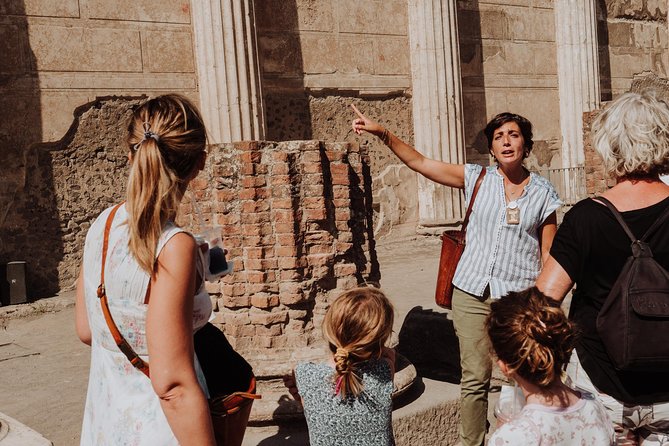
Pompeii comes alive when someone explains what you are looking at. In two hours, an archaeologist guides you from the Forum and Basilica to painted houses, public baths, food counters, and theaters, turning scattered walls into a picture of daily Roman life. I especially like the small-group format, with no more than 20 people, and the skip-the-line admission that saves time at the entrance.
I also like that guides such as Mario, Teresa, Alexandra, Rosanna, and Ilaria are praised for clear explanations, patience, and a good sense of humor. The main caution is the site itself: Pompeii is vast, hot, and uneven, and crowds inside can make it hard to hear even through the headset.
Key points to know before you book
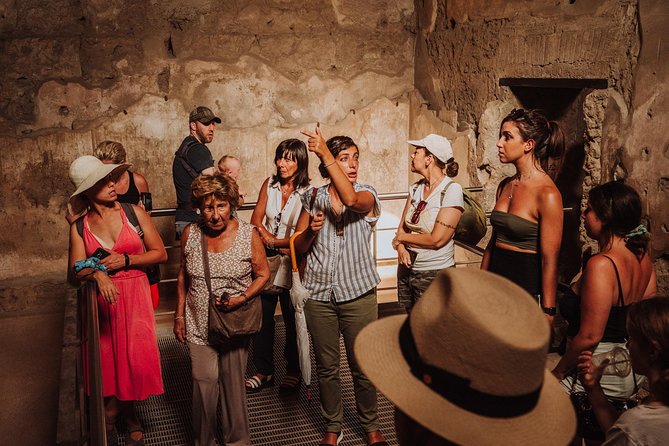
- You see the major highlights in two hours: The route includes the Forum, Lupanar, House of the Faun, Stabian Baths, Via dell’Abbondanza, Thermopolium, and both major theaters.
- An archaeologist leads the visit: Guides explain how the buildings were used rather than simply naming each ruin.
- The group has a 20-person maximum: That gives you a better chance to ask questions than on a large coach tour.
- The site requires real walking: Expect uneven ancient paving, exposed areas, and plenty of time on your feet.
- You can stay after the tour: The guided visit ends at Piazza Esedra, and you can continue exploring Pompeii independently.
- The price is reasonable for a guided introduction: At $35.67 per person, admission and expert guidance are included, but you still need to arrange your own transport and refreshments.
Why an archaeologist changes Pompeii
Pompeii is not a tidy collection of monuments. It is an entire Roman town, with streets, shops, courtyards, baths, homes, political buildings, entertainment spaces, and working kitchens. Without context, you can spend hours looking at walls and still miss what made each building important.
That is the main value of this experience. The guide gives you a route through the most useful parts of the site and explains what you are seeing as you go. A good guide can point out how a courtroom differed from a private house, why a bath complex mattered to Roman life, and how a food counter served ordinary residents.
I like the balance between landmarks and everyday places. The Forum and theaters provide the grand scale, while the Thermopolium and Via dell’Abbondanza show how people ate, worked, and moved through town. The visit is not only about impressive ruins. It is about understanding how a city functioned.
The tour is offered in English. Guides named in the booking material include Mario Celentano, Julia, Alexandra, Ilaria, Diego, Rafaela, Teresa, Antonio, Rosanna, Jolanta, and Sergio. The exact guide depends on the departure, but the strongest pattern is clear: visitors value guides who explain plainly, keep a steady pace, and make time for questions.
More Pompeii tours led by an archaeologist:
- Pompeii Small Group Tour with an Archaeologist
★ 5.0 · 6,593 reviews - Pompeii and Herculaneum Small Group Tour with an Archaeologist
★ 5.0 · 1,350 reviews - Skip the Line Guided Tour of Pompeii led by an Archaeologist
★ 5.0 · 703 reviews
Entering at Porta Marina Superiore
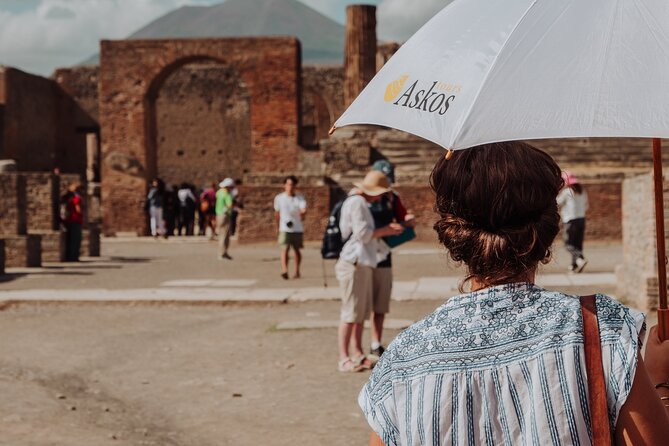
You meet the guide near the main entrance to the archaeological park, known as Porta Marina Superiore, at Via Villa dei Misteri 2. The guide holds an Askos Tours sign, which matters in a busy entrance area where several groups may be gathering.
Skip-the-line admission is included, so you avoid the standard ticket-buying wait. This does not mean every part of Pompeii will be empty. Rooms and popular houses may still have internal lines, and the site can feel crowded even outside the busiest season.
The first stop is listed as the Archaeological Park itself, with about 10 minutes for orientation and entry. Use this moment to check that you have water, sun protection, and comfortable shoes. There is little shade across much of the site, and the stone paving is not forgiving.
The tour ends at Piazza Esedra. That is useful if you want to continue on your own, since you are not rushed straight back to the entrance after the guided portion.
The Forum and Basilica: Pompeii’s public heart
The Forum is the logical first major stop. This broad public square was the center of civic, religious, and commercial life. The guide helps you read the surrounding buildings and understand why this open space mattered more than any single house.
You then visit the Basilica, which served as a courthouse and business center. It is a good reminder that Pompeii was not simply a resort town frozen in time. Legal disputes, financial dealings, elections, religious activity, and trade all shaped daily life here.
The planned time at each stop is about 10 minutes. That keeps the tour moving, but it also means you should not expect a slow study of every column or wall. If you want to examine the Forum in detail, plan to return after the tour.
Lupanar and the Forum granaries
The Lupanar, or brothel, is one of Pompeii’s most famous stops. It is easy to treat it as a novelty, but the guide can place it within the working life of the ancient town. The small rooms and surviving decorations offer a glimpse into a commercial activity that was part of Roman urban society.
The Forum granaries provide a useful contrast. These storage areas held objects and materials connected to the city’s food supply and commerce. Seeing them after the Lupanar helps you move beyond the famous headline sights and notice the practical systems that kept Pompeii running.
Crowds can gather around popular rooms, so patience is useful. One criticism of the route is that you may have to wait inside the park to see certain spaces. The skip-the-line benefit applies to entry, not necessarily to every building on the route.
More ways to see Pompeii:
- Discover the Ancient Ruins of Pompeii: Day Trip from Rome
★ 3.5 · 2,247 reviews - Pompeii Ticket + Tour with Optional Tasting Experience at Pompeii
★ 5.0 · 663 reviews - Pompeii private tour with an Official Guide
★ 5.0 · 631 reviews - Pompeii Private Tour with an Archaeologist and Skip The Line – 3 hours
★ 5.0 · 564 reviews
House of Menander and House of the Faun
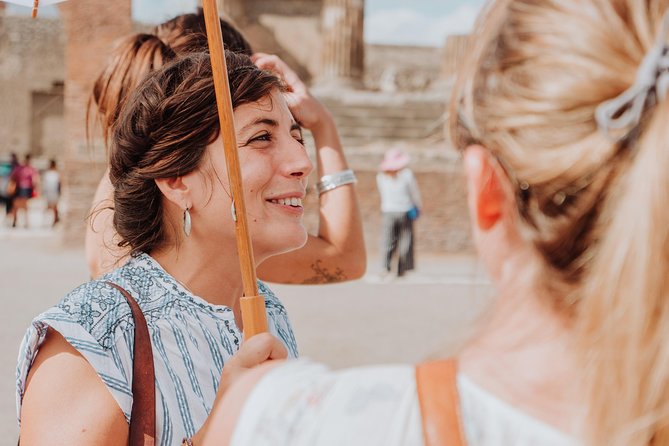
Private homes are where the tour can become especially vivid. The House of Menander is a large, elegant residence named after a Greek playwright. Its size and decoration give you a sense of the wealth available to some Pompeian families, while the layout helps explain how Roman homes were organized around courtyards and reception areas.
The House of the Faun is another major highlight. It is famous for its scale and artistic decoration, including the mosaic associated with Alexander the Great. The important thing here is not just the name or the artwork. The house shows how architecture, decoration, social status, and entertaining guests were tied together.
These homes can look like a series of empty rooms if you walk through them without guidance. With an archaeologist, you get a better sense of movement through the house and the difference between public-facing rooms and more private spaces.
Still, two hours is a quick introduction. You will see selected areas, not every room in either residence. If domestic architecture interests you most, stay afterward and explore at your own speed.
The Stabian Baths and Via dell’Abbondanza
The Stabian Baths are among the most useful stops for understanding Roman public life. The baths were more than places to wash. They were social spaces, and the preserved structure lets you see how Romans used public facilities as part of their regular routine.
The guide then takes you along Via dell’Abbondanza, one of Pompeii’s main streets. Walking this road gives you the strongest feeling of an actual town rather than an isolated archaeological site. Look down at the paving, around at the doorways, and toward the buildings that once opened onto this busy route.
This is also where the physical demands of Pompeii become obvious. The ancient road surface is uneven, and you may walk over raised stones and rough paving. The amount of walking cannot be overstated. If you have limited mobility, ask the operator for current guidance before booking, since the provided information only says that most people can participate.
Thermopolium VI and the taste of daily life
Thermopolium VI is one of the most memorable stops for many people because it connects the ruins to food. A thermopolium was a Roman hot-food counter, a place where residents could buy prepared meals and drinks.
The counter layout gives you a direct look at ordinary urban life. Not every resident cooked in a private kitchen as you might imagine, and public food service was part of the town’s daily rhythm. The stop is brief, but it adds warmth and human scale to the grander public buildings.
I appreciate this kind of stop because it gives children and adults an easy point of connection. The Forum can feel abstract. A place that served food feels immediate.
Teatro Grande and Casa dei Vettii
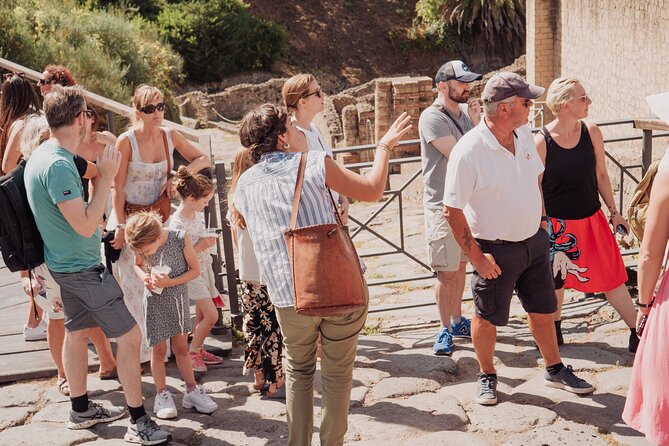
The Teatro Grande brings the tour back to public entertainment. This theater shows how performance and communal gatherings fit into Pompeian life. Your guide can help you understand the building’s purpose, scale, and relationship to the rest of the town.
Casa dei Vettii offers another look at private wealth and decorated domestic space. Like the other houses, it rewards close attention to wall decoration, room arrangement, and the way a home communicated status.
The final stops also make clear why Pompeii cannot be seen properly in one afternoon. The route gives you a strong framework, but it is a sample of a much larger site. One useful plan is to take the guided tour first, then use the remaining time to revisit the house or theater that interested you most.
Is $35.67 a fair price?
At $35.67 per person, this tour offers solid value if you want an organized introduction to Pompeii. Admission is included, and you receive about two hours with an archaeologist rather than paying separately for a ticket and trying to decode the site alone.
The value depends on your touring style. If you enjoy learning from a guide and want to cover the main sights efficiently, the price is sensible. It is also helpful for a first visit, a family outing, or a short stop from Naples or a cruise itinerary.
If you already know Pompeii well, or if you want long stretches for photography and quiet observation, the group format may feel restrictive. A private tour would give you more control over pace and questions, but it would cost more.
The group maximum is 20 people per guide. That is not a private visit, but it is small enough to feel manageable when the guide handles the group well. Headsets are supplied for groups of 16 or more. In crowded rooms, sound can still be a problem, so stay close to the guide when possible.
Practical advice for heat, crowds, and timing
Bring a refillable water bottle. Water is available from fountains, according to the tour information, but you should start with enough for the walk. A hat, umbrella, or small fan can make a real difference in summer, since much of the archaeological park is exposed.
Wear shoes suited to uneven stone. Pompeii is not a gentle paved walk, and the route includes streets, courtyards, and ancient floors. Give yourself time to move carefully rather than trying to keep a city-break pace.
Arrive at the stated meeting point before the start time. The operator has sometimes been able to move a late arrival to the next available departure, but that should not be treated as guaranteed. If you need to cancel, free cancellation is available up to 24 hours before the local start time. Changes or cancellations inside that window are not refunded.
The tour is near public transport, but transport itself is not included. Food and drinks are also not included. Anyone under 18 should bring a passport or ID to qualify for free admission, as advised in the booking details.
Small dogs no heavier than 10 kilograms and no taller than 40 centimeters are permitted. They must be leashed, carried inside buildings, and cleaned up after. Service animals are allowed.
Who will get the most from this Pompeii tour?
I would choose this tour for a first visit, especially if you have only a morning or afternoon. It gives you the basic map of Pompeii, explains the main buildings, and leaves you in a better position to explore alone afterward.
Families can also benefit. Guides including Rosanna, Mario, Teresa, and Alexandra are described as able to keep explanations clear and engaging for children and adults. The food shop, theater, baths, and houses provide enough variety to keep the walk from feeling like a long sequence of walls.
It suits curious visitors who want more than an audio guide but do not want the cost of a private experience. The strongest guides adjust their pace, answer questions, and explain details outside a fixed script.
I would think twice if you dislike group tours, need a very slow pace, or want to visit excavation areas not included on this route. One departure was also criticized for slow delivery and limited interaction. That appears to be the exception, but it is a useful reminder that the guide shapes the experience.
Should you book it?
Yes, if you want an affordable, well-organized first look at Pompeii with an archaeologist and a route that covers the major public buildings, private houses, streets, baths, food shops, and theaters.
Book it with realistic expectations. You are not seeing all of Pompeii in two hours, and skip-the-line entry will not remove every wait inside the park. Wear good shoes, bring water and sun protection, stay near the guide in crowded rooms, and keep extra time afterward if you want to explore the site properly.
At $35.67, this is a practical choice for most first-time visitors. The best reason to choose it is not simply the ticket convenience. It is the chance to understand what you are seeing before you wander farther into one of Italy’s most remarkable archaeological sites.
FAQ
How long does the Pompeii tour last?
The tour lasts approximately two hours.
What language is the tour offered in?
The experience is offered in English.
Where does the tour meet?
You meet at Via Villa dei Misteri 2, near Pompeii’s Porta Marina Superiore entrance. The guide holds an Askos Tours sign.
Where does the tour end?
The guided visit ends at Piazza Esedra.
Is Pompeii admission included?
Yes. The Pompeii admission fee is included in the tour price.
Does the tour include skip-the-line entry?
Yes. Skip-the-line admission is listed as a tour feature, helping you avoid the standard admission wait.
How large is the group?
The maximum group size is 20 people per guide.
Are headsets provided?
Headsets are provided for groups of 16 or more.
Can I cancel for a refund?
You can cancel at least 24 hours before the experience start time for a full refund. Cancellations or changes made less than 24 hours before the start are not refunded or accepted.
Just added around Pompeii
- Wine Tasting and Winery Tour in Vesuvio National Park with Lunch★ 4.5 · 3 reviews
- Mt. Vesuvius Wine Tasting and Lunch Experience from Pompeii★ 4.5 · 20 reviews
- Wine tasting in the Vesuvius national park★ 5.0 · 3 reviews
- Traditional Neapolitan Dinner in Pompei – Villa Franca – Family Restourant★ 5.0 · 8 reviews
- Private Guided Tour and VR Headsets in the Ancient Pompeii★ 5.0 · 3 reviews
- Visit Pompeii with a local expert guide★ 5.0 · 10 reviews
- Tour Mount Vesuvius with Entry Tickets and Round Trip Transfer Included★ 3.5 · 4 reviews
- Vesuvius tour entrance to the crater and return bus★ 4.5 · 9 reviews
Pompeii Tours with an Archaeologist, compared.

Pompeii Small Group Tour with an Archaeologist
Read our review →
Pompeii and Herculaneum Small Group Tour with an Archaeologist
Read our review →
Herculaneum Small Group Tour and Ticket With an Archaeologist
Read our review →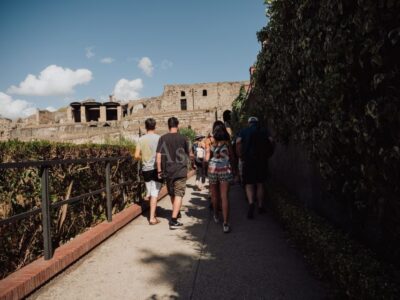
Pompeii & Herculaneum with Archaeologist Guide
Read our review →
Pompeii Private Tour with an Archaeologist and Skip The Line – 3 hours
Read our review →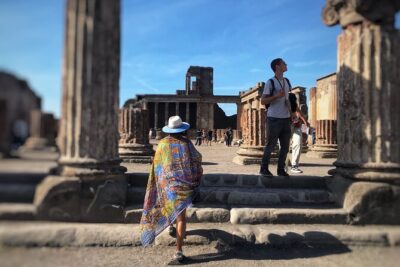
Pompeii Private Tour with an Archaeologist and Skip The Line
Read our review →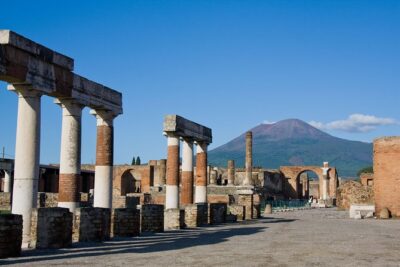
Pompeii 2h Small-Group Tour with Expert Archaeologist
Read our review →Browse the lists this tour appears in