
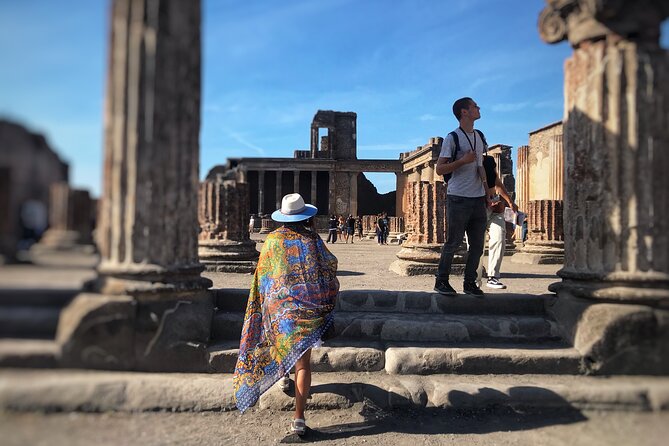
Reviewed · POMPEII TOURS WITH AN ARCHAEOLOGIST
Pompeii Private Tour with an Archaeologist and Skip The Line
Pompeii becomes far easier to understand when an archaeologist points out the small clues: the fast-food counters, worn stepping stones, painted rooms, bathhouse details, and casts of people caught by the eruption. This private tour packs the site’s major sights into two focused hours, with guides such as Luisa, Eliana, Luciana, and Mattia adapting the pace to your group.
I like the one-group-only format, which lets you ask questions and request a family-friendly route. I also like the chance to avoid the worst crowding, especially on late-day visits, while still seeing the Forum, theaters, baths, brothel, gladiator area, and Casa del Fauno.
The main catch is important: the Pompeii entrance ticket is not included. You pay €19 per person, while children under 18 enter free with identification. The skip-the-line benefit works best when you buy your ticket online in advance, so this is not a ticket-inclusive tour.
Key points to know before you book
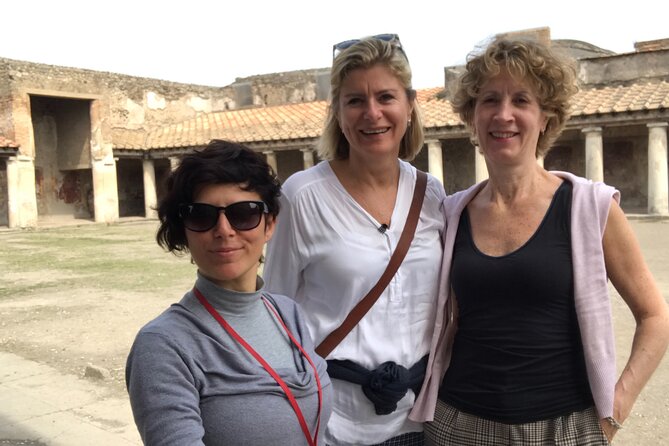
- Two hours with an archaeologist: You get a focused introduction to Pompeii’s most important buildings rather than an all-day wandering tour.
- Private for up to 10 people: Your group controls the questions, pace, and interests.
- The €19 entry ticket is extra: Buy it online ahead of time, especially in high season.
- The route covers the essential sights: Expect theaters, baths, shops, fast-food counters, the Forum, casts, temples, gladiator quarters, the brothel, and Casa del Fauno.
- Guides can adjust the experience: Families, older visitors, and repeat visitors have received routes suited to their needs.
- Meet at Piazza Esedra 10: The tour returns to the same meeting point.
A useful two-hour introduction to Pompeii
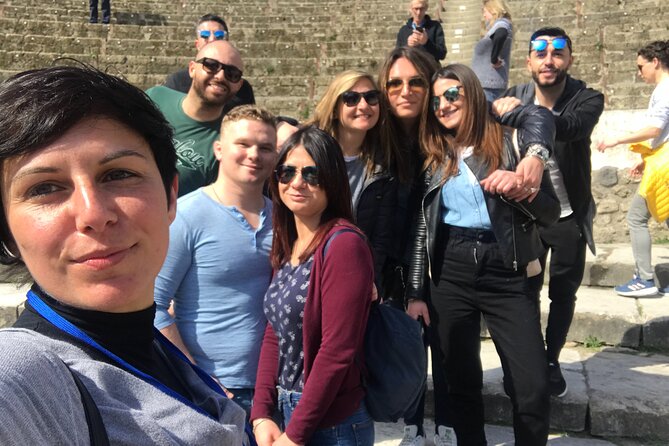
Pompeii is enormous. You can spend much of a day here and still leave parts unseen, so a short private tour needs a clear plan. This one concentrates on the central sights and gives you a framework for exploring on your own afterward.
That is the real strength of the format. In two hours, you are not trying to read every sign or wander down every lane. Your guide explains how the city worked, shows you details that are easy to miss, and helps you decide what deserves more of your time after the tour.
The private setup matters. Your guide is assigned only to your group, with a maximum of 10 people. You can ask about daily life, Roman religion, architecture, food, politics, or the eruption without waiting for a large group to catch up.
Several guides have made a strong impression through their personal approach. Luisa is known for adjusting the route around crowds and finding good spots for group photographs. Eliana has tailored tours to family interests and supplied maps with directions for further exploring. Luciana has helped visitors with elderly parents move comfortably through the ruins, while Viktoria has kept children aged eight and ten involved with age-appropriate explanations.
Your exact guide is not guaranteed, but these examples show the kind of flexible service to expect from the team.
More Private Tours in Pompeii
- Pompeii private tour with an Official Guide
★ 5.0 · 631 reviews - Pompeii Private Tour with an Archaeologist and Skip The Line – 3 hours
★ 5.0 · 564 reviews - Visit in Pompeii – Pompeii Private Tour with Ada
★ 5.0 · 436 reviews
Meeting at Piazza Esedra and handling the ticket
The meeting point is Piazza Esedra, 10, in Pompei. You should receive confirmation when booking, along with a link and instructions for buying the archaeological park ticket.
The entrance ticket costs €19 per person. Children under 18 enter free, but they should bring a passport or other identification because their date of birth may be checked. Food, drinks, and gratuities are not included.
The wording around skip-the-line access deserves careful attention. The tour price covers the guide and assistance, not admission. If you arrive without a ticket, you may still need to purchase one before entering. In high season, buy online in advance using the official website link provided by the operator.
The practical rule is simple: arrange your ticket before you arrive. That is what makes the skip-the-line feature useful. It is not the same as receiving a prepaid entrance ticket with your tour.
The Small Theater and Great Theater
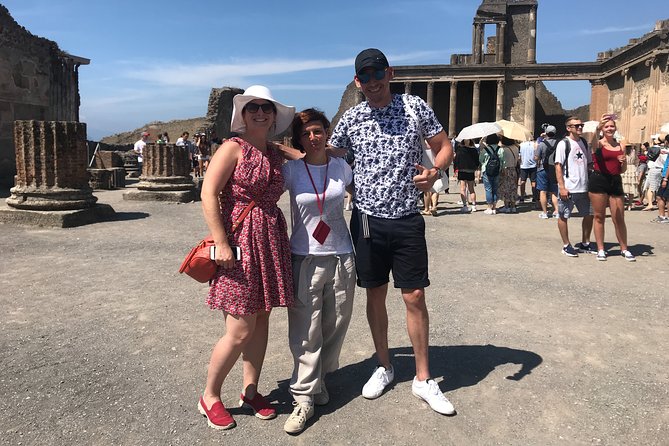
The route begins with Pompeii’s theaters, including the Small Theater, also called the Odeion. Your guide explains its design and the way Roman builders created clear acoustics. This is a good early stop because it shifts your view of Pompeii from a pile of ruins to a functioning city with entertainment, public gatherings, and carefully planned buildings.
The Great Theater is the larger and more important performance space. You have about 15 minutes here, enough to understand its role and layout without turning the visit into a long architectural lecture.
The theaters also give your guide a chance to explain how public life worked. Ask questions if you want more detail about performances, seating, or the relationship between the theaters and nearby gladiator facilities.
Via dell’Abbondanza and Pompeii’s everyday streets
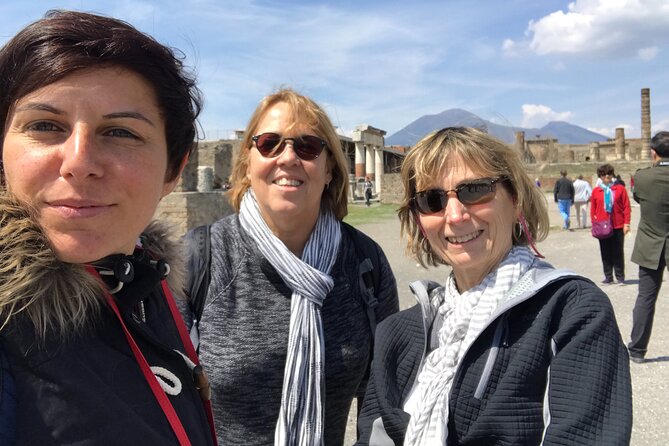
The tour crosses Via dell’Abbondanza, the city’s main street. This is where Pompeii feels most like a real town rather than an archaeological display.
Along the route, you see shops, food counters, and signs of ordinary commercial life. The fast-food counters are especially useful for understanding how residents bought prepared food. They also help place Roman daily routines alongside the more famous temples and public buildings.
Look down as you walk. Pompeii’s streets, curbs, crossings, and building fronts reveal how people moved through the city. Your guide can connect these practical features with the homes, businesses, and public spaces around them.
The drawback is that two hours can only provide a sample. Pompeii has many streets and buildings, and some areas may receive only a passing explanation. If you already know the site well, tell your guide what you want to prioritize.
More Skip-the-Line Tickets in Pompeii
- Skip the Line Guided Tour of Pompeii led by an Archaeologist
★ 5.0 · 703 reviews - Pompeii Skip-the-line Tour with Archaeologist Guide
★ 5.0 · 559 reviews - Complete Pompeii Skip the Line Tour with Archaeologist Guide
★ 4.5 · 379 reviews - Ancient Pompeii Private Tour: Skip the Line & Kid-Friendly Option
★ 5.0 · 167 reviews
Granaries of the Forum and the casts
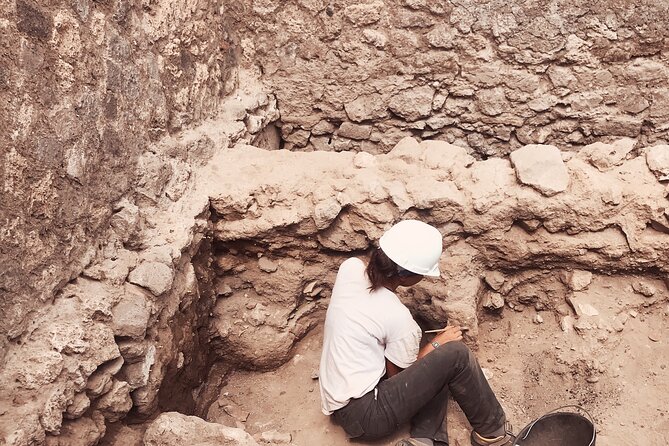
At the Granaries of the Forum, you see casts of people who died during the eruption of 79 AD. You also see an archaeological deposit containing amphorae and work tools.
This is one of the most emotionally powerful parts of the visit, but it can also be difficult. The casts are not simply historical objects. They give a human shape to an event that otherwise might feel distant and abstract.
The amphorae and tools add another layer. They place the disaster within a working city, where food was stored, goods were moved, and people used ordinary equipment before the eruption interrupted everything.
Your guide’s explanation is especially valuable here. Without context, it is easy to focus only on the dramatic casts. With context, you can also consider the work, trade, and routines that surrounded them.
The Stabian Baths and Roman public life
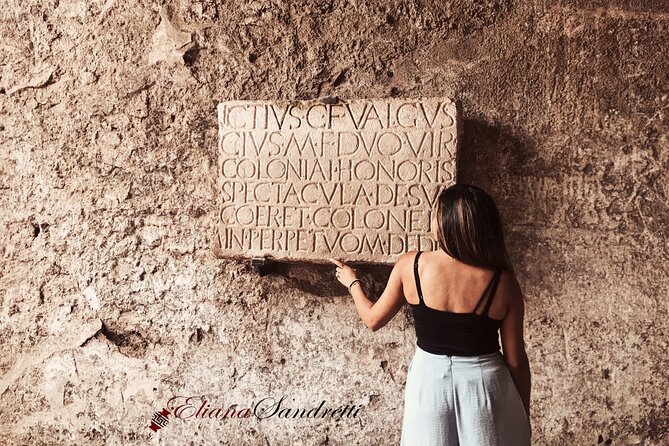
The Stabian Baths are presented as Pompeii’s best-preserved spa complex. You spend about 15 minutes examining the bath area and learning how public bathing fit into Roman life.
This stop helps explain that Roman baths were not just places to wash. They were social and public spaces, linked to exercise, relaxation, conversation, and civic life. The buildings also show the Roman interest in heating systems and orderly public design.
The baths can be hard to understand when viewed alone. Your guide helps identify the different spaces and explains what you are looking at. If you are interested in Roman engineering, ask for more detail here. If your group has children, a quick explanation of the heating system and bath routine can make the stop easier to follow.
Pompeii’s Forum, Basilica, and temples
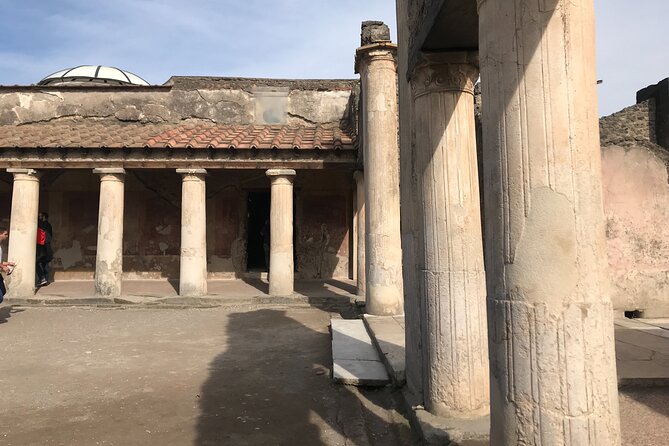
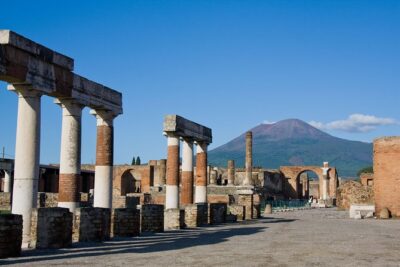
The Forum was Pompeii’s main square, surrounded by markets and temples. It is the city’s central public space and one of the essential stops on the route.
Nearby, the Basilica served as a court where justice was administered. This is a useful place to connect architecture with government and law. Pompeii was not only a collection of homes and shops. It had courts, religious centers, political spaces, and public institutions.
The Temple of Jupiter and Temple of Venus add the religious side of the city. Venus was the city’s honored divinity, while the Temple of Jupiter occupied a key position in the Forum.
A guide makes a real difference in this area because the scale can be confusing. You see columns, open squares, foundations, and partial walls, but your guide supplies the connections between them. Try to pause and look across the Forum rather than rushing from one structure to the next.
Gladiator quarters and the theater district
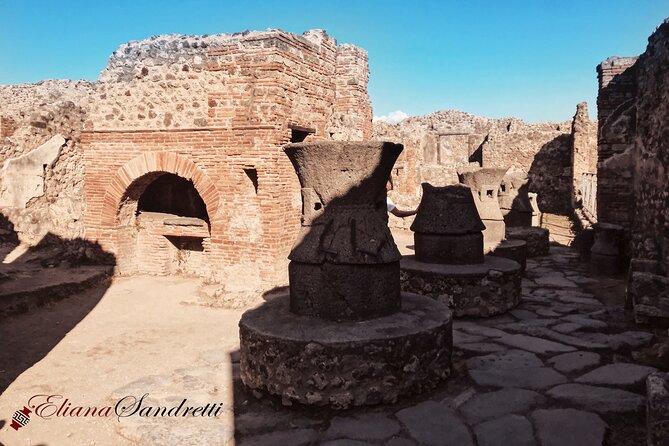
The Quadriporticus of the Theaters, also called the gladiator barracks, shows where gladiators lived and trained. You see their apartments and the spaces connected with their daily routines.
This stop adds a human element to the entertainment buildings. The nearby theaters might first suggest public performance and spectacle. The barracks remind you that those spectacles depended on people living, training, and working behind the scenes.
The area is also a good example of why a private guide can help. A guide can explain how the buildings were used and point out details you might otherwise pass without noticing. The route may not cover every part of the theater district, so mention your interest if gladiatorial history is a priority.
The Lupanar and Pompeii’s less polished side
The Lupanar was Pompeii’s brothel, located on Vicolo del Lupanare. It is one of the site’s most famous stops and one of the places where daily life feels particularly direct.
The small rooms and surviving imagery offer a glimpse of commercial sex in the Roman city. The subject may not suit every family or every visitor, so tell your guide if you prefer to shorten this stop.
For many people, the Lupanar is useful because it broadens the picture of Pompeii. The Forum and temples show public life, while the brothel points to private behavior, commerce, and the less formal side of the city.
Casa del Fauno, a grand Pompeian home
The Casa del Fauno is one of Pompeii’s largest and most luxurious residences. It gives you a chance to see how a wealthy household used space, decoration, and courtyards.
This is a strong final stop because it brings together several themes from the tour. You have seen shops, baths, public squares, temples, theaters, and working spaces. Here you see the domestic world of Pompeii’s wealthy residents.
The house also shows why the ruins need interpretation. Walls, rooms, and open spaces can look plain until your guide explains their purpose and points out surviving decoration. If you care about art, architecture, or domestic life, ask to spend extra time here if the schedule allows.
How much value do you get for $375.05?
The price is $375.05 per group of up to 10, not per person. For a full group, that can be a reasonable way to obtain a private archaeologist for two hours. For one or two people, the cost per person is much higher, so the value depends on how much you care about personal attention.
You are paying for more than admission. The price covers an authorized guide, a private format, route planning, assistance, and help before the tour. You are also paying for time saved and for a better chance of seeing the main sights without wandering into dead ends.
Still, add the €19 entry fee for each adult. A couple should calculate the total before booking, and a family should factor in the free admission for children under 18.
I think the price makes the most sense in three situations:
- You have only a few hours in Pompeii.
- You are visiting with children or older relatives.
- You want a private route and the ability to ask many questions.
If you have a full day and enjoy exploring slowly with a guidebook, you may prefer to buy your ticket and explore independently. The private tour is mainly a time-saving and interpretation service.
Timing, heat, rain, and walking comfort
Pompeii can be hot, and much of the tour takes place outdoors. An early or late start can make the experience easier. One late-afternoon visit at 5 p.m. was especially well suited to avoiding crowds and reducing the heat of a July day.
A two-hour tour still involves walking over ancient streets and uneven surfaces. Wear practical shoes and bring water. You can request a gentler route if someone in your group has mobility concerns, though the information provided does not promise that every area will be accessible.
The tour requires good weather. If a storm causes cancellation, you can choose another date or receive a full refund. One guide, Luciana, used a rainy wait before entry to explain Pompeii with images and local cultural information, but you should still plan for outdoor conditions.
Who should book this Pompeii tour?
I would choose this tour for a first visit when time is tight. It gives you a clear route through the major sights and leaves you with enough orientation to continue on your own.
Families are also a good match. The private format lets the guide adjust the language and pace, and several guides have worked successfully with children. Tell the operator in advance if you want a family-friendly approach.
It also suits repeat visitors who want a different angle. A guide may direct you to areas you missed before, explain decorations more clearly, or adjust the focus toward archaeology, art, daily life, or architecture.
You may want another plan if you dislike guided schedules, want to spend several hours at each house, or expect admission to be included in the advertised price. The ticket issue is the one point you should settle before committing.
Should you book it?
Book this Pompeii tour if you value expert interpretation, have limited time, or want a private route for your family or group. The strongest part is the guide’s ability to make a huge archaeological park manageable, with personal attention from guides such as Luisa, Eliana, Luciana, Viktoria, and Mattia.
Before booking, budget for the separate €19 entrance ticket and buy it online ahead of time. If that extra step is clear to you, this is a practical, focused way to see Pompeii’s major sights without spending your whole day trying to find them.
FAQ
Is the Pompeii entrance ticket included?
No. The entrance ticket costs €19 per person. Children under 18 enter free, but they should bring a passport or other identification to confirm their age.
What does skip the line mean for this tour?
The tour includes skip-the-line assistance, but you must buy the Pompeii entrance ticket separately. Buying online in advance is recommended, especially during high season, so you can avoid the ticket office line.
How long is the private Pompeii tour?
The guided visit lasts approximately two hours. The activity ends back at the meeting point.
Where does the tour meet?
Meet your guide at Piazza Esedra, 10, 80045 Pompei, Italy. The tour also ends back at this meeting point.
How many people can join the private tour?
The price covers one private group of up to 10 people. Only your group participates in the activity.
What happens if the weather is bad?
The experience requires good weather. If it is canceled because of poor weather, you can choose another date or receive a full refund. You can also cancel up to 24 hours before the start time for a full refund.
More Ways to See Pompeii
- Discover the Ancient Ruins of Pompeii: Day Trip from Rome
★ 3.5 · 2,247 reviews - Pompeii Ticket + Tour with Optional Tasting Experience at Pompeii
★ 5.0 · 663 reviews - Sharing Tour of Pompeii
★ 5.0 · 487 reviews - Pompeii Guided Tour & Horse Riding on Vesuvius with Lunch
★ 5.0 · 419 reviews
More Pompeii Tours Led by an Archaeologist
- Pompeii Small Group Tour with an Archaeologist
★ 5.0 · 6,593 reviews - Pompeii and Herculaneum Small Group Tour with an Archaeologist
★ 5.0 · 1,350 reviews - Explore Pompeii with an Archaeologist
★ 5.0 · 511 reviews - Pompeii 2h Small-Group Tour with Expert Archaeologist
★ 5.0 · 385 reviews
Just added around Pompeii
- Wine Tasting and Winery Tour in Vesuvio National Park with Lunch★ 4.5 · 3 reviews
- Mt. Vesuvius Wine Tasting and Lunch Experience from Pompeii★ 4.5 · 20 reviews
- Wine tasting in the Vesuvius national park★ 5.0 · 3 reviews
- Private Guided Tour and VR Headsets in the Ancient Pompeii★ 5.0 · 3 reviews
- Visit Pompeii with a local expert guide★ 5.0 · 10 reviews
- Traditional Neapolitan Dinner in Pompei – Villa Franca – Family Restourant★ 5.0 · 8 reviews
- Tour Mount Vesuvius with Entry Tickets and Round Trip Transfer Included★ 3.5 · 4 reviews
- Vesuvius tour entrance to the crater and return bus★ 4.5 · 9 reviews
Pompeii Tours with an Archaeologist, compared.

Pompeii Small Group Tour with an Archaeologist
Read our review →
Pompeii and Herculaneum Small Group Tour with an Archaeologist
Read our review →
Herculaneum Small Group Tour and Ticket With an Archaeologist
Read our review →
Pompeii & Herculaneum with Archaeologist Guide
Read our review →
Pompeii Private Tour with an Archaeologist and Skip The Line – 3 hours
Read our review →
Pompeii 2h Small-Group Tour with Expert Archaeologist
Read our review →Browse the lists this tour appears in