
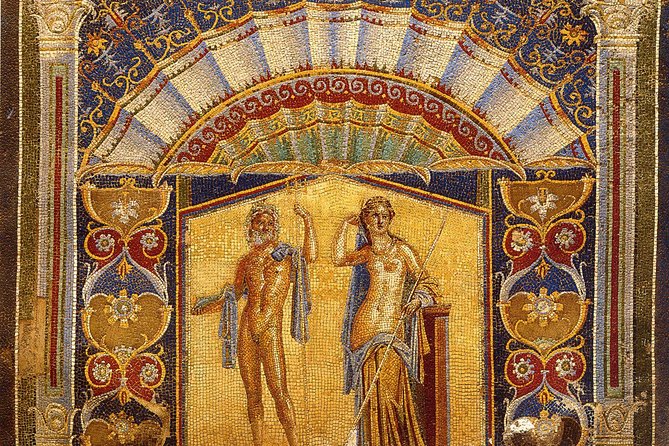
Reviewed · POMPEII TOURS WITH AN ARCHAEOLOGIST
Herculaneum small group tour with an archaeologist – skip the line
Herculaneum gives you an unusually close look at Roman daily life. Volcanic material preserved wooden doors, furniture, partitions, and other details that usually vanish from ancient sites. This two-hour walk brings those details into focus with a licensed archaeologist, rather than leaving you to guess what each room once meant.
I like the skip-the-line admission, which saves time at a busy archaeological site, and the chance to see both grand villas and ordinary parts of town, including baths, eateries, and homes. The main drawback is the short running time: eleven stops in two hours means some places receive only ten minutes, and one booking note warns that incorrect meeting information made the group hard to find.
Key points at a glance
- Carbonized wood and household details: See the wooden partition in the House of the Wooden Partition and carbonized door elements in the House of the Black Hall.
- An archaeologist leads the walk: You get live explanation for two hours, with time to ask questions in a group capped at 20.
- Eleven carefully chosen stops: The route covers villas, baths, civic buildings, and homes rather than focusing on a single type of monument.
- Skip-the-line entry is included: The ticket covers admission, so you do not need to arrange a separate entry pass.
- Plan for strong sun: Bring a cap or hat, as one visitor found the exposed site extremely hot.
- Good value for a focused visit: At $57.26 per person, the price includes admission and a specialist guide, but not transportation or personal expenses.
Why Herculaneum feels different from Pompeii
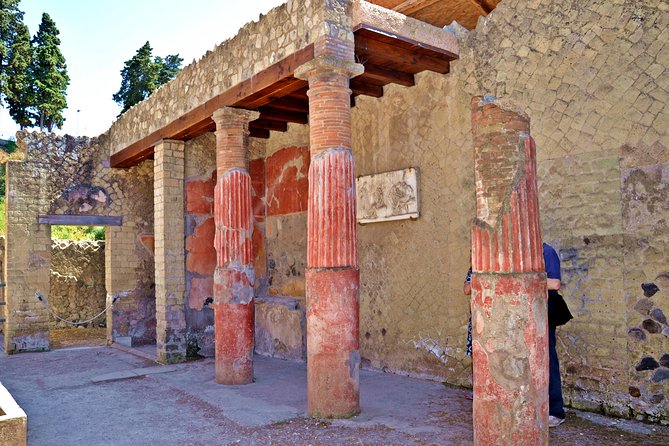
Herculaneum was a Roman resort town, and its preserved buildings can feel more intimate than a broad city ruin. The eruption of Mount Vesuvius buried the settlement under layers of volcanic material, sealing away details that would normally be lost to fire, weather, reuse, or time.
The guide’s most useful job is to connect those physical remains with human choices. You learn how residents faced the eruption, including the question of who fled and who stayed. That turns a walk through old rooms into a more personal account of a town caught in a disaster.
I especially value the small objects and building parts. A carbonized wooden doorpost, an elegant room layout, or a surviving wall painting can tell you more about a household than a grand monument alone. You will see public buildings and wealthy homes, but the tour also helps explain how the town functioned day to day.
The group may contain up to 20 people. That is not a private tour, but it is still small enough for questions, especially compared with a large coach group. Ask when a building’s purpose is uncertain, since several sites have competing interpretations.
More Herculaneum tours:
- Herculaneum: Skip-the-Line Guided Tour with Archaeologist
★ 4.8 · 3,439 reviews - Herculaneum Small Group Tour and Ticket With an Archaeologist
★ 5.0 · 994 reviews - Herculaneum: Skip-the-Line Entry Ticket with Audio Guide
★ 4.3 · 870 reviews
The first houses: deer statues and a wealthy seaside home
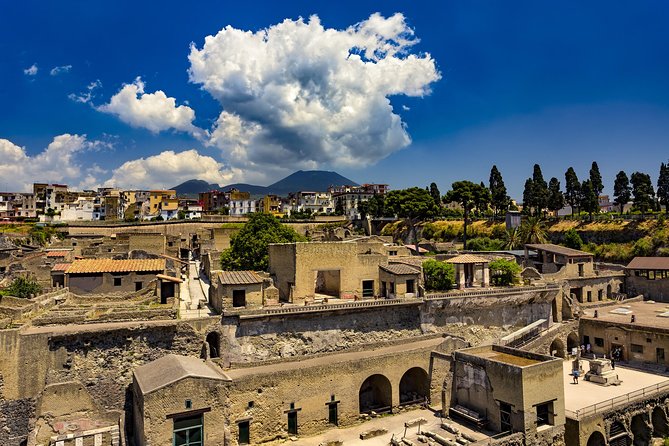
The walk begins at the Casa dei Cervi, or House of the Deer. Its name comes from marble statues of stags or deer found in the peristyle, the columned garden court at the center of the house.
This is a good opening stop because it introduces Herculaneum’s domestic scale. You can see how a wealthy Roman home used an interior garden not simply as decoration, but as a place around which rooms and movement were organized. The listed visit lasts about ten minutes, so expect a focused explanation rather than a full architectural lecture.
Next comes the terrace of Marcus Nonius Balbus. Balbus was a major benefactor who restored and built public structures in the town. After his death, Herculaneum honored him as a patron, and the long inscription on his funeral altar records those honors.
This stop adds civic context to the private houses. You are not just looking at isolated ruins. You are seeing the public role of wealthy citizens who paid for buildings and gained status in return. The terrace also gives the guide a chance to explain how local power worked in a Roman town.
Civic life at the College of the Augustales
The College of the Augustales is thought to have served the cult of Emperor Augustus. It may also have been the headquarters of the local Augustales or even the town curia, so its exact role is not presented as completely certain.
That uncertainty is useful rather than frustrating. Ancient buildings do not always come with neat modern labels, and an archaeologist can explain the evidence and the limits of what is known. You should expect a ten-minute stop centered on the building’s religious and civic purpose.
The building helps show how loyalty to the emperor worked at the local level. Imperial worship was not only a matter of Rome and distant rulers. It also appeared in the civic life of towns such as Herculaneum.
A private doorway to the Suburban Baths
The Casa del Rilievo di Telefo is linked to Marcus Nonius Balbus, although the association is described as possible rather than certain. Its most unusual feature is a private entrance leading to the adjoining Suburban Baths.
That doorway says a lot about social comfort and status. A wealthy household could reach a bathing complex without using the same access as everyone else. You can ask the guide how the house’s arrangement may have worked, though the ten-minute stop means the explanation will stay selective.
This is also a good point to notice that the tour does not treat each building as a standalone object. The route shows connections between a home, a bathing complex, public benefaction, and the town’s social structure.
More Pompeii tours led by an archaeologist:
- From Naples: Pompeii & Herculaneum with Archaeologist Guide
★ 4.8 · 665 reviews - Pompeii: Private Tour with an Archaeologist
★ 4.9 · 168 reviews - Herculaneum Private Tour with an Archaeologist
★ 5.0 · 132 reviews - Pompeii and Herculaneum led by an Archaeologist with private transport
★ 5.0 · 78 reviews
Wooden survival in the House of the Wooden Partition
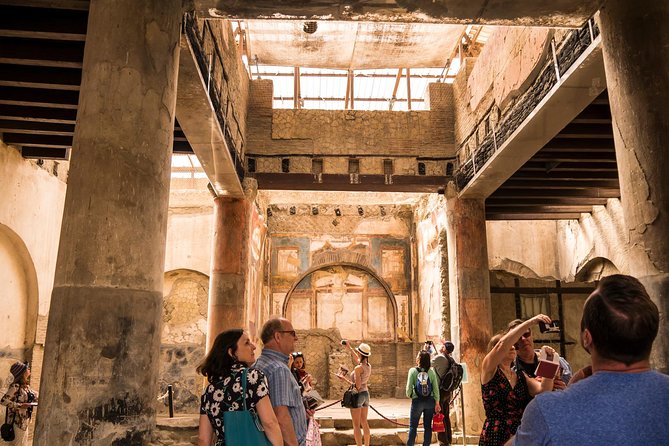
The Casa del Tramezzo di Legno is important because an elegant wooden partition survived. In most Roman ruins, wood has disappeared, leaving only stone foundations and wall fragments. Here, the preserved partition brings the interior arrangement closer to life.
I find this kind of stop especially valuable because it changes your sense of the ancient town. Roman homes were not made only of marble, plaster, and columns. They also had doors, screens, furniture, and practical divisions between rooms.
The official name can appear in Italian as Partem Domus lignea or Casa del Tramezzo di Legno. If you are taking notes or matching the stop to a map, keep both names in mind.
The House of the Skeleton and the human cost of the eruption
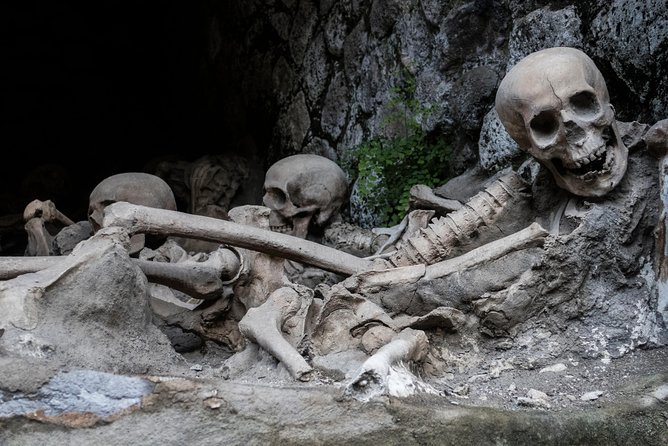
The House of the Skeleton takes its name from human remains found in an upstairs room in 1831. It may have been formed by joining three smaller buildings, which gives the guide another chance to explain how homes changed over time.
This is one of the more sobering stops. The preserved town can sometimes feel like a museum of architecture, but the skeleton reminds you that real people were present when the eruption struck. The tour’s attention to how residents chose to flee or remain makes this stop more than a dramatic label.
The visit lasts about fifteen minutes, one of the longer stops on the route. That extra time matters here, since the building’s layout and discovery story need more explanation than a quick glance.
Roman bathing at the Central Thermae
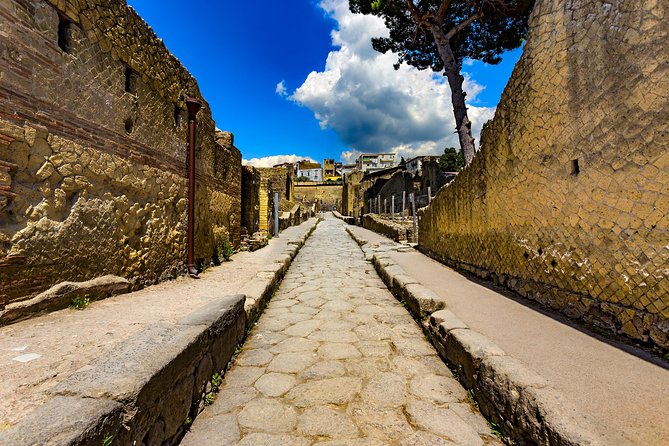
The Central Thermae were built around the beginning of the first century AD. Like many Roman bath complexes, they were divided into men’s and women’s sections, each with a separate entrance.
Baths were not just places to wash. They were social and civic spaces, and their design shows how Roman towns organized shared facilities. I like that this stop gives the itinerary a public building with a practical purpose, balancing the private villas and religious structures.
You have about fifteen minutes here. That should be enough for the basic layout and the division between the two sections, but not for a slow, independent study of every surviving detail. If baths are a major interest for you, listen closely and ask your question before the group moves on.
Luxury and carbonized doors at the House of the Black Hall
The Casa del Salone Nero, or House of the Black Hall, is one of Herculaneum’s more luxurious mansions. Its monumental entrance still preserves carbonized remains of the doorposts and lintel.
This is one of the clearest examples of why Herculaneum rewards a guided visit. A darkened piece of wood can look like a minor fragment if you do not know what you are seeing. With explanation, it becomes evidence of the building’s original fittings and the violent conditions that preserved them.
The stop lasts about ten minutes. Use that time to look up and around the entrance, not only at the floor. Details at eye level and above can be easy to miss when the guide is discussing the wider building.
The Samnite house and its Ionic gallery
The Casa Sannitica follows an arrangement associated with the Samnites, an ancient people who occupied the mountainous part of central Italy. Its atrium is skirted by a gallery with Ionic columns, and the rooms retain fresco decoration.
The contrast between the gallery, atrium, and painted rooms lets you see how design carried social meaning. This is not just a collection of surviving walls. The layout directed visitors through the house and framed the owner’s status.
The guide has about fifteen minutes here, which is helpful because the architectural terms can otherwise blur together. If you are not familiar with an atrium or Ionic columns, this is a good place to ask for a plain explanation.
Two unusual homes near the center of the site
The Casa del Bel Cortile is described as one of Herculaneum’s most original houses. Instead of the usual atrium, it has a courtyard with a stairway and a stone balcony.
That difference makes it a useful reminder that Roman housing was not one fixed design. Owners adapted homes to their needs, plots, tastes, and social position. I would pay attention to how the courtyard changes the feel of the building compared with the more familiar atrium houses.
The final stop is the House of the Grand Portal, a beautiful central domus with several rooms, colonnades, frescoes, and charred wooden remains. Its position in the archaeological area makes it a fitting end to a route that has moved from civic monuments to private interiors.
The description of this house is broad, and the scheduled ten minutes will pass quickly. Treat it as a final survey of several features rather than a detailed examination of every room.
What two hours and $57.26 get you
The price is $57.26 per person. That includes skip-the-line admission and two hours of live guidance from a licensed archaeologist. Transportation, food, drinks, and personal spending are not included.
For me, the value depends on how you like to visit archaeological sites. If you want context, an organized route, and answers to questions, the price is reasonable because it combines the entry ticket with a specialist-led visit. If you prefer to wander slowly and read every sign, the fixed two-hour route may feel restrictive.
Eleven stops in two hours creates a brisk pace. Most stops last ten minutes, while the House of the Skeleton, Central Thermae, and Casa Sannitica receive about fifteen minutes. You get a well-rounded introduction, but not an exhaustive study of each building.
The group maximum of 20 keeps the cost below a private tour while leaving some room for questions. It will not give you the quiet, flexible pace of visiting alone, but it should be easier to follow than a very large group.
Getting there and handling the practical details
You meet and finish at the Archaeological Park of Herculaneum, Corso Resina 187, in Ercolano. Transportation is not included, although the site is near public transportation.
Check the meeting information carefully before you set out. One booking experience reported that the information on the ticket was incorrect and made the group difficult to find. Since the tour begins at the archaeological park, allow time to reach the entrance and confirm the precise meeting point.
The ticket is mobile, and confirmation is issued when you book. Free cancellation is available if you cancel at least 24 hours before the local start time. Changes or cancellations made inside that window are not refunded.
Wear practical shoes and bring water. The site can be intensely sunny, and a cap or hat is a smart idea. One person specifically warned that the sun was severe, so do not treat shade as guaranteed.
Most people can participate, according to the supplied activity information. The tour ends where it begins, which is useful if you are planning another stop in Ercolano afterward.
Who should book this Herculaneum tour
I would choose this tour if you have roughly two hours and want the site explained in a clear order. It suits first-time visitors, people interested in Roman domestic life, and anyone who wants to understand why carbonized wood, frescoes, bath divisions, and civic inscriptions matter.
It is also a sensible choice if you dislike wasting time in admission lines. The included skip-the-line entry removes one small chore from the visit, while the archaeologist gives the ruins a human and civic setting.
You may want a different format if you need a leisurely photography session, have a narrow interest in one building, or prefer to explore without a group. The route is fixed and the pace is purposeful. You will see many highlights, but you will not have much unstructured time.
Should you book it?
Book this Herculaneum tour if you value expert explanation, want to cover a broad selection of homes and public buildings, and like the security of included admission. The strongest reasons are the carbonized household details, the archaeologist-led context, and the balanced route through villas, baths, civic spaces, and smaller homes.
Skip it if you want to move slowly, read every sign, or avoid any chance of meeting-point confusion. If you do book, confirm the exact start location, arrive prepared for strong sun, and use the short stops well by asking focused questions. At $57.26, it is a solid introduction to Herculaneum, provided you accept a brisk two-hour visit.
FAQ
Where does the Herculaneum tour start?
The tour starts at the Archaeological Park of Herculaneum, Corso Resina 187, 80056 Ercolano, Italy.
Where does the tour finish?
The tour finishes at the Archaeological Park of Herculaneum, at the same location where it begins.
How long does the tour last?
The guided visit lasts approximately two hours.
Is admission to Herculaneum included?
Yes. Skip-the-line admission fees are included in the tour price.
Is transportation included?
No. Transportation is not included.
How large can the tour group be?
The group can include a maximum of 20 travelers.
Is the tour led by an archaeologist?
Yes. The experience includes two hours of live guidance from a licensed archaeologist guide.
Can I use a mobile ticket?
Yes. The experience provides a mobile ticket.
Is the tour near public transportation?
Yes. The archaeological park is near public transportation.
What is the cancellation policy?
You can cancel for a full refund up to 24 hours before the experience starts. Cancellations or changes made less than 24 hours before the start time are not accepted for a refund.
More Skip-the-Line Tickets in Naples
- Mount Vesuvius: Skip-the-Line Ticket and Smart Digital Guide
★ 4.2 · 2,780 reviews - From Naples: Pompeii Skip-the-Line Entry Ticket and Tour
★ 4.4 · 2,753 reviews - Pompeii: Skip-the-Line Entry Ticket with Audio Guide or Tour
★ 4.1 · 1,364 reviews - From Naples: Pompeii Guided Tour with Skip-the-Line Tickets
★ 4.8 · 1,171 reviews
Just added around Naples
- Naples: Guided Walking Tour★ 4.7 · 63 reviews
- Wine tasting in the Vesuvius National Park★ 3.5 · 4 reviews
- Naples: Pompeii and Vesuvius Skip-the-Line Day Trip★ 3.8 · 32 reviews
- Visit the Museum MANN with a professional guide★ 5.0 · 3 reviews
- Walking-tour of Naples hystorical Centre★ 4.4 · 4 reviews
- Vesuvius – Herculaneum – Pompeii Excavations Tour★ 4.2 · 9 reviews
- Pompeii: Vesuvius at Sunset★ 3.5 · 31 reviews
- Vesuvius and Herculaneum from Naples★ 3.7 · 29 reviews
Pompeii Tours with an Archaeologist, compared.

Pompeii Small Group Tour with an Archaeologist
Read our review →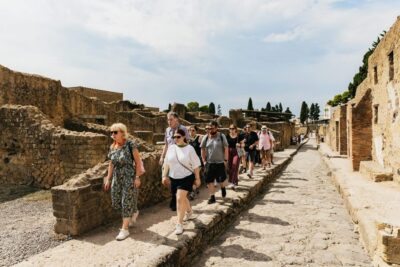
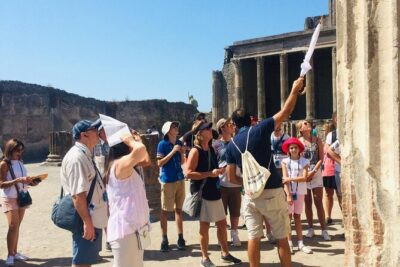
Pompeii and Herculaneum Small Group Tour with an Archaeologist
Read our review →
Herculaneum Small Group Tour and Ticket With an Archaeologist
Read our review →
Pompeii & Herculaneum with Archaeologist Guide
Read our review →
Pompeii Private Tour with an Archaeologist and Skip The Line – 3 hours
Read our review →
Pompeii Private Tour with an Archaeologist and Skip The Line
Read our review →Browse the lists this tour appears in