
Reviewed · POMPEII TOURS WITH AN ARCHAEOLOGIST
Herculaneum Private Tour with an Archaeologist
Herculaneum gives you something Pompeii often cannot: a close look at Roman domestic life. Its houses retain vivid details, wooden fittings, courtyards, baths, and wall decoration, and a private guide can explain what each space was used for instead of leaving you to guess at a field of ruins.
I like the private format, which lets you ask questions and set the pace, and I like the compact two-hour route through major homes, public baths, and the waterfront terrace. Guides such as Mena, Luciano, Sara, and Antonella are praised for turning archaeology into clear, human stories. The main caution is price: at $178.38 per person, you also pay the 16-euro admission fee, and the title promises an archaeologist even though at least one guide described by a customer was a history teacher rather than a practicing archaeologist.
Key points to know before booking
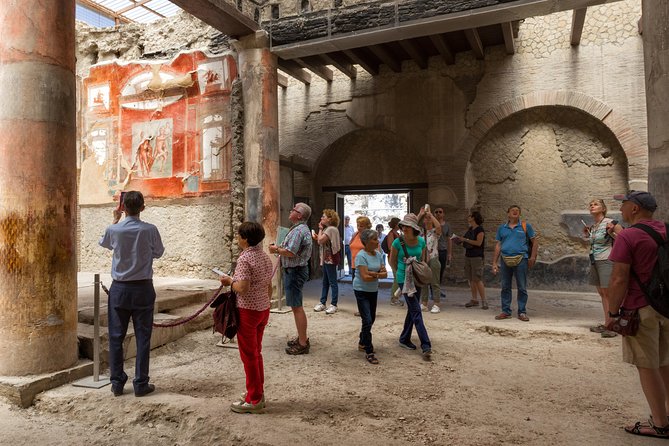
- Two hours covers the essential sights: The route includes eleven stops, from the College of the Augustales to the House of the Deer.
- A private guide makes the ruins readable: Ask questions about Roman homes, shops, baths, decoration, and daily routines.
- Mena, Luciano, Sara, and Antonella receive especially strong praise: Guide assignments are not guaranteed, but these names appear often in positive comments.
- Tickets are extra: Herculaneum admission costs 16 euros for adults and 2 euros for EU citizens aged 18 to 25.
- Go early in hot weather: One customer found a morning start much more comfortable by midday.
- Free luggage storage helps: You can leave bags at the meeting point, which is useful if Herculaneum is between train connections.
Why Herculaneum rewards a private guide
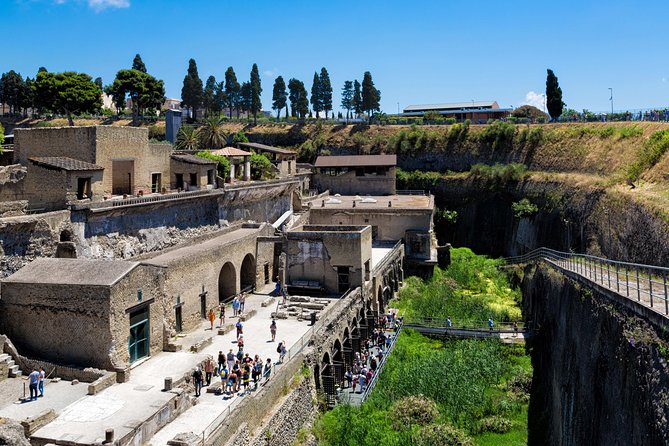
Herculaneum was a Roman seaside town destroyed by the eruption of Mount Vesuvius. Its smaller size makes it easier to cover than Pompeii, but the real advantage is the quality of preservation. As you walk through the site, you can see how people arranged their homes, received visitors, decorated rooms, used public baths, and moved through the town.
Without help, it is easy to admire the walls and miss the point. A guide can explain why a courtyard mattered, how a bath complex worked, or what a house layout says about status and family life. The best guides on this tour appear to do more than recite dates. They compare Herculaneum with Pompeii, answer questions at different levels, and point out small features that you would likely pass by.
The private setup matters most if your group has mixed interests. A first-time visitor can ask basic questions without feeling rushed, while someone who has read about Roman history can ask for more detail. Families also benefit because the guide can keep the visit moving and connect ancient buildings to everyday life.
This is not a long tour. Two hours is enough for a focused introduction, not a full archaeological study. The short format is useful if you are combining Herculaneum with Naples, Vesuvius, or Pompeii, but it also means you should not expect to inspect every open building.
More Herculaneum tours:
- Herculaneum: Skip-the-Line Guided Tour with Archaeologist
★ 4.8 · 3,439 reviews - Herculaneum Small Group Tour and Ticket With an Archaeologist
★ 5.0 · 994 reviews - Herculaneum: Skip-the-Line Entry Ticket with Audio Guide
★ 4.3 · 870 reviews
Meeting your guide at the red ticket office
You meet outside the archaeological site ticket office, described as the red building, on Via dei Papiri Ercolanesi in Ercolano. The tour begins and ends at this meeting point. Your guide provides the explanation and assistance, but the entrance ticket is not included.
That division of costs is worth noting before you book. The advertised price is $178.38 per person, and you must add the Herculaneum admission fee of 16 euros for an adult. EU citizens aged 18 to 25 pay 2 euros. Transportation, food, and drinks are also separate.
The price is easiest to justify for a small group that values individual attention. A larger private group may find the cost more reasonable when divided among several people, especially since group discounts are available. For one or two people, it is a considerable spend compared with entering independently. The value comes from the guide, not from included transport or admission.
There is free luggage storage at the meeting point. That is a practical bonus if you are carrying bags, though the available information does not specify size limits or storage procedures. The site is near public transportation, and most people can take part. Service animals are allowed.
College of the Augustales and the House of the Skeleton
The College of the Augustales is the first listed stop. This building was linked to the Augustales, a group connected with the worship of the emperor. Here, your guide can set the tone for the visit by explaining how religion, civic life, and public identity overlapped in a Roman town.
You then visit the House of the Skeleton. The name alone gives this stop a darker edge, and it provides a reminder that Herculaneum was not simply abandoned over time. The eruption ended the lives of residents suddenly, leaving behind a site where domestic spaces and human tragedy remain closely linked.
Each stop is scheduled for about ten minutes. That pace keeps the tour moving, but it can feel brisk if you want long pauses for photographs or close study. You can ask your guide to spend more time on the parts that interest you most, though doing so may reduce time later in the route.
The House of the Relief of Telephus
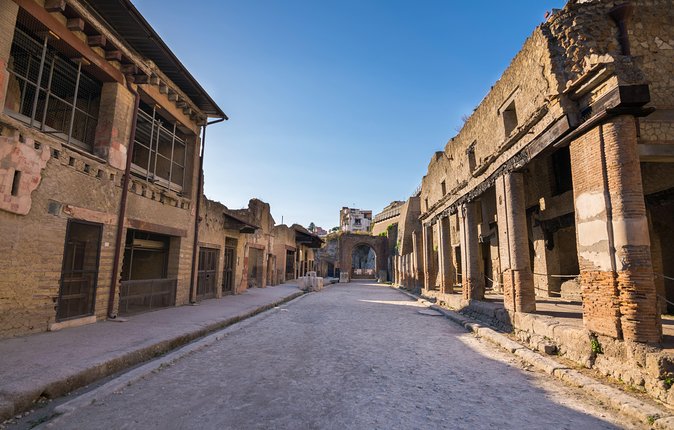
The House of the Relief of Telephus is one of the route’s major residential stops. Its name refers to a relief depicting Telephus, a figure from Greek mythology. This is the sort of place where a guide adds real value, since the decoration is not just attractive. It reflects the myths, artistic tastes, and cultural references that shaped Roman private homes.
Expect your guide to place the room within a larger picture of household life. Roman homes were designed for social display as well as private use. Decoration could signal education, wealth, and familiarity with stories known across the Roman world.
The ten-minute allocation is enough for an explanation and a look around, but you may want to keep your eyes moving. Herculaneum’s appeal is not one grand monument. It is the collection of smaller details that survive from room to room.
More Pompeii tours led by an archaeologist:
- From Naples: Pompeii & Herculaneum with Archaeologist Guide
★ 4.8 · 665 reviews - Pompeii: Private Tour with an Archaeologist
★ 4.9 · 168 reviews - Pompeii and Herculaneum led by an Archaeologist with private transport
★ 5.0 · 78 reviews - Pompeii and Herculaneum Private Walking Tour with an Archaeologist
★ 5.0 · 77 reviews
The Wooden Partition House
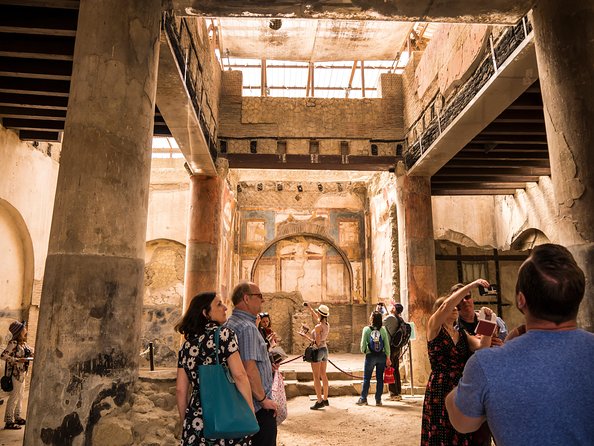
The House of the Wooden Partition is one of the most memorable stops because it preserves a wooden element. Wood normally disappears over time, making surviving fittings especially useful for understanding how Roman interiors were divided and furnished.
The name comes from its wooden partition, which gives you a clearer sense of a lived-in house than a bare stone wall can. A guide can explain how the divider shaped movement and privacy inside the home. This is also a good point to ask about construction, furniture, and the difference between what survived at Herculaneum and what you see at Pompeii.
For families, this house can be easier to picture than a large public building. You can imagine rooms being separated, opened, and used by different people. That human scale is one reason many people consider Herculaneum worth visiting even if Pompeii is already on their itinerary.
The Terrace of M. Nonio Balbo
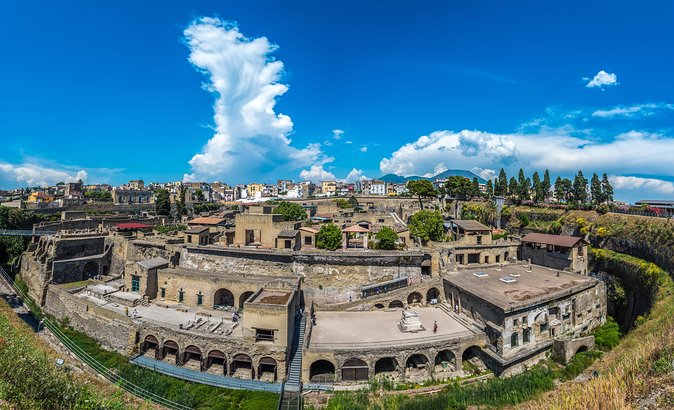
The Terrace of M. Nonio Balbo shifts the focus from private interiors to a public-facing space. M. Nonio Balbo was a prominent local figure, and the terrace carries the memory of civic status and public honor.
This stop also helps explain Herculaneum’s setting as a coastal Roman town. The route does not promise a panoramic viewpoint, but the terrace gives you a different sense of the town’s public spaces and monuments. Your guide can connect the site’s buildings to the people who funded, used, and displayed them.
It is a useful pause between houses because it broadens the story. You are not only walking through former living rooms. You are also seeing how a Roman community honored its leaders and organized shared spaces.
The House of the Black Salon and Samnitic House
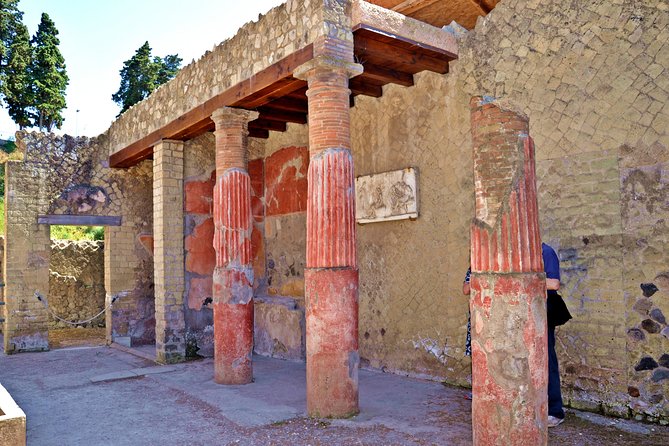
The House of the Black Salon, also called the House of the Salon of Nero in the route description, offers another look at interior decoration. The dark room name points to the visual effect of the space, and a guide can help you understand how color and painted rooms shaped the atmosphere of a Roman house.
Names can vary in translation, so do not be surprised if your guide uses a slightly different English version. The important thing is the room itself and the way its decoration fits into the home.
The Samnitic House takes you further back in the town’s story. Its name connects the building with Samnitic cultural influence, giving your guide a chance to discuss the layers of history before and during Roman control. This is one of the places where a strong guide can keep the explanation clear rather than turning it into a string of unfamiliar labels.
Customers have singled out guides including Daniela, Roberta, Ivan, Nicoletta, and Jasmine for friendly explanations and strong command of the site. Names are not guaranteed, but the repeated praise for individual guides suggests that the human side of this experience matters greatly.
Central Thermae and the Fine Courtyard
The Central Thermae are Herculaneum’s public baths. This stop helps you understand that bathing was not simply about washing. Roman baths were social spaces, and their design can show you how the town organized public life, leisure, and daily routine.
Your guide can explain the different parts of the bathing complex and how the spaces were used. Ten minutes will give you a focused introduction, though anyone especially interested in Roman engineering may want more time than the standard route allows.
Next comes the House of the Fine Courtyard. Courtyards are central to understanding Roman houses because they brought light, air, and movement into the building. They also formed a setting for household activity and social display.
I find courtyards especially helpful when visiting ancient sites because they make the floor plans easier to read. Instead of seeing a collection of rooms, you begin to understand how people moved through the home and how private and public areas related to each other.
The Grand Portal and House of the Deer
The House of the Grand Portal is named for its large entrance. That feature gives you an immediate clue about the importance of the building and how an entrance could shape a visitor’s first impression.
Your guide can use the portal to explain Roman ideas about presentation and status. In an ancient home, an entrance was not just a way in. It could announce wealth, rank, and the kind of welcome a visitor might receive.
The final listed stop is the House of the Deer. It is one of the route’s notable residences and brings the tour back to private life. The name refers to decorative imagery connected with deer, and the house helps round out the visit with another example of a prosperous Roman home.
Ending with a residence makes sense. After seeing civic buildings, baths, and public spaces, you return to the domestic world that makes Herculaneum so compelling. You finish near the meeting point, and the activity ends there rather than including onward transport.
What the guide adds to the two-hour visit
The strongest part of this experience is the explanation. Guides praised by name include Mena, Lucio, Luca, Luciano Leone, Sara, Antonella, Giulio, Giuseppe, Alessia, and others. Several are described as archaeologists or historians, while one customer specifically felt that a guide presented as an archaeologist was actually a high school teacher.
That concern should not be ignored. If professional archaeological credentials are essential to you, confirm who will lead your tour before paying the premium. The guiding quality can still be high, but archaeologist and excellent history guide are not always the same thing.
The most useful guides appear to do four things well:
- Explain buildings in the context of ordinary Roman life.
- Adjust the detail for beginners and people with prior knowledge.
- Compare Herculaneum with Pompeii.
- Notice small features you would likely miss alone.
The private format also gives you room to ask practical questions. You can ask why one house is more elaborate than another, what a bath room was used for, or how the eruption affected what survived. That conversation is hard to recreate with a large group.
Timing, comfort, and who should book
The tour is offered at multiple times during the day. If you visit in summer, choose the earliest available start you can manage. The site can become very hot by midday, and the two-hour route is more comfortable before the strongest heat.
Families should find the length manageable. Two hours is long enough to keep older children interested without asking them to endure a full-day archaeological visit. The guide can also turn the houses and baths into stories about people, meals, homes, work, and public life.
This tour suits you best if:
- You want context rather than a silent walk among ruins.
- You prefer a private guide to a large group.
- You have limited time in the Naples area.
- You are visiting with family or a mixed-age group.
- You plan to compare Herculaneum with Pompeii.
- You care more about interpretation than included transport.
It may not suit you if you want a slow, self-guided visit or if the price must include every cost. The route is focused, and you may want extra time afterward to wander independently. One person was allowed to explore a little after the guided portion and visit two nearby museums, but this should not be treated as a guaranteed part of every booking.
Free cancellation is available up to 24 hours before the start time. Cancellations or changes made later are not accepted for a refund.
Is this private Herculaneum tour worth booking?
I would book it if Herculaneum is a priority and you want the ancient town to make sense rather than simply look impressive. The private guide, family-friendly pace, and strong record of guide quality make the experience more useful than entering alone, especially for a first visit.
I would pause if you are traveling on a tight budget. At $178.38 per person before admission, it is an expensive two-hour outing. Also confirm the guide’s credentials if the archaeologist title is the main reason you are booking.
For the best value, bring a small group, choose an early time in hot weather, and arrive ready to ask questions. If you are deciding between Pompeii and Herculaneum, Herculaneum gives you a smaller, more intimate look at Roman homes, with preservation that often makes daily life easier to picture.
FAQ
How long does the Herculaneum private tour last?
The tour lasts approximately two hours.
Where do I meet the guide?
You meet the guide outside the archaeological site ticket office, described as the red building, on Via dei Papiri Ercolanesi in Ercolano.
Where does the tour end?
The activity ends back at the meeting point.
Is the Herculaneum entrance ticket included?
No. The entrance ticket is separate and costs 16 euros for adults. EU citizens aged 18 to 25 pay 2 euros.
Is transportation included?
No. Transportation is not included.
Is the tour private?
Yes. Only your group participates in the private activity.
Is the tour offered in English?
Yes. The experience is offered in English.
Can I store my luggage?
Yes. Free luggage storage is available at the meeting point.
Can I cancel for a full refund?
Yes, if you cancel at least 24 hours before the experience begins. Cancellations or changes made less than 24 hours before the start time are not accepted for a refund.
Just added around Naples
- Naples: Guided Walking Tour★ 4.7 · 63 reviews
- Wine tasting in the Vesuvius National Park★ 3.5 · 4 reviews
- Visit the Museum MANN with a professional guide★ 5.0 · 3 reviews
- Walking-tour of Naples hystorical Centre★ 4.4 · 4 reviews
- Naples: Pompeii and Vesuvius Skip-the-Line Day Trip★ 3.8 · 32 reviews
- Vesuvius – Herculaneum – Pompeii Excavations Tour★ 4.2 · 9 reviews
- Pompeii: Vesuvius at Sunset★ 3.5 · 31 reviews
- Vesuvius and Herculaneum from Naples★ 3.7 · 29 reviews
Pompeii Tours with an Archaeologist, compared.

Pompeii Small Group Tour with an Archaeologist
Read our review →
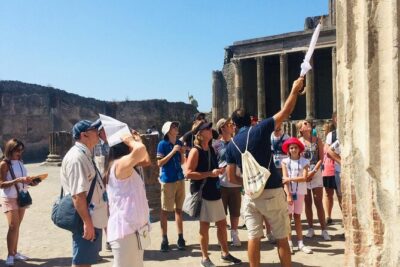
Pompeii and Herculaneum Small Group Tour with an Archaeologist
Read our review →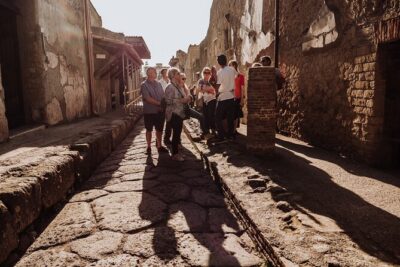
Herculaneum Small Group Tour and Ticket With an Archaeologist
Read our review →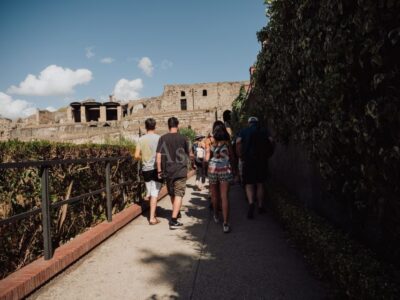
Pompeii & Herculaneum with Archaeologist Guide
Read our review →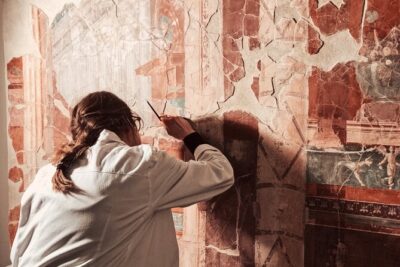
Pompeii Private Tour with an Archaeologist and Skip The Line – 3 hours
Read our review →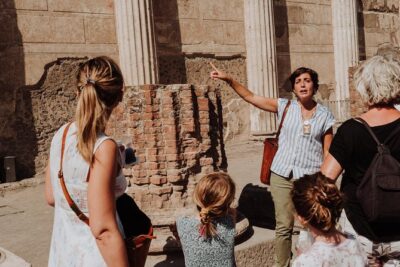
Pompeii Private Tour with an Archaeologist and Skip The Line
Read our review →Browse the lists this tour appears in