
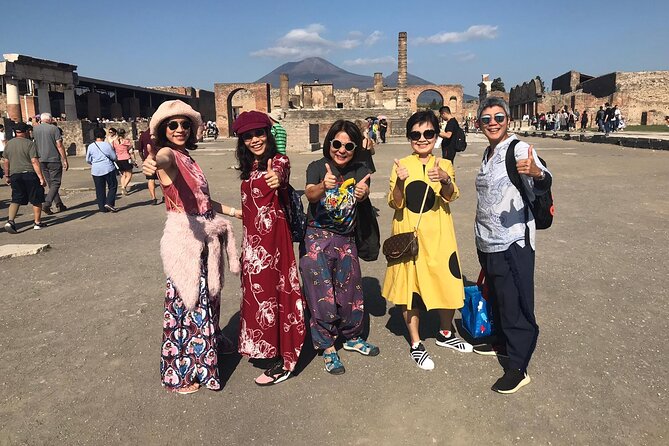
Reviewed · POMPEII TOURS WITH AN ARCHAEOLOGIST
Pompeii Skip-the-line Tour with Archaeologist Guide
Pompeii is far easier to understand with an archaeologist beside you. The ruins can look like a jumble of stone walls and broken columns until someone points out the wagon ruts, shop counters, bathhouse rooms, political buildings, and painted details that reveal how the city worked.
I like the small group limit of 16, which keeps the guide close enough to hear and makes questions practical. I also like the chance to enter with a guide rather than lose time in the entry line, then follow someone who knows how to avoid spending the whole visit staring at anonymous ruins.
The catch is the two-hour limit. Pompeii is enormous, and this tour gives you a strong introduction rather than a full day of exploring. You will also need to reach the meeting point yourself, and the tour is offered in English.
Key things to know before booking
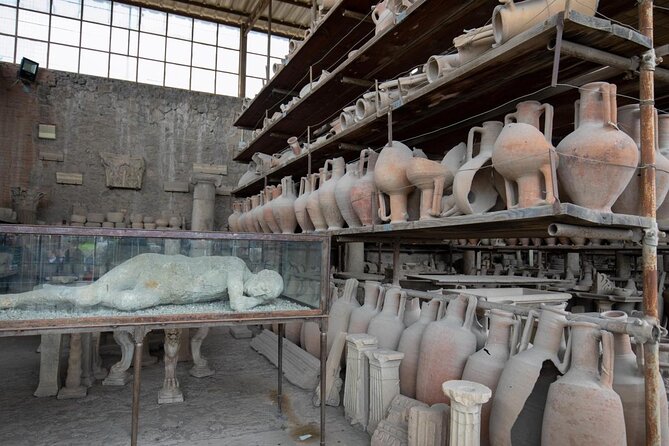
- Archaeologist-led guiding: Guides including Lello, Italo, Leonardo, and Cela bring field experience and point out details that are easy to miss.
- Main Pompeii sights in two hours: Expect the forum, theater, baths, shops, gladiator barracks, House of Menander, Gymnasium, and Lupanare.
- Groups capped at 16 people: This is more personal than a large coach-style group and leaves room for questions.
- Easy public transport access: From Naples or Sorrento, use the Circumvesuviana train to Pompei Scavi and walk to the meeting point.
- Ancient streets underfoot: You will walk on original cobblestones and lava rock, so sturdy, comfortable shoes matter.
- Good value for a short visit: At $71.35 per person, the price pays for admission, a specialist guide, and a focused route through a huge site.
Why an archaeologist changes Pompeii
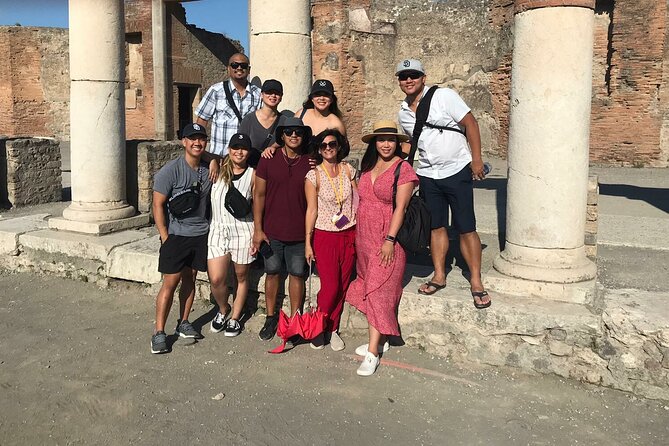
Pompeii is one of those places where a guide earns their fee quickly. On your own, you can see a theater, a temple, and a row of houses. You may not know why a raised sidewalk mattered, how a Roman bathhouse was arranged, or what a stone counter in a shop tells you about daily meals.
The guides on this tour are not simply reciting dates. Lello, who has worked at Pompeii for many years, is particularly good at linking small physical details to daily Roman life. Italo is praised for explaining the site clearly, answering questions, and keeping the route moving without rushing people past important features. Leonardo and Cela are also described as warm, engaging guides who make the material accessible to families.
That matters because Pompeii can feel overwhelming. The site covers a large area, and several streets can look alike after an hour. A specialist guide gives you a framework. You learn what you are looking at, why it mattered, and how the eruption of Mount Vesuvius in AD 79 changed the city forever.
The guide also helps you picture Pompeii as a living town rather than a frozen ruin. You will hear about public baths, food shops, clothing sellers, theaters, temples, politicians, priests, gladiators, and ordinary households. The result is less about memorizing Roman dates and more about seeing how the city functioned.
More Guided Tours in Pompeii
- Skip the Line Guided Tour of Pompeii led by an Archaeologist
★ 5.0 · 703 reviews - Pompeii private tour with an Official Guide
★ 5.0 · 631 reviews - Pompeii Guided Tour & Horse Riding on Vesuvius with Lunch
★ 5.0 · 419 reviews
Meeting near Pompeii’s main entrance
You meet at Hotel Vittoria on Piazza Esedra, near the archaeological park. The guide then leads the group into Pompeii. The tour ends back at the meeting point area.
Getting there is straightforward from Naples or Sorrento. The Circumvesuviana train runs toward Pompeii, and the Pompei Scavi station is the useful stop for the excavations. Give yourself extra time. A late arrival is a serious problem here because missed tours are not refunded.
One detail needs special attention: this booking is a guided tour confirmation, not a stand-alone ticket you can use independently. Admission is included, but the confirmation is intended for entry with the guide. Keep your phone accessible, and provide your full mobile number with country code when booking in case the operator needs to reach you.
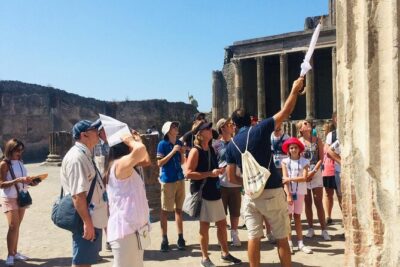
The group can include up to 16 people. That is not a private tour, but it is small enough for the guide to check that everyone is keeping up and to answer questions without turning every stop into a crowd-management exercise. Ear sets are provided on some departures, which helps when the group spreads out on busy streets.
Ancient streets, wagon ruts, and the first clues
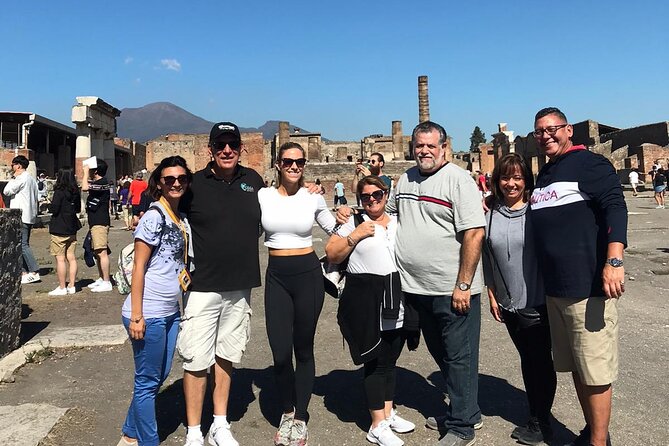
Once inside, you walk on the original Roman streets. This is one of the most memorable parts of the visit, but it is also where you notice the physical demands of Pompeii. The paving is uneven, and sections are made from hard volcanic stone. Wear shoes with good support, not smooth sandals or delicate city footwear.
Look down for the ruts cut by wagon wheels. These grooves make the streets feel practical rather than ceremonial. You begin to see Pompeii as a working town, where carts moved goods and residents crossed between homes, shops, public buildings, and entertainment venues.
The guide uses these details to explain Roman habits and urban planning. I find this more useful than a long lecture at the entrance. You are learning while standing in the setting itself, with the evidence under your feet.
Summer can be hot, with little shade across open sections of the site. Bring a hat and water. The tour description specifically advises a hat for summer sun, and that is good advice. The two-hour duration sounds modest, but walking over lava rock in strong heat can make it feel longer.
The theater and the rhythm of public life
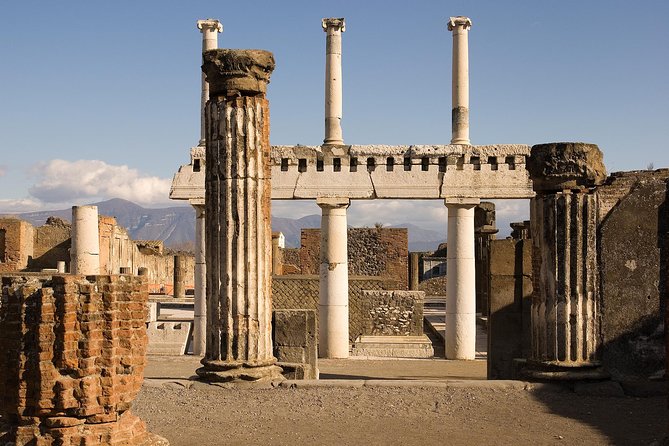
The route includes Pompeii’s theaters, where residents once watched tragedy and comedy. These spaces help explain how entertainment fitted into Roman life. You are not just looking at rows of stone seats. You are seeing a public setting built for shared performances and civic identity.
The small theaters are among the site’s appealing stops because their scale makes them easier to imagine. The larger theater gives a stronger sense of public spectacle. Your guide explains what the spaces were used for and points out features an untrained eye might pass without notice.
This is a good section for families. Younger visitors may not remember a list of Roman institutions, but a theater gives them something concrete to picture. The guides also welcome questions from children and adults, which helps keep the pace lively.
The drawback is time. You will not linger at every theater or explore every corner of each building. If theater architecture is your main interest, you may want to stay in Pompeii after the guided portion ends.
More Skip-the-Line Tickets in Pompeii
- Pompeii Private Tour with an Archaeologist and Skip The Line – 3 hours
★ 5.0 · 564 reviews - Pompeii Private Tour with an Archaeologist and Skip The Line
★ 5.0 · 391 reviews - Complete Pompeii Skip the Line Tour with Archaeologist Guide
★ 4.5 · 379 reviews - Ancient Pompeii Private Tour: Skip the Line & Kid-Friendly Option
★ 5.0 · 167 reviews
Baths, shops, and the everyday city
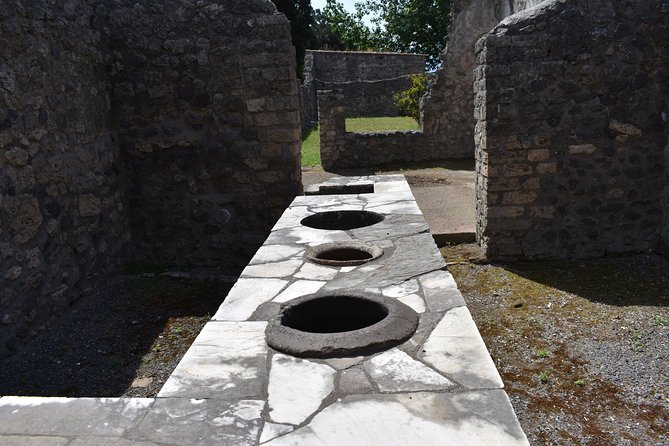
The thermal bathhouse offers one of the clearest windows into ordinary Roman routine. Residents came to bathe, exercise, socialize, and exchange news. The baths were not simply places to wash. They were part of the city’s social life.
Inside, the guide helps you understand how the rooms fit together and why bathing was such a regular public activity. Without that explanation, the surviving walls can seem plain. With it, you start to recognize a sequence of spaces and a pattern of use.
The tour also passes remains of businesses, including food shops, bars, and stores connected with clothing. These are among my favorite Pompeii stops because they move the story away from emperors and disasters. A counter, doorway, or narrow workroom can tell you about the people who cooked, sold, served, and bought goods in the city.
You may notice how often the guide draws attention to humble details. That is where the tour’s value lies. Pompeii is famous because the eruption preserved so much of a Roman town, but the preservation only helps if someone explains what the fragments mean.
The forum, where power and religion met
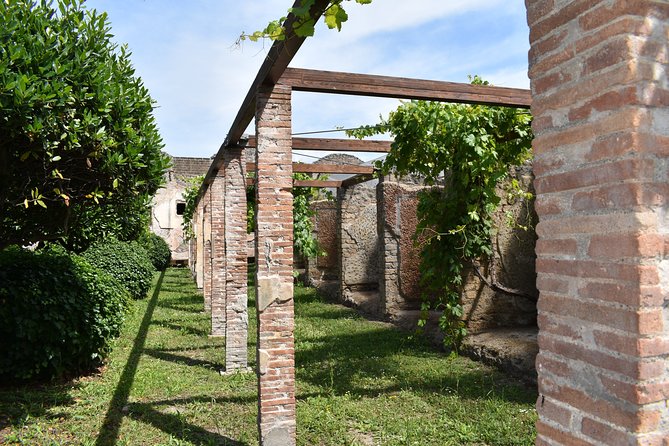
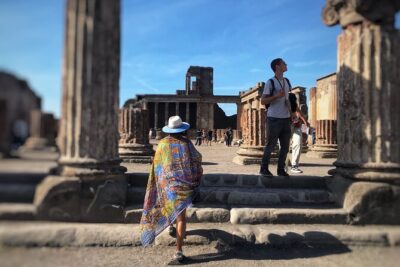
The forum was the civic heart of Pompeii. This is where political, religious, and commercial life came together. The tour takes you among the remains of temples and civic buildings, with explanations of the roles played by priests, politicians, and public officials.
The forum can be difficult to read on your own. The open space is large, and many structures survive only as partial walls or foundations. A guide gives the area order by explaining what stood where and how people used it.
This is also where the scale of Pompeii becomes clear. The forum was not an isolated monument. It connected to streets, temples, offices, markets, and public buildings. You begin to see the city as a network instead of a collection of separate attractions.
Because the forum is open and exposed, this part of the route can be hot. If you book the 5 pm departure, the tour still lasts two hours, so it may finish around 7 pm. That later timing can be more comfortable in strong summer sun, but confirm your plans around the full two-hour schedule.
Gladiator barracks and the Lupanare
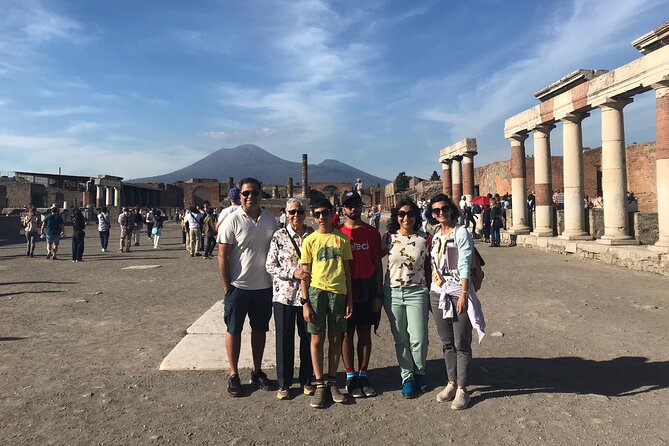
The tour includes the barracks where Roman gladiators trained and lived. This stop adds a different note to the visit. It shows the organized, demanding side of public entertainment and helps connect the theaters with the people who performed in them.
The Lupanare, or brothel, is one of Pompeii’s most popular attractions. It is a small, direct, and sometimes awkward stop, especially with children. The site is best understood as part of the city’s commercial life rather than treated as a novelty.
The guide explains the building and its surviving features in context. Families should decide in advance how they want to handle this part of the tour. The tour is suitable for most people, but the subject matter may not suit every young child.
Other named stops include the Gymnasium and the House of Menander. The House of Menander helps show the contrast between public streets and private homes, while the Gymnasium adds another piece to the picture of Roman exercise and social life. You will not see every building in Pompeii, but this mix gives you a useful spread of public, private, religious, commercial, and entertainment spaces.
What two hours really gives you
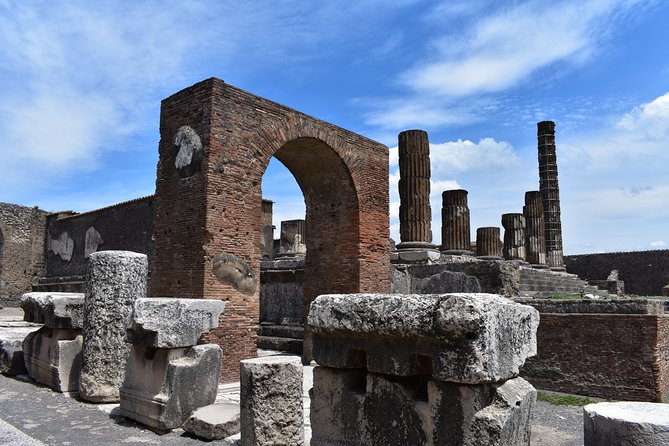
Two hours is enough for a strong first visit, not enough for the entire archaeological park. The tour moves at a purposeful pace, stopping for explanations and questions while covering the principal sights.
That format suits you if you have half a day, are visiting from Naples or Sorrento, or want an orientation before exploring alone. Several guides give suggestions for additional areas to see after the tour, which is helpful because the site is so large.
If you have a full day and already know Pompeii well, a private guide or a longer specialist visit may suit you better. At $71.35 per person, this is not the cheapest way to enter the ruins. Still, admission and a specialist-led two-hour route are included, and the cost is easier to justify if you would otherwise wander without understanding what you see.
The group discount option may also help if you are booking for several people. Check the final price for your party, since the listed rate is per person.
Who should book this Pompeii tour
I would choose this tour for a first visit, especially if you have limited time or want the site explained in clear English. It is a good fit for families, couples, and small groups who prefer questions and conversation over a large group with a microphone.
It is also a good choice for anyone curious about archaeology. The strongest guides bring personal field experience, explain how the site is studied, and point out details that ordinary sightseeing misses. The best parts are not always the famous buildings. They are the marks of daily life: wheel ruts, shop layouts, bath rooms, street design, and the relationship between homes and public spaces.
You may skip it if you strongly prefer independent wandering, need a slow pace, or want to spend many hours inside the park. The two-hour schedule is fixed, and late arrivals receive no refund. Pompeii is uneven underfoot, and the tour requires steady walking.
Booking, weather, and practical details
Free cancellation is available up to 24 hours before the start time. Changes or cancellations made within 24 hours are not refunded, and the operator uses local time for the cut-off.
The experience requires good weather. If poor weather causes cancellation, you are offered another date or a full refund. The same applies if the minimum number of people is not reached.
Most people can take part, and service animals are allowed. The site is near public transportation, but you still need to arrange your own transport and hotel or port transfer. Food is not included, so plan any meal or drink stops separately.
Book ahead if your schedule is fixed. This experience is often reserved about 42 days in advance, which suggests that popular dates can fill well before a Naples or Sorrento visit.
Should you book it?
Book this Pompeii tour if you want the ruins to make sense, not just a quick walk among old stones. The archaeologist guides, small group size, included admission, and focused route make $71.35 reasonable for a first visit.
I would especially choose it for a half-day schedule or a family group. Arrive early, wear serious walking shoes, bring a hat, and plan to continue exploring after the tour if you have time. Skip it only if you want a full-day independent visit or prefer not to follow a fixed route.
FAQ
How long is the Pompeii tour?
The guided visit lasts approximately two hours. The 5 pm departure also lasts two hours.
What sights are included?
The route includes major areas such as the forum, theaters, thermal baths, shops, gladiator barracks, Gymnasium, House of Menander, and Lupanare. The exact order can vary.
Is admission to Pompeii included?
Yes, admission is included with the guided experience. The confirmation is for entry with the guide and is not intended as an independent ticket to use on its own.
Where does the tour start and finish?
The meeting point is Hotel Vittoria on Piazza Esedra in Pompei. The activity ends back at the meeting point.
How do I reach Pompeii by public transportation?
From Naples or Sorrento, you can take the Circumvesuviana train to the Pompei Scavi station. From there, the excavation entrance and meeting area are easy to reach.
What should I wear?
Wear comfortable shoes with good support because you will walk on original ancient streets and lava rock. A hat is useful during summer, when much of the route is exposed to the sun.
Can I cancel for a refund?
You can cancel at least 24 hours before the start time for a full refund. Cancellations or changes made less than 24 hours before the tour are not refunded. If bad weather or insufficient numbers cause the operator to cancel, you are offered another date or a full refund.
More Ways to See Pompeii
- Discover the Ancient Ruins of Pompeii: Day Trip from Rome
★ 3.5 · 2,247 reviews - Pompeii Ticket + Tour with Optional Tasting Experience at Pompeii
★ 5.0 · 663 reviews - Sharing Tour of Pompeii
★ 5.0 · 487 reviews - Visit in Pompeii – Pompeii Private Tour with Ada
★ 5.0 · 436 reviews
More Pompeii Tours Led by an Archaeologist
- Pompeii Small Group Tour with an Archaeologist
★ 5.0 · 6,593 reviews - Pompeii and Herculaneum Small Group Tour with an Archaeologist
★ 5.0 · 1,350 reviews - Explore Pompeii with an Archaeologist
★ 5.0 · 511 reviews - Pompeii 2h Small-Group Tour with Expert Archaeologist
★ 5.0 · 385 reviews
Just added around Pompeii
- Wine Tasting and Winery Tour in Vesuvio National Park with Lunch★ 4.5 · 3 reviews
- Mt. Vesuvius Wine Tasting and Lunch Experience from Pompeii★ 4.5 · 20 reviews
- Wine tasting in the Vesuvius national park★ 5.0 · 3 reviews
- Traditional Neapolitan Dinner in Pompei – Villa Franca – Family Restourant★ 5.0 · 8 reviews
- Private Guided Tour and VR Headsets in the Ancient Pompeii★ 5.0 · 3 reviews
- Visit Pompeii with a local expert guide★ 5.0 · 10 reviews
- Tour Mount Vesuvius with Entry Tickets and Round Trip Transfer Included★ 3.5 · 4 reviews
- Vesuvius tour entrance to the crater and return bus★ 4.5 · 9 reviews
Pompeii Tours with an Archaeologist, compared.

Pompeii Small Group Tour with an Archaeologist
Read our review →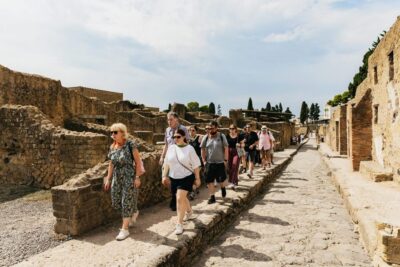
Pompeii and Herculaneum Small Group Tour with an Archaeologist
Read our review →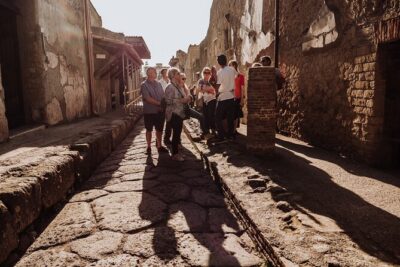
Herculaneum Small Group Tour and Ticket With an Archaeologist
Read our review →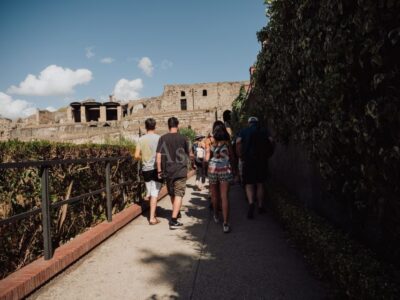
Pompeii & Herculaneum with Archaeologist Guide
Read our review →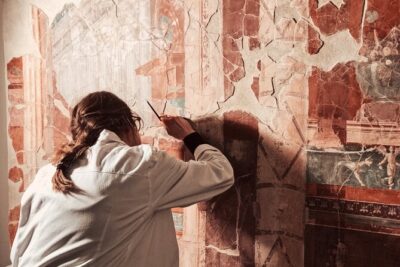
Pompeii Private Tour with an Archaeologist and Skip The Line – 3 hours
Read our review →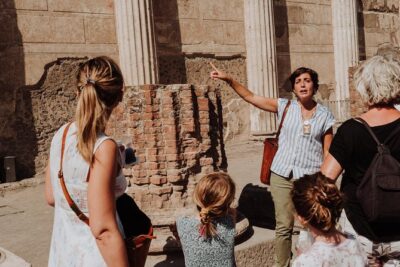
Pompeii Private Tour with an Archaeologist and Skip The Line
Read our review →Browse the lists this tour appears in