
Reviewed · POMPEII TOURS WITH AN ARCHAEOLOGIST
Pompeii Private Tour with an Archaeologist Guide
Pompeii makes far more sense when someone helps you read its streets, homes, shops, and public buildings. On this private archaeologist-led tour, you move through the ruins with a guide who can explain how daily life worked, not just point out broken walls. Guides such as Rossana, Mena, Paolo, Jolanda, and Silvia have been praised for bringing the ancient city to life and keeping children and adults involved.
I like the one-group format, which lets you ask questions and slow down when a fresco, shop counter, or bath complex catches your eye. I also like the route itself: it includes famous places such as the Forum and House of the Faun, plus ordinary-life details at the Thermopolium and along Via dell’Abbondanza. The main drawback is time. Two hours gives you a useful introduction, but Pompeii is enormous, and you may want another hour or two afterward.
Key points to know before you book
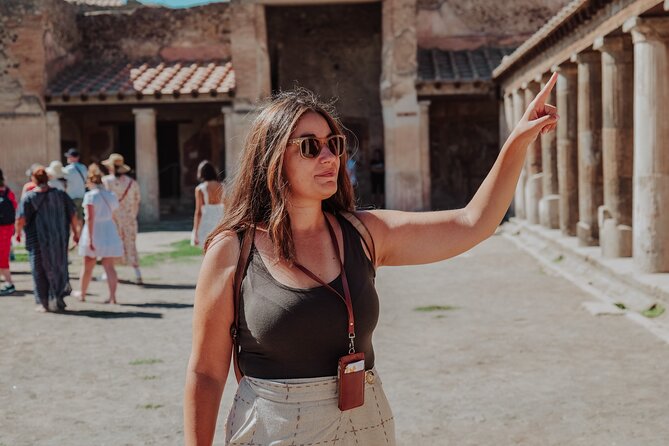
- Private access to an archaeologist guide: Your group receives the guide’s full attention rather than following a large crowd.
- A strong mix of famous and everyday Pompeii: The route includes the Forum, theaters, baths, houses, a bakery-style food counter, and an ancient commercial street.
- English-language guiding: The experience is offered in English.
- Entrance ticket costs extra: The tour price covers the guide, not admission to Pompeii. Recent visitors paid about €20 per person for entry.
- Two hours is a fast introduction: You see many major places, but the site is large enough to justify extra independent time.
- Closed shoes matter: Uneven ancient paving makes flip-flops a poor choice.
Why an archaeologist changes the Pompeii experience
Pompeii can feel confusing at first. You enter a huge field of streets and roofless buildings, many of them reduced to walls, columns, and fragments of decoration. Without context, it is easy to look at a house, shrug, and move on.
A good archaeologist guide helps you picture the structure as a working home, shop, bath, theater, or civic building. Guides on this tour explain how people lived, how public space worked, and what archaeologists can establish with confidence versus what remains an educated interpretation. That distinction matters. Pompeii invites dramatic stories, but careful guiding is more useful than fantasy.
The private setting is especially helpful here. You can ask why a house has a certain layout, what a counter was used for, or how the baths functioned. The guide can also adjust the pace for your group. One party used the slower pace to accommodate a person with a broken foot, while another guide kept children engaged with questions and clear explanations.
I would not treat the two-hour visit as a complete exploration of Pompeii. Think of it as a well-planned orientation that gives you the tools to continue on your own. One especially useful pattern is to finish the guided walk and then spend another hour exploring areas that caught your interest.
More Guided Tours in Pompeii
- Skip the Line Guided Tour of Pompeii led by an Archaeologist
★ 5.0 · 703 reviews - Pompeii private tour with an Official Guide
★ 5.0 · 631 reviews - Pompeii Skip-the-line Tour with Archaeologist Guide
★ 5.0 · 559 reviews
Meeting at Porta Marina Superiore
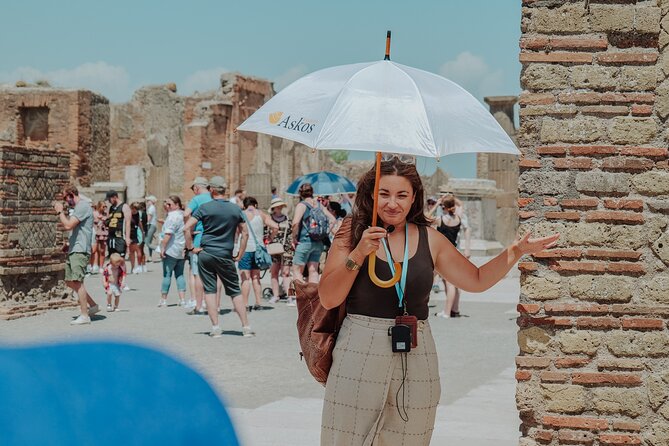
The meeting point is the main entrance known as Porta Marina Superiore, at Via Villa dei Misteri 1 in Pompei. Your guide holds an Askos Tours sign, which makes the meeting easier to manage at a busy archaeological entrance.
The tour begins and ends at the same location, but transportation is not included. You make your own way to Pompeii, and the guide can offer information about returning to your accommodation or reaching the closest train station after the visit.
Confirmation arrives at booking, and the activity is offered in English. It is also near public transportation. Service animals are allowed, and most people can take part, but you should expect a lot of walking over old stone surfaces.
Wear firm, closed shoes. Pompeii’s ancient streets are not smooth museum floors, and loose sandals can make the walk less comfortable. Bring water and sun protection if the weather is hot. A rainy day does not automatically spoil the experience, but wet paving can require extra care.
House of the Vettii and the Lupanar
The House of the Vettii gives you a look inside an affluent Pompeian home. Its importance is not only its decoration. The layout helps you understand how status, entertaining, household work, and private space fit together in a Roman house.
This is one of the places where a guide adds real value. You can see rooms and courtyards, but the guide explains what each space may have been used for and points out details that are easy to miss. One guide used the homes to discuss successful businesswomen and the role of women in Pompeian society, adding a useful human angle to the usual focus on emperors and wars.
The nearby Lupanar brings a different side of ancient life into view. It is one of Pompeii’s most talked-about sites, but a guide can place it within the wider social and commercial setting instead of treating it as a quick curiosity. It is a short stop, so the explanation matters more than the time spent inside.
If you are visiting with children, the guide can help you decide how much detail is appropriate. The private format makes that easier than a fixed group tour.
The Thermopolium and ancient everyday life
The House and Thermopolium of Vetutius Placidus is one of the route’s most appealing stops because it connects directly with ordinary food and commerce. The counter gives you a glimpse of an ancient version of fast food, where people could buy prepared food rather than cook every meal at home.
This is the kind of place I particularly like at Pompeii. Grand houses and temples tell you about wealth and public power. A food counter tells you how the city worked on a normal day. Look closely at the layout and imagine the rhythm of buying, serving, eating, and moving along the street.
The guide’s explanation also helps connect this small commercial space to the broader city. Pompeii was not just a collection of villas. It was a living town with businesses, homes, entertainment, public baths, and crowded streets.
More Private Tours in Pompeii
- Pompeii Private Tour with an Archaeologist and Skip The Line – 3 hours
★ 5.0 · 564 reviews - Visit in Pompeii – Pompeii Private Tour with Ada
★ 5.0 · 436 reviews - Pompeii Private Tour with an Archaeologist and Skip The Line
★ 5.0 · 391 reviews - Pompeii Vineyard Escape: Private Wine Tasting & Lunch
★ 5.0 · 329 reviews
Teatro Grande and the House of the Faun
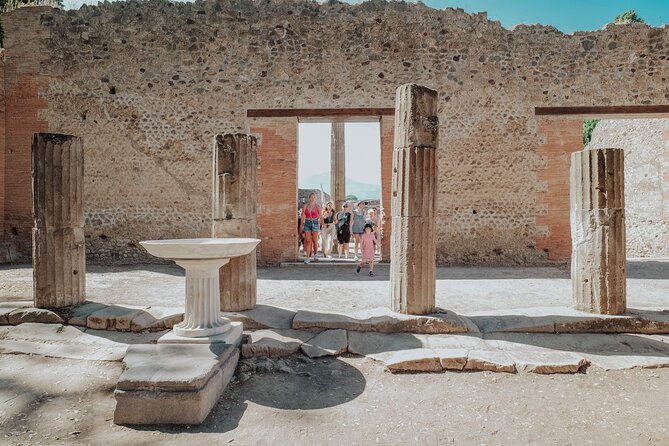
The Teatro Grande, or Large Theater, is a short stop on the route. The theater helps you understand that entertainment was a major part of civic life. It is also a useful change of pace after the tighter spaces of the houses and shops.
The tour then reaches the House of the Faun, one of Pompeii’s most important private residences. Its size and decoration show the wealth of its owners, while the name comes from the famous faun statue associated with the house. The guide can help you compare this residence with the House of the Vettii and see how large homes differed in scale and design.
The stops are brief, so you should not expect a long, detailed examination of every room. The benefit is that the tour keeps moving and covers a broad range of Pompeii. If the House of the Faun is a priority for you, note what interests you and return after the guided portion.
Stabian Baths and the Forum Baths
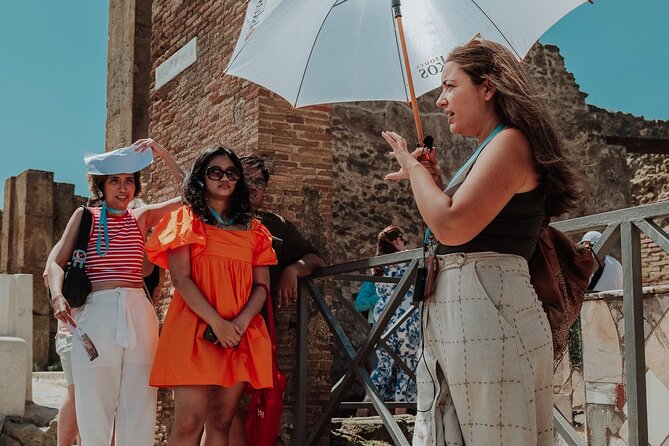
The Stabian Baths are among the most useful places for understanding Roman public life. Baths were not simply places to wash. They were social spaces where people met, exercised, relaxed, and followed a sequence of hot, warm, and cool rooms.
An archaeologist guide can explain the practical design of the complex and show how the Roman heating system worked. You begin to see the baths as a piece of city infrastructure rather than a set of empty rooms.
The Forum Baths offer another chance to compare public bathing facilities with the city’s civic center. The route moves between domestic houses, commercial buildings, and public structures, which helps you see how closely daily life and public life were tied together.
The baths also offer some relief from the open streets. On a hot day, though, much of the tour remains outdoors, so do not count on the stops providing shade throughout the visit.
Via dell’Abbondanza and the ancient street network
Walking along Via dell’Abbondanza is one of the best ways to understand Pompeii as a town rather than a group of isolated monuments. This street connected homes, businesses, public buildings, and side roads.
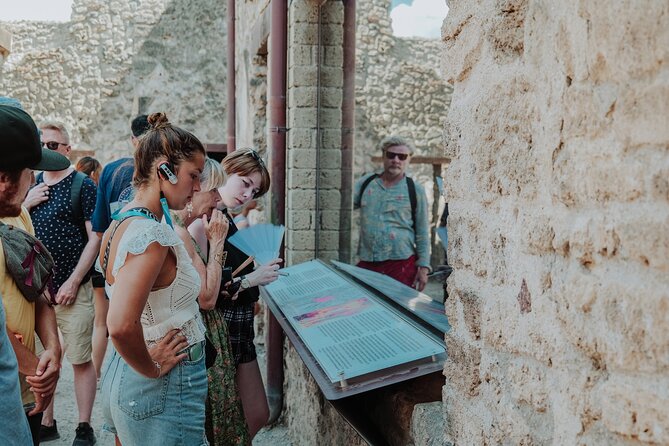
Look down as you walk. The old paving stones, raised crossings, and wheel marks help you picture carts and pedestrians sharing the road. The guide can point out features that disappear into the general clutter when you explore alone.
This is also where the private pace helps. A large group may need to keep moving to stay together. With your own guide, you can pause for a question or spend a little longer examining a shopfront. The tradeoff is that a two-hour route cannot give every street the attention it deserves.
Macellum, House of Menander, and the Forum Granaries
The Macellum was a market building connected with food sales and public commerce. It adds another piece to the picture of Pompeii’s economy. After seeing the Thermopolium, you have a better sense of how people bought and consumed food in the city.
The House of Menander returns you to private life. It is associated with an affluent household and gives the guide another setting for explaining decoration, room arrangement, and social status. Moving between houses and markets keeps the tour from becoming a parade of similar ruins.
The Granaries of the Forum now hold archaeological material and provide an important reminder that Pompeii is an active excavation and preservation site. The area helps explain how objects from the ancient city are protected and studied.
I appreciate this combination because it avoids focusing only on the most photogenic ruins. You see evidence of wealth, trade, storage, food, bathing, entertainment, and civic life in one compact walk.
The Forum, Pompeii’s grand public center
The route ends at the Forum, the city’s main public square. This is the place where the pieces come together. After seeing homes, shops, baths, theaters, and streets, you can better understand why the Forum mattered.
The Forum was a center for public business, religion, politics, and ceremony. The open space and surrounding buildings may look stark today, but the guide’s explanation helps you reconstruct the activity that once filled it.
It is a fitting final stop because you finish with Pompeii’s public face after spending much of the tour looking at private and practical life. From here, you can continue exploring on your own or ask the guide for suggestions. Several guides offer advice about other areas worth visiting after the official tour ends.
What $178.45 per person really buys
At $178.45 per person, this is not a budget way to enter Pompeii. The price covers private guiding and archaeological expertise, but it does not include the Pompeii entrance ticket or transportation. Recent experience put admission at about €20 per person, so you should add that cost before comparing the total with a group tour.
The value depends heavily on your group size and priorities. For two people, the private format is costly, but it gives you a personal pace and a chance to ask as many questions as you like. For a family or larger party using the group discount, the per-person cost may feel more reasonable.
I see the strongest value in three situations: you have only half a day, you want help with the major sites, or you care about archaeology and everyday Roman life rather than simply taking photographs. If you plan to spend many hours reading signs and navigating alone, a private guide may be less important.
The 99 percent recommendation rate and five-star average show a very strong pattern of satisfaction, but the one lower rating points to a fair concern: communication can vary, and two hours may not feel like enough. Ask questions early and tell the guide what interests you most. That gives the tour a better chance of matching your expectations.
Who will get the most from this tour
I would choose this tour for first-time visitors who want a clear introduction without spending a day lost among the ruins. It also suits families, since several guides have kept children engaged and adjusted explanations for younger listeners.
It works well for people with limited time. One guide can show you major highlights in half a day and suggest where to continue afterward. It is also a good choice for history-minded visitors who want to discuss evidence, interpretation, and daily life.
You may want a longer option if available, or plan extra time on your own, if you are especially interested in mosaics, painting, architecture, or the excavation process. One person felt that four hours would have been better because the site is so large. That is a sensible assessment.
Free cancellation is available up to 24 hours before the start time. Changes or cancellations inside that window are not accepted for a refund.
Should you book the Pompeii private tour?
Book it if you want Pompeii to make sense quickly and you value personal attention. The archaeologist guides, private pace, and mix of famous monuments with ordinary shops and streets make this more useful than simply wandering from ruin to ruin.
I would not book it expecting to see every corner of the park in two hours. Treat it as a focused introduction, wear proper shoes, budget separately for admission, and leave time afterward for your own exploration. For first-time visitors, families, and anyone with only a short window in Pompeii, that is a strong use of your time and money.
FAQ
Where does the Pompeii private tour begin?
The tour begins at Porta Marina Superiore, the main entrance to the archaeological site, at Via Villa dei Misteri 1, 80045 Pompei, Italy.
How will I recognize the guide?
The guide will hold a sign with Askos Tours written at the top.
How long does the tour last?
The tour lasts approximately two hours.
Is the Pompeii entrance ticket included?
No. The entrance ticket is not included in the tour price. A recent visit reported paying about €20 per person for admission.
Is transportation included?
No. You arrange your own transportation to and from the archaeological site.
Is the tour private?
Yes. Only your group takes part in the activity.
Is the tour offered in English?
Yes. The experience is offered in English.
What should I wear?
Closed shoes are best. The ancient streets and ruins can be difficult to walk on in flip-flops or open sandals.
Can I cancel for a full refund?
Yes, if you cancel at least 24 hours before the experience begins. Cancellations made less than 24 hours before the start time are not refunded.
More Ways to See Pompeii
- Discover the Ancient Ruins of Pompeii: Day Trip from Rome
★ 3.5 · 2,247 reviews - Pompeii Ticket + Tour with Optional Tasting Experience at Pompeii
★ 5.0 · 663 reviews - Sharing Tour of Pompeii
★ 5.0 · 487 reviews - Pompeii Guided Tour & Horse Riding on Vesuvius with Lunch
★ 5.0 · 419 reviews
More Pompeii Tours Led by an Archaeologist
- Pompeii Small Group Tour with an Archaeologist
★ 5.0 · 6,593 reviews - Pompeii and Herculaneum Small Group Tour with an Archaeologist
★ 5.0 · 1,350 reviews - Explore Pompeii with an Archaeologist
★ 5.0 · 511 reviews - Pompeii 2h Small-Group Tour with Expert Archaeologist
★ 5.0 · 385 reviews
Just added around Pompeii
- Wine Tasting and Winery Tour in Vesuvio National Park with Lunch★ 4.5 · 3 reviews
- Mt. Vesuvius Wine Tasting and Lunch Experience from Pompeii★ 4.5 · 20 reviews
- Wine tasting in the Vesuvius national park★ 5.0 · 3 reviews
- Traditional Neapolitan Dinner in Pompei – Villa Franca – Family Restourant★ 5.0 · 8 reviews
- Private Guided Tour and VR Headsets in the Ancient Pompeii★ 5.0 · 3 reviews
- Visit Pompeii with a local expert guide★ 5.0 · 10 reviews
- Tour Mount Vesuvius with Entry Tickets and Round Trip Transfer Included★ 3.5 · 4 reviews
- Vesuvius tour entrance to the crater and return bus★ 4.5 · 9 reviews
Pompeii Tours with an Archaeologist, compared.

Pompeii Small Group Tour with an Archaeologist
Read our review →
Pompeii and Herculaneum Small Group Tour with an Archaeologist
Read our review →
Herculaneum Small Group Tour and Ticket With an Archaeologist
Read our review →
Pompeii & Herculaneum with Archaeologist Guide
Read our review →
Pompeii Private Tour with an Archaeologist and Skip The Line – 3 hours
Read our review →
Pompeii Private Tour with an Archaeologist and Skip The Line
Read our review →Browse the lists this tour appears in