
Reviewed · POMPEII TOURS WITH AN ARCHAEOLOGIST
Pompeii 2-hour Private Tour with an Archaeologist-Ticket included
Pompeii is far easier to understand with someone who can explain what you are seeing. This two-hour private walk takes you from the city’s public center to its homes, baths, brothel, theaters, and casts of eruption victims, with an archaeologist supplying the links between scattered ruins.
I like the private format because you can ask questions, slow down for photos, or focus on daily life instead of following a large crowd. I also like the guide quality: Alessandra, Silvia, Ivan, Luca, and others are described as archaeologists, with some having worked directly on excavations at Pompeii. The main drawback is time. Two hours gives you a strong introduction, not a complete visit to this huge site.
Key points to know before booking
- Private access to the guide’s full attention: Only your group takes part, so the visit can adjust to your interests and walking speed.
- A useful first-time route: The Forum, House of Menander, Stabian Baths, Lupanar, House of the Faun, and theaters give you a broad look at Roman public and private life.
- Archaeology explained on site: Guides such as Silvia and Alessandra bring excavation experience and current site work into the conversation.
- Casts and household details: The Forum granaries include casts of victims, a dog, and a tree, along with marble furnishings and fountain baths.
- Easy meeting point, no included transfers: Meet at Porta Marina Superiore and finish at Piazza Esedra. You arrange your own way to and from Pompeii.
- Best for a focused visit: The tour suits first-time visitors, families, and anyone who wants context without spending half a day in a large group.
Why a private archaeologist changes Pompeii
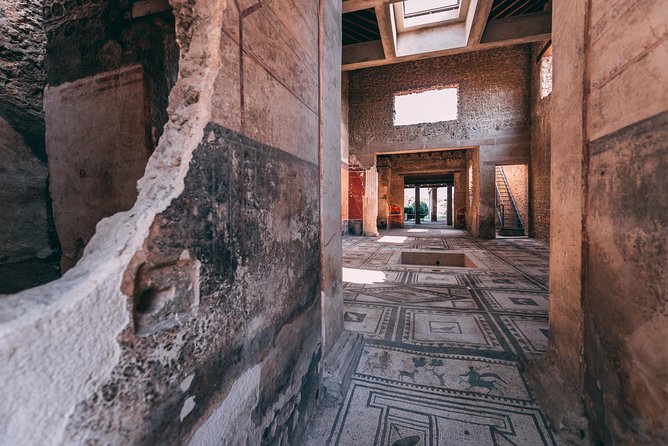
Pompeii can feel like a maze of broken walls if you walk in without a plan. Streets branch off in several directions, buildings have similar-looking remains, and the most important clues are often small: a painted detail, a worn threshold, a drainage channel, or the shape of a public building.
A private archaeologist helps you read those clues. Instead of seeing only collapsed walls, you get a sense of how the city worked. The Forum was a civic and commercial center. The baths served as social spaces as well as places to wash. The houses reveal differences in wealth, taste, and status. The theaters show how entertainment fit into public life.
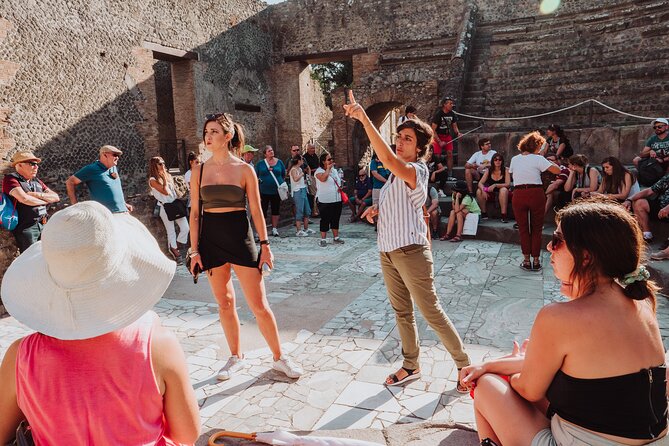
The format also keeps the experience personal. You are not sharing the guide with a large group, so you can ask why a particular room matters or request more attention to art, architecture, Roman customs, or the eruption. One guide, Mena, was especially attentive to a group interested in everyday art and social roles, while also allowing plenty of time for photographs.
The strongest praise goes to the guides’ ability to make Pompeii feel understandable. Ivan is described as an archaeologist whose explanations made a long-awaited visit more meaningful. Luca reportedly pointed out small details that could easily be missed and helped his group picture the city as it once was. That is the real value here: not more ruins, but better explanations.
More Private Tours in Pompeii
- Pompeii private tour with an Official Guide
★ 5.0 · 631 reviews - Pompeii Private Tour with an Archaeologist and Skip The Line – 3 hours
★ 5.0 · 564 reviews - Visit in Pompeii – Pompeii Private Tour with Ada
★ 5.0 · 436 reviews
Meeting at Porta Marina Superiore
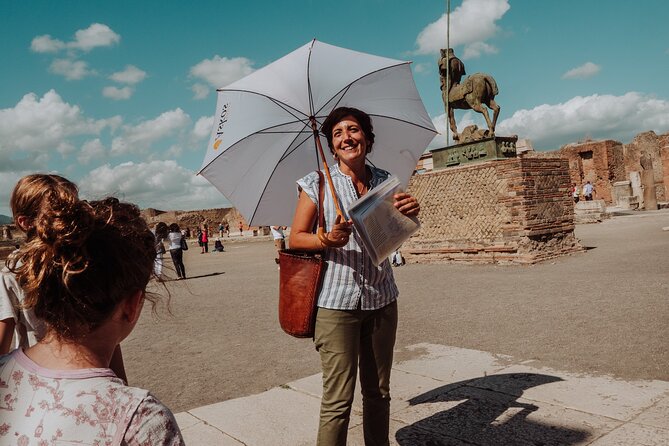
Your guide meets you at the main entrance called Porta Marina Superiore, at Via Villa dei Misteri 2 in Pompei. Look for a person holding a sign with Askos Tours at the top.
This detail matters because Pompeii has more than one entrance, and arriving at the wrong gate can cost precious time. The company sends meeting instructions, and one group specifically found the directions and accompanying photo useful. I would still allow extra time to reach the entrance, especially if you are coming by train or from another part of town.
The tour ends at Piazza Esedra, at the ruins. Hotel pickup, hotel drop-off, and transport to or from the archaeological park are not included. Your guide can provide useful advice for reaching your accommodation or the nearest train station after the visit.
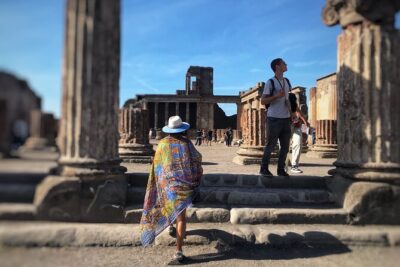
The Basilica and Forum: Pompeii’s public heart
The first major stop is the Basilica, an open portico that sheltered merchants and public business. The remains may look spare, but this is an important place to begin because it introduces Pompeii as a functioning city rather than a collection of private houses.
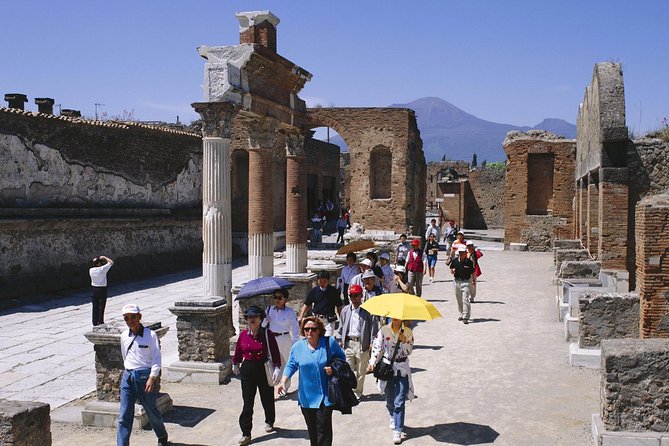
From there, the route moves to the Forum, the ancient main square. The Forum was the public center of Pompeii, and its open space helps you understand the scale of civic life. This is where an archaeologist’s explanation earns its keep. Columns, platforms, surrounding buildings, and worn paving stones make more sense when you know how the space was used.
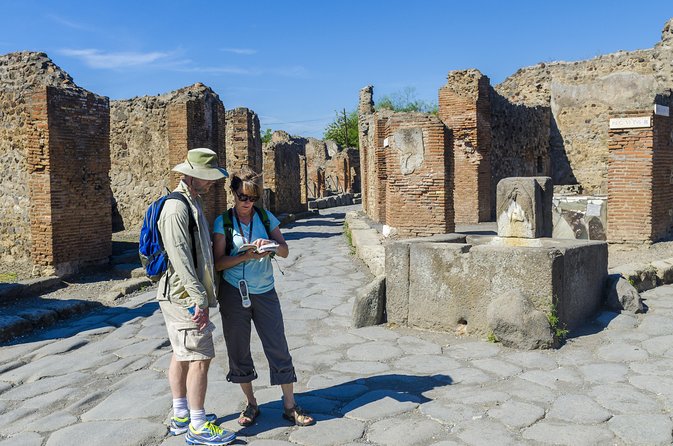
You also walk along one of Pompeii’s main streets. Pay attention to the uneven stone paving and the arrangement of buildings along the road. The tour does not treat the street as mere passage between stops. It helps you see how movement, commerce, homes, and public buildings fit together.
The Forum portion is relatively brief, listed at about 10 minutes, so expect a clear orientation rather than a long lecture at every building. That is sensible on a two-hour tour. You will see more of Pompeii, but you will need to return on your own for a slower look at the central square.
Granaries of the Forum and the casts of victims
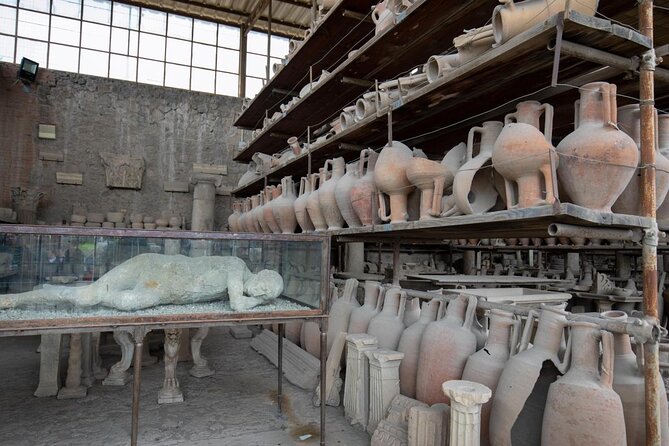
The Forum granaries offer one of the visit’s most powerful stops. Inside, you can see marble tables and baths made for fountains that once decorated the entrances of houses. The collection also includes casts of victims from the eruption, along with casts of a dog and a tree.
These casts can be difficult to see, and the guide’s role is important here. The scene is not simply a dramatic display. It connects the city’s buildings to the people, animals, and ordinary objects caught in the disaster. Ask your guide about how the casts relate to the wider work of preserving and studying Pompeii.
This stop can feel more emotional than the grand houses or theaters. If you prefer to spend more time on architecture, say so. The private format makes that possible. The listed visit lasts about 15 minutes, which gives you time for explanation without allowing this single stop to dominate the entire route.
More Pompeii tours led by an archaeologist:
- Pompeii Small Group Tour with an Archaeologist
★ 5.0 · 6,593 reviews - Pompeii and Herculaneum Small Group Tour with an Archaeologist
★ 5.0 · 1,350 reviews - Skip the Line Guided Tour of Pompeii led by an Archaeologist
★ 5.0 · 703 reviews - Pompeii Skip-the-line Tour with Archaeologist Guide
★ 5.0 · 559 reviews
House of Menander and Roman home life
The House of Menander is described as one of Pompeii’s most impressive private homes, both for its design and its contents. It gives you a chance to move from public space into domestic life.
A good guide can help you notice how a wealthy Roman home was arranged and decorated. You may find that the house tells you as much about status and household organization as it does about art. The name comes from Menander, the Greek comic playwright, and the house’s decoration reflects the taste and culture of the people who lived there.
The tour allows roughly 15 minutes here. That is enough for a guided introduction, particularly if your guide has a background in excavation and can point out details that are easy to miss. It is not enough for an exhaustive study of every room, so visitors with a strong interest in Roman domestic architecture may want extra time at Pompeii after the tour.
Stabian Baths: more than a place to wash
The Stabian Baths are the oldest thermal complex in the city and occupy a large area near Brothel Lane, the Holconius crossroads, and Via Stabiana. This is one of the best places to understand how public facilities shaped social life.
Roman baths were not only practical. They were places to meet, talk, exercise, and spend time. The remains help you see how Pompeii organized shared amenities, and the guide can explain the difference between the spaces and their functions.
The baths also show how a Roman city invested in public comfort. For a first visit, this is a useful counterpoint to the grand houses. You see that urban life depended on more than temples and government buildings. Everyday routines mattered too.
The route allows about 15 minutes here. Wear sturdy shoes, since Pompeii has rough and uneven ground. The tour requires a moderate level of fitness, and comfortable footwear is specifically recommended.
The Lupanar and the less polished side of Pompeii
The Lupanar is Pompeii’s most famous brothel and one of the site’s most talked-about buildings. It offers a direct look at a part of Roman urban life that formal monuments often leave out.
This stop is short, about 15 minutes, but the subject can prompt useful questions about commerce, sex work, privacy, and the way ancient cities used small, specialized buildings. Your guide can give the setting context rather than leaving you with a sensational image and little explanation.
Families should know what they are seeing. The tour is not described as restricted by age, and children have taken part, with guides keeping younger visitors engaged through stories. Still, parents may prefer to prepare older children for the subject before arrival.
House of the Faun and the scale of private wealth
The House of the Faun was one of Pompeii’s largest and most impressive private residences. Its scale provides a sharp contrast with ordinary streets and smaller homes.
This is where you can get a clearer idea of how wealth shaped Roman domestic space. Large residences were not simply bigger versions of modest houses. Their layout, decoration, and reception areas conveyed status to everyone who entered.
The House of the Faun is allotted around 15 minutes. That may seem brief, but the private guide can focus the explanation on what interests you most. If you want architectural detail, say so. If you care more about how people lived in the rooms, the guide can take that direction instead.
Teatro Piccolo and Teatro Grande
The route also includes a look at the Teatro Piccolo, or small theater, followed by Teatro Grande, the most important theater in Pompeii.
Seeing both helps you compare different kinds of performance spaces. The smaller theater gives you a more intimate setting, while Teatro Grande shows the scale of Pompeii’s public entertainment. The larger theater is allotted about 10 minutes, enough for an overview of its role and design.
Theater stops are useful late in the tour because they return you to public life after the quieter domestic buildings. You have seen commerce, homes, baths, and the brothel. Now you see how performance and civic gathering fit into the same city.
The exact walking order or time at each location can change with site conditions and your group’s pace. The supplied schedule lists many stops at 10 or 15 minutes, but the total tour lasts about two hours. Think of those figures as a compact route plan, not a promise that every room will receive a full quarter hour.
What the $214.75 price means
At $214.75 per person, this is not a budget Pompeii visit. The price includes admission to the archaeological park, a professional archaeologist guide, and a private tour for your group.
The value depends heavily on group size. For one or two people, the per-person cost is high. For a family or small group sharing the private guide, the price becomes easier to justify because you are buying personal attention rather than a standard walk with strangers.
I see the best value in the guide’s expertise. A self-guided visit costs less, but it requires you to plan a route and interpret the site alone. A large group tour may also cost less per person, yet it can be harder to hear, ask questions, or pause for photographs. Here, you pay for a focused route and the ability to shape the conversation.
The current rating is 4.9 from 181 reviews, with 98 percent of customers recommending the experience. The praise is especially consistent about the guides’ archaeological background, patience, clear explanations, and ability to adjust for children or older family members. One party arrived late, and Giovanni reportedly stayed patient and helped them reach the entrance without making them feel hurried.
That said, the tour cannot show all of Pompeii. If you want a full-day archaeological study, this is not the right product. It is a strong starting point or a practical choice for a short visit.
Timing, walking, and weather
Plan on walking over rough Roman streets and uneven ground for two hours. A moderate level of fitness is needed, and comfortable shoes are essential. Pompeii operates in all weather, so dress for the forecast and bring suitable protection from sun or rain.
There is no hotel transfer. You need to reach Porta Marina Superiore yourself and make your own onward arrangements from Piazza Esedra. The site is near public transportation, but the tour does not include transport tickets.
The company allows free cancellation up to 24 hours before the start time. Cancellations or changes made less than 24 hours ahead are not refunded or accepted. Confirmation arrives when you book, and the mobile ticket makes it easy to keep the booking details with you.
Who will get the most from this Pompeii tour
I would choose this tour for a first visit when you want the major sights explained without committing to a long full-day program. It also fits families well. Guides have kept children aged seven and nine engaged with stories, while another guide adjusted the pace for older family members on steep or rough ground.
It suits couples and small groups who want to ask questions freely. It is also a good choice if you care about archaeology, excavation, Roman daily life, or the small details hidden in plain sight.
You may want something else if you prefer to wander alone for several hours, read every display at leisure, or cover a much larger part of the site. The two-hour route is focused. Its strength is clarity, not total coverage.
Should you book the Askos Tours private visit?
Book it if you want Pompeii explained by an archaeologist and value a private pace more than the lowest price. The strongest reason is the guide. Names such as Alessandra, Silvia, Ivan, Luca, Paolo, and Giovanni appear in the tour’s excellent feedback, with particular praise for excavation experience, patience, and lively explanations.
I would be especially comfortable choosing it for a family, a small group with mixed interests, or anyone making a short Pompeii visit from another base. Set your expectations correctly: you will get a well-chosen introduction to the Forum, homes, baths, Lupanar, theaters, and casts, not every corner of the park.
For the best experience, arrive early at Porta Marina Superiore, wear shoes made for uneven paving, tell the guide what interests you, and keep time afterward if you want to explore further. At $214.75 per person, it is a premium visit, but the private archaeologist format gives that cost a clear purpose.
FAQ
How long does the Pompeii private tour last?
The tour lasts approximately two hours.
Where does the tour begin?
You meet the guide at Porta Marina Superiore, the main entrance to the archaeological site, at Via Villa dei Misteri 2 in Pompei.
Where does the tour end?
The tour ends at Piazza Esedra, and you leave the guide at the Pompeii ruins.
Is admission to Pompeii included?
Yes. Admission fees to the archaeological park are included in the tour price.
Is this a private tour?
Yes. Only your group takes part in the private activity.
Does the tour include hotel pickup or transportation?
No. Hotel pickup, hotel drop-off, and transportation to and from the ruins are not included.
Can I cancel for a full refund?
Yes, if you cancel at least 24 hours before the experience start time. Cancellations or changes made less than 24 hours in advance are not refunded or accepted.
More 2-Hour Experiences in Pompeii
- Pompeii 2h Small-Group Tour with Expert Archaeologist
★ 5.0 · 385 reviews - 2 hours Pompeii Tour with Local Historian – Ticket Included
★ 5.0 · 335 reviews - Pompeii: 2 Hour Private Tour with an Archeologist Guide
★ 5.0 · 214 reviews - 2 Hours Private Tour in Pompeii with Archaeologist
★ 5.0 · 123 reviews
More Ways to See Pompeii
- Discover the Ancient Ruins of Pompeii: Day Trip from Rome
★ 3.5 · 2,247 reviews - Pompeii Ticket + Tour with Optional Tasting Experience at Pompeii
★ 5.0 · 663 reviews - Explore Pompeii with an Archaeologist
★ 5.0 · 511 reviews - Sharing Tour of Pompeii
★ 5.0 · 487 reviews
Just added around Pompeii
- Wine Tasting and Winery Tour in Vesuvio National Park with Lunch★ 4.5 · 3 reviews
- Mt. Vesuvius Wine Tasting and Lunch Experience from Pompeii★ 4.5 · 20 reviews
- Wine tasting in the Vesuvius national park★ 5.0 · 3 reviews
- Traditional Neapolitan Dinner in Pompei – Villa Franca – Family Restourant★ 5.0 · 8 reviews
- Private Guided Tour and VR Headsets in the Ancient Pompeii★ 5.0 · 3 reviews
- Visit Pompeii with a local expert guide★ 5.0 · 10 reviews
- Tour Mount Vesuvius with Entry Tickets and Round Trip Transfer Included★ 3.5 · 4 reviews
- Vesuvius tour entrance to the crater and return bus★ 4.5 · 9 reviews
Pompeii Tours with an Archaeologist, compared.

Pompeii Small Group Tour with an Archaeologist
Read our review →
Pompeii and Herculaneum Small Group Tour with an Archaeologist
Read our review →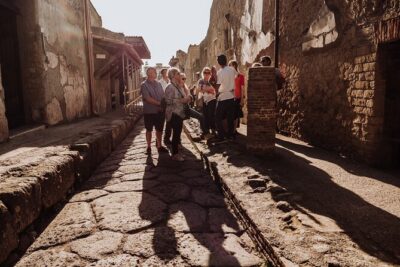
Herculaneum Small Group Tour and Ticket With an Archaeologist
Read our review →
Pompeii & Herculaneum with Archaeologist Guide
Read our review →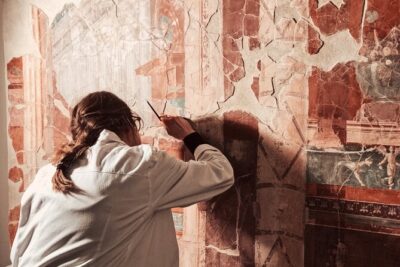
Pompeii Private Tour with an Archaeologist and Skip The Line – 3 hours
Read our review →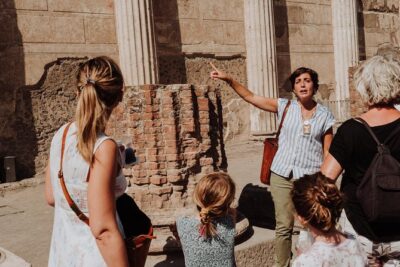
Pompeii Private Tour with an Archaeologist and Skip The Line
Read our review →Browse the lists this tour appears in