
Reviewed · POMPEII TOURS WITH AN ARCHAEOLOGIST
Best of Pompeii & Herculaneum: Private Tour with an Archaeologist
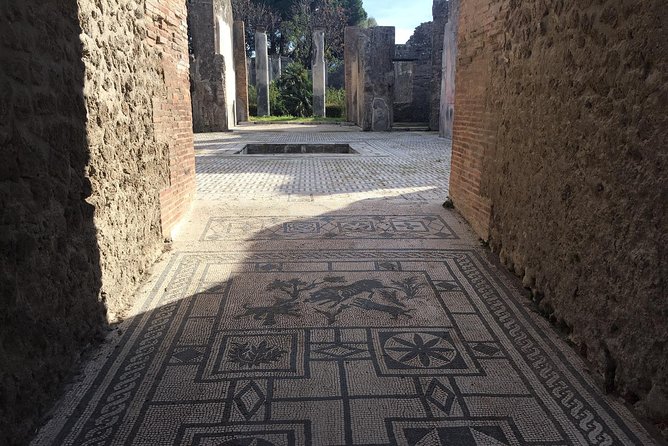
Pompeii and Herculaneum tell two different stories of the same volcanic disaster. This private tour lets you see both in one morning or afternoon, with an archaeologist explaining the Forum, theaters, thermal baths, brothel, private homes, shops, frescoes, and mosaics.
I like the private format, since your group of up to eight can ask questions without being folded into a large crowd. I also like the balance between Pompeii’s public spaces and Herculaneum’s remarkably preserved homes and shops. The main drawback is cost: the $720.91 group price does not include the two entrance fees, and private transportation costs extra.
Key points to know before booking
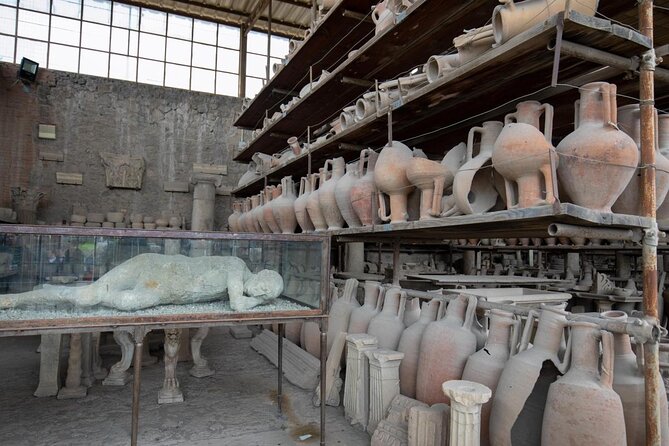
- Two volcanic cities in one tour: Spend about two hours at Pompeii and another hour and a half at Herculaneum.
- An archaeologist leads the visit: The guide is a local archaeology expert, with guides such as Roberto and Giada receiving special praise for clear explanations and friendly service.
- Pompeii focuses on public life: See the Forum, theaters, thermal baths, surrounding civic buildings, and the Lupanare.
- Herculaneum focuses on daily life at home: Look for private houses, a bakery, a Thermopolium, colorful frescoes, mosaics, and stucco decoration.
- Bring extra funds for admission: Tickets are listed separately at €40 per person for both parks.
- The route is one-way: You meet in Pompeii and finish at Herculaneum, so plan your return from Ercolano.
Why seeing Pompeii and Herculaneum together works
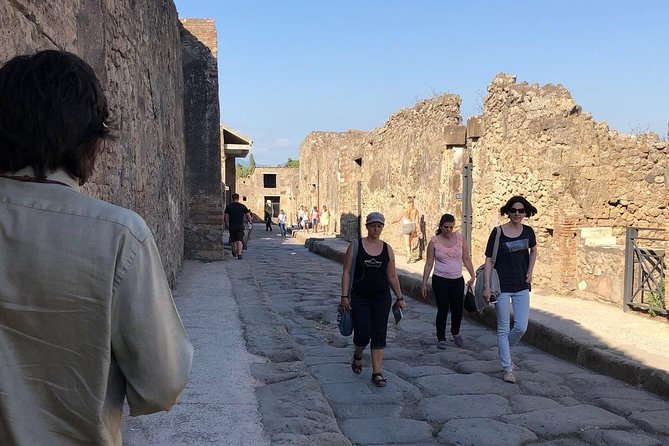
If you visit only Pompeii, you see an enormous city with streets, civic buildings, public entertainment, and open archaeological spaces. If you visit only Herculaneum, you get a closer look at houses, shops, and household decoration. Seeing both gives you a more useful picture of Roman life.
The two sites are not interchangeable. Pompeii is the grander stop, with about two hours devoted to public buildings and the city center. Herculaneum receives about an hour and a half, but its smaller scale makes private life easier to picture. The tour’s strength is this contrast.
I find a private archaeologist especially helpful here because ruins can otherwise become a parade of walls and stones. A guide can explain why one building mattered, how a shop functioned, or what a mosaic tells you about the person who owned the house. The experience is not just about looking at preserved objects. It is about connecting them to ordinary routines.
The tour is offered in English and is private for your group. The maximum group size is eight, which is large enough to share the cost but still small enough for questions. If your group has several people who want to ask about the eruption, Roman customs, or architecture, that format has real value.
More Private Tours in Pompeii
- Pompeii private tour with an Official Guide
★ 5.0 · 631 reviews - Pompeii Private Tour with an Archaeologist and Skip The Line – 3 hours
★ 5.0 · 564 reviews - Visit in Pompeii – Pompeii Private Tour with Ada
★ 5.0 · 436 reviews
Pompeii’s Forum, theaters, and thermal baths
You begin at Piazza Esedra in Pompeii, where the visit to the Pompeii Archaeological Park lasts about two hours. Admission is not included, so you should allow for the separate ticket cost of €40 per person for Pompeii and Herculaneum together.
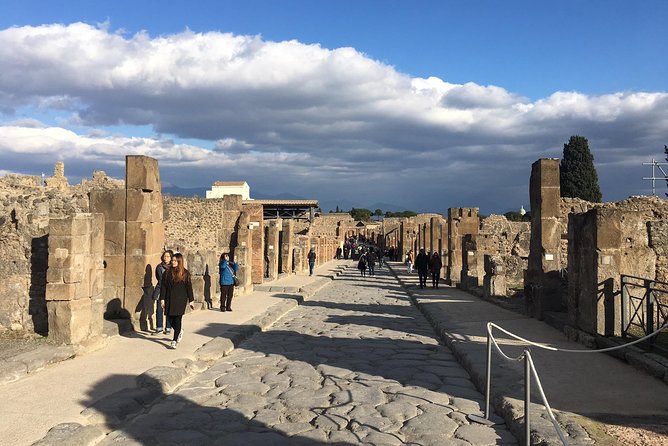
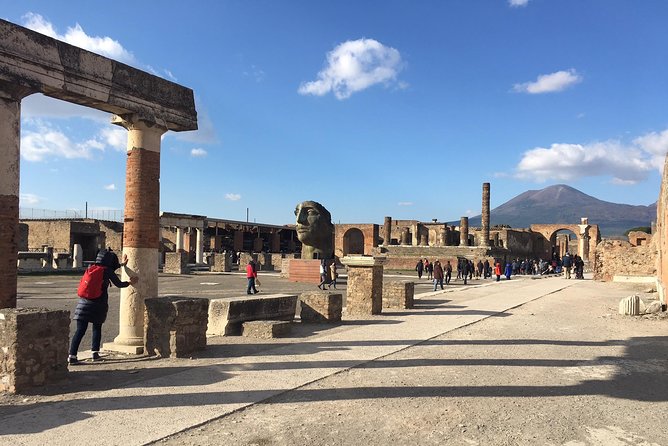
The Pompeii portion centers on public buildings. You see the Forum and its surroundings, along with the theaters and thermal baths. These sites help explain how the city worked as a public place, not just as a collection of private houses.
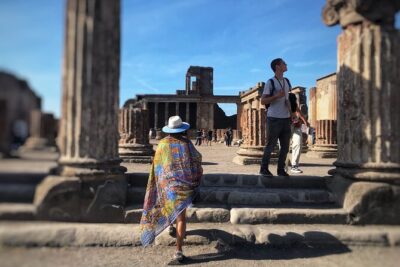
The Forum is the natural anchor. It was the civic heart of Pompeii, and the surrounding buildings show how religion, politics, commerce, and public business shared one central area. An archaeologist can give you the basic layout quickly, then help you notice details that are easy to miss when walking alone.
The theaters offer a different view of Roman society. They remind you that entertainment was part of city life, just as public bathing was. The thermal baths are also useful because they reveal how much time and money Romans invested in shared facilities.
I like this part of the tour for its sense of scale. Pompeii was not simply a wealthy neighborhood preserved by ash. It was a functioning city with public venues and civic spaces. Two hours is enough for a focused introduction, but not enough to cover every corner of the park. That limit is worth accepting if your goal is to compare both archaeological sites in one outing.
The Lupanare and the less polished side of Roman life
The Pompeii route includes the Lupanare, the city’s famous brothel. It is an important stop because it adds a blunt, human detail to the picture of Roman society.
The building is often remembered for its paintings and small rooms, but the larger value is what it shows about the range of businesses operating in an ancient city. The Lupanare is not a polished monument. It is a reminder that Pompeii included practical, commercial, and sometimes uncomfortable parts of daily life.
A guide can also help you avoid treating the site as a joke or a quick photo stop. The point is not simply that a brothel existed. It is how the space fits into the wider city, alongside baths, theaters, shops, homes, and civic buildings.
If you are visiting with children or anyone who prefers a more formal historical presentation, keep the nature of this stop in mind. The tour includes it as a recognized part of Pompeii, and the guide can explain it in context.
Herculaneum’s homes, shops, and bright decoration
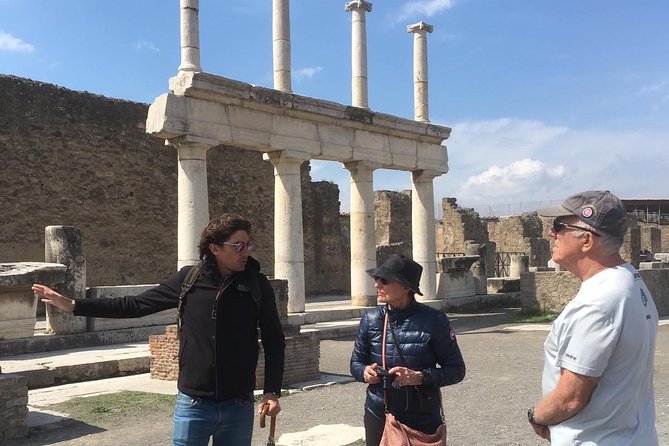
After Pompeii, the tour continues to the Archaeological Park of Herculaneum in Ercolano. The visit lasts about an hour and a half and ends at the park on Corso Resina.
Herculaneum brings the focus indoors. You see private houses and shops decorated with frescoes, mosaics, and stucco work. The remains give you a more intimate sense of Roman interiors than the broad public spaces at Pompeii.
The bakery is one of the useful stops because it points to food production and business. The Thermopolium, a Roman food and drink shop, gives you another glimpse of commercial life. These are the places that help you picture what people bought, sold, prepared, and ate.
The decoration is a major reason to include Herculaneum. Frescoes and mosaics can make a house feel less like a ruin and more like a lived-in space. Stucco details add another layer, showing that Roman interiors were not plain stone rooms.
I would not treat Herculaneum as a shorter or lesser version of Pompeii. It offers a different kind of evidence. Pompeii helps you understand the city; Herculaneum helps you understand the home and the neighborhood shop. The private guide’s explanations matter here because the surviving details can be easy to overlook without context.
More Herculaneum tours:
- Pompeii and Herculaneum Small Group Tour with an Archaeologist
★ 5.0 · 1,350 reviews - Private Day Tour to Vesuvius, Herculaneum & Pompeii with Pick Up
★ 5.0 · 279 reviews - The Ultimate Ruins of Pompeii and Herculaneum Private Day Trip
★ 5.0 · 103 reviews - Naples: Pompeii & Herculaneum Day Trip – Small Group Tour
★ 4.5 · 72 reviews
What an archaeologist adds to the visit
The tour includes a local expert archaeologist as your private guide. That is the central reason to choose this experience over simply buying park admission and walking in on your own.
A good guide can answer questions as they arise, rather than forcing you to rely on a set script. One account of Roberto highlights his ability to discuss both the eruption and the day-to-day lives of Pompeii’s residents. That combination is exactly what this tour needs. The disaster is dramatic, but daily life gives the ruins meaning.
Giada is also singled out for being funny, kind, and highly informed. She even recommended a pizza place after the tour. That small detail matters because a guide who can offer a useful local suggestion may help you turn the visit into part of a better day in Campania.
Guide assignments can vary, so you should not assume Roberto or Giada will lead your date. Still, their praised qualities show what to value: clear answers, a warm manner, and the ability to connect major events with ordinary routines.
The private setting also changes the pace. You can ask for more detail at the Forum, move on when a topic is clear, or pause for an explanation of a decoration. A shared group tour may cost less, but it usually gives you less control over questions and timing.
Price, admission, and the real value
The listed price is $720.91 per group of up to eight people. That price makes the most sense for a full group. Divided among eight, the guide fee becomes much easier to justify. For one or two people, it is a serious expense.
You must also budget for entrance tickets. Admission to Pompeii and Herculaneum is listed separately at €40 per person. For a group of eight, that adds €320, using the stated price. A light lunch break is optional from €20 per person.
Private transportation is another extra. If you want a private vehicle with a professional driver, the listed option costs €350. Since the tour starts in Pompeii and ends in Herculaneum, transportation deserves attention. You are not returning to the starting point as part of the stated route.
The tour lasts about four to five hours, while the two site visits total roughly three and a half hours. The remaining time may be used for moving between the parks and handling the flow of the visit, but the exact timing can vary. I would keep the rest of your day flexible rather than booking a tight connection immediately afterward.
The best value comes when you have a group that wants expert explanation and prefers not to organize the two parks alone. If you already plan to buy admission and visit both sites, the guide fee buys personal attention and a clear route. If you mainly want to wander at your own pace, the private format may feel expensive.
Meeting points and practical planning
The meeting point is Piazza Esedra, 10/13, in Pompeii. The tour finishes at the Archaeological Park of Herculaneum, Corso Resina, 187, in Ercolano.
Because the start and finish are in different towns, plan your onward journey before you set out. The experience is near public transportation, but private transportation can be arranged for €350 if you want a professional driver.
A mobile ticket is provided. Confirmation is sent within 48 hours of booking, subject to availability. The tour is offered in English, and service animals are allowed.
The activity requires good weather. If poor weather forces cancellation, you are offered another date or a full refund. In normal circumstances, the booking is non-refundable and cannot be changed, so choose your date carefully before paying.
Most people can take part, but Pompeii and Herculaneum are archaeological parks rather than polished indoor museums. You should be comfortable spending several hours at historic sites and moving through outdoor areas. The supplied details do not specify a fully accessible route, so anyone with particular mobility needs should confirm the route before booking.
Who will get the most from this private tour
I would choose this tour for a family, group of friends, or small party that wants both sites without spending time building its own plan. It is especially useful if people in your group have different levels of background knowledge. The archaeologist can explain the basics without making those already interested feel ignored.
It also suits anyone who wants to ask many questions. Pompeii and Herculaneum reward curiosity, and the private format gives you room to follow it.
The tour is less suitable if you want a slow, all-day study of Pompeii alone. Two hours cannot cover the entire park. It is also not the cheapest choice for a couple, particularly after adding admission and optional transportation.
For food lovers, the optional light lunch starts at €20 per person, and Giada’s pizza recommendation may be useful after the visit. Still, lunch is not included, so treat it as an add-on rather than part of the core experience.
Should you book Best of Pompeii and Herculaneum?
Book it if you want an archaeologist to connect Pompeii’s public life with Herculaneum’s homes and shops, and if your group can share the private cost. The strongest parts are the focused route, the chance to ask questions, and the contrast between the Forum, theaters, baths, and Lupanare at Pompeii and the frescoed houses, bakery, and Thermopolium at Herculaneum.
Think twice if your budget is tight, you want to return to Pompeii afterward, or you prefer to explore without a set route. Remember the extra €40 per person for admission and the possible €350 transportation charge.
For a group of up to eight, this is a practical way to see two major archaeological parks in one half-day. You leave with more than a story about the eruption. You get a clearer sense of how Romans worked, relaxed, shopped, bathed, worshipped, and lived at home.
FAQ
How long does the private Pompeii and Herculaneum tour last?
The experience lasts approximately four to five hours. The Pompeii visit is about two hours, and the Herculaneum visit is about one hour and thirty minutes.
What does the tour include?
The tour includes a local expert archaeologist as your private guide. It does not include entrance fees, lunch, or private transportation.
How much are the entrance fees?
Entrance to the Pompeii and Herculaneum Archaeological Parks is listed at €40 per person. This cost is separate from the tour price.
Where does the tour start and finish?
The tour starts at Piazza Esedra, 10/13, in Pompeii. It ends at the Archaeological Park of Herculaneum on Corso Resina, 187, in Ercolano.
Is transportation included?
No. Private transportation with a professional driver is an optional extra listed at €350. The tour is also near public transportation.
Is this a private activity?
Yes. Only your group participates, with a maximum group size of eight people.
What happens if bad weather cancels the tour?
The experience requires good weather. If it is canceled because of poor weather, you are offered a different date or a full refund. Under normal circumstances, the booking is non-refundable and cannot be changed.
More Ways to See Pompeii
- Discover the Ancient Ruins of Pompeii: Day Trip from Rome
★ 3.5 · 2,247 reviews - Pompeii Ticket + Tour with Optional Tasting Experience at Pompeii
★ 5.0 · 663 reviews - Sharing Tour of Pompeii
★ 5.0 · 487 reviews - Pompeii Guided Tour & Horse Riding on Vesuvius with Lunch
★ 5.0 · 419 reviews
More Pompeii Tours Led by an Archaeologist
- Pompeii Small Group Tour with an Archaeologist
★ 5.0 · 6,593 reviews - Skip the Line Guided Tour of Pompeii led by an Archaeologist
★ 5.0 · 703 reviews - Pompeii Skip-the-line Tour with Archaeologist Guide
★ 5.0 · 559 reviews - Explore Pompeii with an Archaeologist
★ 5.0 · 511 reviews
Just added around Pompeii
- Wine Tasting and Winery Tour in Vesuvio National Park with Lunch★ 4.5 · 3 reviews
- Mt. Vesuvius Wine Tasting and Lunch Experience from Pompeii★ 4.5 · 20 reviews
- Wine tasting in the Vesuvius national park★ 5.0 · 3 reviews
- Traditional Neapolitan Dinner in Pompei – Villa Franca – Family Restourant★ 5.0 · 8 reviews
- Private Guided Tour and VR Headsets in the Ancient Pompeii★ 5.0 · 3 reviews
- Visit Pompeii with a local expert guide★ 5.0 · 10 reviews
- Tour Mount Vesuvius with Entry Tickets and Round Trip Transfer Included★ 3.5 · 4 reviews
- Vesuvius tour entrance to the crater and return bus★ 4.5 · 9 reviews
Pompeii Tours with an Archaeologist, compared.
Pompeii Small Group Tour with an Archaeologist
Read our review →
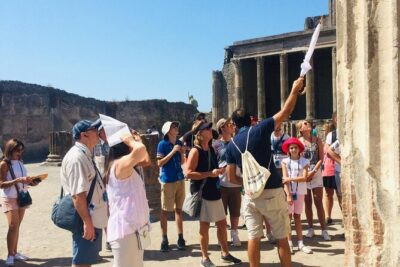
Pompeii and Herculaneum Small Group Tour with an Archaeologist
Read our review →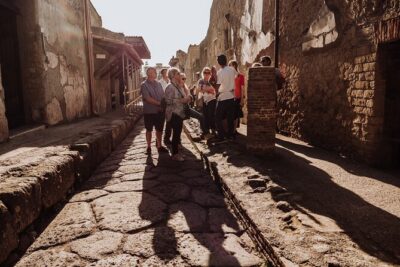
Herculaneum Small Group Tour and Ticket With an Archaeologist
Read our review →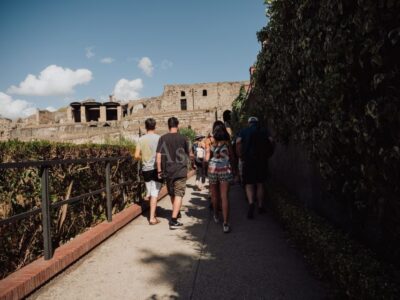
Pompeii & Herculaneum with Archaeologist Guide
Read our review →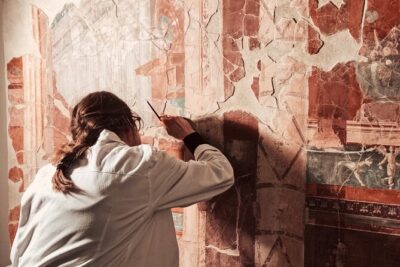
Pompeii Private Tour with an Archaeologist and Skip The Line – 3 hours
Read our review →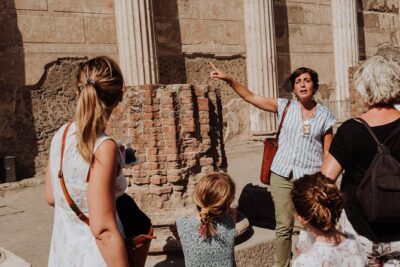
Pompeii Private Tour with an Archaeologist and Skip The Line
Read our review →Browse the lists this tour appears in