
Reviewed · POMPEII TOURS WITH AN ARCHAEOLOGIST
Pompeii Small Group with an Archaeologist and Skip The Line
Pompeii is easier to understand when someone helps you read the streets, buildings, and wall paintings as parts of one vanished city. This tour takes you through the main sights with an archaeologist guide, including Eliana Sandretti, Francesco, Dario, or Anna, rather than leaving you to wander a huge site with only a map.
I like the small groups of up to 10 and the focus on the most important ruins. I also like the chance to ask questions about daily life, architecture, excavations, and the people behind the buildings. The main drawback is the price, $217.69 per person, for a tour listed at about two hours. Also, the minimum-group rule has occasionally led to offers of a private tour at an extra cost, so read the booking terms carefully.
Key points to know before booking
- Archaeologist-led visit: Eliana Sandretti has worked at Pompeii since she was 18, and guides such as Francesco and Dario bring strong site knowledge.
- Small-group format: The maximum is 10 people, making it easier to hear explanations and ask questions.
- Fast entrance: Admission is included, with skip-the-line access at the Pompeii Archaeological Park.
- Major sights in a short visit: You see the theaters, forum, basilica, baths, Lupanar, gladiator barracks, casts, and Casa del Fauno.
- Two hours requires focus: This is an efficient introduction, not a full-day exploration of Pompeii.
- Good timing matters: A late-afternoon start can mean fewer people inside, while hot weather calls for water, sunscreen, and a hat.
Why an archaeologist makes Pompeii easier to read
Pompeii is not a single monument. It is a large Roman city with streets, homes, shops, public buildings, temples, baths, theaters, and political spaces spread across a broad archaeological park.
That scale is the reason I would consider a guided visit. On your own, you can see the stones and paintings, but you may miss what each space was for and how the pieces fit together. A guide can point out the difference between a wealthy home and a more modest one, explain how public buildings functioned, and connect the city’s grand spaces with ordinary life.
Eliana Sandretti is the main name associated with this experience. Her background working as an archaeologist at Pompeii gives the tour a useful link to current excavation work and discoveries. The guides also include Francesco, Dario, and Anna. Past tours led by Francesco included extra time when the schedule allowed, while Dario stepped in for a last-minute change and handled a private visit.
The small format matters here. A group of 10 is still large enough to have company, but much easier to manage than a large flag-following crowd. You have a better chance of hearing the explanation beside a fresco or asking why a room was built in a certain way.
More Skip-the-Line Tickets in Pompeii
- Skip the Line Guided Tour of Pompeii led by an Archaeologist
★ 5.0 · 703 reviews - Pompeii Private Tour with an Archaeologist and Skip The Line – 3 hours
★ 5.0 · 564 reviews - Pompeii Skip-the-line Tour with Archaeologist Guide
★ 5.0 · 559 reviews
Meeting in Pompeii and getting inside
The meeting point is Ristorante Suisse at Piazza Esedra, 10/13, in Pompei. The activity ends back at the meeting point, and transport to or from the site is not included.
You receive a mobile ticket, and the entrance ticket is included in the price. The skip-the-line feature saves time at the entrance, which matters during busy periods. Pompeii is too large to spend your limited visit waiting outside, especially when the guided portion is only about two hours.
The tour is offered in English. Confirmation arrives at booking, and the maximum group size is 10. Most people can take part, and service animals are allowed. The site itself includes uneven walking areas, so you should still expect a fair amount of walking over ancient streets and worn surfaces.
One practical detail deserves attention. The activity requires a minimum number of participants. If that minimum is not met, the company may offer a different date or a refund. In some cases, the company has contacted small bookings and offered a private visit for an additional payment. That can work well if you value a private guide, but it changes the price considerably. If you are booking for only two people, confirm this point before committing.
Small Theater and Teatro Grande
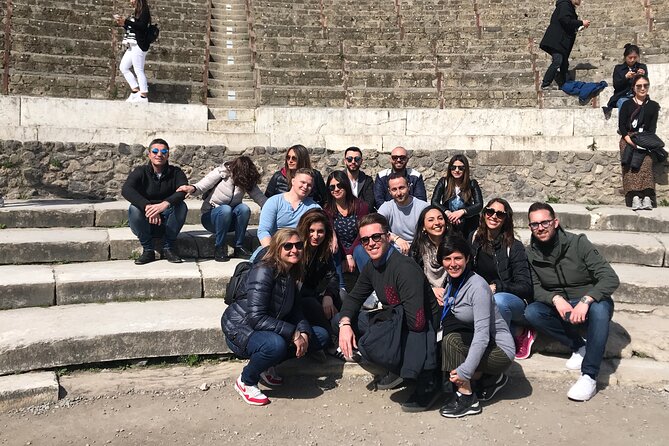
The route includes Pompeii’s small theater, used for music and singing performances, followed by the Teatro Grande.
The small theater gives you a sense of the city’s cultural life on a more intimate scale. It was designed for performances rather than mass public gatherings, and the setting helps explain how entertainment fitted into Roman town life.
The Teatro Grande is the larger performance venue, where Greek-Roman comedies and tragedies were presented. The contrast between the two theaters is useful. You see that Pompeii had more than one type of public performance space, each suited to a different audience and purpose.
The listed time at the Teatro Grande is about 15 minutes. That is enough for an explanation and a look around, but not enough for a long pause or detailed study of every feature. If theaters are your main interest, you may want to return after the tour, if opening conditions and your schedule allow.
The main street and the city’s everyday movement
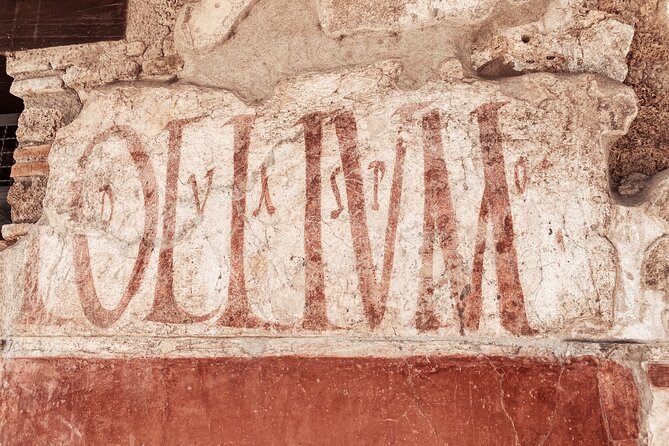
The route crosses one of Pompeii’s main streets. This is one of the best moments for understanding the city as a place where people lived, worked, shopped, traveled, and met.
The street’s preserved surfaces and colors help you picture daily movement through the city. The guide can give the setting meaning by explaining how the street connected major public and private areas. Without that context, it is easy to see only a line of ancient paving.
This part also reminds you that Pompeii was not built as a museum. It was a functioning city. Public buildings, homes, shops, religious sites, and entertainment venues were linked by the streets under your feet.
More Pompeii tours led by an archaeologist:
- Pompeii Small Group Tour with an Archaeologist
★ 5.0 · 6,593 reviews - Pompeii and Herculaneum Small Group Tour with an Archaeologist
★ 5.0 · 1,350 reviews - Explore Pompeii with an Archaeologist
★ 5.0 · 511 reviews - Pompeii Private Tour with an Archaeologist and Skip The Line
★ 5.0 · 391 reviews
Granai del Foro and the casts of the victims
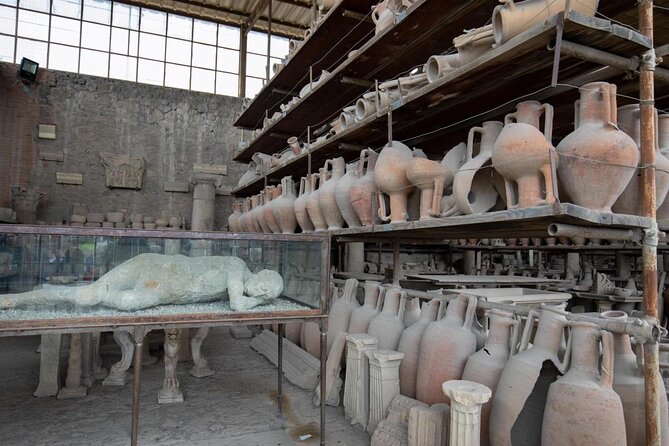
At the Granai del Foro, or the forum barns, you see casts of people who died during the eruption of 79 AD.
This can be the most emotionally difficult stop. The casts are not simply archaeological objects. They make the disaster personal and show the human cost of the eruption in a way that walls and columns cannot.
The stop is listed at about 15 minutes. Your guide can place the casts within the larger story of Pompeii, but the pace may feel quick if you want time for quiet reflection. I would treat this as a serious stop, not a photo opportunity.
Stabian Baths and Roman public life
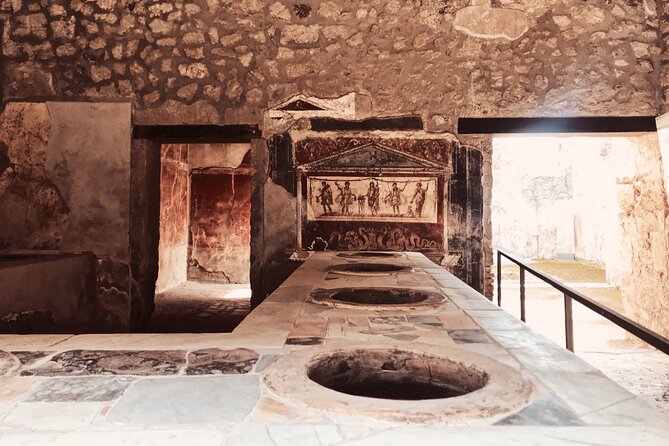
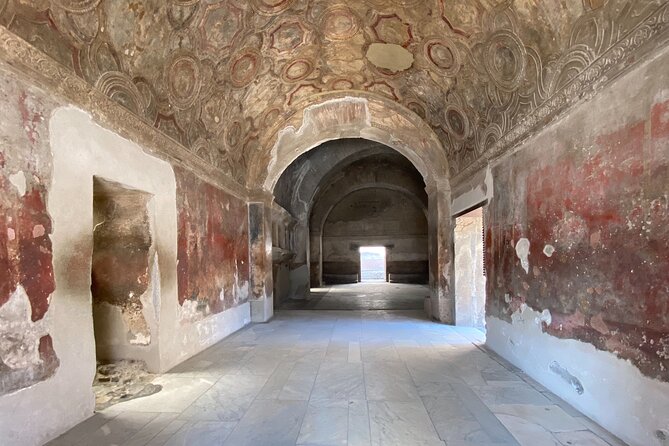
The Stabian Baths are included for their colorful frescoes and preserved layout. Public baths were important social spaces, not just places to wash. They offered room for exercise, conversation, and routine public life.
The baths also help you see the practical side of Roman engineering and architecture. A guide can explain how different rooms served different purposes and why decoration mattered in a public building.
The suggested time is about 15 minutes. Pompeii’s frescoes can reward close attention, but the tour is designed to keep moving. If you want to study color, patterns, or individual painted scenes, note the location and consider making a return visit.
The Forum, Basilica, and Temple of Jupiter
The Foro di Pompei was the city’s main square. It was the public heart of Pompeii, where civic, religious, and commercial activity came together.
From here, the tour continues to the Basilica, the former court building where justice was administered. This is a valuable stop because it shows the legal and political side of city life. Pompeii was not only a collection of homes and shops. It had formal places for government and law.
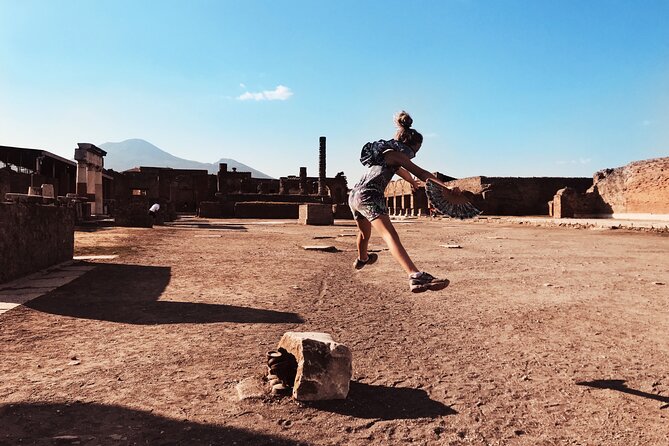
The Temple of Jupiter provides one of the most recognizable views in Pompeii, with Mount Vesuvius behind it. The mountain is not just a scenic backdrop. It is central to the story of the eruption and gives the ruins a strong sense of place.
The forum portion is listed at about 10 minutes, while the Basilica is listed at about 15 minutes. That is enough for the guide to explain the layout and importance of each site, but the schedule leaves little room for lingering. If you want a slow look at inscriptions, columns, or architectural details, you will need more time beyond the guided route.
Gladiator barracks and the Quadriporticus of the theaters
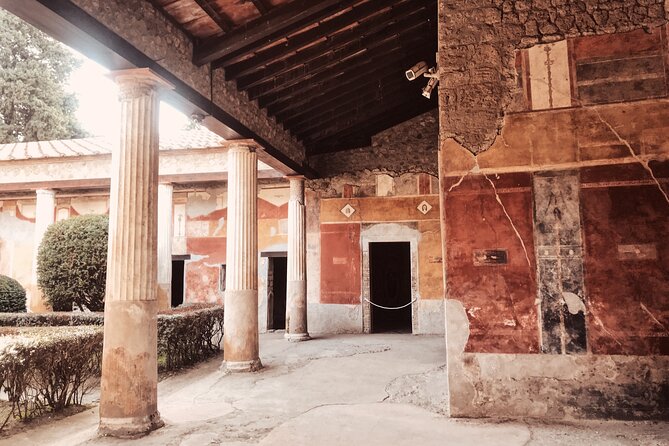
The Quadriporticus of the theaters is presented as the gladiator barracks. You see the apartments and the areas where gladiators trained.
This stop adds a human side to the entertainment buildings. The theaters were not only places where audiences sat. Performers and gladiators also needed living and training spaces nearby.
The area can help you picture the people who made public spectacles possible. A good guide can connect the rooms and training areas with the wider social structure of Pompeii, without reducing the site to a collection of dramatic stories.
The listed visit lasts about 15 minutes. That makes it a useful overview rather than a detailed examination of every room.
Lupanar and Pompeii’s less polished side
The Lupanar, or old red-light district, is one of Pompeii’s most talked-about stops. It offers a look at a side of Roman urban life that public monuments often leave out.
This visit is useful because it broadens your picture of the city. Pompeii included religion, law, family homes, entertainment, commerce, and sex work. The guide can explain the building within its social setting rather than treating it as a sensational oddity.
The stop is listed at about 15 minutes. Crowds can affect how easily you see the interior, and the space may feel tight. Keep your expectations practical: this is a brief historical visit, not a long, private examination of every detail.
Casa del Fauno, one of Pompeii’s great houses
Casa del Fauno is one of the richest and most luxurious residences in Pompeii. It gives you a clear look at how wealthy residents used architecture, decoration, courtyards, and display to express status.
This is also where a guide can help you compare social levels within the city. The route’s focus on wealthy homes, more modest spaces, public buildings, and working areas gives the two-hour visit a useful range.
The house is listed at about 15 minutes. That is enough to understand why it matters, especially when the guide points out its scale and decoration. It is not enough to absorb every room or spend long periods studying the artwork, so keep that in mind if domestic architecture is your main interest.
What the two-hour schedule really means
The route includes many stops, with most given 15 minutes and the forum about 10 minutes. In practice, this is a brisk introduction to Pompeii’s key areas.
That is a strength if you have only a few hours. You get a clear route, entrance assistance, and a guide who helps you avoid spending your visit lost among side streets. It also works well before another activity in Pompeii.
The trade-off is depth. Pompeii can occupy an entire day, and this tour cannot cover every house, temple, shop, and painted wall. Some guides may continue longer when the schedule allows, but you should book this expecting the advertised duration of about two hours.
Several visitors with children found the pace manageable, including one group with a two-and-a-half-year-old and another with an eight-year-old. A stroller may require help over difficult sections, and one guide assisted with carrying one. Still, Pompeii’s surfaces are old and uneven, so a stroller can make the visit harder.
Price, timing, and overall value
At $217.69 per person, this is not a budget way to enter Pompeii. The price includes admission, taxes and fees, an authorized guide, and the small-group service, but not food, drinks, tips, or transport.
The value depends on how you use your time. If you have only a short window, skip-the-line entry and a focused route can prevent a lot of wasted time. The archaeologist element also matters if you want more than a basic overview. You are paying for interpretation, not just access.
For a couple who wants a private visit, the extra cost created by a low group count may be hard to justify. For a family, older visitor, or anyone who prefers direct explanations and a slower question-and-answer exchange, a private arrangement may be useful if the price suits your budget.
Timing can improve the experience. One late-afternoon tour at 4 p.m. had relatively light crowds, making it easier to stop inside homes and hear the guide. Morning can be convenient, but Pompeii can be hot and exposed. Bring water, sunscreen, and a hat or umbrella. The tour requires good weather, and poor conditions can lead to a new date or a full refund.
Who should book this Pompeii tour
I would recommend it most strongly if you have two or three hours, want to see the major sights, and prefer a human explanation to a self-guided walk.
It is a good match for:
- First-time visitors to Pompeii
- Families who want a clear route and room for questions
- People interested in archaeology, architecture, and daily life
- Anyone arriving by public transport who wants an organized start
- Visitors who do not want to spend time figuring out the enormous site alone
It is less suitable if you want a full-day archaeological study, long periods inside individual houses, or the lowest possible entrance cost. Independent visitors who have already researched Pompeii may prefer to buy admission and explore at their own pace.
Should you book it?
Book this tour if the archaeologist guide is the main reason you are going. Eliana Sandretti’s background, along with the strong performances from guides such as Francesco and Dario, gives the experience more substance than a basic walk around the ruins.
Before paying, confirm the group arrangement if you are booking for only one or two people. Also check your start time, since a late afternoon visit may offer a calmer experience. If you accept the high price and short schedule, this is a practical way to meet Pompeii’s major buildings, understand the people who used them, and leave with a clear sense of the city rather than a blur of ancient stones.
FAQ
How long does the Pompeii tour last?
The tour lasts approximately two hours.
What language is the tour offered in?
The tour is offered in English.
Is admission to Pompeii included?
Yes. The entrance ticket, taxes, and fees connected with the ticket purchase are included.
Does the tour include skip-the-line access?
Yes. You receive fast-track access at the entrance and arrive with your ticket.
How large is the group?
The maximum group size is 10 people.
Where does the tour meet?
The meeting point is Ristorante Suisse at Piazza Esedra, 10/13, 80045 Pompei, Italy.
Where does the tour end?
The activity ends back at the meeting point.
Are transport, food, and drinks included?
No. Transport, food, drinks, and tips are not included.
What happens if the minimum group size is not reached?
You may be offered a different date or experience, or a full refund. The provider has also contacted some small bookings about continuing as a private tour for an additional charge. Free cancellation is available up to 24 hours before the start time, while cancellations or changes made less than 24 hours in advance are not refunded.
More Ways to See Pompeii
- Discover the Ancient Ruins of Pompeii: Day Trip from Rome
★ 3.5 · 2,247 reviews - Pompeii Ticket + Tour with Optional Tasting Experience at Pompeii
★ 5.0 · 663 reviews - Pompeii private tour with an Official Guide
★ 5.0 · 631 reviews - Sharing Tour of Pompeii
★ 5.0 · 487 reviews
Just added around Pompeii
- Wine Tasting and Winery Tour in Vesuvio National Park with Lunch★ 4.5 · 3 reviews
- Mt. Vesuvius Wine Tasting and Lunch Experience from Pompeii★ 4.5 · 20 reviews
- Wine tasting in the Vesuvius national park★ 5.0 · 3 reviews
- Traditional Neapolitan Dinner in Pompei – Villa Franca – Family Restourant★ 5.0 · 8 reviews
- Private Guided Tour and VR Headsets in the Ancient Pompeii★ 5.0 · 3 reviews
- Visit Pompeii with a local expert guide★ 5.0 · 10 reviews
- Tour Mount Vesuvius with Entry Tickets and Round Trip Transfer Included★ 3.5 · 4 reviews
- Vesuvius tour entrance to the crater and return bus★ 4.5 · 9 reviews
Pompeii Tours with an Archaeologist, compared.

Pompeii Small Group Tour with an Archaeologist
Read our review →
Pompeii and Herculaneum Small Group Tour with an Archaeologist
Read our review →
Herculaneum Small Group Tour and Ticket With an Archaeologist
Read our review →
Pompeii & Herculaneum with Archaeologist Guide
Read our review →
Pompeii Private Tour with an Archaeologist and Skip The Line – 3 hours
Read our review →
Pompeii Private Tour with an Archaeologist and Skip The Line
Read our review →Browse the lists this tour appears in