
Reviewed · POMPEII TOURS WITH AN ARCHAEOLOGIST
Pompeii and Herculaneum Small Group Tour with an Archaeologist
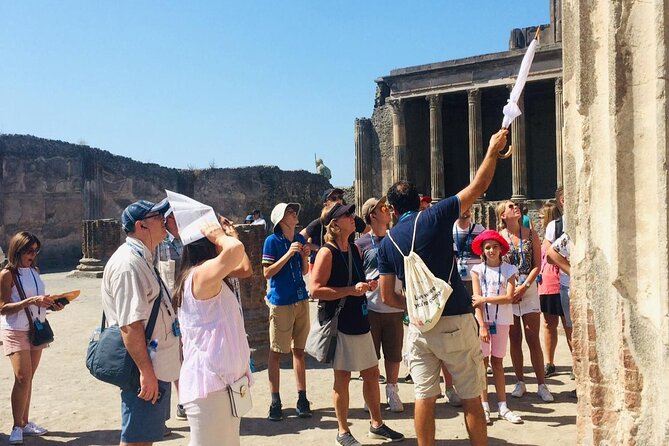
The great strength of this tour is that you see Pompeii and Herculaneum in one day, with an archaeologist explaining what maps and guidebooks often miss. You move from Pompeii’s Forum, baths, theaters, and plaster casts to Herculaneum’s carbonized wood, colorful houses, and unusually well-preserved streets.
I like the included entry tickets and transport, which remove much of the day’s fuss. I also like the guides’ focus on daily Roman life. Guides such as Michele, Michael, Diego, Paulo, and Antonio have been praised for turning walls, mosaics, shops, and baths into a readable story. The catch is pace: two hours at Pompeii is enough for major sights, but not enough for this enormous site.
Key points to know before booking
- Two archaeological sites in one day: See Pompeii’s major landmarks, then compare them with Herculaneum’s smaller but better-preserved houses.
- Archaeologist-led visits: Guides including Michele, Michael, Diego, Paulo, and Antonio explain architecture, rituals, engineering, and ordinary life.
- Transport varies by departure city: Naples, Sorrento, and Rome departures use a modern minibus, while Pompeii departures use the Circumvesuviana train to Herculaneum.
- About four hours inside the ruins: Plan for roughly two hours at each site, with a short lunch break between them.
- Lunch is not included: Bring food if you prefer, since some departures use a mall stop and the break is short.
- Best for a first look: You will see the headline sights, but Pompeii deserves a return visit if you want to explore at your own speed.
Why seeing both sites changes the story
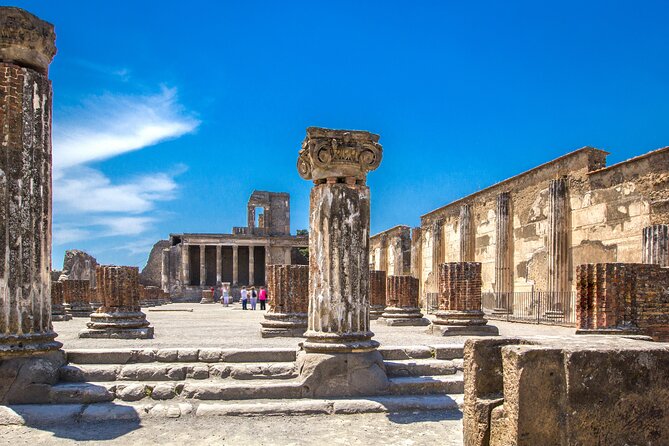
Pompeii and Herculaneum are often paired, but they do not feel like copies of one another. Pompeii is the sprawling city, with a Forum, theaters, public baths, shops, villas, and long streets that give you a sense of urban scale. Herculaneum is smaller, more compact, and often more intimate, with remarkably preserved interiors and wooden details.
That contrast is the reason I like this tour. Pompeii shows you how a whole city worked. Herculaneum lets you look closely at the homes and objects within it. In a single day, you can compare public Roman life with domestic life.
The guide matters here. Without context, a painted wall can become just another pretty wall, and a row of stone counters can be hard to read. An archaeologist can explain how rooms were arranged, why baths were built as they were, and what the remains suggest about social rank and daily habits.
The tour’s rating of 4.8 from 1,350 reviews, with 95 percent recommending it, reflects a clear pattern: the strongest part is the guiding. The experience is less suited to someone who wants hours of solitary wandering.
More Herculaneum tours:
- Private Day Tour to Vesuvius, Herculaneum & Pompeii with Pick Up
★ 5.0 · 279 reviews - The Ultimate Ruins of Pompeii and Herculaneum Private Day Trip
★ 5.0 · 103 reviews - Naples: Pompeii & Herculaneum Day Trip – Small Group Tour
★ 4.5 · 72 reviews
Pompeii starts with the city’s public heart
The Pompeii visit generally lasts about two hours. That sounds generous until you see the site’s size. You will cover major landmarks, but you should think of this as a guided introduction rather than a complete exploration.
The route begins around the Basilica and Forum. The Basilica was an open portico used for business and other activity, while the Forum was the city’s main public square. These spaces help you picture Pompeii as a working town, not simply a collection of ruined houses.
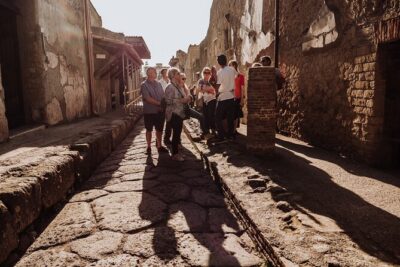
You then walk along one of Pompeii’s main streets. Look down as you go. The paving stones, raised sidewalks, and worn surfaces help explain how people moved through the city. Your guide can also point out details you might pass without noticing.
The House of Menander is one of the early highlights. It was a large, richly decorated home, and its architecture and contents suggest the status of its owner. This is where the tour begins to show the difference between public Pompeii and private Pompeii.
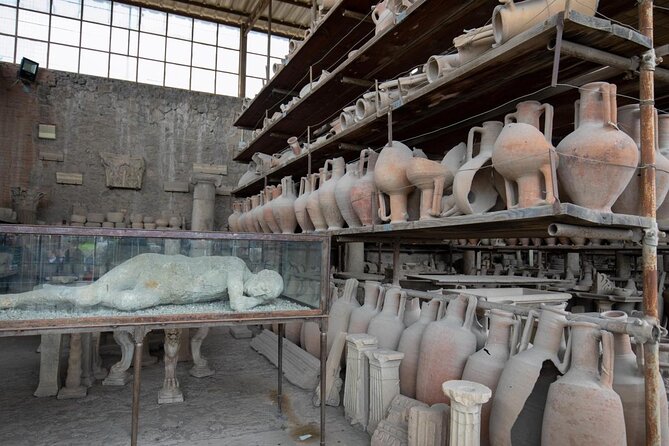
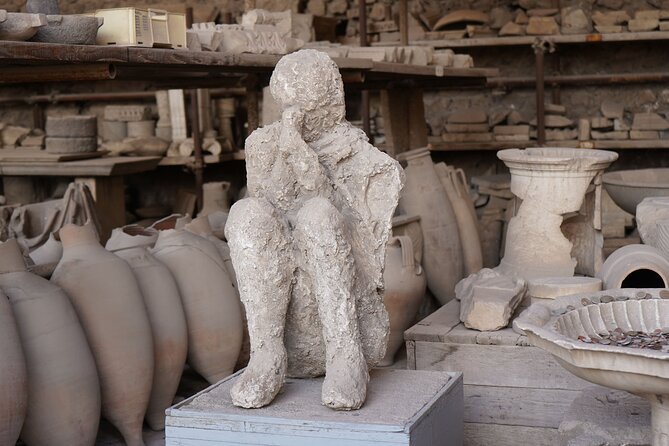
At the Forum granaries, you can see marble tables, fountain elements, and plaster casts. The casts are among Pompeii’s most affecting sights. They preserve the shapes left by victims in the ash, including human figures and a dog. They are not easy to look at, but they keep the eruption from becoming an abstract date in a history book.
Baths, brothels, and theaters make Pompeii readable
The Stabian Baths occupy a broad section of the city and are described as Pompeii’s oldest thermal complex. The layout gives you a useful look at Roman bathing culture, which was social as well as practical. Separate areas and different rooms show how much planning went into a facility that served ordinary city life.
The Lupanar, Pompeii’s most famous brothel, is a brief but memorable stop. Small rooms and painted imagery make the building unusually direct. It is also a reminder that Roman cities contained businesses and private habits that formal monuments tend to hide.
The House of the Faun is one of Pompeii’s largest and most impressive residences. Even if your visit does not cover every room, the scale helps you understand how different elite homes were from the smaller houses nearby.
You also visit the Odeon, or Teatro Piccolo, and the Teatro Grande. The smaller theater gives a sense of more intimate performances, while the larger theater was Pompeii’s main venue. Together, they show the city’s appetite for entertainment and the range of public spaces beyond the Forum.
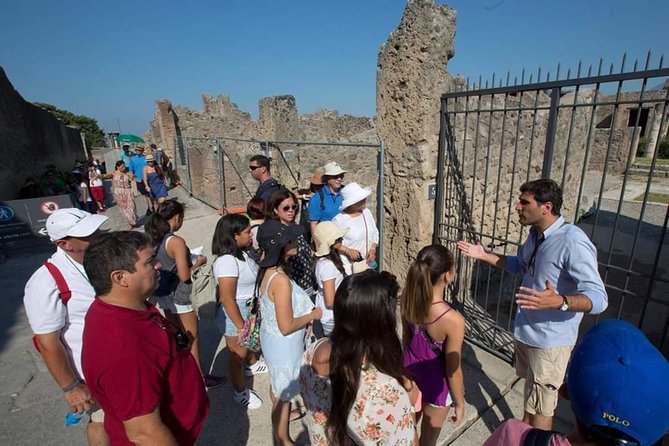
A practical warning: the Pompeii route can feel fast. The guide may keep the group moving to reach Herculaneum on schedule, and the headset lets you hear explanations without crowding around the guide. Still, headsets do not solve every problem. If the group spreads out, you can lose the signal, so stay close and pause for photos when the guide gives you an opening.
The lunch break is useful, but not the highlight
After Pompeii, you get a short break for lunch at your own cost. This is not a leisurely meal built into the experience. You have limited time before the transfer to Herculaneum.
On some departures, the stop is at a mall with several food choices, including pizza. That is practical and helps avoid the tourist traps around the Pompeii entrance, but it does not feel like part of the ancient-site experience. If atmosphere matters to you, bring a picnic or a snack. One useful tip is to buy something before boarding the train to Herculaneum, especially on the Pompeii departure, since the timetable leaves little room for an unplanned meal.
Food and drinks are not included. The short break is best treated as a chance to refuel, not as a featured stop.
More Pompeii tours led by an archaeologist:
- Pompeii Small Group Tour with an Archaeologist
★ 5.0 · 6,593 reviews - Skip the Line Guided Tour of Pompeii led by an Archaeologist
★ 5.0 · 703 reviews - Pompeii Private Tour with an Archaeologist and Skip The Line – 3 hours
★ 5.0 · 564 reviews - Pompeii Skip-the-line Tour with Archaeologist Guide
★ 5.0 · 559 reviews
Herculaneum rewards close attention
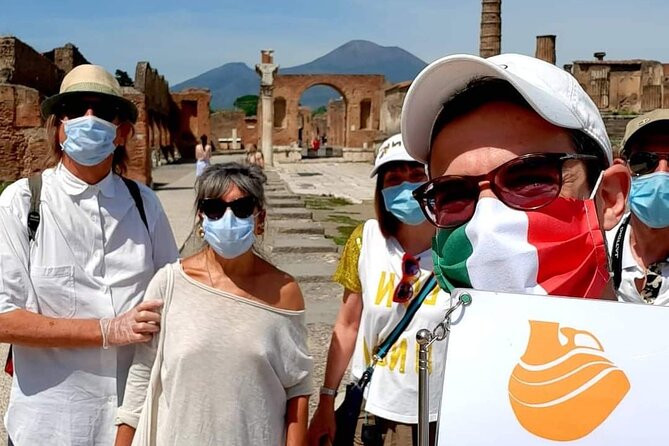
The transfer depends on where you start. From Naples, Sorrento, or Rome, you travel by modern minibus. From Pompeii, you take the Circumvesuviana train with the guide, then walk about 10 minutes from Ercolano Scavi station to the entrance. The train journey itself takes about 30 minutes.
At Herculaneum, the guide takes the group to the ticket office, using the included entry ticket. You then have about two hours inside the ruins. Herculaneum is smaller than Pompeii, so this amount of time feels more workable, though it is still a focused visit.
The House of the Deer is named for marble deer statues found in its peristyle. It gives you a look at the decorative side of an affluent Roman home. Nearby, the terrace of Marcus Nonius Balbus honors a major civic benefactor whose building projects and public honors are recorded in inscriptions.
The College of the Augustales was linked to the cult of Emperor Augustus and may also have served as a local administrative center. This stop adds political and religious context to the private houses.
The House of the Telephus Relief is unusual for its private access to the nearby Suburban Baths. Its connection with Marcus Nonius Balbus is possible rather than certain, which makes it a good place to hear how archaeology separates evidence from guesswork.
Herculaneum’s wooden details are its great reward
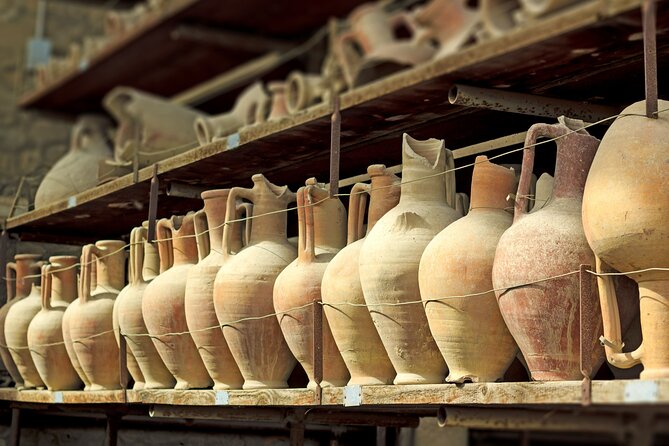
The House of the Wooden Partition is important because the elegant wooden screen survived. At Pompeii, you often concentrate on painted plaster and stone. At Herculaneum, carbonized wood gives you a sharper sense of the materials used inside Roman homes.
The House of the Skeleton takes its name from human remains found in an upper room in 1831. It may have been formed from three smaller buildings, showing how houses changed as families and property owners adapted existing structures.
The Central Baths were built around the beginning of the first century AD and had separate men’s and women’s sections. As at Pompeii, the baths are useful because they connect architecture with routine. This was part of the machinery of city life, not simply a grand monument.
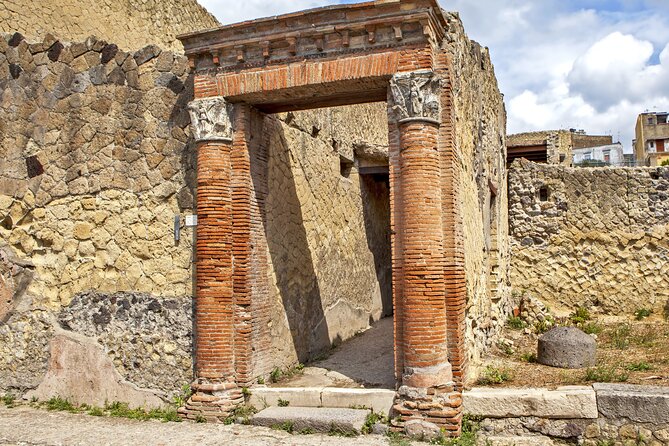
The House of the Black Hall is one of Herculaneum’s more luxurious homes. Its monumental entrance still retains carbonized doorposts and a lintel, a rare detail that makes the building feel unexpectedly close to its original form.
The Samnite House has an atrium bordered by Ionic columns and rooms decorated with frescoes. The House of the Beautiful Courtyard is especially distinctive because it uses a courtyard, stairway, and stone balcony instead of the more familiar atrium arrangement.
The House of the Grand Portal completes the route with columns, frescoes, and charred wooden remains. These details are why Herculaneum often surprises people who expected it to be merely a smaller Pompeii.
Transport options and the end of the day
The Naples option includes round-trip transport from outside Starhotels Terminus. The Sorrento option includes round-trip transport from Piazza Angelina Lauro. The Rome option includes train tickets between Rome and Naples plus full-day transport from Naples, making it a very long day, but one that avoids arranging the connections yourself.
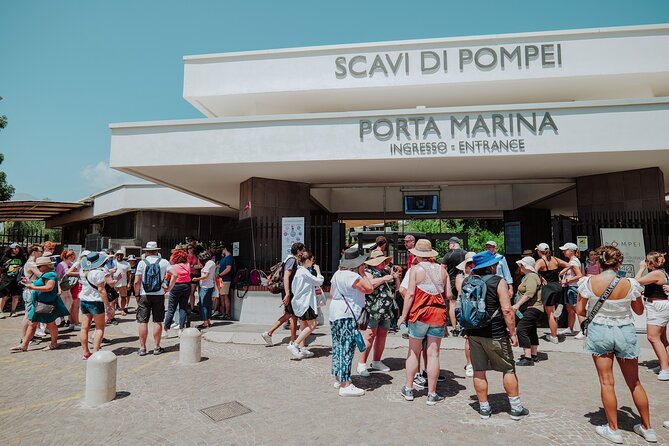
The Pompeii departure is different. You meet at Porta Marina Superiore, visit Pompeii, and then travel with the guide to Herculaneum by train. The tour ends at the Herculaneum ruins, not back at Pompeii. If you leave a car at Pompeii, you must arrange your own return. This is one of the most important details to understand before booking.
The whole experience can last from six to 11 hours, depending on the departure city and transport schedule. A Rome departure will take much longer than a Pompeii start. Groups can have up to 20 people, so this is small enough for a guided conversation but not a private tour.
Headsets are supplied for all participants. They are helpful in crowded areas and allow the guide to speak while the group stands apart, though you should keep within range.
Is the $77.09 price good value?
At $77.09 per person, the price is reasonable for a full day that includes both entry tickets, guiding at both sites, transport on the selected route, and headsets. Adult admission alone is listed as 20 euros for Pompeii and 16 euros for Herculaneum, before you add transport between cities.
The real value is the planning. You do not need to work out the transfer from Pompeii to Herculaneum, find both ticket offices, or decide which major buildings to prioritize. An archaeologist also gives you a framework for understanding what you see.
The limitation is time. You are paying for breadth and explanation, not freedom. If your ideal day involves lingering over every fresco, sitting in a theater, or returning to one house for a second look, this will feel compressed.
I would book it for a first visit, especially if you are based in Naples or Sorrento and want an efficient introduction. I would skip it if you already know both sites well or strongly prefer independent exploration.
Who will enjoy this tour most?
This tour suits you if:
- You want to see both sites in one day.
- You value an archaeologist’s explanation more than free time.
- You are staying in Naples, Sorrento, Rome, or Pompeii and want transport arranged.
- You prefer a planned route through large archaeological areas.
- You are interested in architecture, engineering, art, religion, and ordinary Roman life.
It is less suitable if you need a slow pace or extended time for photography. The tour is also not recommended for guests with visual impairments unless accompanied by a dedicated personal assistant.
Guides have different personalities, but names praised in connection with this experience include Michele, Michael, Diego, Paulo, Antonio, Alfredo, Amadeo, Gianni, Tomas, and Vince. You cannot select a particular guide from the information provided, but the repeated strength of the tour is the archaeologist-led commentary and willingness to answer questions.
Free cancellation is available up to 24 hours before the start time. Changes or cancellations inside that window are not accepted for a refund.
My verdict: book it for context, not spare time
I would recommend this tour to most first-time visitors who want Pompeii and Herculaneum explained in one well-organized day. The combination is excellent, the entry fees are included, and the guides can make ancient streets and houses far easier to understand.
Go in expecting a brisk highlight tour. Bring water and a snack, wear shoes suited to uneven archaeological paths, stay near the guide when using the headset, and make a note of your return plan if you begin in Pompeii.
If you have only one day, this is a strong way to use it. If you have two days, use this tour for orientation, then return to Pompeii on your own for the slower visit it deserves.
FAQ
How long does the Pompeii and Herculaneum tour last?
The experience lasts approximately six to 11 hours. The exact length depends on your departure city and transport arrangement.
How much time do I spend at each archaeological site?
The guided visit generally includes about two hours at Pompeii and two hours at Herculaneum.
Are admission tickets included?
Yes. Entry to both Pompeii and Herculaneum is included. The listed adult prices are 20 euros for Pompeii and 16 euros for Herculaneum.
Is transportation included?
Yes, but it depends on your selected departure. Naples, Sorrento, and Rome options use a modern minibus for the day’s transport. The Pompeii option includes a one-way Circumvesuviana train ticket to Herculaneum.
Where do I meet the guide?
Pompeii departures meet at Porta Marina Superiore. Naples and Rome departures meet outside Starhotels Terminus. Sorrento departures meet at Piazza Angelina Lauro.
Is lunch included?
No. Meals and drinks are not included. A short lunch break is provided, and you pay for your own food.
Does the tour return me to Pompeii after Herculaneum?
No. For the Pompeii departure, the tour ends at the Herculaneum ruins. You must arrange your own return to Pompeii.
What language is the tour offered in?
The tour is offered in English.
Can I cancel for a full refund?
Yes, if you cancel at least 24 hours before the experience start time. Cancellations made less than 24 hours before the start time are not refunded.
More Ways to See Pompeii
- Discover the Ancient Ruins of Pompeii: Day Trip from Rome
★ 3.5 · 2,247 reviews - Pompeii Ticket + Tour with Optional Tasting Experience at Pompeii
★ 5.0 · 663 reviews - Pompeii private tour with an Official Guide
★ 5.0 · 631 reviews - Explore Pompeii with an Archaeologist
★ 5.0 · 511 reviews
Just added around Pompeii
- Wine Tasting and Winery Tour in Vesuvio National Park with Lunch★ 4.5 · 3 reviews
- Mt. Vesuvius Wine Tasting and Lunch Experience from Pompeii★ 4.5 · 20 reviews
- Wine tasting in the Vesuvius national park★ 5.0 · 3 reviews
- Traditional Neapolitan Dinner in Pompei – Villa Franca – Family Restourant★ 5.0 · 8 reviews
- Private Guided Tour and VR Headsets in the Ancient Pompeii★ 5.0 · 3 reviews
- Visit Pompeii with a local expert guide★ 5.0 · 10 reviews
- Tour Mount Vesuvius with Entry Tickets and Round Trip Transfer Included★ 3.5 · 4 reviews
- Vesuvius tour entrance to the crater and return bus★ 4.5 · 9 reviews
Pompeii Tours with an Archaeologist, compared.

Pompeii Small Group Tour with an Archaeologist
Read our review →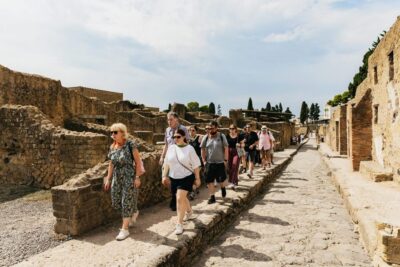
Herculaneum Small Group Tour and Ticket With an Archaeologist
Read our review →
Pompeii & Herculaneum with Archaeologist Guide
Read our review →
Pompeii Private Tour with an Archaeologist and Skip The Line – 3 hours
Read our review →
Pompeii Private Tour with an Archaeologist and Skip The Line
Read our review →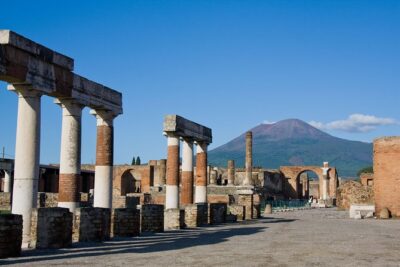
Pompeii 2h Small-Group Tour with Expert Archaeologist
Read our review →Browse the lists this tour appears in