
Reviewed · POMPEII TOURS WITH AN ARCHAEOLOGIST
PompeiI Exclusive Tour with your Archaeologist in a Small Group
Pompeii is far too large and layered to understand by simply wandering through its broken streets. This two-hour guided visit gives you a clear route through the ancient city, from the Forum and temples to bathhouses, shops, homes, and the theater, while an archaeology guide explains what you are actually seeing.
I like two things right away: the group is limited to 15 people, and the guides focus on how archaeologists know what happened here, not just on dates and names. Guides such as Ricardo, Raffaele, Antonio, Ornella, and PierLuigi are repeatedly praised for clear explanations and lively storytelling. The main drawback is that the advertised price of $30.25 does not include the €19 Pompeii admission ticket, and two hours cannot cover every major area.
Key points to know before booking
- Archaeologist-led explanations: You get more than a walk past ruins. The guide explains Roman buildings, daily life, excavation methods, and the evidence behind the stories.
- A compact route through the essentials: The tour links the western entrance, temples, Forum, food shops, baths, homes, Via dell’Abbondanza, and theater.
- Small group, up to 15 people: This is easier to hear and more personal than a large guide-led procession.
- Plaster casts at the Macellum: You may see the famous casts created from cavities left by victims of the eruption.
- Extra admission cost: The tour fee covers the guide, but Pompeii Park admission is separate at €19 per adult. Admission is free for children under 18.
- Comfortable shoes matter: Pompeii’s ancient streets are uneven, and the route involves steady walking.
Why Pompeii makes a guide worth the money
Pompeii can look simple at first glance: walls, columns, painted fragments, and broad stone streets. The real interest lies in working out what each space was for, how people used it, and what small clues tell archaeologists about Roman life.
A guide can point out the difference between a temple, basilica, bath, shop, private house, and public square. The best moments come when the guide explains not only what a building was, but how its function has been established. Ricardo, for example, is praised for connecting archaeology with everyday language, Roman culture, and the roots of common words.
I would not choose this tour because it covers every corner of Pompeii. It does not. I would choose it because it gives you a useful framework in two hours, then leaves you better prepared to explore alone.
The experience is offered in English and has a maximum group size of 15. Some groups have been around 12 people, though one account describes a larger group than expected, so I would treat 15 as the firm advertised limit rather than assume a private outing.
More Pompeii tours led by an archaeologist:
- Pompeii Small Group Tour with an Archaeologist
★ 5.0 · 6,593 reviews - Pompeii and Herculaneum Small Group Tour with an Archaeologist
★ 5.0 · 1,350 reviews - Skip the Line Guided Tour of Pompeii led by an Archaeologist
★ 5.0 · 703 reviews
Meeting at Porta Marina Superiore
The guide waits outside the archaeological park at Via Villa dei Misteri, 1, near Porta Marina Superiore, holding a Pompeii Vip sign. Check the sign carefully before joining the group.
Porta Marina is the western entrance to ancient Pompeii. Its name comes from the road that once led toward the sea. That detail immediately helps you see Pompeii as a functioning city connected to its surroundings, rather than as an isolated ruin.
The tour begins outside the entrance, and the guide helps with the park ticket process. You receive a link the afternoon before the tour to purchase a skip-the-line admission ticket online. The tour booking itself is not the admission ticket, so do not arrive assuming the $30.25 fee gets you inside.
The park ticket costs €19 per adult, while admission is free for children under 18. The separate charge makes the total cost higher than the headline price, but the guide fee remains reasonable if you value interpretation and a planned route.
Venus, the Basilica, and the road to the Forum
The first stops lead you through some of Pompeii’s most important public and religious spaces. At the Temple of Venus, the guide introduces the goddess who served as Pompeii’s patron. The temple’s position near the western entrance makes it a useful first lesson in the city’s religious and civic organization.
Next comes the Basilica, one of the most important buildings around the Forum. It was used for business management and legal matters, and it was among the Forum’s most lavish structures. This is a good place to hear how public life worked in a Roman town.
The Sanctuary of Apollo is one of Pompeii’s oldest worship sites. Its position along the route from Porta Marina to the city center shows how religious buildings were woven into the main movement of the city.
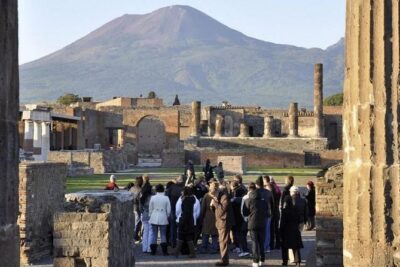
The tour then reaches Pompeii’s Forum, the main square and the center of daily public life. This is one of the moments when a guide helps most. The open space can be difficult to read without context, but the surrounding temples, civic buildings, and raised viewpoints begin to form a picture of how people gathered, traded, worshiped, and handled public business.
The Temple of Jupiter and the view toward Vesuvius
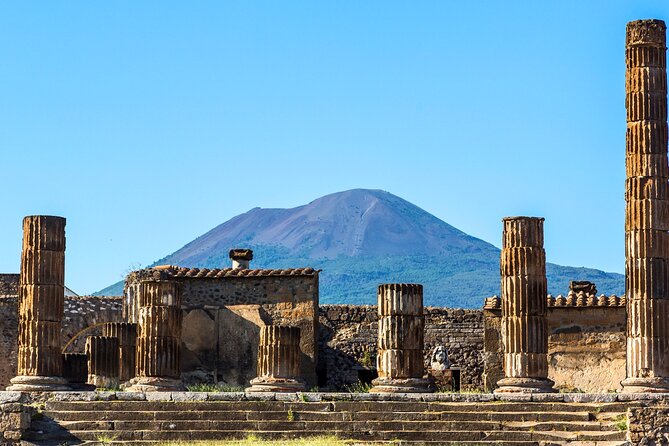
The Temple of Jupiter dominates the northern side of the Forum. Behind it, Vesuvius rises dramatically, linking the ancient city to the eruption that buried it.
The view is not just a photo opportunity. It gives the disaster a physical setting. Pompeii was not destroyed in an abstract historical episode. The volcano is right there, beyond the rooftops and columns, and the guide can connect the setting to the city’s final days.
The Forum area can be exposed to sun, wind, and rain. One guide, Raphael Romano, is praised for using covered shelters during wet weather while continuing the explanation. Still, bring sensible protection for the forecast, since this is an outdoor site and the tour depends on good weather.
More ways to see Pompeii:
- Discover the Ancient Ruins of Pompeii: Day Trip from Rome
★ 3.5 · 2,247 reviews - Pompeii Ticket + Tour with Optional Tasting Experience at Pompeii
★ 5.0 · 663 reviews - Pompeii private tour with an Official Guide
★ 5.0 · 631 reviews - Pompeii Private Tour with an Archaeologist and Skip The Line – 3 hours
★ 5.0 · 564 reviews
Food, trade, and the plaster casts
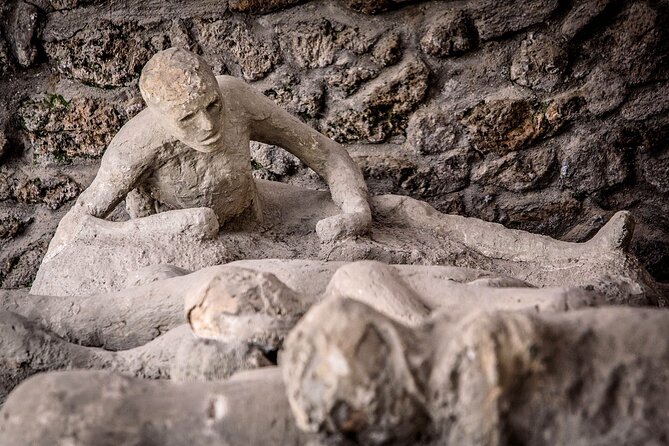
At the Macellum, Pompeii’s monumental food market, the guide shifts from politics and religion to shopping and daily needs. The building was used for the sale of food and other everyday goods, giving you a more ordinary view of Roman life.
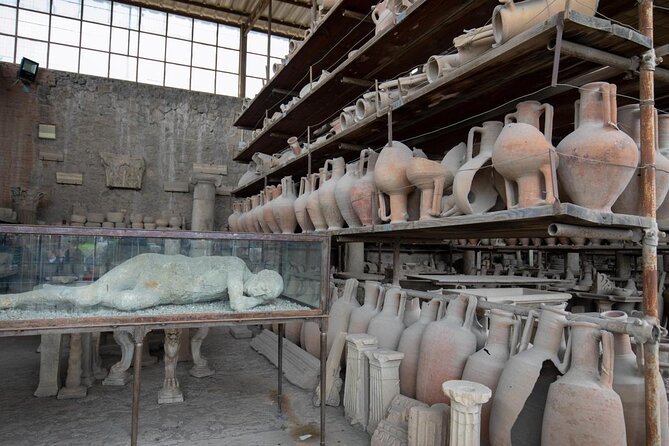
This is also where you may see plaster casts of victims from the eruption. The casts were made by filling cavities left in hardened volcanic material where bodies had decomposed. The result can be emotionally difficult, but it is one of the clearest reminders that Pompeii was a living city, not just an architectural site.
The strength of an archaeologist-led explanation is especially clear here. You can ask how the casts were made and what evidence allows archaeologists to reconstruct the final moments. The focus is not only on tragedy, but also on the methods used to study it.
Forum Baths and the ancient thermopolium
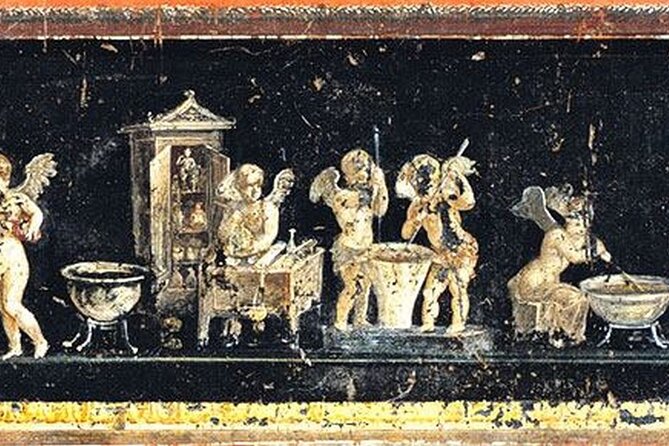
The Forum Baths are among Pompeii’s best-preserved structures. Separate entrances served the women’s and men’s sections, and the surviving rooms help explain how bathing worked as both a practical and social part of Roman life.
The details can be easy to miss without a guide. Look for how rooms connect, how the building was organized, and how the surviving structure differs from the open public spaces outside.
The Thermopolium of Vetuzio Placido offers another change of scale. This was an old refreshment shop, similar to a diner, where residents could buy food and drink. After temples, legal buildings, and public squares, this stop brings you closer to the ordinary rhythm of eating and shopping.
I like this part of the route because it keeps Pompeii from becoming a parade of grand monuments. Ancient cities were made of small businesses and daily errands as much as temples and theaters.
The House of the Faun and the House of the Vettii
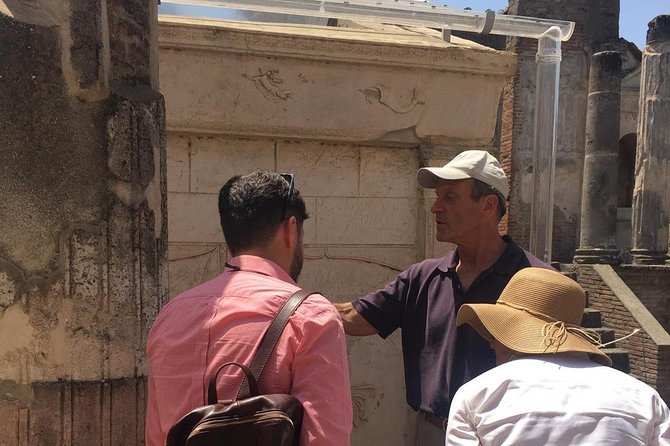
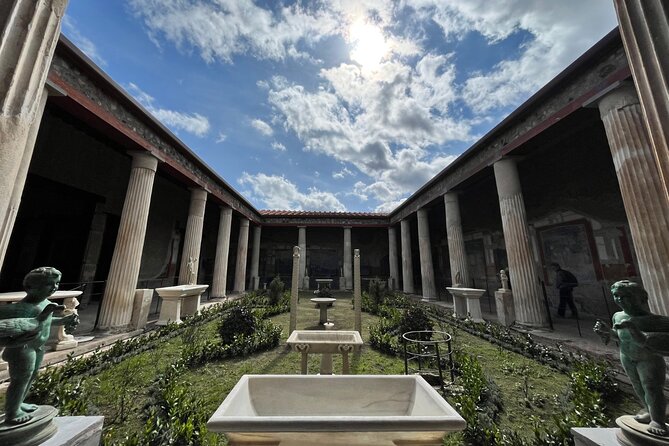
The House of the Faun is one of Pompeii’s largest private residences. Its sidewalk carries the Latin greeting HAVE, a small but memorable detail that makes the ancient street feel surprisingly personal.
The House of the Vettii is another famous residence, associated with wealth and protected by Priapus, the god of prosperity. Both houses are subject to seasonal opening and closing, so you should not assume that every scheduled visit will include entry into both.
That is an important limitation. The itinerary names these homes as part of the route, but access inside can change. If one is closed, the guide can still explain its role and architecture from the available areas, but you may not see every room or decoration.
The home stops also show why a two-hour tour is selective. Pompeii has many residences, shops, temples, and streets. You get representative examples rather than a full survey.
Via dell’Abbondanza and the theater
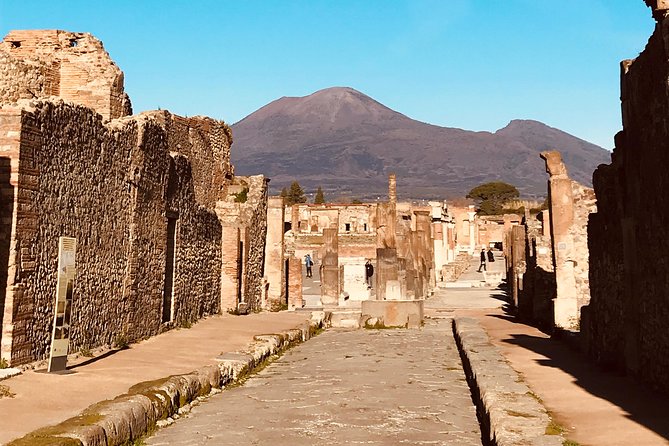
Via dell’Abbondanza was the ancient city’s main street, known as the decumanus maximus. Walking along it helps connect the separate stops. You can imagine homes, shops, workshops, and public buildings linked by a busy urban route.
The street is also where comfortable shoes become essential. Pompeii’s surfaces can be rough and uneven, and you will be walking rather than simply standing in one plaza. Good footwear will make the final part of the tour much more enjoyable.
The route ends at the Teatro Grande, where comedies and tragedies were performed in the Greco-Roman tradition. The theater gives the tour a fitting close because it brings together architecture, entertainment, and community life.
One practical point: the tour ends back at the meeting point, so you should not plan a separate pickup at the theater. Afterward, you can continue exploring Pompeii on your own if you still have energy and a valid park admission.
The guides make the difference
The strongest feature of this experience is the quality of the guiding. Ricardo is praised for answering questions and explaining the evidence behind archaeological conclusions. Raffaele is described as friendly, clear, and deeply interested in the subject. Antonio is noted for mixing humor with detailed explanations and for shaping part of the final half hour around group interests.
Ornella receives especially warm praise for storytelling, patience, and the ability to make Roman life feel close and understandable. PierLuigi is also described as giving a thoughtful two-hour visit that continued to prompt reflection afterward.
Names and guide assignments can change, so you cannot book with a guarantee of one particular person unless the operator confirms it. The consistent point is that the experience depends heavily on who leads the group and how well the guide handles questions, pace, and crowd conditions.
One piece of criticism concerns an earphone that did not work and was not replaced. Another account found some repeated explanations. These are not reasons to reject the tour, but they are useful reminders to speak up quickly if you cannot hear or if your audio equipment fails.
Some guides speak loudly and clearly without earphones. Others may use audio equipment, particularly when the site is noisy. Test the device at the start and ask for help immediately if the sound is poor.
Is the $30.25 fee good value?
The headline price is attractive for a two-hour specialist-led visit, but the real calculation includes the €19 adult park ticket. You should also account for the fact that the tour does not cover every major section of Pompeii.
I think the price is fair for three reasons. First, Pompeii is large enough that a poor route can waste time. Second, an archaeologist can explain evidence and building use in a way an audio guide may not. Third, the small group allows questions and makes it easier to stay with the guide.
The value is weaker if you want a long independent exploration or a private itinerary. One two-hour account specifically notes that the amphitheater and brothels were not included, and another points out that Pompeii is too large to cover fully in this format.
Think of this as an orientation tour, not a complete day at the park. It gives you the main civic center and a useful selection of homes, businesses, religious sites, and public facilities. You can then explore more on your own.
Who should book this Pompeii tour?
I would recommend it to first-time visitors, families, and anyone who wants the site to make sense without doing extensive preparation. The tour has worked well for families with children aged 11 and 14, partly because the guides use stories, questions, humor, and clear explanations rather than delivering a dry lecture.
It also suits people arriving from Naples who want a focused visit rather than an all-day archaeological expedition. Two hours is long enough to learn a great deal, but short enough to fit into a wider day.
History buffs may enjoy it too, especially if you ask about excavation techniques, changing interpretations, and the evidence behind the plaster casts. If you already know Pompeii well, you may prefer a longer or more specialized visit.
Plan for sun, wind, or rain, and wear sturdy walking shoes. The tour requires good weather, and cancellation is free up to 24 hours before the start time. If bad weather or insufficient enrollment cancels the experience, you are offered another date or a full refund.
Should you book it?
Book this tour if you want a clear, human explanation of Pompeii and prefer seeing the most important areas in a small group. The guides are the main reason to choose it, especially if you can ask questions and enjoy learning how archaeologists interpret the remains.
Skip it if your priority is the amphitheater, brothels, or distant sections of the park, since those are not guaranteed on this route. In that case, use this as a starting point and leave extra time to continue exploring independently.
For most first visits, I think the combination of an archaeologist, a manageable group, and a tightly planned route gives you good value. Just budget for the separate admission ticket and arrive ready to walk.
FAQ
How long does the Pompeii tour last?
The tour lasts approximately two hours.
Is the Pompeii admission ticket included?
No. The tour price does not include admission to Pompeii Archaeological Park. The adult ticket costs €19, and admission is free for children under 18.
How do I find the guide?
Meet at Via Villa dei Misteri, 1, outside the archaeological park near Porta Marina Superiore. The guide waits with a sign reading Pompeii Vip.
What language is the tour offered in?
The tour is offered in English.
How large is the tour group?
The advertised maximum is 15 people.
Can I cancel for a refund?
Yes. You can cancel at least 24 hours before the start time for a full refund. Cancellations or changes made less than 24 hours before the tour are not accepted.
Just added around Pompeii
- Wine Tasting and Winery Tour in Vesuvio National Park with Lunch★ 4.5 · 3 reviews
- Mt. Vesuvius Wine Tasting and Lunch Experience from Pompeii★ 4.5 · 20 reviews
- Wine tasting in the Vesuvius national park★ 5.0 · 3 reviews
- Private Guided Tour and VR Headsets in the Ancient Pompeii★ 5.0 · 3 reviews
- Visit Pompeii with a local expert guide★ 5.0 · 10 reviews
- Traditional Neapolitan Dinner in Pompei – Villa Franca – Family Restourant★ 5.0 · 8 reviews
- Tour Mount Vesuvius with Entry Tickets and Round Trip Transfer Included★ 3.5 · 4 reviews
- Vesuvius tour entrance to the crater and return bus★ 4.5 · 9 reviews
Pompeii Tours with an Archaeologist, compared.
Pompeii Small Group Tour with an Archaeologist
Read our review →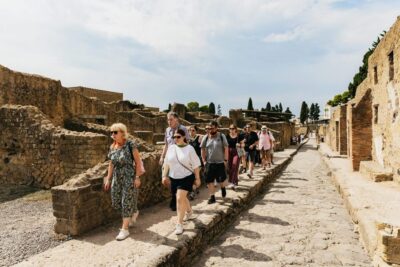
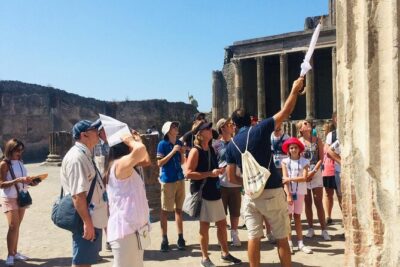
Pompeii and Herculaneum Small Group Tour with an Archaeologist
Read our review →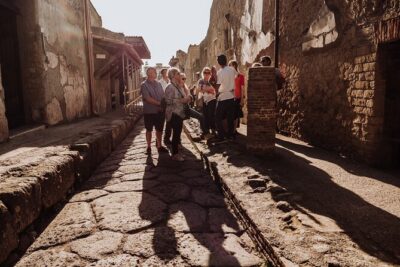
Herculaneum Small Group Tour and Ticket With an Archaeologist
Read our review →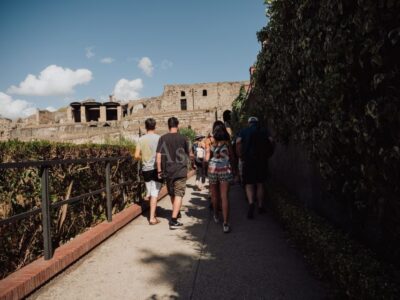
Pompeii & Herculaneum with Archaeologist Guide
Read our review →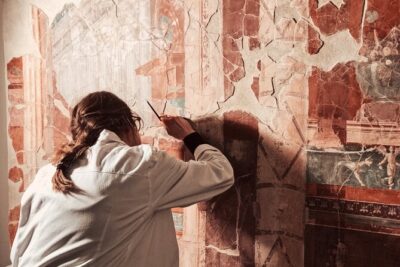
Pompeii Private Tour with an Archaeologist and Skip The Line – 3 hours
Read our review →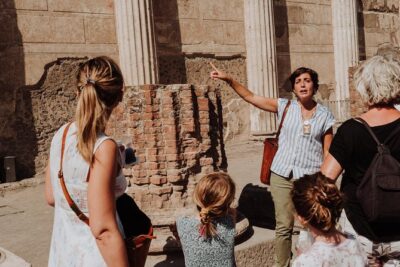
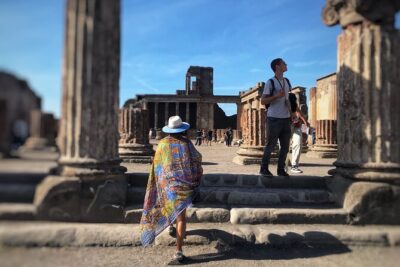
Pompeii Private Tour with an Archaeologist and Skip The Line
Read our review →Browse the lists this tour appears in