
Reviewed · SKIP-THE-LINE TICKETS IN POMPEII
Pompeii tour with LOCAL GUIDE and SKIP THE LINE entrance
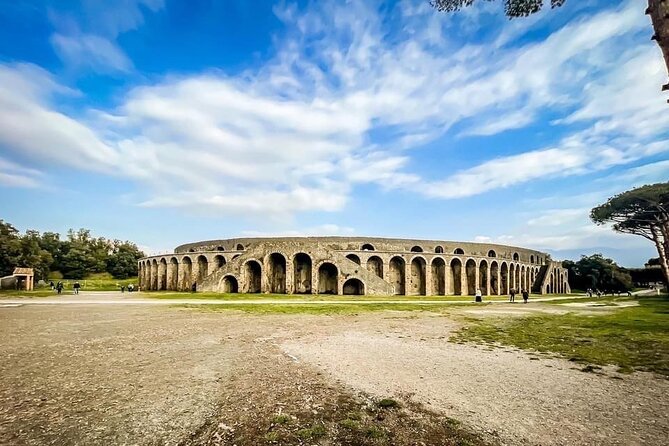
Pompeii is not a tidy collection of ruins behind glass. It is a full Roman city, with streets, homes, shops, baths, public squares, and intimate traces of ordinary life still in place. This tour takes you through that frozen city with a local guide, using priority entry so you spend more time inside and less time waiting at the gate.
I like two things here: the small group, capped at 14 people, and the chance to remain in the archaeological park after the guided walk. Guides such as Gennaro, Antonio, Anna, and Sasa bring different personalities to the experience, with several praised for making Pompeii clear and engaging for both adults and children.
The main drawback is time. The experience lasts about two and a half hours, but the guided portion is roughly two hours, and Pompeii is far too large to see properly in that span. If this is a once-in-a-lifetime visit, a four-hour tour may suit you better.
Key points at a glance
- Priority entry near the station: Meet at Via Villa dei Misteri, a few meters from Pompeii’s station and car parks.
- A small group of up to 14: This is more personal than a large crowd, though headphones are not included.
- Essential Pompeii sights: Visit the Forum, Casa del Menandro, the Lupanar, and Stabian Baths.
- Guides with strong personal reviews: Gennaro, Antonio, Anna, and Sasa are among the guides named for clear explanations and warm service.
- Time to continue alone: After the guided walk, you can remain inside the excavations.
- Good value for a short visit: At $66.38 per person, the price covers admission and an authorized guide, but not an extended exploration.
Why Pompeii works best with a guide
Pompeii can look like a maze of stone walls if you walk in without context. A guide helps you see the difference between a private home, a public building, a bath complex, and a commercial space. The result is less about staring at old walls and more about picturing a functioning Roman town.
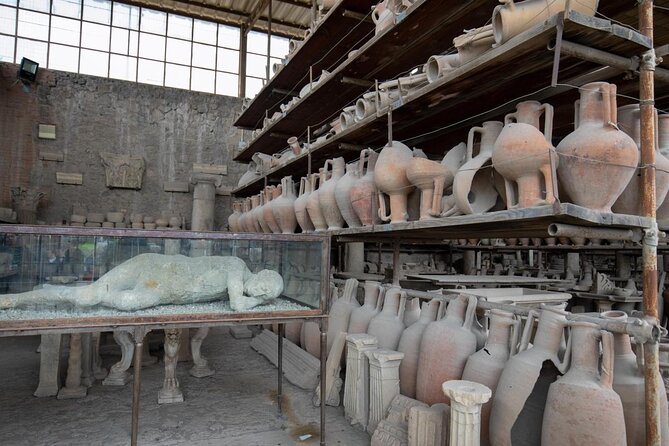
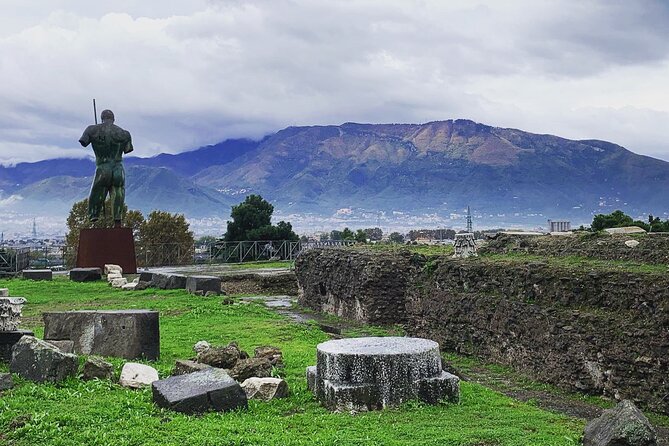
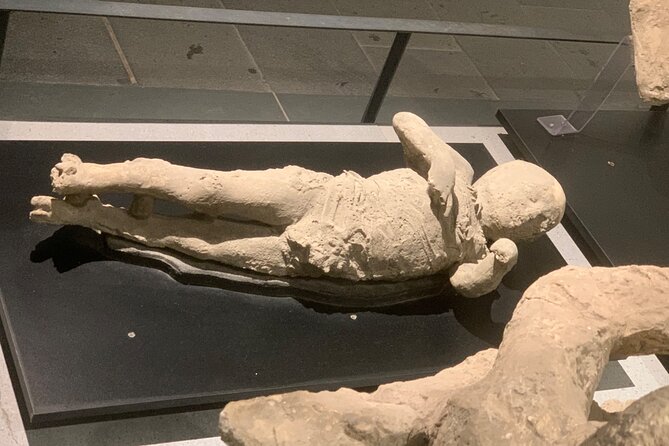
The city was buried by the eruption of Vesuvius in AD 79. Volcanic ash covered streets and buildings, preserving details that normally disappear over time. Excavation began in the 18th century, and about 75 percent of the city has now been uncovered.
I find Pompeii most effective when the guide connects grand monuments with small details. A forum tells you how the city was governed and where business happened. A dining room, silverware hoard, or erotic wall painting shows how people lived behind the public face of Rome.
That is the strength of this experience. You are not simply handed an entrance ticket. An authorized local guide leads the way and explains what you are seeing as the ruins unfold around you.
More Guided Tours in Pompeii
- Skip the Line Guided Tour of Pompeii led by an Archaeologist
★ 5.0 · 703 reviews - Pompeii private tour with an Official Guide
★ 5.0 · 631 reviews - Pompeii Skip-the-line Tour with Archaeologist Guide
★ 5.0 · 559 reviews
Meeting at Via Villa dei Misteri
The tour begins at Via Villa dei Misteri, 3, near the entrance to the archaeological park. The meeting point is also close to the station and car parks, which matters if you are arriving by public transport or car.
The operator describes the meeting location as a few meters from the station and parking areas, but communication about the exact place has been confusing for some people. I would check the booking messages carefully and keep your phone available before departure. One family nearly arrived late because the meeting instructions were unclear.
The mobile ticket is useful, and confirmation is provided when you book. The service is offered in English. Service animals are allowed, and most people can participate.
This is a shared tour, not a private one, with a maximum of 14 people. That size should allow the guide to answer questions and keep the group moving without the feel of a huge organized crowd. Still, headphones are not included, so stay close if the guide is speaking in an open area or near other groups.
Entering Pompeii with priority access
The ticket includes admission to the Archaeological Park and priority service for entry. This can save useful time, especially when the entrance is busy. Priority entry does not make Pompeii itself small, though. Once inside, you still need to walk between the sites and keep pace with the group.
The main guided visit is listed at about two hours, with the full experience lasting approximately two and a half hours. The difference likely allows time for meeting, entry, and the end of the guided route. You should not think of this as a full-day exploration.
The short format has one clear advantage: it gives you a focused introduction. If you have limited time in Pompeii, you will see several major areas without having to plan the route yourself. The tradeoff is that many other streets, villas, and buildings will remain for another visit.
Casa del Menandro and the life of a wealthy family
Casa del Menandro is one of the more revealing stops because it shows how a prosperous Roman family lived. The large house went through several building phases and includes an atrium decorated with scenes from the Iliad and Odyssey.
Its name comes from a portrait of Menander, an Athenian playwright, placed in the porch. That detail is a useful reminder that Roman households displayed Greek culture as part of their education and status.
The house also contains a rhodium-style peristyle, with the northern side built higher than the others. You do not need to remember the architectural term to appreciate the design. The point is that this was not a simple shelter. It was a carefully arranged home built for comfort, display, and social life.
Below the house was a small thermal area and an underground room that may have been a cellar. Archaeologists found a chest containing 118 pieces of silverware, hidden before restoration work began. The collection is now in Naples, but the story gives the house a human edge. Someone packed away the family’s banquet service, expecting to return.
On the southern side, the rustic quarter includes a reconstruction of a wagon. This helps connect the elegant rooms with the working side of the household. The stop lasts about 15 minutes, so your guide will need to select the most useful details rather than explain every architectural feature.
More Skip-the-Line Tickets in Pompeii
- Pompeii Private Tour with an Archaeologist and Skip The Line – 3 hours
★ 5.0 · 564 reviews - Pompeii Private Tour with an Archaeologist and Skip The Line
★ 5.0 · 391 reviews - Complete Pompeii Skip the Line Tour with Archaeologist Guide
★ 4.5 · 379 reviews - Ancient Pompeii Private Tour: Skip the Line & Kid-Friendly Option
★ 5.0 · 167 reviews
The Lupanar and Pompeii’s frank side
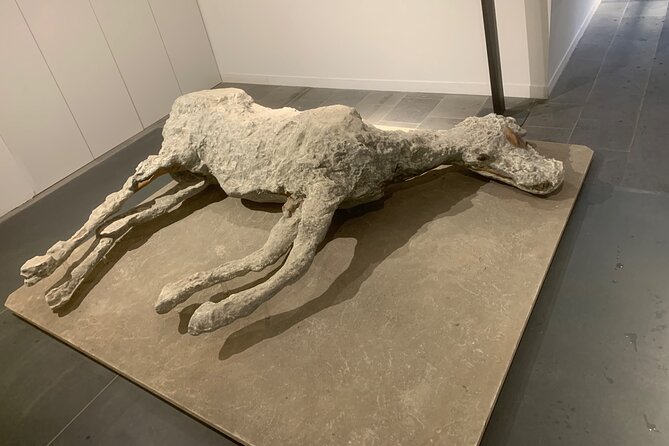
The Lupanar is one of Pompeii’s most talked-about buildings. It was a brothel with five small rooms on the ground floor, each fitted with a built-in bed. Curtains closed the rooms, and a latrine sits under the stairwell at the end of the corridor.
Erotic paintings on the walls showed customers what services were available. The prostitutes were mostly Greek and Eastern slaves, and the prices ranged from two to eight asses. A cup of wine cost one ass, giving you a rough sense of the business.
This is a brief stop of about ten minutes, and the rooms are small. You may encounter a queue or a crowd inside, so the guide’s explanation is especially useful. The building is not just a sensational stop. It also raises uncomfortable questions about slavery, sex, class, and daily commerce in Roman society.
The route includes the Lupanar twice in the supplied schedule. In practice, you should expect attention to this part of Pompeii’s social life, though the exact order or amount of time may vary. If you prefer a longer historical discussion, ask the guide questions while the group is nearby.
The Forum, where public Pompeii came together
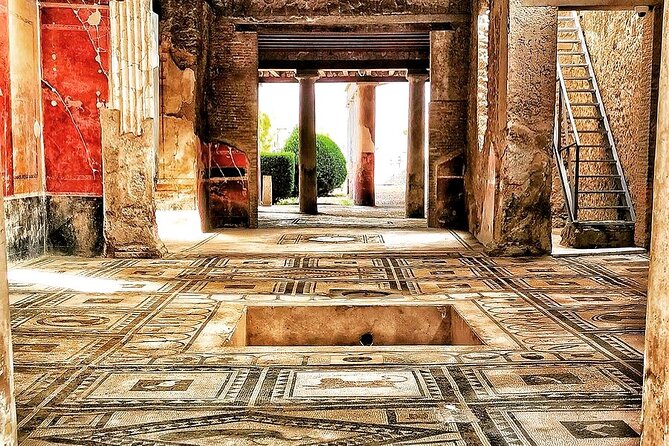
The Forum was the center of civic life. Government buildings, courts, business offices, shops, and religious sites surrounded the square. This is where Pompeii’s public identity comes into focus.
The square began as a fairly simple open area with a packed-earth surface. The Sanctuary of Apollo occupied the western side, while shops lined the eastern side. Major changes took place in the third and second centuries BC, when the square was regularized, surrounded by arcades, and paved with tuff.
Later, in the early imperial period, the Forum received travertine paving. Some paving slabs still show recesses made for bronze letters from a large inscription. The Temple of Jupiter was set along the axis of the square, facing in the direction of Vesuvius.
Your guide can make this broad open area easier to read. Without explanation, it is easy to miss how the buildings once worked together. With context, the Forum becomes the place where politics, religion, money, justice, and public life met.
The scheduled visit is about 20 minutes. That is enough for orientation and a strong overview, not a detailed study of every building around the square.
The Stabian Baths and Roman daily routine
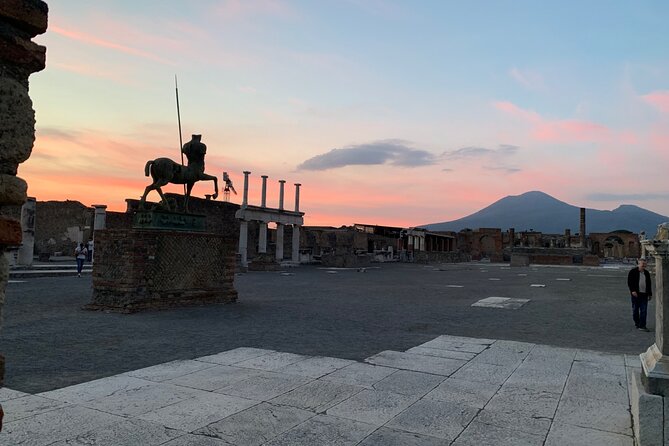
The Stabian Baths are the oldest thermal complex in Pompeii of their kind. The building was buried in the eruption and later uncovered through archaeological work.
Roman baths were not simply places to wash. They were part of daily social life, and a bath complex helps you picture a routine shared by many parts of the population. The tour gives you about ten minutes here, so expect a quick explanation of the complex rather than a room-by-room examination.
I like this stop because it balances the wealth of Casa del Menandro and the public scale of the Forum. Pompeii becomes easier to understand when you move between a private house, a commercial building, a civic square, and a public bath.
What the guide adds

The guides named in the feedback bring different strengths. Gennaro is described as friendly, funny, and highly informed, with a gift for explaining how Pompeii’s residents lived. Antonio is noted for connecting with children and making the ruins interesting to younger minds.
Anna is praised for her patience after a delayed arrival caused by train navigation problems. She took time to explain the ruins and connect with the group. Sasa is described as informative and helpful, though one person felt the short tour did not allow enough time to see the site.
The praise is strongest for the human side of the guiding. A good Pompeii guide does not merely recite dates. The guide explains what a room was for, who used it, and how the city functioned before the eruption.
The group size helps, but you should still stay near the guide. Since headphones are not included, it can be harder to hear in wide spaces or when several groups gather in the same area.
Is $66.38 good value?
At $66.38 per person, the cost includes the entrance ticket, priority entry, an authorized local guide, and the guided route. You are paying for interpretation and convenience, not just access to the ruins.
For a first visit lasting about two and a half hours, that is a reasonable package if you want someone else to handle the route and explain the main sights. Priority entry adds value when the entrance is busy, and the small group is more appealing than a large coach-style tour.
The price is less attractive if you already know Pompeii well or want to explore at your own pace. The short duration means you may still want several additional hours inside the park. Since you can stay after the tour, the ticket becomes more useful if you have the energy and time to continue alone.
I would compare this with longer options before booking. One person who considered the visit a major bucket-list experience felt that two hours was not enough and recommended a four-hour guided tour with headphones. That is fair advice. Pompeii rewards extra time.
Who should book this Pompeii tour?
I would choose this tour if you want a clear introduction, priority entry, and a local guide without committing to a long half-day program. It suits first-time visitors who want to see the major highlights and learn how to read the ruins.
Families may also appreciate the format. Antonio’s ability to connect with children is a useful sign, and the focused route can help younger visitors avoid an exhausting march through the entire park.
I would think twice if Pompeii is a top priority of your Italy trip and you want detailed coverage. In that case, choose a longer private or small-group experience if available. You can also use this tour as an introduction, then remain inside to explore further, but the guided portion will not cover the whole city.
The activity is non-refundable and cannot normally be changed after booking. If poor weather makes the tour unsafe, or if the minimum number is not met, a different date or a full refund is offered. Keep your phone on before the tour, since weather-related changes may be communicated close to the start.
Should you book it?
Book this Pompeii tour if you value a local guide, priority entry, and a focused route through the Forum, Casa del Menandro, Lupanar, and Stabian Baths. The $66.38 price is fair for a short guided introduction, especially with a group capped at 14.
Do not book it expecting to see all of Pompeii. If you have only one chance to visit and want the fullest possible experience, choose a longer tour. If you want a well-organized starting point and the freedom to keep exploring afterward, this is a practical choice.
FAQ
How long does the Pompeii tour last?
The experience lasts approximately two hours and 30 minutes. The guided visit itself is described as about two hours, and you may remain inside the archaeological park after the guided tour ends.
What is included in the price?
The price includes the Pompeii entrance ticket, priority service for entry, an authorized local guide, and the listed Time Machine experience. Tips are not included.
Where does the tour begin?
The meeting point is Via Villa dei Misteri, 3, 80045 Pompei, Italy. It is near the archaeological park entrance, the station, and car parks.
What places does the tour visit?
The route includes the Archaeological Park of Pompeii, Casa del Menandro, the Lupanar, the Forum of Pompeii, and the Stabian Baths. The schedule lists the Lupanar twice.
How large is the group?
The activity allows a maximum of 14 participants. The service is offered in English, and headphones are not listed as an included feature.
Can I stay in Pompeii after the tour?
Yes. After the guided tour ends, you may remain inside the excavations and continue exploring on your own.
More Ways to See Pompeii
- Pompeii Small Group Tour with an Archaeologist
★ 5.0 · 6,593 reviews - Discover the Ancient Ruins of Pompeii: Day Trip from Rome
★ 3.5 · 2,247 reviews - Pompeii and Herculaneum Small Group Tour with an Archaeologist
★ 5.0 · 1,350 reviews - Pompeii Ticket + Tour with Optional Tasting Experience at Pompeii
★ 5.0 · 663 reviews
Just added around Pompeii
- Wine Tasting and Winery Tour in Vesuvio National Park with Lunch★ 4.5 · 3 reviews
- Mt. Vesuvius Wine Tasting and Lunch Experience from Pompeii★ 4.5 · 20 reviews
- Wine tasting in the Vesuvius national park★ 5.0 · 3 reviews
- Traditional Neapolitan Dinner in Pompei – Villa Franca – Family Restourant★ 5.0 · 8 reviews
- Private Guided Tour and VR Headsets in the Ancient Pompeii★ 5.0 · 3 reviews
- Visit Pompeii with a local expert guide★ 5.0 · 10 reviews
- Tour Mount Vesuvius with Entry Tickets and Round Trip Transfer Included★ 3.5 · 4 reviews
- Vesuvius tour entrance to the crater and return bus★ 4.5 · 9 reviews
Skip-the-Line Tickets in Pompeii, compared.
Pompeii Private Tour with an Archaeologist and Skip The Line – 3 hours
Read our review →
Pompeii Private Tour with an Archaeologist and Skip The Line
Read our review →
Complete Pompeii Skip the Line Tour with Archaeologist Guide
Read our review →
Ancient Pompeii Private Tour: Skip the Line & Kid-Friendly Option
Read our review →

Pompeii small group tour with skip-the-line entrance included
Read our review →
Pompeii Skip-the-Line Entry Small Group Guided Tour
Read our review →
Skip-the-Line Half-Day Private Tour Ancient Pompeii Highlights with Native Guide
Read our review →Browse the lists this tour appears in