
Reviewed · SKIP-THE-LINE TICKETS IN POMPEII
Ancient Pompeii Private Tour: Skip the Line & Kid-Friendly Option
Pompeii is easiest to understand when someone helps you read its streets, shops, homes, and public buildings as parts of one vanished city. This private walking tour focuses on the main sights, from the Forum and Temple of Apollo to the House of the Vettii and the plaster casts of eruption victims.
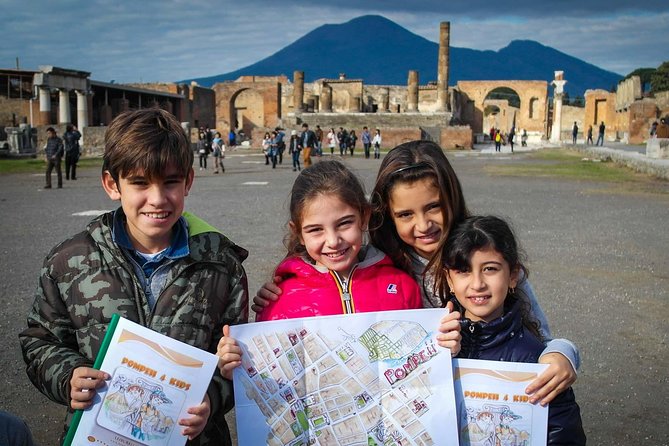
I like the one-guide-for-your-group format, which lets you ask questions and adjust the pace. I also like the family option, with puzzles, stickers, games, and a special map for children. The main caution is the heat and the rough, open-air walking route. One review also described a guide moving too fast for people with mobility problems, so discuss your pace at the start.
Key points to know before booking
- The Forum and Via dell’Abbondanza anchor the visit: You see Pompeii’s political center and its busiest ancient street.
- Private guiding makes the ruins readable: Your guide can explain what a building did, who used it, and how daily life worked.
- The family option is more than a shorter tour: Children ages 6 to 11 receive activities, stickers, puzzles, and a map tied to the buildings they visit.
- The House of the Vettii is a major highlight: Its restored rooms and wall paintings show how wealthy freedmen displayed their success.
- The tour covers a lot in about two hours: Expect steady walking, uneven surfaces, sun, and little shade in some areas.
- Check the ticket wording carefully: The tour information says admission is included in one place, but also says entry fees are not included and tickets can be bought quickly at the site.
Why a private Pompeii guide makes sense
Pompeii is not a single monument. It is a large Roman town with streets, temples, businesses, baths, theaters, houses, public offices, and religious buildings spread across an archaeological park. Without context, you can look at a wall, a column, or a shop counter and miss what made it important.
A private guide gives you a human explanation as you walk. Guides such as Francesca, Natalia, Fabrizio, Viviana, Anna, and Alfredo have received especially warm praise for clear storytelling, patience with children, and the ability to adjust the route. Names are not guaranteed, so you cannot request a particular person with certainty, but the guide quality is a major part of the experience.
The private format also helps if your group has mixed interests. You can ask for more detail about Roman politics, domestic life, architecture, religion, or the eruption. If your children are tiring, you can spend less time in one area and keep moving.
The advertised duration is about two hours. That is enough for the headline sights, but Pompeii is large. You will not see every house or street. Treat this as a strong introduction, not a complete day at the site.
More Private Tours in Pompeii
- Pompeii private tour with an Official Guide
★ 5.0 · 631 reviews - Pompeii Private Tour with an Archaeologist and Skip The Line – 3 hours
★ 5.0 · 564 reviews - Visit in Pompeii – Pompeii Private Tour with Ada
★ 5.0 · 436 reviews
Entering Pompeii through Porta Marina
You meet your guide at Via Villa dei Misteri, 2, near the archaeological park. The tour returns to this same meeting point, and hotel pickup and drop-off are not included. The location is near public transportation, but you will need to arrange your own way there.
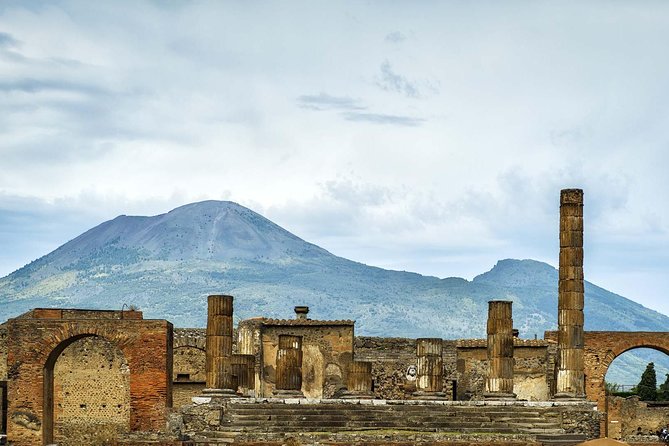
The opening orientation covers Mount Vesuvius and the eruption of AD 79. The eruption buried Pompeii in ash and volcanic material, preserving an unusually detailed record of Roman town life. The city had about 20,000 residents, and the remains show far more than grand temples. They reveal kitchens, shops, public toilets, streets, wall paintings, mosaics, and ordinary working spaces.
The route can include the city walls and Porta Marina, one of the old gateways toward the harbor. This is a useful place to picture Pompeii as a working port town rather than a collection of ruins. Your guide can also point out how the city was organized and how people moved through it.
Wear good walking shoes. The ancient paving is uneven, and the route includes exposed streets and open courtyards. Summer heat can make the same two-hour walk feel much longer, so an early start is sensible. One family said an 11 a.m. visit became hot by the end, while a morning departure would have been preferable.
The Forum, Basilica, and Temple of Apollo
The Forum was Pompeii’s main political, religious, and commercial square. It is a broad pedestrian plaza, roughly 157 by 38 meters, where wheeled traffic was not allowed. Your guide can use the surrounding buildings to explain how public business, worship, trade, and civic life came together here.
The Forum is visually impressive, but its meaning is not always obvious from the stones alone. A guide can point out the buildings around the square and explain how Roman public space worked. You will also learn about Pompeii’s political system and the roles played by local officials.
At the southwestern end is the Basilica, one of the city’s oldest major public buildings. It dates from the second century BC and once served legal and commercial purposes. Its scale helps you understand that Pompeii was a serious urban center, not a small village preserved by accident.
The Temple of Apollo is one of Pompeii’s oldest religious sites, with roots reaching back to the sixth century BC. Its raised platform, broad staircase, and portico with 48 columns make it easy to recognize. Bronze replicas of Apollo and Diana are displayed here, while the original Hellenistic bronzes are held in Naples.
These stops are relatively brief in the planned route. That is useful if you want a broad overview, but you may want to tell your guide if you prefer fewer locations with more time for questions.
Via dell’Abbondanza and Pompeii’s everyday streets
Via dell’Abbondanza is Pompeii’s longest and most important street. It ran from the Forum toward the Sarno Gate and served as a commercial and social route through the city.
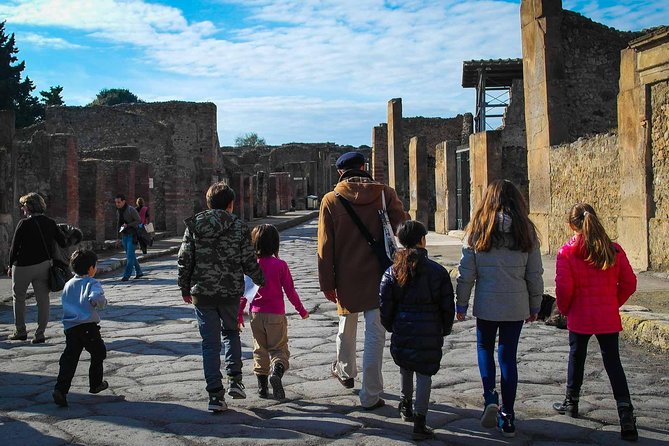
Walking here gives you some of the clearest clues about daily life. You can see storefronts, house entrances, paving stones, and the famous raised stepping-stones used to cross streets. These blocks helped people avoid muddy or dirty water in the roadway while allowing carts to pass between them.
The tour also points out an ancient fast-food counter. Large storage jars were built into the counter for serving food and drink. It is one of the most relatable sights in Pompeii because it connects a modern habit with a Roman one: not everyone cooked every meal at home.
Your guide may also show public weighing scales and explain how goods were measured and sold. Details like these are where a private tour earns its keep. You are not just looking at old stone. You are seeing how food, trade, traffic, and household life worked.
More Skip-the-Line Tickets in Pompeii
- Skip the Line Guided Tour of Pompeii led by an Archaeologist
★ 5.0 · 703 reviews - Pompeii Skip-the-line Tour with Archaeologist Guide
★ 5.0 · 559 reviews - Pompeii Private Tour with an Archaeologist and Skip The Line
★ 5.0 · 391 reviews - Complete Pompeii Skip the Line Tour with Archaeologist Guide
★ 4.5 · 379 reviews
The Forum Baths and Roman bathing culture
The Forum Baths were built around 80 BC and were still operating when Vesuvius erupted. The complex preserves the familiar Roman bathing sequence: the Apodyterium for changing, the Frigidarium for cold water, the Tepidarium for a warm room, and the Calidarium for hot bathing.
The rooms are notable for their barrel-vaulted ceilings, stucco decoration, and terracotta figures called telamones. Even if you are not especially interested in ancient plumbing, the baths make Roman engineering and social customs easier to picture.
Baths were not simply places to wash. They were part of public life and leisure. Your guide can explain how the heating system worked and how the different rooms fit together. This is a compact stop, but one of the best for understanding the practical side of Roman civilization.
Some surfaces and passages may feel tight or uneven. Keep your group together and avoid rushing through the rooms, especially if anyone needs extra time on steps or rough paving.
The House of the Vettii and Pompeii’s private homes
The House of the Vettii is among the most rewarding residential buildings on the route. It reopened in 2023 after a 20-year restoration and is often treated as one of Pompeii’s finest houses.
The home belonged to Aulus Vettius Conviva and Aulus Vettius Restitutus, two former slaves who became wealthy wine merchants. Their house was designed to display their new social position. That detail adds an important human angle: Pompeii’s wealth was not limited to old aristocratic families.
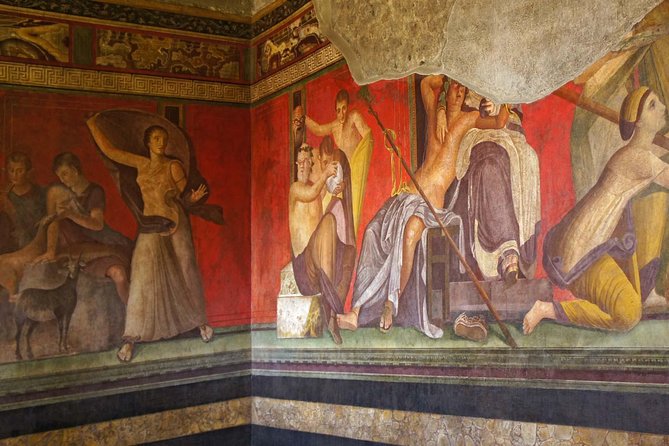
Inside, you can see colorful wall paintings, floor mosaics, and carefully arranged rooms. The decoration is not just pretty. It tells you how homeowners used art, gardens, rooms, and entrances to present themselves to visitors.
The restored condition makes this stop especially valuable, but access to individual buildings can vary. Archaeological sites sometimes close areas for preservation or maintenance. Your guide will direct you to the best available route on the day.
Other private homes may also be included among the highlights. These houses help balance the grand public buildings. You see where people lived, received visitors, stored goods, and displayed family status.
The Large Theatre and Pompeii’s public entertainment
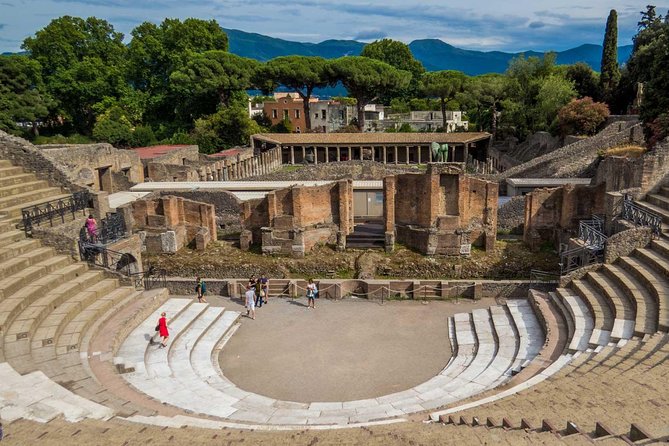
The Teatro Grande is one of the world’s oldest surviving masonry theaters. Built in the second century BC and carved into a natural lava hillside, it shows how Greek design ideas were adapted for Roman use.
The theater is a good place to discuss entertainment in Pompeii. Performances were not a minor side activity. A large theater helped define the social life of the city and brought people together across class lines.
The planned stop here is short, so you may mainly see the shape, seating, stage area, and setting. If theater architecture interests you, ask your guide for extra explanation. If you are visiting with children, the theater also offers an easy visual break after the denser Forum and bath stops.
The route can include another old brothel, a subject that often catches children’s attention for obvious reasons. Guides generally use it to explain Roman social customs and the difference between public and private life. Parents can decide how much detail suits their children.
The Antiquarium and the plaster casts
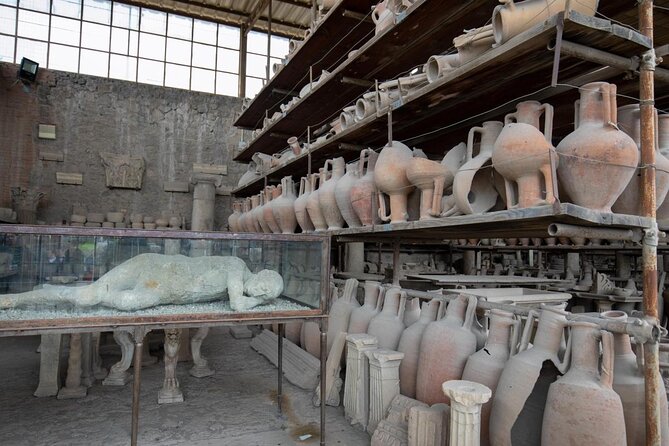
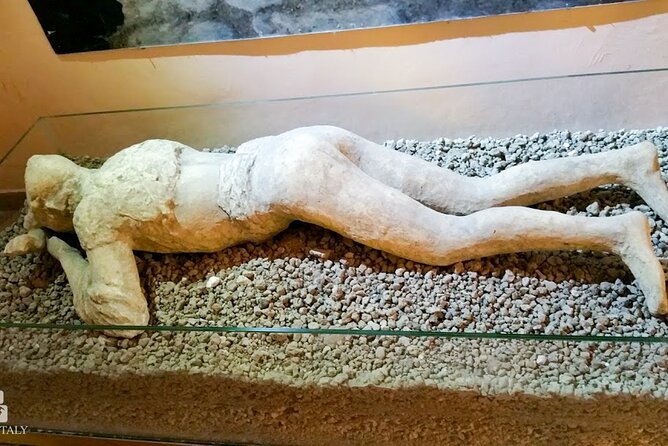
The Antiquarium is a climate-controlled museum within the Pompeii complex. It holds delicate and important finds from the city, including several plaster casts of people caught in the eruption.
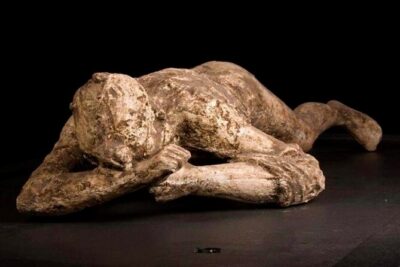
The casts are among the most emotional parts of the visit. They show the final positions of victims, including children. Their presence changes the tone of the tour. Pompeii is not only about buildings and ancient technology. It is also about people who lost their lives suddenly.
Some casts remain around the archaeological site, while the Antiquarium offers a protected setting for others. Your guide can explain how the casts were made from cavities left in the hardened volcanic material. You may want to prepare young children in advance, since this stop can be upsetting.
This is a good place to slow down. The Forum and streets can feel busy and visually crowded with details, while the museum gives you time to consider the human cost of the eruption.
The family option for children ages 6 to 11
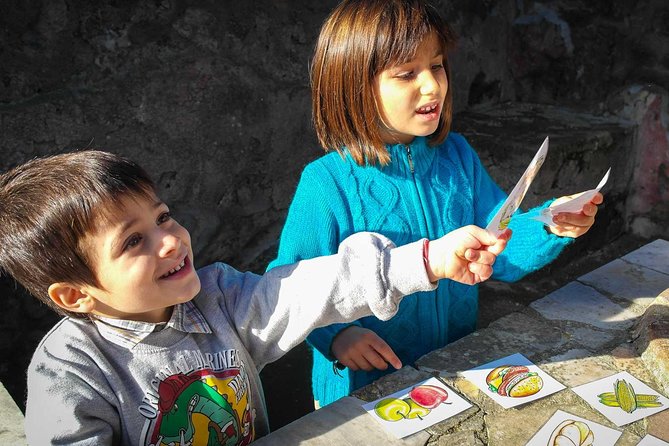
The family tour keeps the same main sights but changes the way they are presented. Children receive a Pompeii4kids kit with a map, stickers, activities, and an activity book. The guide uses puzzles and short games to connect people from ancient society with the buildings they visit.
For example, children may identify where a gladiator, actor, slave, politician, or another character would have worked or lived, then place the matching sticker on the map. This turns the route into a series of small discoveries rather than a long lesson.
The family option has worked well for children from about 5 to 15 in different groups, although the formal recommendation is for children ages 6 to 11. Guides including Francesca, Sabrina, Viviana, Natalia, Anna, and Fabrizio have been praised for keeping children involved while still giving adults substantial historical detail.
This is not a separate amusement activity. You still visit the Forum, streets, baths, homes, theater, and casts. The difference is the pace and the tools used to explain them.
Price, timing, and practical value
The listed price is $165.05 per person. For a private tour, that price can make sense if your group values personal attention, flexible explanations, and a route shaped around your interests. It is less attractive if you prefer to wander independently or plan to spend most of the day exploring beyond the main sights.
The tour includes a Blue Badge private guide and mobile booking. The supplied information gives conflicting details about admission fees. One section says admission is included, while another says fees are not included and explains that the guide can buy tickets quickly at the site using the fast-track line. Confirm the exact ticket arrangement before paying, since this affects the real cost.
The fast-track access still matters during busy periods. It does not turn Pompeii into a quiet museum, but it can reduce time spent waiting. The private guide may also help your group avoid crowded areas, as Nandor and Francesca were especially praised for doing.
Plan for moderate physical fitness. You will walk on ancient paving, cross open spaces, and spend much of the visit standing. Good shoes, water, sun protection, and an early start are practical choices. A current valid passport is required on the day for children under 18.
Free cancellation is available up to 24 hours before the start time. Changes or cancellations inside that window are not accepted for a refund.
Should you book this Pompeii tour?
Book it if you want Pompeii explained rather than simply photographed. It is particularly useful for families, first-time visitors, and anyone who wants the Forum, baths, homes, theater, and victim casts organized into a clear story.
The family option is worth serious consideration if you have children. The map, stickers, games, and flexible storytelling give young minds something to do while the adults learn. For the best balance of comfort and attention, book an early time and tell the guide about your group’s walking pace.
Skip it if you prefer several unstructured hours among the ruins, or if your budget is tight and you are comfortable reading the site on your own. Also confirm the admission fee before booking.
For most families and first-time visitors, this is a strong introduction to Pompeii. The private format, engaging guides, and child-focused materials make the ancient city easier to understand without stripping away its serious side.
FAQ
How long does the private Pompeii tour last?
The tour lasts approximately two hours.
Where does the tour begin?
The meeting point is Via Villa dei Misteri, 2, 80045 Pompei, Italy.
Where does the tour end?
The tour ends back at the original meeting point.
Is hotel pickup or drop-off included?
No. Pickup and drop-off are not included.
Is the tour private?
Yes. Only your group participates in the activity.
Is the tour offered in English?
Yes. English is the listed tour language.
What does the family option include?
The family option includes a Pompeii4kids kit with a map, stickers, activities, and an activity book. The guide also uses games and a route designed for children.
Are entrance fees included?
The supplied tour details are inconsistent. One section lists admission as included, while another says admission fees are not included and explains that the guide can buy tickets quickly at the site. Confirm this point before booking.
Can I cancel for a full refund?
Yes, if you cancel at least 24 hours before the experience start time. Cancellations or changes made less than 24 hours in advance are not accepted for a refund.
More Ways to See Pompeii
- Pompeii Small Group Tour with an Archaeologist
★ 5.0 · 6,593 reviews - Discover the Ancient Ruins of Pompeii: Day Trip from Rome
★ 3.5 · 2,247 reviews - Pompeii and Herculaneum Small Group Tour with an Archaeologist
★ 5.0 · 1,350 reviews - Pompeii Ticket + Tour with Optional Tasting Experience at Pompeii
★ 5.0 · 663 reviews
Just added around Pompeii
- Wine Tasting and Winery Tour in Vesuvio National Park with Lunch★ 4.5 · 3 reviews
- Mt. Vesuvius Wine Tasting and Lunch Experience from Pompeii★ 4.5 · 20 reviews
- Wine tasting in the Vesuvius national park★ 5.0 · 3 reviews
- Traditional Neapolitan Dinner in Pompei – Villa Franca – Family Restourant★ 5.0 · 8 reviews
- Private Guided Tour and VR Headsets in the Ancient Pompeii★ 5.0 · 3 reviews
- Visit Pompeii with a local expert guide★ 5.0 · 10 reviews
- Tour Mount Vesuvius with Entry Tickets and Round Trip Transfer Included★ 3.5 · 4 reviews
- Vesuvius tour entrance to the crater and return bus★ 4.5 · 9 reviews
Skip-the-Line Tickets in Pompeii, compared.
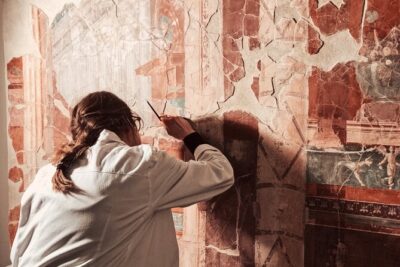
Pompeii Private Tour with an Archaeologist and Skip The Line – 3 hours
Read our review →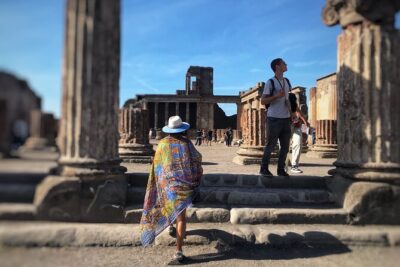
Pompeii Private Tour with an Archaeologist and Skip The Line
Read our review →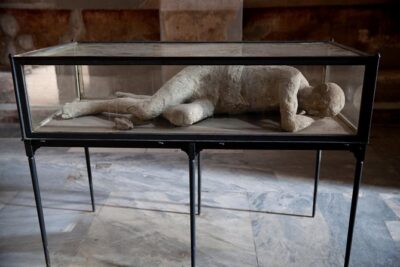
Complete Pompeii Skip the Line Tour with Archaeologist Guide
Read our review →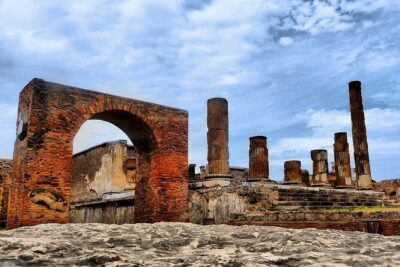
Pompeii small group tour with skip-the-line entrance included
Read our review →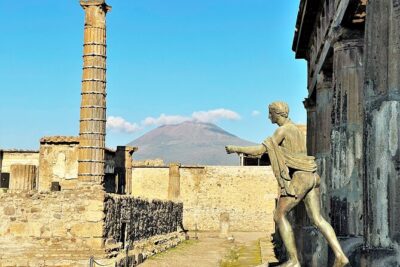
Pompeii Skip-the-Line Entry Small Group Guided Tour
Read our review →
Skip-the-Line Half-Day Private Tour Ancient Pompeii Highlights with Native Guide
Read our review →
Pompeii Small Group with an Archaeologist and Skip The Line
Read our review →Browse the lists this tour appears in