
Reviewed · GUIDED TOURS IN POMPEII
Pompeii: Guided Tour with Priority Entrance
Pompeii is not a single ruined building. It is a whole Roman city, and the best moment comes when you stop seeing scattered stones and begin to understand how its streets, shops, baths, temples, and homes worked together. This tour takes you through the main public areas with priority admission and an English-speaking guide.
I especially like the headsets, which let you hear the guide over the noise of a busy archaeological site, and the route through Via dell’Abbondanza, where shops, snack bars, and workshops once lined the city’s main street. The guide also adds useful context to sights that can otherwise look like piles of masonry.
The main drawback is pace. Pompeii is enormous, but this tour lasts about two and a half hours, with some schedules describing roughly two hours inside the ruins. Crowds, heat, uneven paving, and occasional delays at individual buildings can limit how much you see.
Key points to know before booking
- Priority entry saves time: You avoid the ordinary admission process, though priority access does not guarantee that every entrance line will disappear.
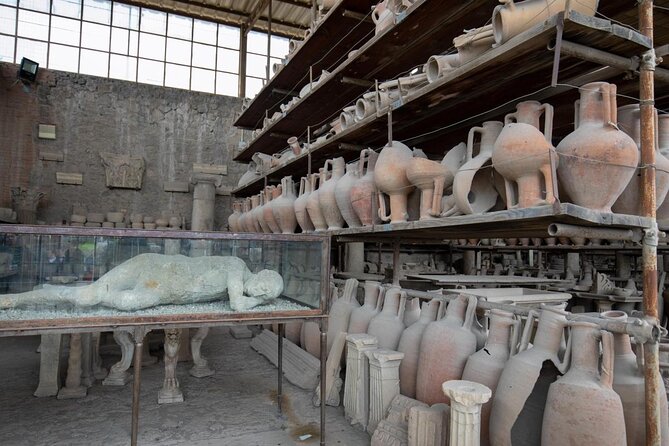
- The route covers major highlights: Expect the Forum, Temple of Jupiter, Macellum, Via dell’Abbondanza, baths, Lupanar, House of the Faun, theater, and Basilica.
- Headsets help in a crowd: They are supplied for groups larger than 10, and they make it easier to hear while standing several steps away from the guide.
- The morning is cooler: A 9 a.m. start can mean less heat and fewer crowds, while a later afternoon departure may feel quieter on some days.
- Wear serious walking shoes: Pompeii’s ancient streets are uneven, and the site involves long periods of walking and standing.
- Guide quality matters: Guides named in past tours include Max, Vincenzo, Giulia, Claudio, Viviana, and Anarita, though your assigned guide can vary.
Why a guided Pompeii visit helps
Pompeii is one of those places where a guide can change the entire experience. Without context, you may see a temple, a courtyard, or a line of columns and move on. With an explanation of how the space was used, the city begins to feel practical and lived-in.
This tour focuses on the heart of ancient Pompeii rather than trying to march across every corner of the archaeological park. That is a sensible choice for a first visit. You get an introduction to public life, religion, commerce, entertainment, bathing, and private homes in one outing.
The guide is licensed, the tour is offered in English, and the group can reach up to 25 people. That is small enough to stay reasonably together, but it is not a private tour. The strongest experiences come when the guide keeps a steady pace and uses the headset system well.
Past guides such as Max and Vincenzo have been praised for clear explanations and humor, while Giulia and Claudio have been noted for adding archaeological and historical context. Names are not guaranteed, but these examples show the sort of guide you want: someone who explains daily life, not just dates and names.
More Guided Tours in Pompeii
- Skip the Line Guided Tour of Pompeii led by an Archaeologist
★ 5.0 · 703 reviews - Pompeii private tour with an Official Guide
★ 5.0 · 631 reviews - Pompeii Skip-the-line Tour with Archaeologist Guide
★ 5.0 · 559 reviews
Meeting at Camping Zeus near Porta Marina
The meeting point is at Camping Zeus, Via Villa dei Misteri 3, near the Pompeii ruins. The tour returns to this same meeting point, so you are not left searching for a different end location after two hours on your feet.
Give yourself extra time to find the meeting area. A few people have found the location easy to reach, but organized tour groups can gather close together around the entrances. Arriving early matters because a delayed start can eat into your time inside, and the site is too large to make up lost minutes.
The tour does not include transportation or food. You need to arrange your own way to the meeting point and eat before or after the visit. Do not bring a heavy bag if you can avoid it. You will be walking on old stone streets, and carrying extra weight becomes tiresome quickly.
Public transportation is nearby, and the site can also be reached by taxi. The important practical detail is simple: confirm the meeting point before you go, then arrive with water, sun protection, and comfortable shoes.
Priority entry and the first look at Pompeii
The tour begins with admission to the Archaeological Park of Pompeii. Priority entry is one of the clearest reasons to book a guided visit rather than simply arriving with an ordinary ticket, especially during busy periods.
Still, keep your expectations realistic. Priority admission means the tour has an arranged entry rather than asking you to wait through the standard ticket process. It does not mean you will never encounter a queue inside the site. Popular buildings may have controlled access, and groups can gather around the same famous rooms.
Once inside, your guide begins connecting the city’s layout to Roman public life. Pompeii was not preserved as a decorative ruin. It was a working city with offices, markets, temples, baths, theaters, homes, and places to eat. That practical framing is one of the tour’s chief strengths.
The site is a UNESCO archaeological area, but you do not need to be an archaeology specialist to enjoy it. A good explanation of where people bought food, settled business disputes, worshipped, bathed, and watched performances gives the stones a human scale.
The Civil Forum and Temple of Jupiter
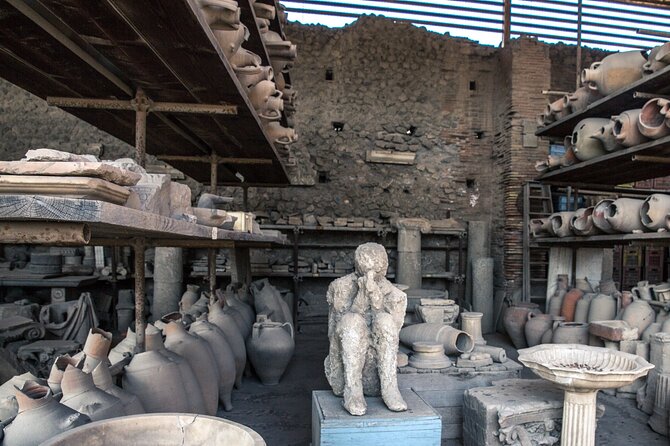
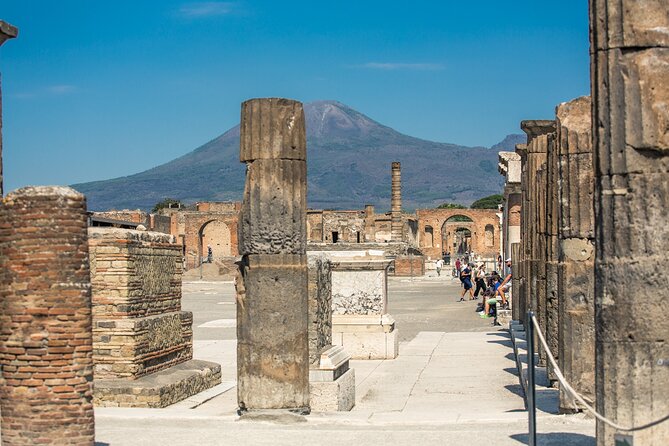
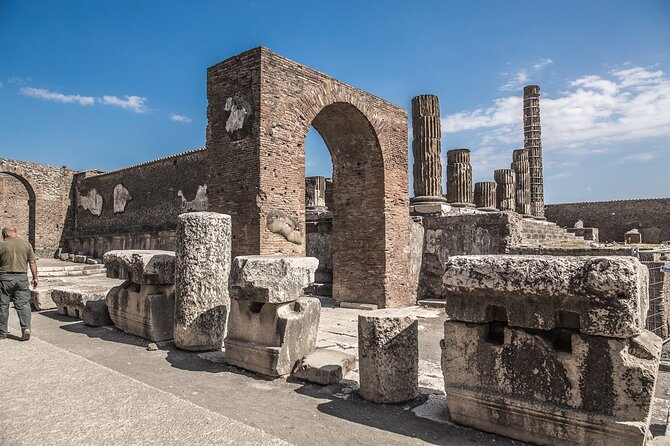
The Civil Forum was the city’s main public square. It brought together administration, justice, business, trade, and worship, making it the right place to begin understanding Pompeii’s civic life.
Your guide can point out how the buildings around the Forum were arranged and why the open square mattered. It was not merely a space for taking photographs. It was the center of public activity, where the city’s institutions and religious life met.
At the north end, the Temple of Jupiter commands attention. Mount Vesuvius rises behind it, giving you one of Pompeii’s most memorable views. The temple changed after Pompeii became a Roman colony in 80 BC, when it was reshaped as a Capitolium dedicated to Jupiter, Juno, and Minerva.
The location makes the stop especially worthwhile. You are looking at a major religious building while also seeing the volcano that shaped Pompeii’s fate. The guide’s explanation helps you understand both the political meaning of the temple and the physical setting.
Expect some standing here while the group gathers and listens. In summer, the open Forum offers little relief from the sun, so a hat, sunscreen, and water are not optional extras.
More ways to see Pompeii:
- Pompeii Small Group Tour with an Archaeologist
★ 5.0 · 6,593 reviews - Discover the Ancient Ruins of Pompeii: Day Trip from Rome
★ 3.5 · 2,247 reviews - Pompeii and Herculaneum Small Group Tour with an Archaeologist
★ 5.0 · 1,350 reviews - Pompeii Ticket + Tour with Optional Tasting Experience at Pompeii
★ 5.0 · 663 reviews
Macellum and Via dell’Abbondanza
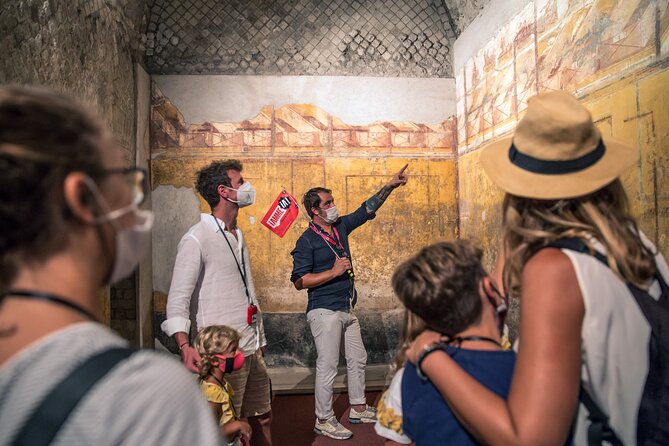
The Macellum was a market complex with a colonnaded courtyard, rooms for religious activity, and commercial spaces. A counter in one room may have been used for selling fish, while other areas were connected with the imperial cult.
This stop is useful because it shows how commerce and religion overlapped in Roman cities. Pompeii’s public buildings were not always devoted to one cleanly separated purpose. Markets, civic business, rituals, and imperial loyalty could exist side by side.
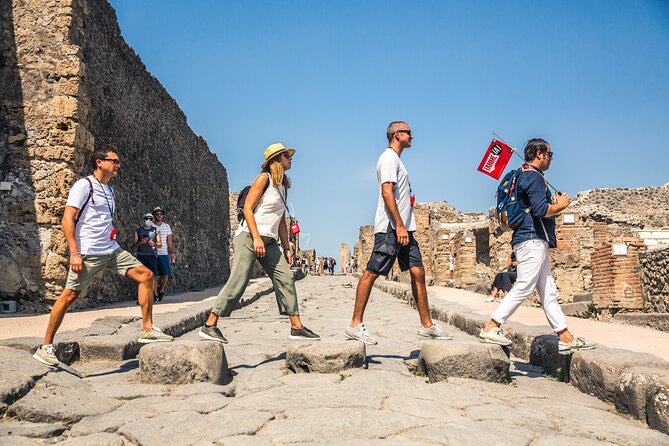
From here, the route reaches Via dell’Abbondanza, the city’s main east-west street. In ancient Pompeii, this road was noisy and crowded with workshops, shops, cafes, snack counters, and restaurants. It is one of the best places to picture ordinary movement through the city.
The street also gives you a clear sense of the walking conditions. Ancient paving stones are uneven, and you may need to step carefully. Comfortable shoes with a firm sole will serve you much better than thin sandals or fashion footwear.
This part of the tour can be more revealing than a grand temple. It shows how people ate, worked, shopped, and moved about. You are not only looking at monumental Rome. You are looking at the plumbing, storefronts, counters, and worn streets of everyday life.
The Stabian Baths and Roman bathing culture
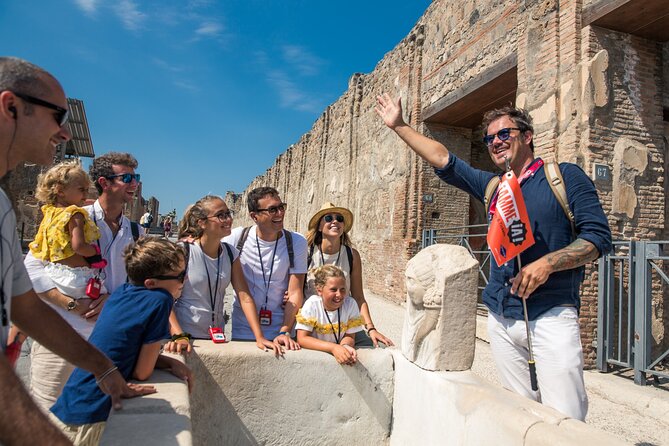
The Stabian Baths date to the period shortly after Sulla’s veterans established the Roman colony in 80 BC. The complex had separate entrances and areas for men and women, along with rooms for changing, cold baths, warm baths, and hot baths.
The men’s section included an apodyterium, or changing room, plus a tepidarium and frigidarium. The hot room, or calidarium, shows how Roman bathing depended on a carefully organized sequence of temperatures and spaces.
The baths were badly damaged by the earthquake of AD 62, years before the eruption. That detail is important because Pompeii did not go directly from a normal day to volcanic destruction. The city was already dealing with earthquake damage and repair work.
The stop is brief, listed at about 10 minutes, so you will receive an overview rather than a long architectural study. That is probably enough for a first visit, but anyone fascinated by Roman engineering may wish for more time to explore later.
The Lupanar and the limits of a quick route
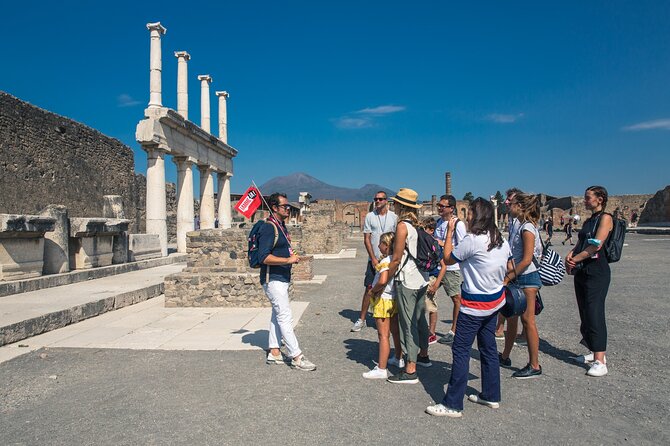
The Lupanar is Pompeii’s best-known brothel. Its small rooms and erotic wall paintings offer a direct, if uncomfortable, look at one part of Roman commercial life.
The Latin word lupanar means brothel. The women working there were mostly enslaved people from Greece and the East, and the reported prices ranged from two to eight asses. For context, a glass of wine cost one as. These details help place the building within the city’s economy, though they also remind you that not every part of Pompeii’s daily life was free or equal.
Access to the Lupanar can be difficult when many groups arrive at once. A line may form, and the guide cannot always control how quickly the building opens. If the wait is long, the tour may need to keep moving to protect the rest of the route.
This is one place where the short format has a downside. You may see the famous rooms and paintings, but you may not have much time to pause. If the Lupanar is your main reason for visiting Pompeii, an independent return visit could be worthwhile.
The House of the Faun and the Alexander Mosaic
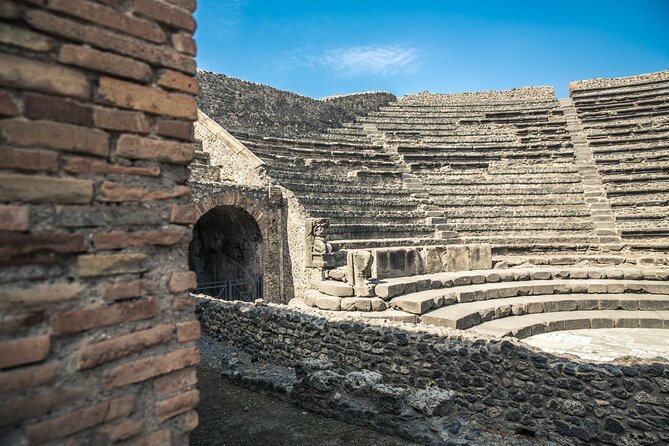
The House of the Faun is one of Pompeii’s grand private villas. Its name comes from a bronze statue of a dancing faun, and the home is famous for its mosaics, including the Alexander Mosaic.
The Alexander Mosaic depicts a dramatic battle between Alexander the Great and the Persian king Darius III. Its importance is not just visual. It shows the level of art, expense, and storytelling found in an elite Roman home.
The guide can help you read the house as more than a beautiful floor. Its size and decoration reveal the social gap between wealthy families and the people living and working around them. The contrast with Via dell’Abbondanza is useful: one route shows commerce and daily movement, while this house shows private power and display.
Crowding can affect how long you can stand in front of a major mosaic. Stay close enough to hear the guide, but do not expect the quiet, empty-room feeling of a museum.
The Large Theater and the Basilica
The Large Theater was an open-air venue for comedies, dramas, and music. Its curved seating and stage area give you a quick sense of how Roman entertainment worked, and the open setting makes it easier to picture a crowd filling the seats.
The theater is also a helpful reminder that Pompeii was not only a place of business and worship. People came here to watch performances, meet friends, and spend leisure time. If your guide has time, this is a good place to ask about Roman theater and the different audiences who used it.
The Basilica was the Forum’s most sumptuous building and covered about 1,500 square metres. It was used for business and the administration of justice, with five entrances leading from the Forum and an interior divided into three naves.
The Basilica’s scale is easy to miss if you only look at the surviving walls. The guide’s explanation helps you reconstruct the building’s purpose and the activity it once held. This is a strong final stop because it brings together Pompeii’s legal and commercial life.
Some tours finish near a large map in a central part of the site. That can be helpful if you want to continue on your own to areas such as the larger amphitheater or other streets. Confirm with your guide exactly where the group ends before separating.
Heat, walking, crowds, and headsets
Pompeii is exposed, and summer heat can be intense. Bring water, use sunscreen, and wear a hat if you have one. Water fountains on the site can be used to refill your bottle, according to the practical advice given by past visitors.
The best time depends on your priorities. A 9 a.m. tour is often the safest choice for cooler temperatures and a faster start before the crowds build. A later afternoon tour may feel quieter on some days, but the heat can be harder, and opening conditions around famous buildings can change.
Headsets are supplied for groups larger than 10. They are a real help when the guide is speaking beside a crowded street or when you are standing behind other people. Equipment can occasionally fail, so tell the guide at once if you cannot hear. Do not wait until the group has moved several rooms ahead.
The maximum group size is 25. That is manageable, but it can feel large in narrow spaces. A smaller group may provide more chances to ask questions, while a larger group may offer a lower price than a private tour.
Is $59.13 good value?
At $59.13 per person, this is not the cheapest way to enter Pompeii. You are paying for priority admission, a licensed English-speaking guide, a planned route, and headsets when the group is larger than 10.
The value depends on how you like to visit archaeological sites. If you want context and do not want to spend your first hour working out the Forum, temples, streets, and houses alone, the fee is reasonable. A good guide can help you understand what you are seeing in a limited amount of time.
If you already know Pompeii well, read about Roman architecture, or prefer to set your own pace, the tour may feel restrictive. You might want to spend 30 minutes at one house while the group needs to move on. The ticket and guide save effort, but they also impose a route.
The price does not include lunch or transportation. Factor those costs into your day, especially if you are coming from Naples, Sorrento, or elsewhere along the Amalfi Coast.
Who should book this Pompeii tour?
I would choose this tour for a first visit, especially if you have about half a day and want a clear introduction to the site. It suits people who value explanation more than wandering alone and families who want the main sights presented in a sensible order.
It can also work well for adults who do not want to research Roman buildings before arriving. The guide explains the Forum, baths, market, theater, homes, and Basilica while you are standing in front of them.
Families should think carefully about the walking and heat. The site is huge, the stones are uneven, and some children may find the standing portions tiring. The tour can be useful for older children who enjoy stories about Roman life, but you should bring water and avoid heavy bags.
If you need a highly flexible schedule, have limited mobility, or care most about visiting every corner, an independent visit may suit you better. The organized route gives you structure, but Pompeii rewards extra time.
Final verdict: book for context, not total freedom
Book this tour if you want priority entry and a well-organized introduction to Pompeii’s central sights. The best parts are the guide’s explanations of daily life, the easy-to-hear headset system, and the route from the Forum through the baths, market street, theater, homes, and Basilica.
Choose an independent visit instead if you dislike group pacing or want to wait patiently for every famous building. If you do book, arrive early, choose a cooler time of day, wear sturdy shoes, and allow extra time afterward to explore beyond the guided route.
Free cancellation is available up to 24 hours before the start time. Poor weather or failure to meet the minimum group size can lead to a new date, another experience, or a full refund.
FAQ
How long does the Pompeii guided tour last?
The experience lasts approximately two and a half hours. The guided portion inside the ruins is also described as about two hours, so allow extra time for meeting the guide, entry, and movement through the site.
Where does the tour meet?
You meet at Camping Zeus, Via Villa dei Misteri 3, 80045 Pompei, Italy. The tour ends back at the same meeting point.
Is admission to Pompeii included?
Yes. Priority admission to the Pompeii ruins is included in the tour price.
Is the tour offered in English?
Yes. The tour is offered in English and includes an official, licensed guide.
Are headsets provided?
Headphones are provided for groups larger than 10 people so you can follow the guide more clearly in the busy outdoor site.
What should I wear and bring?
Wear comfortable shoes because the route uses uneven ancient streets. Sunscreen and water are strongly recommended, especially in summer, when Pompeii can become very hot.
Just added around Pompeii
- Wine Tasting and Winery Tour in Vesuvio National Park with Lunch★ 4.5 · 3 reviews
- Mt. Vesuvius Wine Tasting and Lunch Experience from Pompeii★ 4.5 · 20 reviews
- Wine tasting in the Vesuvius national park★ 5.0 · 3 reviews
- Traditional Neapolitan Dinner in Pompei – Villa Franca – Family Restourant★ 5.0 · 8 reviews
- Private Guided Tour and VR Headsets in the Ancient Pompeii★ 5.0 · 3 reviews
- Visit Pompeii with a local expert guide★ 5.0 · 10 reviews
- Tour Mount Vesuvius with Entry Tickets and Round Trip Transfer Included★ 3.5 · 4 reviews
- Vesuvius tour entrance to the crater and return bus★ 4.5 · 9 reviews
Guided Tours in Pompeii, compared.


Pompeii Guided Tour & Horse Riding on Vesuvius with Lunch
Read our review →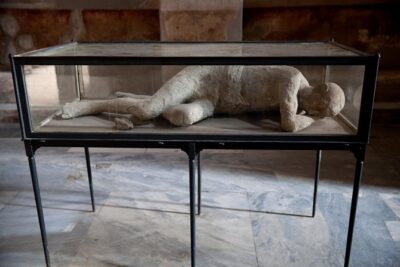
Complete Pompeii Skip the Line Tour with Archaeologist Guide
Read our review →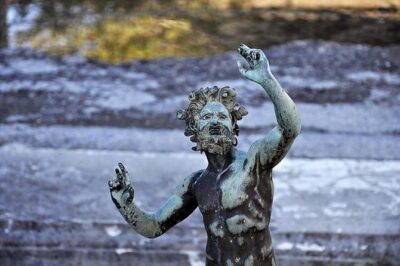
Guided Small Group Tour Max 6 People with Private Option
Read our review →
Pompeii Guided Group Tour with Entry Ticket and Archaeologist
Read our review →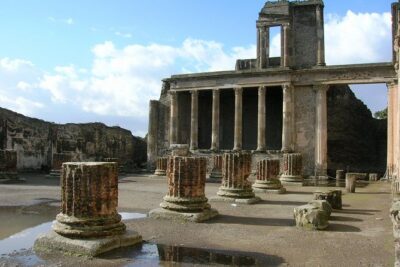
2 Hour Private Tour with an Archeologist Guide
Read our review →
Stories of Pompeii: Small Group tour with archeology expert guide
Read our review →
Mount Vesuvius Tour from Pompeii Led by an Expert Guide
Read our review →Browse the lists this tour appears in