
Reviewed · HERCULANEUM TOURS FROM NAPLES
Herculaneum – Small Group Tour (admission included)
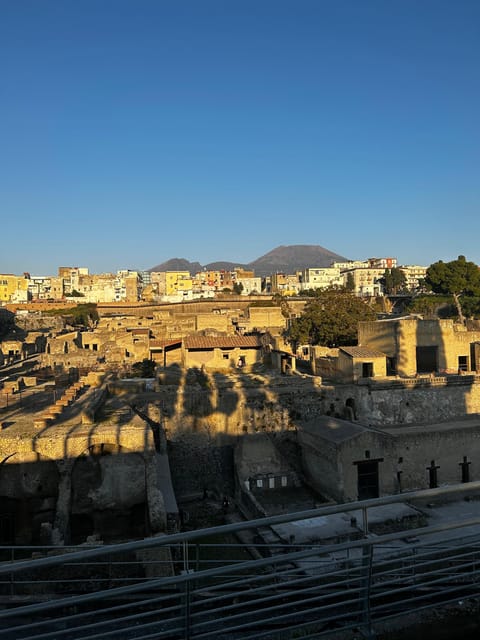
Herculaneum gives you something Pompeii cannot quite match: a smaller ancient town where houses, wood, paintings, and household details survived in remarkable condition. The 79 A.D. eruption buried it under roughly 60 feet of scorching ash, sealing away a close-up view of Roman daily life.
I like the two-hour focus and the chance to study elegant private homes without facing Pompeii’s huge scale. I also like the small-group format, which gives you room to ask questions. Guides such as Marzia, Roberta, and Gabriella have been praised for clear explanations and for adjusting their approach to families and children.
The main consideration is time. Two hours is enough for a strong introduction, but not for every corner of the site. The tour can also be rearranged to a weekday if too few people book, so keep some flexibility in your schedule.
Key points to know before you go
- Herculaneum was smaller and wealthier than Pompeii: Expect a more intimate look at private Roman homes and refined decoration.
- The eruption preserved unusual materials: The town was buried under about 60 feet of ash, helping protect details lost elsewhere.
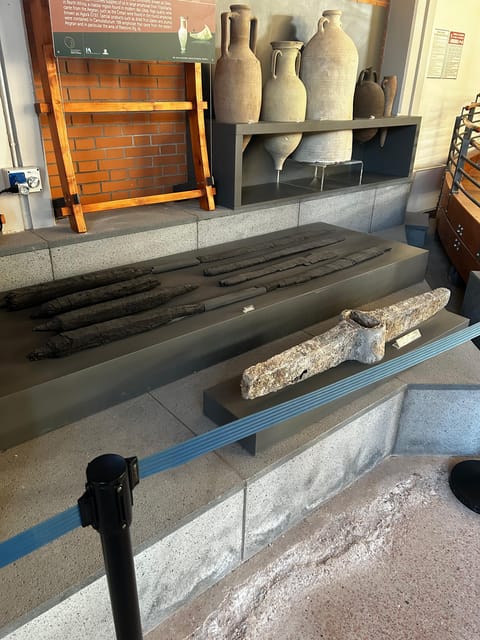
- The boat museum adds a human scale: The tour includes a nearby display connected with the catastrophe and the people caught in it.
- The guide shapes the experience: Marzia, Roberta, and Gabriella have each been singled out for thoughtful explanations and questions.
- Two hours keeps the visit manageable: You get a clear route through the ruins without committing to a full day.
- The price includes entry: At $75 per person, you are paying for both admission and a licensed guided visit.
Why Herculaneum feels different from Pompeii
Pompeii is the larger name, but Herculaneum may be the better fit if you want detail over scale. Pompeii spreads across a broad area and can feel like a full archaeological city survey. Herculaneum is smaller, more compact, and easier to grasp during a short guided visit.
Its original role also helps explain the mood. Herculaneum was largely a residential center for wealthy Romans, while Pompeii had a broader mix of homes, shops, workshops, and public spaces. Here, the private houses and their decoration take center stage.
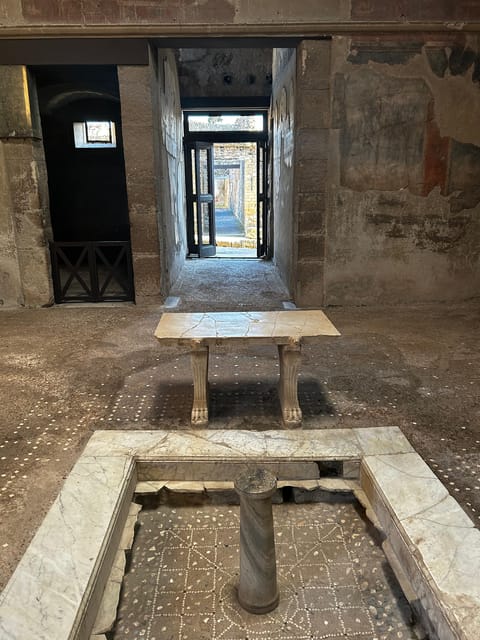
That difference matters because you are not simply walking past walls. You can look at the design of a Roman home, notice the quality of its decoration, and consider what that says about the people who lived there. The town offers a closer look at status, taste, and domestic life.
I especially like that the experience begins with the eruption and the nature of the city. Without that background, the ruins can look like a collection of attractive walls. With it, the buildings become part of a story about a coastal town, its residents, and the sudden force that buried them.
More Herculaneum tours:
- Ercolano: Herculaneum Entry Ticket with Optional Audio Guide
★ 4.1 · 581 reviews - Herculaneum: Skip The Line Entrance ticket + Audioguide
★ 4.3 · 266 reviews - Herculaneum: Tickets & Tour with a Local Archaeologist
★ 4.8 · 226 reviews
Meeting at Corso Resina, 187
The tour begins at Corso Resina, 187, just outside the Herculaneum ticket office. This is a useful meeting point because you do not need to search through the archaeological site to find your guide. Look for the guide before entering through the ticket process.
The advertised meeting point is outside the ticket office, and the admission ticket is included. That removes one common nuisance at major archaeological sites: standing in one line for entry and then trying to locate a guide inside.
Still, arrive with enough time to identify the group. The exact starting time depends on availability, and the tour lasts two hours from the meeting point and back to the same area. If your day includes a train, meal, or another timed visit, leave a little breathing room rather than scheduling everything tightly.
The tour is offered in English, Italian, and German. Small groups are available, which is important here. Herculaneum rewards pauses, and a smaller group makes it easier to hear an explanation inside a house or ask about a detail that catches your eye.
Starting with Vesuvius and the 79 A.D. eruption
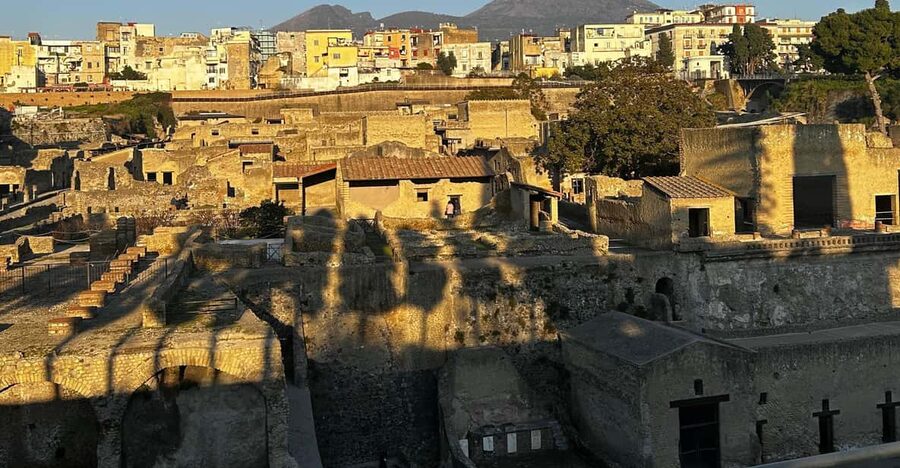
The opening explanation focuses on the eruption of Mount Vesuvius and why Herculaneum was affected differently from Pompeii. Both towns were destroyed and preserved, but not in the same way.
Herculaneum was covered by pyroclastic flows, a fast-moving mixture of hot gas, ash, and volcanic material. The site was buried beneath a huge mass of cinder, described as roughly 60 feet deep. That deep covering helped seal the ancient town away for centuries.
The result is one of the most important reasons to visit. You are not seeing only stone foundations and reconstructed outlines. In places, the preservation allows you to think about surfaces, fittings, decoration, and materials that make Roman life feel less abstract.
The guide’s job here is not to turn the visit into a geology lecture. It is to connect the natural disaster with the town’s physical remains. The strongest part of the introduction is the link between the eruption, the town’s location near the coast, and the evidence left behind.
You should expect some serious subject matter. The eruption was a disaster that killed residents, and the tour addresses the people who lived there as well as the buildings they left behind. That human focus gives the visit weight without losing sight of the architecture.
The boat museum and the human story
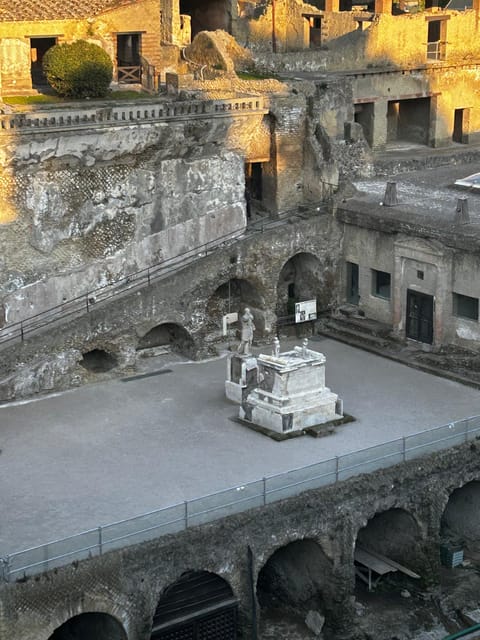
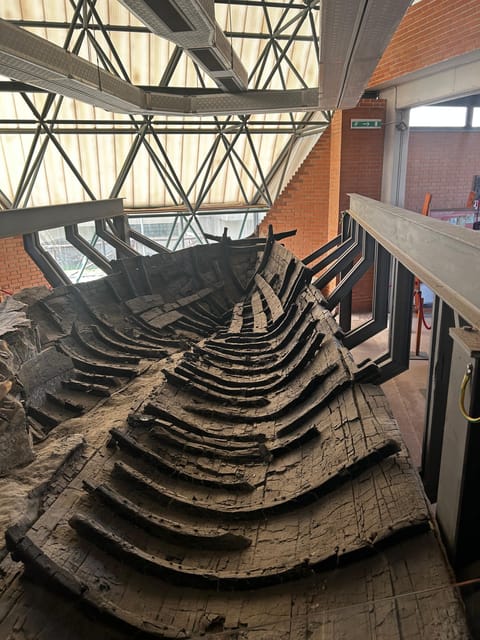
One unusual feature of this experience is its attention to the boat museum. The tour explains the special preservation of Herculaneum and includes a visit to the nearby museum display.
The boat adds a useful change of scale. Ancient streets and grand houses can make you think in terms of monuments. A boat, by contrast, points toward transport, the coast, and the practical lives of people living near the Gulf of Naples.
The visit also helps explain why Herculaneum is more than a smaller copy of Pompeii. The site’s story is tied to its coastal setting and to the way volcanic material covered it. The museum display gives the eruption a more direct, physical presence.
Do not expect a separate, lengthy museum visit. The whole experience lasts two hours, so this is one part of a walking route rather than an extended museum session. That is a fair trade if you want a balanced introduction to both the ruins and the disaster.
A few more Ercolano outings worth a look
- Naples: Pompeii and Herculaneum Tour with Tickets and Lunch
★ 4.4 · 136 reviews - Vesuvio Skip The Line Ticket With Digital Audioguide
★ 3.2 · 91 reviews - Herculaneum Archaeological Park smart Audio Tour
★ 3.8 · 70 reviews - Herculaneum: Private Walking Tour with Archeologist Guide
★ 5.0 · 59 reviews
Walking through wealthy Roman homes
The main part of the tour takes you through the archaeological site, with a focus on everyday life in an ancient Roman center. The private houses are the stars.
You will see original styles and elegant decoration that reflect Herculaneum’s wealth. Paintings and other details help show how Roman homes were designed, not simply where their walls once stood. The point is to understand how rooms, decoration, and domestic spaces worked together.
This is where a guide adds real value. A bare doorway can be easy to pass. A good explanation can help you understand why the space mattered, what kind of home it may have been, and how decoration communicated status. Marzia has been praised for giving detailed answers, while Roberta has been noted for offering information in measured portions rather than overwhelming the group.
The route also covers different aspects of town life, not just the most decorated houses. That balance matters. If every stop were a grand residence, you would get a narrow picture of the city. The tour aims to show an ancient center as a place where people lived, worked, moved around, and responded to their surroundings.
Some of the most memorable moments are likely to come from small details. A painted surface, an unusual building feature, or an object in the museum can make the past feel close. You will not need to know Roman history in advance to appreciate these stops.
Guides who adjust to the group
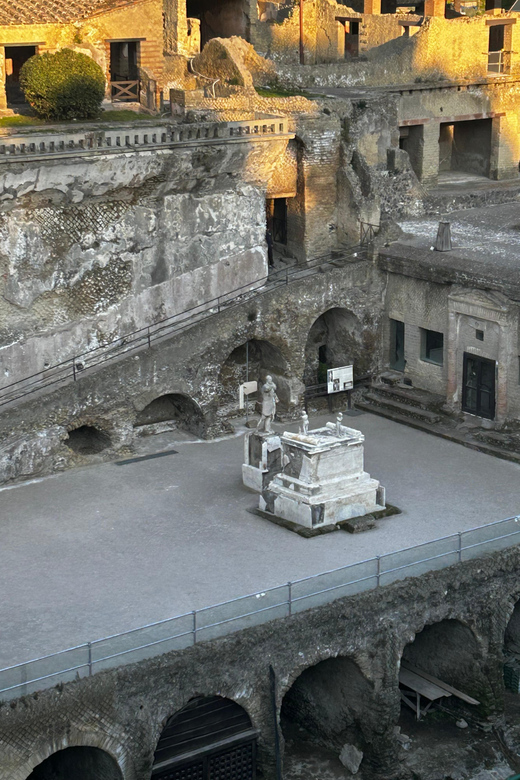
The guide is the key variable in a two-hour archaeological tour. The experience is built around explanation, not just entry into the ruins.
Gabriella has shown a useful family approach, adapting her explanations to keep three children involved for the full two hours. That is a good sign if you are visiting with young people who may lose interest during long discussions of dates and building styles.
Marzia has been described as passionate about Herculaneum and careful with questions. One detail from her tours is especially telling: she took time to show the nearby Antiquarium and pointed out a resemblance between a visitor’s earrings and an ancient example on display. That is the kind of small observation that can make a standard site visit feel personal without turning it into a performance.
Roberta has been praised for combining clear information with a comfortable amount of detail. Those qualities matter because Herculaneum can reward close looking, but too much explanation can make two hours feel heavy.
You should still remember that guides differ. The activity is offered in three languages, and the exact guide may not be known when you book. The strongest evidence points to a consistently well-received guiding team, but no guided visit can guarantee the same style or pace every day.
Is $75 a fair price?
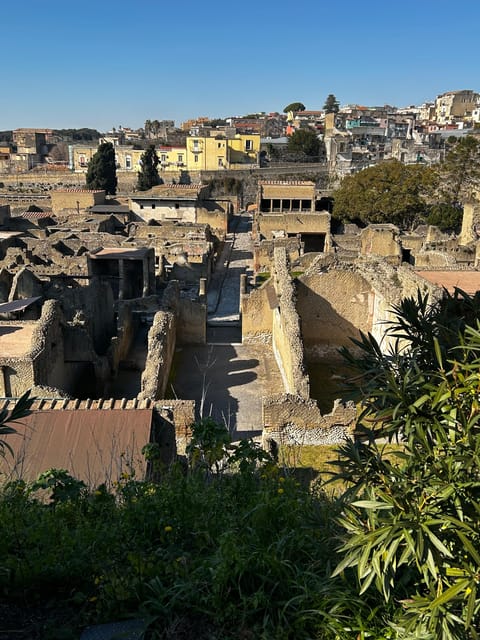
At $75 per person, this is not the cheapest way to enter Herculaneum. The price includes skip-the-line admission and a licensed guide from the Regione Campania, so you are paying for interpretation as well as access.
The value depends on how you like to visit archaeological sites. If you enjoy reading every sign alone and moving at your own pace, you may prefer an independent visit. If you want the eruption, architecture, preservation, and daily life tied together in a clear route, the guided format makes more sense.
Two hours also keeps the cost easier to judge. You are not paying for a full-day commitment, and the compact format can fit neatly into a broader Campania schedule. The tradeoff is that you will not have time to inspect every building or linger at every display.
Skip-the-line entry has practical value, especially if you are visiting at a busy time. It does not make the site private or remove all waiting, but it means the ticket is handled as part of the experience rather than left for you to sort out.
For families, the price may be easier to justify because a good guide can keep children engaged and explain the site in plain terms. For a group of four or five adults who ask many questions, the small-group format can also provide better value than a large, fast-moving tour.
What the two-hour pace feels like
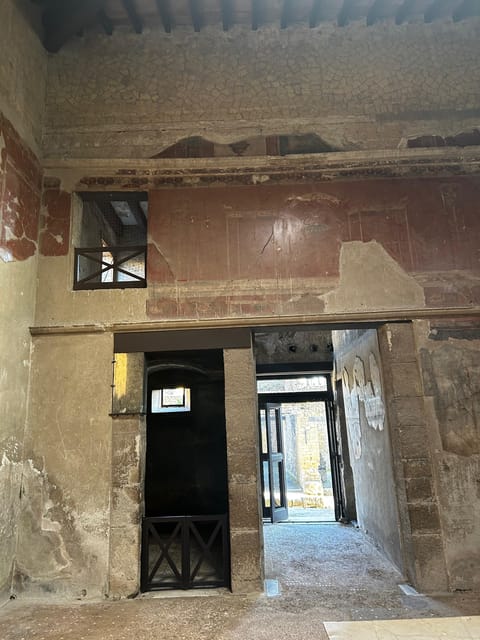
The route is compact but not empty. You begin outside the ticket office, move into the archaeological site with your guide, visit the key areas and museum display, and return to Corso Resina, 187.
You should expect continuous walking and regular stops for explanations. The tour is not designed as a quick photo circuit. It works best when you look closely at the buildings and give the guide time to connect details with the eruption and Roman domestic life.
The shorter length is a strength if you are combining Herculaneum with other plans. It is also a limitation if you want long periods of independent exploration. At the end, you may still want to stay in the area and look around on your own, but the guided portion gives you a strong framework first.
One practical scheduling note is worth keeping in mind. If too few people book, the tour may be moved to a weekday, although communication about the change has been clear and alternatives have been offered. Keep your itinerary flexible if your dates are tight.
Who will get the most from this tour
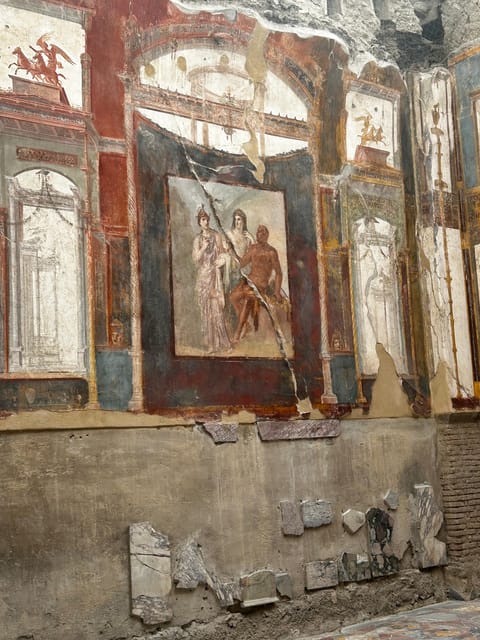
I would choose this experience if you want a focused introduction rather than a long archaeological study. It suits first-time visitors who want help making sense of the ruins, especially if Pompeii feels too large or time-consuming.
Families should consider it seriously. Gabriella’s ability to adjust explanations for children is a useful sign, and the two-hour length is easier for younger attention spans than a full day among ruins.
It also works well for anyone who has already visited Pompeii. Herculaneum offers a different scale and a more residential feel, so the two sites complement each other rather than simply repeating the same experience.
You may want another option if you dislike guided pacing or prefer to spend a long time in one house. The tour has a set route and a fixed duration, and the guide’s explanations are central to the experience.
Should you book this Herculaneum tour?
Book it if you want to understand why Herculaneum is different from Pompeii, see well-preserved homes, and connect the ruins with the eruption that buried them. The licensed guide, included admission, small-group setting, and boat museum visit give the two-hour route a clear purpose.
I would be especially comfortable recommending it to families, first-time visitors, and anyone with only a short window in the area. If you already know the site well or want hours of solo exploration, admission alone may suit you better.
At $75, the tour earns its price through the guide’s interpretation and the convenience of included entry. Leave room for a possible weekday change, meet outside the ticket office on Corso Resina, and expect a compact visit built around homes, daily life, preservation, and the human cost of Vesuvius.
FAQ
Where does the Herculaneum tour meet?
The meeting point is just outside the Herculaneum ticket office at Corso Resina, 187.
How long does the tour last?
The guided visit lasts two hours and returns to Corso Resina, 187.
Is admission to Herculaneum included?
Yes. The price includes a skip-the-line admission ticket.
Which languages are available?
The tour is offered in English, Italian, and German.
Does the tour include the boat museum?
Yes. The experience includes an explanation of Herculaneum’s unusual preservation and a visit to the boat museum.
Can I cancel for a full refund?
Yes. You can cancel up to 24 hours in advance for a full refund.
Just added around Ercolano
- Vesuvius and Pompeii Transfer + Entrance for the Vesuvio★ 4.2 · 11 reviews
- Herculaneum with an Archaelogical Guide & Ticket★ 4.8 · 11 reviews
- Herculaneum Archaeological Park smart Audio Tour★ 3.8 · 70 reviews
- Herculaneum: Skip-The-Line Entrance Tickets + Audioguide★ 4.7 · 3 reviews
- Herculaneum: Private Walking Tour with Archeologist Guide★ 5.0 · 59 reviews
- Herculaneum: 2hour Shared Guided Tour + entry tickets★ 4.3 · 38 reviews
- Herculaneum: Private Tour with Driver from Naples★ 4.6 · 15 reviews
- Herculaneum Guided Walking Tour with Entry Ticket★ 3.7 · 21 reviews
Herculaneum Tours from Naples, compared.
Pompeii and Herculaneum Small Group Tour with an Archaeologist
Read our review →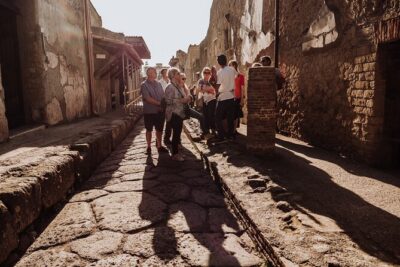
Herculaneum Small Group Tour and Ticket With an Archaeologist
Read our review →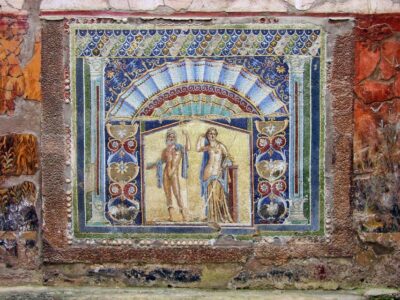
Pompeii & Herculaneum with Archaeologist Guide
Read our review →
Pompeii, Herculaneum, & Vesuvius Full-Day Tour
Read our review →
Herculaneum Entry Ticket with Optional Audio Guide
Read our review →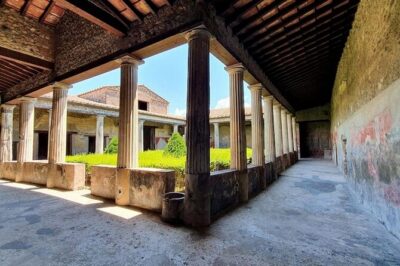
Day Trip of Pompeii, Herculaneum and Vesuvius from Naples
Read our review →Browse the lists this tour appears in