
Reviewed · GUIDED TOURS IN POMPEII
Small Group Guided Walking Tour of Ancient Pompeii Highlights
Pompeii is easier to understand when someone shows you what you are looking at. This two-hour walking tour takes you from the city’s theatres to its baths and Lupanar, using the ruins themselves to explain daily Roman life before the eruption of Vesuvius in 79 AD.
I like the small-group limit of 18 people, which gives you a better chance to hear the guide and ask questions. I also like that entrance tickets and skip-the-line access are included, important when the sun is hot and the queues are long. The main catch is the short format: two hours covers the headline sites, but you will likely want extra time afterward to explore on your own.
Key points to know before you book
- Archaeology-focused guiding: Guides including Lello have used their archaeology background to make the ruins easier to understand.
- Four strong Pompeii stops: The route includes the Teatro Grande, Odeon, Forum Baths, and Lupanar.
- Small group, not private: The maximum is 18 people, with some departures much smaller.
- Tickets are included: Your confirmation is for the guided visit and cannot be used as a stand-alone Pompeii admission ticket.
- Plan for uneven walking: You will walk on original ancient streets, so comfortable shoes matter.
- A useful family length: The two-hour schedule gives younger visitors a focused look rather than an all-day march.
Why this Pompeii tour works well in two hours
Pompeii is huge, open, and full of tempting side streets. Without a plan, you can spend much of your visit simply trying to work out which buildings matter and why. This tour gives you a clear route through several of the city’s most recognizable remains.
The schedule adds up to about two hours. That is long enough to see important public buildings and one of Pompeii’s most talked-about sites, but not so long that the visit becomes a hot, tiring slog. One family found the pace and amount of information a good fit for teenagers, which makes sense: the tour keeps moving and does not ask you to stand through a long lecture at every corner.
Your guide is the key to the experience. Past departures have included Lello, Italo, and Susanna. Lello is described as an archaeologist with a lively style, while Italo is noted for being friendly, animated, and passionate about Pompeii. You should not book expecting a specific guide unless that is confirmed for your date, but the tour clearly depends on a guide who can turn walls, stones, and faded paintings into a readable story.
A radio system with a small earpiece has also been used on some tours. That detail matters in a ruin site where groups spread out and street noise can make a normal speaking voice hard to hear. It lets you look at the building instead of crowding around the guide.
More Guided Tours in Pompeii
- Skip the Line Guided Tour of Pompeii led by an Archaeologist
★ 5.0 · 703 reviews - Pompeii private tour with an Official Guide
★ 5.0 · 631 reviews - Pompeii Skip-the-line Tour with Archaeologist Guide
★ 5.0 · 559 reviews
Meeting at Coffee Shop Vittoria
The tour begins at Coffee Shop Vittoria on Via Mare in Pompei. You need to arrive 10 minutes early. The operator warns that the guide will not wait for late arrivals because the group entrance is booked for a set time.
That rule may feel strict, but it protects the rest of the group and the timed entry. Build in extra time for finding the meeting point, especially if you are arriving by public transportation or walking from elsewhere in Pompei. The activity ends back at the same meeting point.
This is not hotel pickup and drop-off. You are responsible for reaching the start and leaving afterward. The meeting point is near public transportation, which helps, but the details provided do not include a private transfer or a meal stop.
Entering Pompeii with the guide
The opening portion is listed as Private Tours of Pompeii and lasts about 30 minutes, with admission included. Think of this as your introduction to the archaeological site and the first layer of orientation.
Pompeii rewards context. A street may look like a line of old paving stones until someone explains how people moved through the city, what the buildings were used for, and how the eruption changed the site. Your guide’s job here is to give you a framework so the later stops make sense.
The phrase skip-the-line access is important, but read the ticket condition carefully. You receive a guided tour confirmation, not an independent ticket that you can use whenever you wish. You need to enter with the guide at the scheduled time.
That also means you should not plan a last-minute change of pace. If you arrive late, you may miss the group entry. The tour is structured, and the timed admission is part of what keeps the visit moving.
Teatro Grande and Pompeii’s public life
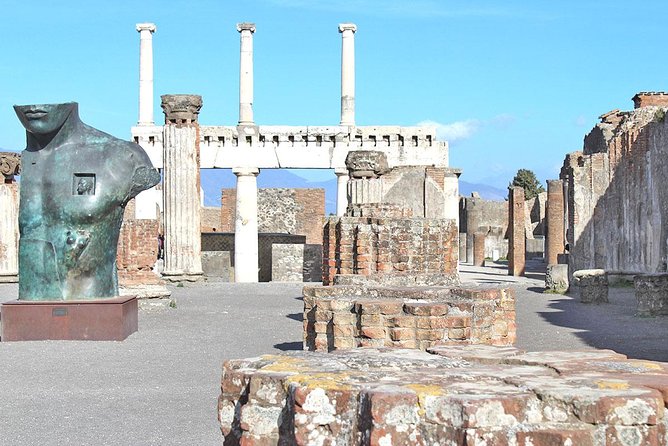
The Teatro Grande is a large open-air theatre with space for about 5,000 people. The scale gives you a quick sense of how social and public Roman city life could be.
This is not just a photo stop. A good guide can help you picture the theatre as an active civic space, rather than a silent curve of ancient stone. Look at how the seating and performance area are arranged, and listen for the clues that show how the building served a large audience.
The listed time here is about 20 minutes. That is enough for an explanation and a look around, but not enough for a slow architectural study. If you are especially interested in ancient theatres, make a mental note to spend extra time here after the guided portion, if site access allows.
The theatre also gives the tour a welcome change of scale. You move from the broad idea of the city to a building designed for thousands of people. That contrast helps make Pompeii feel like a functioning town, not simply an archaeological field.
More Walking Tours in Pompeii
- Pompeii 3 Hours Walking Tour Led by an Archaeologist
★ 5.0 · 126 reviews - Explore Pompeii: 2-Hour Guided Walking Tour with Included Ticket
★ 4.5 · 77 reviews - Pompeii: walking tour with 3D glasses and with entrance ticket
★ 4.5 · 61 reviews - Pompeii walking tour
★ 5.0 · 29 reviews
Odeon, the smaller theatre
The Odeon, also called the Teatro Piccolo, held about 800 people. Its smaller size gives it a different character from the Teatro Grande and makes the point that Pompeii had more than one kind of performance space.
The tour allows about 20 minutes here. That is a sensible amount of time for a first visit. You can compare the two theatres, notice the different scale, and ask the guide how their roles may have differed.
This stop is especially useful if you enjoy seeing how a city serves different audiences. The grand theatre suggests mass entertainment, while the smaller Odeon feels more intimate by comparison. You do not need specialist knowledge to appreciate the difference, and the guide can supply the missing background.
The trade-off is the same as at the Teatro Grande: the stop is focused, not leisurely. If your main interest is architecture, theatre, or ancient performance, you may wish to continue exploring after the two-hour tour rather than treating the guided route as your complete Pompeii visit.
The Forum Baths and Roman bathing
The Terme del Foro, or Forum Baths, is a Roman bath complex buried by the eruption of Vesuvius in 79 AD. The site offers a close look at a practical part of urban life: bathing was not simply about washing, but also about routine, comfort, and social contact.
Your guide can help you read the remains as a complex rather than a pile of rooms. Pay attention to the layout and the way the building was organized. Even without a long stop, the baths add an everyday dimension to the tour that the large theatres cannot provide.
The listed time is about 20 minutes. That keeps the route moving, though it limits how much detail you can absorb. I would listen for the basic function of the rooms and the wider role of public baths, then return later if you want a slower look.
The baths are also a reminder that Pompeii was a lived-in city. The theatres show public spectacle. The baths show routine and shared civic life. Together, these stops give you a more useful picture than a tour focused only on dramatic ruins.
Lupanar and the less polished side of Pompeii

The Lupanar is Pompeii’s best-known brothel site. Some frescoes remain visible, and they illustrate the services associated with the women who worked there.
This stop can be memorable because it brings an unvarnished side of Roman life into view. The images and setting are direct, and the subject may not suit every child or every visitor. If you are touring with a family, use your judgment and be ready for mature material.
The tour allows about 30 minutes here, making it the longest named stop. That extra time gives the guide room to explain the building and the surviving frescoes rather than rushing you through a narrow or crowded area.
The Lupanar is also a good example of why Pompeii needs interpretation. On your own, you may see small rooms and faded paintings. With context, you can think about how the space functioned and what it reveals about Roman society. The subject is popular, but the value of the stop comes from placing it within the wider city.
What the small group changes
The maximum group size is 18 people. That is not a private tour, but it is more manageable than the very large groups you may see moving through Pompeii.
A smaller group makes practical differences. You can stay closer to the guide, hear explanations more clearly, and ask questions without holding up a long line of people. One departure had only six other participants, while another group numbered 10. Those are comfortable sizes for a site where streets and doorways can feel tight.
The group size can vary, so do not assume you will always get a six-person experience. Still, the cap offers useful protection against an unwieldy crowd. The radio and earpiece system can help too, especially if the group spreads out around a building.
The compromise is flexibility. Because this is a scheduled group tour, the guide cannot wait for late arrivals, and the pace must suit everyone. If you prefer to stop for long periods at one mosaic or wander without a route, a private visit may fit you better.
The $107.23 price and what it buys
At $107.23 per person, this is not a bargain admission ticket. The value depends on how much you want from Pompeii beyond simply entering the ruins.
The price includes the professional guide, entrance tickets, and skip-the-line access. You are paying for interpretation and saved time as well as admission. That can be worthwhile at Pompeii, where a guide can connect the theatres, baths, and Lupanar into a clear story instead of leaving you to decode the site alone.
It is also a short tour. If you measure value by hours alone, the price may feel high. If you use the guided two hours as an orientation and then continue exploring independently, the calculation improves. One previous group stayed for more than two additional hours after the guide finished because they knew what they were seeing.
Drinks and lunch are not included. Bring your own water and plan food separately. The tour itself is concentrated on the ruins, so you are not paying for a meal or transport package you may not need.
Heat, shoes, and the Pompeii walking surface
Wear comfortable shoes. You will be walking on original ancient streets, which can be uneven and tiring. Smart-casual dress is requested, but practical footwear should take priority.
Summer heat is another real consideration. Pompeii is an exposed archaeological site, and the schedule includes steady walking between stops. The two-hour length helps, but it does not remove the need to prepare sensibly. Carry water, since drinks are not included.
The route may suit most people, and service animals are allowed. Children must be accompanied by an adult. The information provided does not promise a fully step-free route, so anyone with mobility concerns should confirm the conditions before booking.
Who should book this experience
I would choose this tour if you want Pompeii’s major highlights explained by a guide, but do not want to spend a full day in a large group. It is a strong match for first-time visitors, families with older children or teenagers, and anyone who values a clear route through a large site.
It also suits you if you like questions and conversation. The smaller format gives you a better chance to ask about the buildings, the frescoes, or the daily life behind the ruins.
I would think twice if you want a completely self-directed visit, need hotel transportation, or plan to spend the entire day examining every section at a slow pace. The tour is an introduction and guided highlight walk, not a substitute for unlimited independent time.
FAQ
How long is the Pompeii walking tour?
The tour lasts approximately two hours.
What sites are included?
The route includes Pompeii, the Teatro Grande, the Odeon or Teatro Piccolo, the Terme del Foro, and the Lupanar.
Are entrance tickets included?
Yes. Entrance tickets are included with the guided experience.
Does the tour include skip-the-line access?
Yes. Skip-the-line access is included.
Is this a stand-alone ticket to Pompeii?
No. The confirmation is for the guided tour and can only be used with the guide. It is not an independent ticket for entering the ruins on your own.
Where does the tour start and end?
It starts at Coffee Shop Vittoria on Via Mare in Pompei and ends back at the same meeting point.
How large is the group?
The group has a maximum of 18 participants.
What should I wear?
Smart-casual clothing is requested, and comfortable shoes are strongly recommended because you will walk on original ancient streets.
Can I cancel for a refund?
You can cancel at least 24 hours before the start time for a full refund. Cancellations or changes made less than 24 hours before the start are not refunded or accepted.
Should you book this Pompeii tour?
Book it if you want a focused introduction, a professional guide, and included entry without waiting in the longest lines. The strongest reasons are the small-group cap, the archaeology-led storytelling associated with guides such as Lello, and the chance to continue exploring after the guided route.
At $107.23, it makes the most sense when you treat the tour as both your orientation and your efficient first pass through Pompeii. Arrive early, wear sturdy shoes, carry water, and leave yourself extra time afterward if you want to see more. For a first visit, that combination gives you structure without taking away the freedom to wander.
More Ways to See Pompeii
- Pompeii Small Group Tour with an Archaeologist
★ 5.0 · 6,593 reviews - Discover the Ancient Ruins of Pompeii: Day Trip from Rome
★ 3.5 · 2,247 reviews - Pompeii and Herculaneum Small Group Tour with an Archaeologist
★ 5.0 · 1,350 reviews - Pompeii Ticket + Tour with Optional Tasting Experience at Pompeii
★ 5.0 · 663 reviews
Just added around Pompeii
- Wine Tasting and Winery Tour in Vesuvio National Park with Lunch★ 4.5 · 3 reviews
- Mt. Vesuvius Wine Tasting and Lunch Experience from Pompeii★ 4.5 · 20 reviews
- Wine tasting in the Vesuvius national park★ 5.0 · 3 reviews
- Visit Pompeii with a local expert guide★ 5.0 · 10 reviews
- Traditional Neapolitan Dinner in Pompei – Villa Franca – Family Restourant★ 5.0 · 8 reviews
- Private Guided Tour and VR Headsets in the Ancient Pompeii★ 5.0 · 3 reviews
- Tour Mount Vesuvius with Entry Tickets and Round Trip Transfer Included★ 3.5 · 4 reviews
- Vesuvius tour entrance to the crater and return bus★ 4.5 · 9 reviews
Guided Tours in Pompeii, compared.


Pompeii Guided Tour & Horse Riding on Vesuvius with Lunch
Read our review →
Complete Pompeii Skip the Line Tour with Archaeologist Guide
Read our review →
Guided Small Group Tour Max 6 People with Private Option
Read our review →
Pompeii Guided Group Tour with Entry Ticket and Archaeologist
Read our review →
2 Hour Private Tour with an Archeologist Guide
Read our review →
Stories of Pompeii: Small Group tour with archeology expert guide
Read our review →
Mount Vesuvius Tour from Pompeii Led by an Expert Guide
Read our review →Browse the lists this tour appears in