
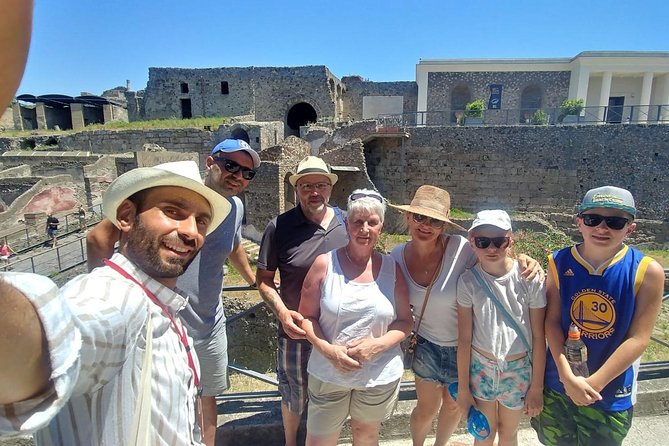
Reviewed · GUIDED TOURS IN POMPEII
Pompeii Ancient City Walking Tour – Italian & English Guide
Pompeii gives you something few ancient sites can: an entire Roman town laid out under your feet. With a guide, you move from the 80 BC amphitheater to temples, villas, and painted rooms while the story of Vesuvius stays tied to real streets and real homes. The tour also handles the first tricky step, meeting you at the ticket office entrance.
I like the focus on major sights, especially the House of the Faun and Villa of the Mysteries. I also like the modest group limit of 25, which should make it easier to hear the guide than on a huge walking tour. Simone has been praised for clear, engaging explanations, and he was willing to repeat points in Italian when needed.
The main catch is cost clarity: the $36.12 tour price does not include Pompeii’s separate €22 admission fee. You should also confirm the meeting details before setting out, since one booking went badly when the operator did not answer questions or appear.
Key points
- See Pompeii’s headline ruins in about two guided hours, including the amphitheater, temples, major villas, and the Villa of the Mysteries.
- Meet at Piazza Porta Marina, where the guide helps with the entrance process but does not pay your €22 park admission.
- Look for the House of the Faun’s Alexander Mosaic reproduction, one of the most memorable art stops on the route.
- Expect an English-led visit, with Italian support possible if the guide is Simone and a mixed-language group needs clarification.
- Continue with a free visit to the Roman Catholic Sanctuary of Pompeii, listed as a one-hour stop on the second day.
- Keep communication records and reconfirm, because the small sample of published feedback includes both high praise and one serious no-show complaint.
Pompeii’s big story, told through ordinary streets
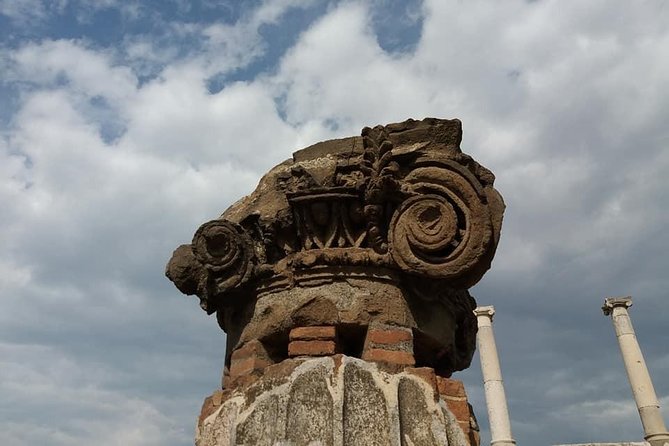
The power of Pompeii is not just in its ruins. It is in the way the ruins fit together. You see an arena, a temple, a wealthy house, and a painted room within the same ancient town. That makes the Roman world easier to picture than a single isolated monument ever could.
This walk gives you a guided introduction rather than hours of independent wandering. The main archaeological visit is scheduled for about two hours, enough to cover the essential sights but not enough to see every street, shop, bath, and house in the park.
That limit is useful if you want a first look or have other plans around Naples, Sorrento, or the Amalfi Coast. It is less suitable if you want a slow archaeological study. Pompeii is enormous, and even the listed stops alone can require steady walking across uneven ancient streets.
At the entrance, look for the Sesto Continente Tours sign at Piazza Porta Marina. The included service is help at the ticket office entrance, not the ticket itself. That distinction matters. You pay the €22 Pompeii admission fee separately, except for the listed free categories, including children under 18, EU seniors over 65, and certain EU journalists, students, and teachers.
More Guided Tours in Pompeii
- Skip the Line Guided Tour of Pompeii led by an Archaeologist
★ 5.0 · 703 reviews - Pompeii private tour with an Official Guide
★ 5.0 · 631 reviews - Pompeii Skip-the-line Tour with Archaeologist Guide
★ 5.0 · 559 reviews
Starting at Piazza Porta Marina
The meeting point puts you at one of the practical gateways to the archaeological park. Your guide meets you there, helps you get through the entrance process, and then leads the group inside.
That assistance is one of the more useful parts of the arrangement. Pompeii’s entrance procedure can feel less simple when you are trying to find the right meeting point, locate your ticket window, and keep a group together. The guide’s role is facilitation, so do not expect admission to be bundled into the tour price.
The listed group limit is 25 people. That is not a private tour, but it is small enough to keep the guide’s explanations within reach. Ask your guide to repeat anything you miss, especially if the group includes both Italian and English speakers.
The tour is offered in English. One account of Simone’s guiding describes him leading the full visit in English for a mixed group, while offering to repeat explanations in Italian when questions came up. That suggests useful flexibility, but you should not assume a fully bilingual presentation at every departure.
The House of the Faun and Alexander’s battle

The House of the Faun is one of Pompeii’s largest residences. Its name comes from the faun statue in the entrance area, while its most famous artwork is the Alexander Mosaic, showing Alexander the Great facing the Persian king Darius III.
The version included in this visit is described as a reproduction of that famous floor mosaic. Even so, it gives you a clear chance to understand how Roman houses used art to display wealth, taste, and education.
This is a good place to pay attention to the difference between a Roman home and a modern house. A grand residence was not merely a private retreat. Its layout, decoration, and artworks made a statement to visitors. The House of the Faun helps your guide explain that social world without reducing Pompeii to a disaster story.
The scheduled stop is about ten minutes. That is enough for a pointed explanation and a look at the key feature, but you will not have much time to linger over every design detail. If this house becomes your favorite stop, note its location so you can return after the guided walk if the site rules and opening conditions allow.
Jupiter, Vesuvius, and the oldest temple
At the Temple of Jupiter, Vesuvius rises behind the remaining columns and foundations. The view links the volcano to the town in a way that can feel more direct than any museum display.
The temple honored Jupiter, Juno, and Minerva, the Capitoline Triad. Jupiter was the chief god, and the temple held an important place in the public and religious life of Pompeii.
Your guide can help you read what remains: the open space of the forum, the temple platform, and the relationship between religion, politics, and public life. The stop is listed at about ten minutes, so expect a concise explanation rather than a long lecture.
I like this pause because it gives you a visual anchor. You are not only hearing about Vesuvius as the force that buried Pompeii. You are seeing the volcano behind a Roman sacred site, exactly the sort of setting that makes the town’s geography easier to grasp.
More Walking Tours in Pompeii
- Pompeii 3 Hours Walking Tour Led by an Archaeologist
★ 5.0 · 126 reviews - Explore Pompeii: 2-Hour Guided Walking Tour with Included Ticket
★ 4.5 · 77 reviews - Pompeii: walking tour with 3D glasses and with entrance ticket
★ 4.5 · 61 reviews - Pompeii walking tour
★ 5.0 · 29 reviews
Apollo’s temple and a very old sacred site
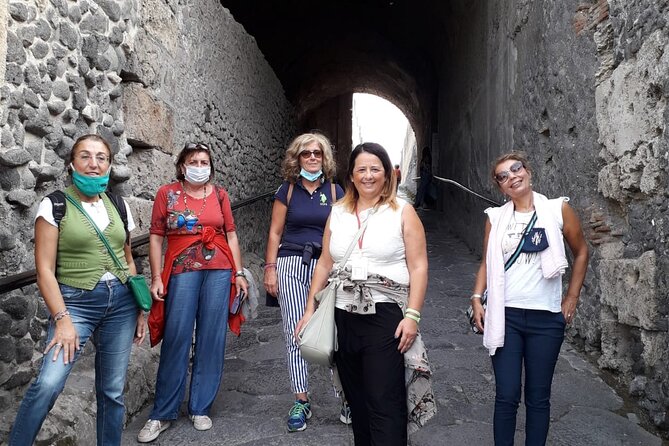
The Temple of Apollo is described as Pompeii’s oldest religious building. Its columns and central statue area show how long this place served as a center of worship before the eruption.
A reproduction of a bronze statue of Apollo is displayed here. The god is shown in a pose associated with a bow and arrow, surrounded by Corinthian columns.
The ten-minute stop gives your guide room to explain the temple’s religious role and the design of its columned court. It also adds variety to the visit. After the grand House of the Faun, you move from private wealth to public worship.
You should listen for how the guide connects the temple to the rest of Pompeii. Ancient religion was not tucked away from daily life. Temples helped shape the town’s public spaces and civic identity.
The Roman amphitheater and the crowd above the sand
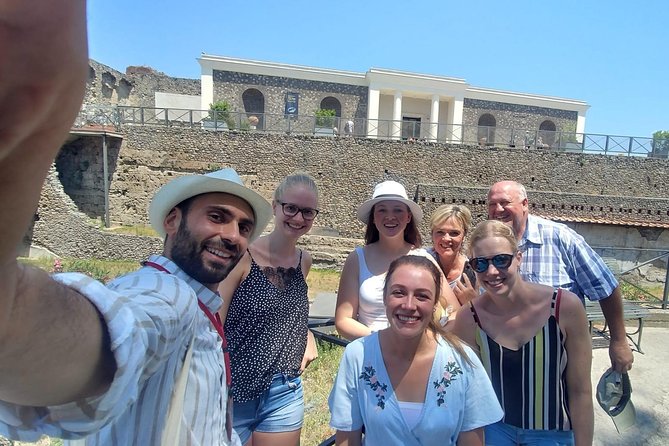
Pompeii’s Roman amphitheater was built in 80 BC and is considered the oldest surviving amphitheater of its type. It hosted gladiatorial shows and could hold up to 20,000 people.
That capacity is striking when you remember the size of Pompeii’s population and streets. The arena was built for mass entertainment, with seating divided into three sections according to social class. The architecture turned rank into a physical arrangement: your place in society affected where you sat.
The amphitheater is one of the stops where a short guide explanation can add real value. On your own, you can see the stone steps and arena. With context, you can picture the organized crowd, the spectacle, and the social rules built into the seating plan.
The stop lasts around ten minutes. You may want to ask where different social groups sat and how the arena fit into the city beyond the walls. Since the tour is time-limited, the guide will likely keep the talk focused.
The House of Menander and the House of the Vettii
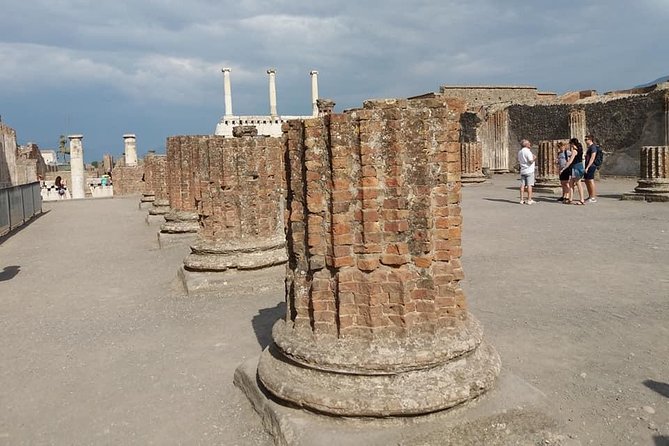
The House of Menander takes its name from a painted image of the Greek poet Menander, not from the original owners. The house belonged to the Poppaei family and contains mosaics and wall paintings.
This stop gives you another useful lesson: ancient buildings are often named for the artwork or feature that helps modern visitors identify them. The name does not always tell you who lived there.
The House of the Vettii offers a different social angle. The brothers Vettii had been enslaved and later became freedmen. They spent heavily on their home, filling it with frescoes and wall paintings that displayed their new social position.
I find that detail especially valuable because it cuts through the idea that Pompeii was made up only of senators and old aristocratic families. The town included people whose fortunes changed, and the Vettii used architecture and decoration to show the world that they had arrived.
Both houses receive about ten minutes. That is enough to focus on the most important rooms and images, but not enough for a full art-history lesson. If you enjoy Roman domestic life, these are the stops where you may wish you had extra time.
Villa of the Mysteries and Pompeii’s most puzzling paintings
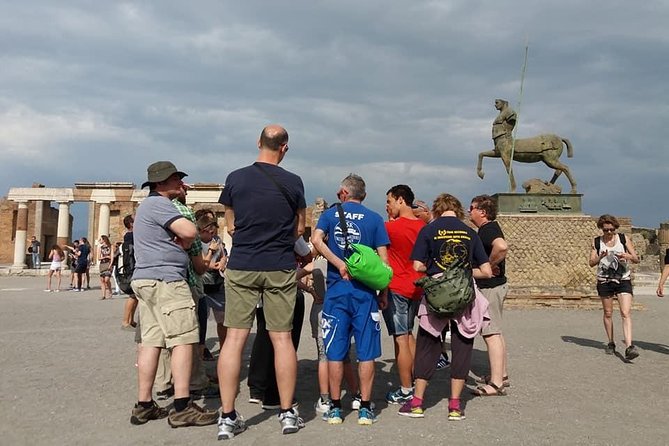
The Villa of the Mysteries is known for nine painted scenes arranged in sequence on the walls of an initiation room. The paintings are connected with a bride’s transition into adult womanhood and the worship of Dionysus, the Greek god of wine and fertility.
This is one of the tour’s most distinctive stops. You are not just looking at decorative wall art. You are trying to follow a visual story whose ritual meaning has drawn attention for generations.
The guide’s role matters here. Without some explanation, the sequence can look like a set of dramatic figures and symbols. With help, you can consider how marriage, adulthood, religious ceremony, and Dionysus may connect within the room.
The stop is listed at ten minutes, which is short for such a complex subject. Still, it gives you a strong reason to choose a guided visit. The paintings reward context more than a quick photograph does.
A separate hour at Pompeii’s Catholic sanctuary
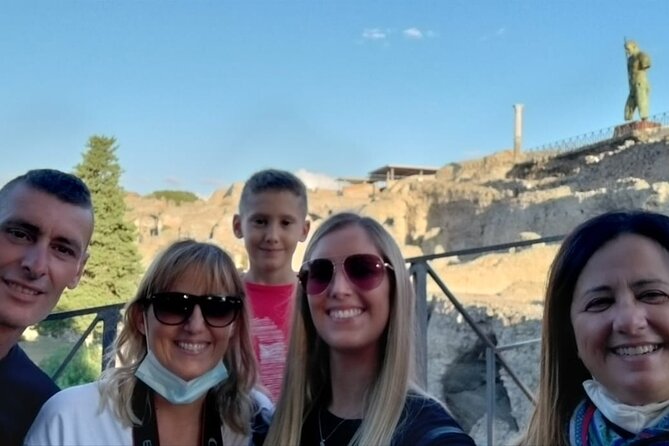
The second part of the program is a free visit to the Roman Catholic Sanctuary of Pompeii, listed for about one hour. This is separate from the archaeological park and offers a very different view of Pompeii.
The ancient city shows Roman civic life, household decoration, and pagan worship. The sanctuary represents the later Catholic identity of Pompeii. Keeping the visit free means you can set your own pace rather than follow another guided lecture.
The schedule calls this a two-day experience, while the archaeological walk itself is about two hours and the sanctuary visit about one hour. Pay close attention to the date and timing supplied when you book. The information provided does not explain the gap between the two portions, so you should not assume they form one continuous walk.
That split can work well if you want time to pause between the ancient ruins and the sanctuary. It may feel less convenient if you expected one compact half-day visit.
What the $36.12 price really covers
At $36.12 per person, the price is reasonable only after you add the €22 Pompeii entrance ticket. Your actual cost is therefore the tour fee plus admission, unless you qualify for one of the listed free categories.
What you are paying for is the guided structure, the explanation at the major sights, and help at the entrance. You are not paying for private guiding, transportation, meals, or a ticket to the archaeological park.
For a first visit, that can be good value. Pompeii is large, and the names of houses and temples can blur together without a plan. A guide gives you a route and helps you spend limited time on the places with the clearest stories.
The value is weaker if you already know Pompeii well or want to wander without a fixed pace. You could enter independently and use a book or map. One dissatisfied customer did exactly that after the guide failed to appear and still reported having a good visit, which shows that Pompeii can reward self-guided exploration too. It does not excuse poor tour communication, but it helps you judge how much structure you need.
Guide quality and communication
The strongest praise centers on the guide’s explanations. Simone is described as engaging and thorough, bringing the eruption story to life while giving serious attention to the art inside the villas.
That balance is important. Pompeii is often presented only as a tragedy frozen in ash. A good visit should also show you the houses, paintings, religious buildings, social divisions, and personal ambitions of the people who lived there.
The published score is 4.5 from 10 ratings, with 90 percent of customers recommending the activity. Those numbers suggest a generally positive experience, but the small sample means you should keep expectations practical rather than treating the score as a guarantee.
The outlier problem is serious: one booking involved unanswered questions, no meeting with the operator, and no refund. Before you leave for Piazza Porta Marina, confirm the meeting instructions and keep your booking information available. This is especially important if you have a tight train or ferry connection.
Who should book this Pompeii walk
I would choose this tour if you want a guided introduction to the main sights and prefer someone else to shape the route. It suits first-time visitors, small families, and anyone who wants the art and architecture explained instead of simply photographed.
It is also a good fit if you want an English guide but may need occasional Italian clarification. Simone’s handling of a mixed group suggests that this can work well, though English is the stated tour language.
I would hesitate if you want a full-day archaeological study. The guided portion is only about two hours, and the ten-minute stops leave little time for side streets or extended viewing. Independent visitors who like to read, sketch, or revisit rooms will probably want more time inside the park.
The physical demands are not described in detail, but most participants can take part, and the tour is near public transportation. Service animals are allowed. You should still expect an outdoor archaeological site and a fair amount of walking.
Should you book it?
Book this tour if you want Pompeii’s major sights explained in a compact English-led walk, especially the House of the Faun, amphitheater, painted villas, and Villa of the Mysteries. The entrance assistance and group size add practical value, and Simone appears to offer the kind of clear storytelling that makes the ruins easier to understand.
Skip it if you want complete independence, a long unhurried visit, or a price that already includes admission. Most important, confirm the meeting arrangements before you go. With that precaution, this is a useful introduction to Pompeii, as long as you understand that the €22 ticket is extra and the sanctuary portion is a separate, self-guided visit.
FAQ
What is the price of the Pompeii walking tour?
The tour costs $36.12 per person. Pompeii admission is not included and costs €22 per person unless you qualify for one of the listed free admission categories.
Where does the tour meet?
You meet the guide at Piazza Porta Marina, 80045 Pompei NA, Italy. Look for the Sesto Continente Tours sign.
Is the Pompeii entrance ticket included?
No. The tour includes assistance at the ticket office entrance, but you must pay the €22 Pompeii admission fee separately.
How long is the guided Pompeii visit?
The guided archaeological park visit lasts about two hours. The program also lists a one-hour free visit to the Roman Catholic Sanctuary of Pompeii.
Is the tour conducted in English?
Yes. English is the stated tour language. Italian clarification may be available, and Simone has repeated explanations in Italian for mixed groups.
What sights are included in the archaeological park?
The route includes the amphitheater, Temple of Apollo, Temple of Jupiter, House of the Faun, House of Menander, House of the Vettii, and Villa of the Mysteries, along with other parts of the site.
How large is the group?
The group can include a maximum of 25 people.
Is the tour suitable for most people?
Most people can participate. The activity is near public transportation, and service animals are allowed.
Can I cancel for a full refund?
Yes, if you cancel at least 24 hours before the start time. Changes or cancellations made less than 24 hours before the start time are not accepted or refunded. If bad weather or too few bookings cancel the activity, you are offered another date or a full refund.
More Ways to See Pompeii
- Pompeii Small Group Tour with an Archaeologist
★ 5.0 · 6,593 reviews - Discover the Ancient Ruins of Pompeii: Day Trip from Rome
★ 3.5 · 2,247 reviews - Pompeii and Herculaneum Small Group Tour with an Archaeologist
★ 5.0 · 1,350 reviews - Pompeii Ticket + Tour with Optional Tasting Experience at Pompeii
★ 5.0 · 663 reviews
Just added around Pompeii
- Wine Tasting and Winery Tour in Vesuvio National Park with Lunch★ 4.5 · 3 reviews
- Wine tasting in the Vesuvius national park★ 5.0 · 3 reviews
- Mt. Vesuvius Wine Tasting and Lunch Experience from Pompeii★ 4.5 · 20 reviews
- Traditional Neapolitan Dinner in Pompei – Villa Franca – Family Restourant★ 5.0 · 8 reviews
- Private Guided Tour and VR Headsets in the Ancient Pompeii★ 5.0 · 3 reviews
- Visit Pompeii with a local expert guide★ 5.0 · 10 reviews
- Tour Mount Vesuvius with Entry Tickets and Round Trip Transfer Included★ 3.5 · 4 reviews
- Vesuvius tour entrance to the crater and return bus★ 4.5 · 9 reviews
Guided Tours in Pompeii, compared.


Pompeii Guided Tour & Horse Riding on Vesuvius with Lunch
Read our review →
Complete Pompeii Skip the Line Tour with Archaeologist Guide
Read our review →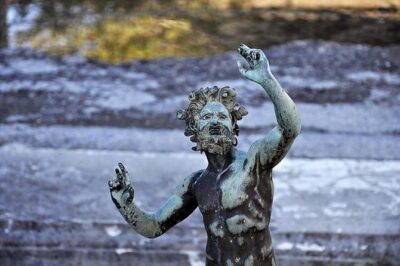
Guided Small Group Tour Max 6 People with Private Option
Read our review →
Pompeii Guided Group Tour with Entry Ticket and Archaeologist
Read our review →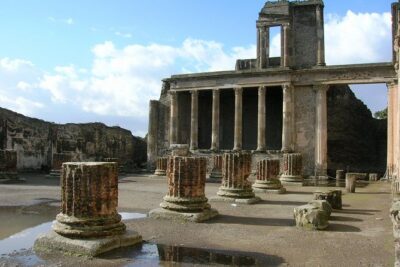
2 Hour Private Tour with an Archeologist Guide
Read our review →
Stories of Pompeii: Small Group tour with archeology expert guide
Read our review →
Mount Vesuvius Tour from Pompeii Led by an Expert Guide
Read our review →Browse the lists this tour appears in