
Reviewed · PRIVATE TOURS IN POMPEII
Guided Private Tour in Pompeii
Pompeii is easiest to understand when someone helps you connect its grand temples with ordinary Roman life. This private walk with archaeologist Tony, also listed as Toni, moves from the old harbor entrance through baths, food stalls, theaters, homes, and the forum, showing how the city worked from morning to night.
I like the private format, which lets your group of up to five set the pace and ask questions freely. I also like the focus on daily routines, from public bathing and fast food to politics, shopping, entertainment, and domestic life.
The main consideration is the price. At $326.72 per group, it can be good value for four or five people, but entry costs an additional 18 euros per person, and the promised food tastings and wine are not clearly listed among the formal inclusions.
Key points to know before you book
- Archaeologist-led storytelling: Tony or Toni brings strong knowledge of Pompeii’s buildings, people, and customs to the walk.
- Private group of up to five: You avoid a large group and can ask for more detail or a quicker pace.
- A broad Pompeii sampler: The route includes theaters, baths, a fast-food counter, villas, temples, markets, and the forum.
- About 2.5 hours on foot: It covers many highlights, but not every corner of the enormous archaeological park.
- Entry is extra: The tour fee does not include the Pompeii Archaeological Park ticket, listed as 18 euros per person, with free entry for visitors under 18.
- Food and wine need checking: The description refers to Roman-style snacks, bakery tasting, and wine in a villa garden, but these are not stated in the formal inclusion list.
What this private Pompeii tour does well
Pompeii can feel like a maze of broken walls unless you have a clear route and a guide who can explain what each space once meant. This tour takes a sensible thematic approach. You are not simply shown ruins. You move through the parts of town that shaped Roman life: entertainment, religion, bathing, shopping, business, politics, and home life.
The private setting matters here. With no other group to slow you down, your guide can spend more time on the subjects that interest you. If you care about Roman food, you can ask more about the thermopolium and market. If architecture is your thing, the House of the Faun and its grand design deserve extra attention.
Tony or Toni is the guide name attached to the experience. The strongest praise centers on clear historical explanations, careful preparation, humor, and storytelling that makes Pompeii’s people easier to picture. One particularly useful feature is flexibility. Tony has adjusted routes for limited time, including a shorter Pompeii visit and, on other arrangements, a much longer day combining Pompeii with the Amalfi Coast.
That said, this advertised experience is the 2.5-hour Pompeii tour. Do not assume the longer eight-hour combination day is part of this booking.
More Guided Tours in Pompeii
- Skip the Line Guided Tour of Pompeii led by an Archaeologist
★ 5.0 · 703 reviews - Pompeii private tour with an Official Guide
★ 5.0 · 631 reviews - Pompeii Skip-the-line Tour with Archaeologist Guide
★ 5.0 · 559 reviews
Starting at Porta Marina Inferiore
The meeting point is Ristorante Suisse at Piazza Esedra, 10/13, near the Pompeii archaeological entrance. The route begins at Porta Marina Inferiore, also called the Piazza Esedra entrance. This is a useful starting point because it gives you a view toward Pompeii’s ancient port area and puts you close to the first major remains.
The formal schedule gives this opening stop only five minutes, so think of it as orientation rather than a full lesson on the port. Your guide will help you understand where the city sat and how visitors once approached it before leading you into the streets.
The site is near public transportation, which helps if you are arriving without a car. The tour ends back at the meeting point, so you do not need to arrange a separate pickup at the far side of the park.
Theaters, temples, and Pompeii’s public life
The first part of the route introduces Pompeii as a working city, not just a disaster site. From a panoramic viewpoint, you see the area of the Teatro Grande and Teatro Piccolo. The larger theater hosted performances, while the smaller one had a more intimate setting for music or speeches.
The itinerary notes that the theater viewpoint is not accessible at the moment. That matters. You should expect an outside or panoramic look rather than a full visit inside both theaters. The stop is short, but it gives useful context for Roman entertainment and public gathering.
At the Temple of Isis, the focus shifts to religion and discovery. The route includes a house opposite the temple, described as important to the discovery of Pompeii. This is a nice example of how excavation, architecture, and modern archaeological work overlap.
You then pass the thermopolium of Vetutius Placidus, one of Pompeii’s best-known food counters. The painted decoration helps explain how Roman fast food worked. The word thermopolium refers to a place selling hot food and drink, making it a useful stop for anyone curious about what ordinary people ate outside the home.
The stop is listed for only five minutes, so you will get the key idea rather than a long food history lesson. If Roman cooking interests you, ask your guide about ingredients and preparation while you are there.
Roman bathing at the Stabian Baths
The Stabian Baths receive 20 minutes, making them one of the more substantial stops. This public complex shows how bathing was woven into Roman social life. The baths were not merely places to wash. They offered a routine of heat, cooling, exercise, conversation, and time with other members of the community.
The experience description frames this as a Roman-style bathing ritual. You should read that as explanation and interpretation, not as a modern spa treatment. You are visiting ancient rooms and learning how they were used.
This stop is especially valuable because the surviving layout helps you picture a complete public service. Pompeii’s baths reveal Roman engineering, social habits, and expectations about cleanliness. They also offer a break from the parade of temples and elite houses, since bathing was part of daily life for a wide range of residents.
You will be walking over uneven ancient surfaces, so comfortable shoes matter. The 2.5-hour length is manageable for many people, but the route still involves steady movement through a large archaeological area.
More Private Tours in Pompeii
- Pompeii Private Tour with an Archaeologist and Skip The Line – 3 hours
★ 5.0 · 564 reviews - Visit in Pompeii – Pompeii Private Tour with Ada
★ 5.0 · 436 reviews - Pompeii Private Tour with an Archaeologist and Skip The Line
★ 5.0 · 391 reviews - Pompeii Vineyard Escape: Private Wine Tasting & Lunch
★ 5.0 · 329 reviews
The Lupanare and the less polished side of Pompeii
The Piccolo Lupanare is the stop that deals most directly with sex work in Roman Pompeii. The itinerary calls it a red-light district and includes a visit to the brothel. Expect a compact, direct look at a part of urban life that is often softened in general descriptions of the city.
This stop can be useful for understanding that Pompeii was not only temples, villas, and public speeches. It was a commercial town with ordinary services and less respectable businesses as well. The guide’s role is important here, since the site needs context and a straightforward explanation of what the rooms and decoration may have meant.
Families should decide in advance if this subject suits everyone in the group. The supplied information does not give a minimum age for the tour, although Pompeii admission is free for visitors under 18.
The House of the Faun and Roman luxury
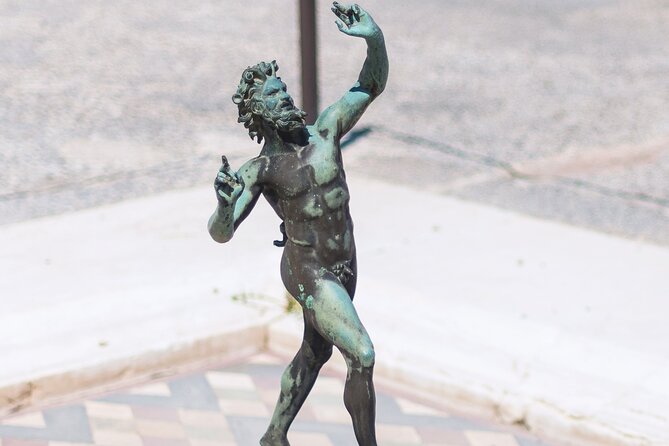
The House of the Faun is one of the tour’s longer stops, with 20 minutes scheduled. It is presented as one of Pompeii’s finest examples of a luxury home, and it gives you a useful contrast with the public baths, food counters, and small commercial spaces seen earlier.
Here, your guide can explain how wealth appeared in Roman domestic architecture. The scale of the house, its decoration, and its formal rooms point to a family with status and money. This is also where the tour description places domestic life, frescoes, a garden setting, and a glass of wine.
There is an important practical distinction. The formal inclusion list promises an authorized archaeologist guide and a Pompeii highlights tour, but it does not specifically list wine, snacks, or a tasting. If those extras matter to you, confirm them before paying. You should not assume every descriptive detail is included in the base price.
Basilicas, Apollo, and the Roman Forum
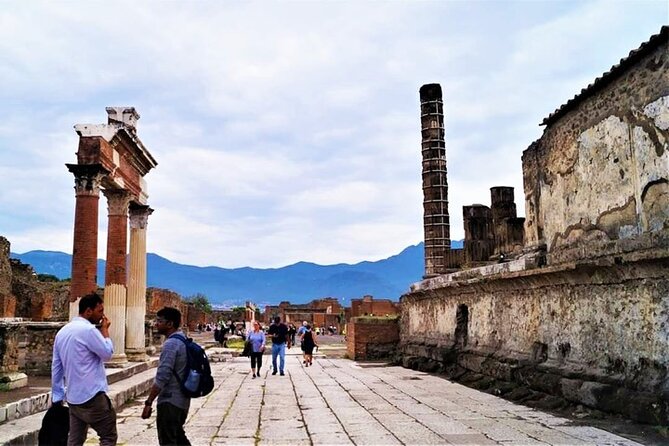
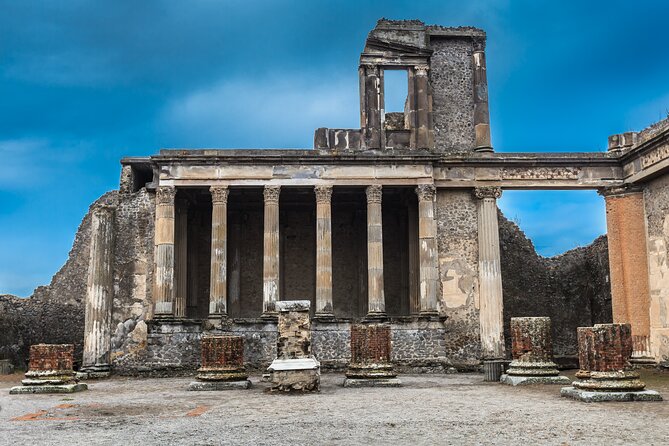
The route then turns toward the heart of public Pompeii. The basilica is described as the Roman parliament, with high-style marble decoration. In Roman cities, a basilica was used for public business, legal matters, and administration. It was not a church in the later Christian sense.
The stop is brief, just five minutes, but it helps you read the forum as a working civic center rather than a field of columns. The Temple of Apollo follows, also with five minutes. This sanctuary is one of the key religious sites in Pompeii and helps explain the role of worship in the city’s public spaces.
The Temple of Venus offers a scenic highlight. Its position and surroundings make it one of the places where you can pause for a broader sense of Pompeii’s setting. The itinerary does not assign much time here, so expect a concise explanation and a quick look rather than a long stop.
The Temple of Jupiter brings you back to civic ceremony and public speech. The itinerary describes it as the sanctuary connected with speeches in the Roman Forum. Along with the basilica and other forum buildings, it shows how religion, government, and public life overlapped in the Roman city.
Finally, you reach the Forum itself, with 15 minutes scheduled. This was the main square and the center of city activity. It is the natural place to pull together what you have seen: food, politics, worship, business, and social life all met here.
The Macellum, frescoes, and evidence of the eruption
The Macellum was the food market, and it receives 15 minutes. This is one of the better stops for making Pompeii feel ordinary. Markets connect the grand public buildings with daily errands, buying food, and preparing meals.
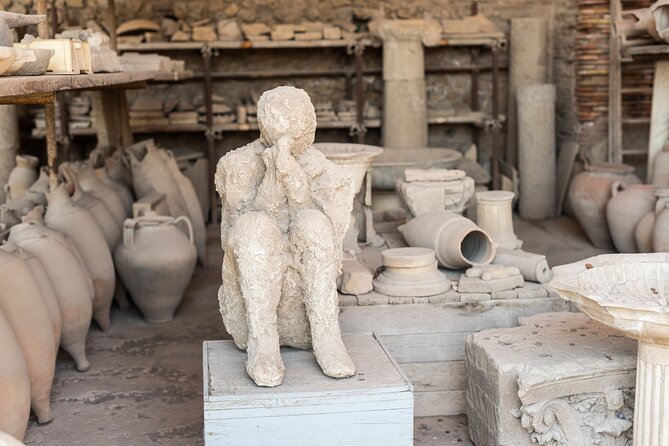
The itinerary also highlights frescoes and body casts here. These can be among the most affecting parts of a Pompeii visit. The paintings show decoration and belief, while the casts confront you with the human cost of the eruption. The guide’s explanation helps keep the experience grounded rather than turning it into a quick shock stop.
The route does not promise every famous building or every major body-cast display in Pompeii. Its strength is range. In a short period, you see enough different building types to understand how the city functioned.
Food, snacks, and the question of what is included
The experience description presents Pompeii through Roman food as well as architecture. It refers to freshly baked bread, Roman-style snacks, ancient ingredients, cooking methods, and a glass of wine in a villa garden. Those details could make the tour especially appealing if you like history through taste and domestic customs.
Still, you should check the exact arrangement before booking. The stated inclusions are the authorized archaeologist guide, private touring, and Pompeii highlights. Admission is specifically excluded, and food or wine is not separately listed as included.
That does not prove the tastings are unavailable. It means the wording is not precise enough to treat them as guaranteed. Ask Capri Top Tours what the food and wine portion includes, where it takes place, and if there is an extra charge.
Is $326.72 good value?
The listed price is $326.72 for the group, up to five people. For one person, that is expensive. For five people, the cost works out to about $65 per person before the 18-euro admission fee. For a couple, it is a much larger investment than joining a shared group.
The value rests on the guide. A private archaeologist-led tour can save you from wandering between disconnected ruins and can make a short visit count. It also gives you the chance to shape the conversation around your interests. Tony’s ability to adjust the pace is useful if you have a train to catch or only a few hours in Pompeii.
Add the admission price for everyone who needs a ticket. Visitors under 18 enter free according to the supplied details, but the tour fee itself remains a group charge.
The best value comes when four or five people share the booking, especially if you want a focused visit and personal explanations. If you are alone or traveling as a couple, compare the cost with a shared tour before deciding.
Timing, pace, and who should book
The available operating hours are Monday through Sunday from 9:00 a.m. to 3:00 p.m., for the period listed as May 28, 2025, through June 16, 2026. Confirmation is provided at booking, and the activity is private.
A 2.5-hour route with 13 stops is brisk. Several sites receive only five minutes, while the baths, lupanare, House of the Faun, Macellum, and Forum receive more time. You will get a strong overview, but you will not study every building in detail.
I would choose this tour if you want:
- A private guide rather than a large group
- A broad introduction to Pompeii
- Clear attention to daily Roman life
- A route that covers both famous and practical city spaces
- Help making sense of the site within a limited schedule
I would look for a longer tour if you want detailed archaeology, extensive time in individual houses, or a slower look at paintings and inscriptions. This route is designed to show you many types of buildings quickly.
Most people can take part, according to the supplied information, and the site is near public transportation. The uneven ground and walking distance are still worth considering. Free cancellation is available if you cancel at least 24 hours before the start time. Inside 24 hours, no refund is provided, and late changes are not accepted.
Should you book this Pompeii tour?
Book it if you are sharing the cost with a small group and want Pompeii explained by an archaeologist rather than viewed as a collection of ruins. The route gives you a useful cross-section of Roman life, and Tony’s storytelling, humor, preparation, and flexibility are major strengths.
Be cautious if you are booking mainly for the food tasting or wine. Those elements appear in the experience description but not in the formal list of inclusions, so confirm them first.
For a first visit with limited time, this is a strong, focused introduction. For serious archaeology fans, a longer private visit may offer better value. The right choice depends less on the number of stops than on how much time you want to give each one.
FAQ
How long does the Pompeii tour last?
The tour lasts approximately 2 hours and 30 minutes.
How many people can join the private tour?
The price covers one private group of up to five people.
Is the Pompeii entrance ticket included?
No. Admission to Pompeii Archaeological Park is listed separately at 18 euros per person. Entry is free for visitors under 18.
Where does the tour begin?
The meeting point is Ristorante Suisse, Piazza Esedra, 10/13, 80045 Pompei, Italy. The route begins at the Piazza Esedra, Porta Marina Inferiore entrance.
Where does the tour end?
The activity ends back at the meeting point.
Who leads the tour?
The tour is led by an authorized archaeologist guide. The guide is referred to as Tony or Toni in the supplied information.
What Pompeii sites are included?
The route includes the Teatro Grande and Teatro Piccolo viewpoint, Temple of Isis, thermopolium of Vetutius Placidus, Stabian Baths, Piccolo Lupanare, House of the Faun, basilica, Temple of Apollo, Macellum, Temple of Venus, Temple of Jupiter, and the Forum.
Does the tour include food or wine?
The experience description refers to freshly baked bread, Roman-style snacks, and wine in a Roman villa garden. The formal inclusion details do not list these items, so you should confirm what is included before booking.
When does the tour operate?
The listed operating hours are Monday through Sunday, from 9:00 a.m. to 3:00 p.m., during the period from May 28, 2025, through June 16, 2026.
Can I cancel for a full refund?
Yes. You can receive a full refund if you cancel at least 24 hours before the experience start time. Cancellations or changes made less than 24 hours before the start time are not refunded or accepted.
More Ways to See Pompeii
- Pompeii Small Group Tour with an Archaeologist
★ 5.0 · 6,593 reviews - Discover the Ancient Ruins of Pompeii: Day Trip from Rome
★ 3.5 · 2,247 reviews - Pompeii and Herculaneum Small Group Tour with an Archaeologist
★ 5.0 · 1,350 reviews - Pompeii Ticket + Tour with Optional Tasting Experience at Pompeii
★ 5.0 · 663 reviews
Just added around Pompeii
- Wine Tasting and Winery Tour in Vesuvio National Park with Lunch★ 4.5 · 3 reviews
- Mt. Vesuvius Wine Tasting and Lunch Experience from Pompeii★ 4.5 · 20 reviews
- Wine tasting in the Vesuvius national park★ 5.0 · 3 reviews
- Visit Pompeii with a local expert guide★ 5.0 · 10 reviews
- Traditional Neapolitan Dinner in Pompei – Villa Franca – Family Restourant★ 5.0 · 8 reviews
- Private Guided Tour and VR Headsets in the Ancient Pompeii★ 5.0 · 3 reviews
- Tour Mount Vesuvius with Entry Tickets and Round Trip Transfer Included★ 3.5 · 4 reviews
- Vesuvius tour entrance to the crater and return bus★ 4.5 · 9 reviews
Private Tours in Pompeii, compared.

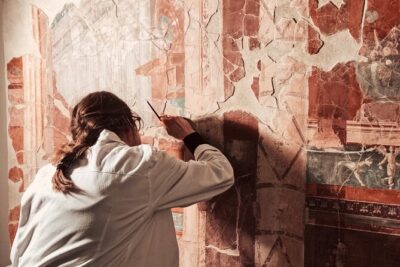
Pompeii Private Tour with an Archaeologist and Skip The Line – 3 hours
Read our review →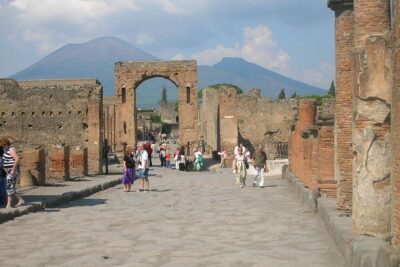
Visit in Pompeii – Pompeii Private Tour with Ada
Read our review →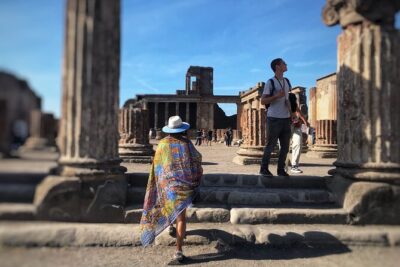
Pompeii Private Tour with an Archaeologist and Skip The Line
Read our review →
Pompeii Vineyard Escape: Private Wine Tasting & Lunch
Read our review →
Private Day Tour to Vesuvius, Herculaneum & Pompeii with Pick Up
Read our review →
Guided Small Group Tour Max 6 People with Private Option
Read our review →
2 Hour Private Tour with an Archeologist Guide
Read our review →Browse the lists this tour appears in