
Reviewed · WALKING TOURS IN POMPEII
Pompeii Walking Tour: The Real History of the Ruins
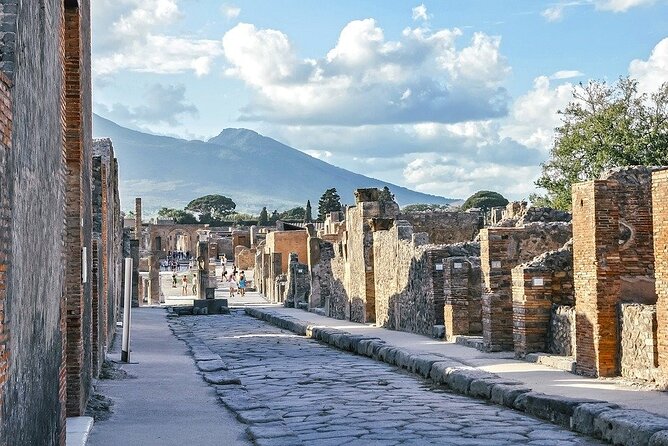
Pompeii is most powerful when you stop seeing it as a field of ruins and start reading it as a real town. This two-hour walk takes you from theaters and family homes to bathhouses, a brothel, shops, and the civic heart of the city, with the eruption of AD 79 always close in mind. The preserved streets and sidewalks are especially striking.
I like the route’s range. You get both public monuments and ordinary details, including a richly decorated home, ancient shops, and the tools once used to check market weights. I also like that the ticket and guide are included for $42.05, which is fair for a compact introduction to a huge archaeological site. The main caution is timing: some guests were told conflicting start times, and one group waited an hour before beginning, so confirm the meeting details before setting out.
Key points to know before you book
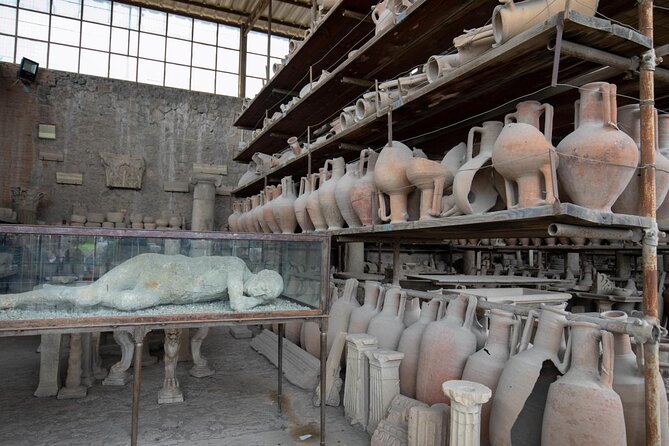
- A two-hour route with strong variety: The walk covers theaters, a wealthy house, baths, a brothel, temples, the Forum, and the old market area.
- The guide makes the difference: Grace, Frederica, Vincenzo, and Igor are named as especially clear, funny, and engaging guides.
- You enter at Porta Anfiteatro: The meeting point is the InStazione help desk, followed by registration and a walk to the archaeological park entrance.
- Ancient street life is a main attraction: Via Stabiana includes sidewalks, pedestrian crossings, shops, and houses that make Pompeii feel like a functioning town.
- The group may be large: The maximum is 35 people, so staying near the guide matters.
- Check the start time carefully: The scheduled departure is 10:30 am, but timing problems have occurred.
Why this two-hour Pompeii walk works
Pompeii can be hard to tackle alone. The site is large, the ruins are spread across a grid of streets, and many buildings need explanation before their importance becomes clear. A guide gives you a route and, just as important, a way to understand what you are seeing.
At $42.05 per person, this is not the cheapest way to enter Pompeii, since the entrance ticket is part of the price. Still, the cost is reasonable if you want context rather than a quick look at stones and columns. You are paying for an English-speaking guide, a planned route, and the chance to connect a theater, bath, shop, home, and forum into one picture of Roman life.
The walk lasts about two hours. That is long enough to see many of the key areas, but not long enough to cover every corner of Pompeii. I would treat it as an introduction, not a complete archaeological study. If you have only a morning, the focused route makes sense. If you want extensive time in villas, gardens, or less-visited streets, you may want more time in the park after the guided portion.
The scheduled departure is 10:30 am every day. You meet at the InStazione help desk in Pompei, register your details, and then go with the guide to Porta Anfiteatro. The end point is at the Pompeii excavation area on Viale delle Ginestre.
More Walking Tours in Pompeii
- Pompeii 3 Hours Walking Tour Led by an Archaeologist
★ 5.0 · 126 reviews - Explore Pompeii: 2-Hour Guided Walking Tour with Included Ticket
★ 4.5 · 77 reviews - Pompeii: walking tour with 3D glasses and with entrance ticket
★ 4.5 · 61 reviews
From Porta Anfiteatro to the Teatro Grande
The first major stop is the Teatro Grande, Pompeii’s large Roman theater. The building was buried by Vesuvius in AD 79 and later uncovered during archaeological work. Its stage once hosted comedies, mimes, pantomimes, and atellane performances.
A guide can help you picture this as a working entertainment venue rather than a silent semicircle of seats. The theater gives the tour an immediate sense of public life. Pompeii was not simply a town of private houses. It had performances, crowds, political activity, religious ceremonies, shops, and public services.
The route also includes the Odeon, a smaller theater dating to the period when the Samnite city was brought into the Roman colony. The two theaters show that entertainment had different settings and audiences. The larger Teatro Grande handled major performances, while the Odeon offered a more compact space.
This is a good opening because the buildings are visually clear and easy to compare. The drawback is that a two-hour route cannot linger over every architectural detail. If theater design is your main interest, you may want to spend extra time here after the group moves on.
Via Stabiana and the feel of an ancient street
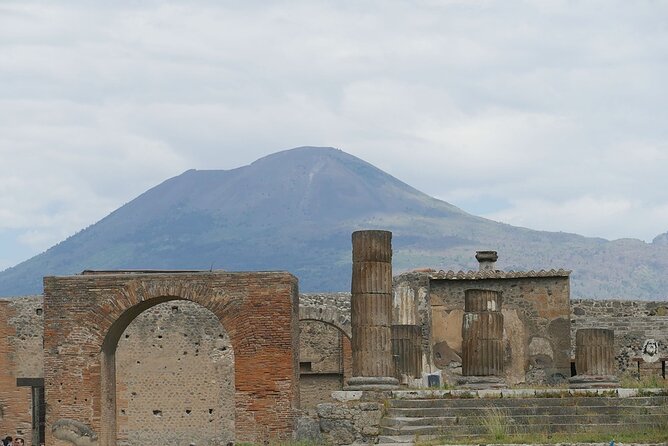
Via Stabiana is one of the walk’s most effective stops. It is a preserved cobbled road with raised sidewalks and pedestrian walkways. Shops and homes line the route, giving you a better sense of how people moved through Pompeii than a single monumental building can provide.
Look at the street as a piece of town planning. The paving, sidewalks, and entrances show how public movement and private life met at the front door. The succession of shops and workshops also helps you picture daily trade. Pompeii becomes easier to understand when you imagine people buying food, visiting a bath, walking to the Forum, and returning home along these same stones.
The route includes restored paintings connected with shops, the thermopolium of Asellina, and artisan workshops known as officinae. The thermopolium was an inn or food-serving establishment, adding a useful everyday detail to the grander monuments.
This section is especially good for anyone who prefers ordinary life to famous statues. It also gives you practical visual clues about the city’s layout. Stay close to the guide here, since the group can spread out along the street and the explanation may continue while you are still looking at the previous shop.
Casa del Menandro, a wealthy Pompeian home
Casa del Menandro is a large urban house covering nearly 1,800 square meters. It was excavated between 1926 and 1932 and offers a look at how a prosperous family lived in Pompeii.
The name comes from an image of the Greek poet Menander found in the house, not from the owner. That small detail matters because it shows how archaeologists often name buildings based on an important feature rather than a confirmed resident. You should not assume that every famous house belonged to the person associated with its name.
The house is valued for its Hellenistic decoration and its scale. It helps explain the difference between a modest dwelling and an elite domus, where architecture, artwork, family identity, and social status all came together. A guide can point out how the structure functioned as a home while also serving as a setting for receiving guests and displaying wealth.
You have about 15 minutes here. That is enough to grasp the house’s size and character, but it is a quick visit. If you enjoy domestic architecture, mosaics, or wall decoration, this is one of the places where you may wish the route had more time.
More ways to see Pompeii:
- Pompeii Small Group Tour with an Archaeologist
★ 5.0 · 6,593 reviews - Discover the Ancient Ruins of Pompeii: Day Trip from Rome
★ 3.5 · 2,247 reviews - Pompeii and Herculaneum Small Group Tour with an Archaeologist
★ 5.0 · 1,350 reviews - Skip the Line Guided Tour of Pompeii led by an Archaeologist
★ 5.0 · 703 reviews
The Stabian Baths and Pompeii’s public routine
The Stabian Baths are described as the oldest bath complex in Pompeii. The eruption preserved both male and female sections, making this one of the most useful stops for understanding public bathing.
Roman baths were not just places to wash. They were part of the rhythm of city life, and the surviving rooms show how carefully these complexes were organized. The division between male and female areas also gives you a concrete example of how public facilities operated.
The route gives you about 15 minutes here. That short stop works well if you need a basic explanation of Roman bathing and the building’s age. It is less satisfying if you want a room-by-room study of the heating system or construction methods, since the guide must keep moving.
I like this stop because it shifts the story from elite homes to shared civic facilities. After seeing how one wealthy household lived, you see a service used by a wider part of the town. The contrast adds depth without requiring a long lecture.
The Lupanar and Pompeii’s less polished side
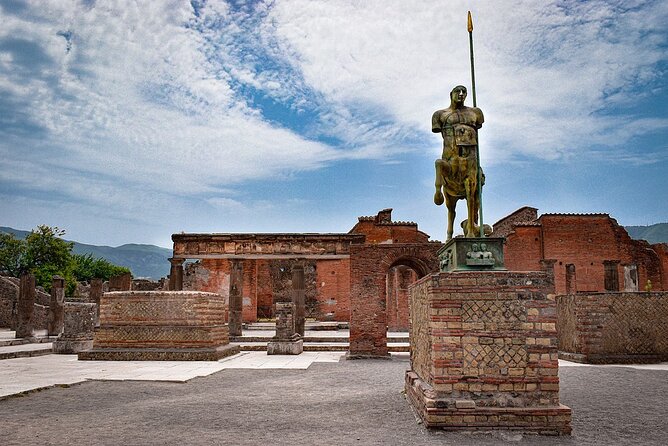
The Lupanar is Pompeii’s best-known brothel. Its walls contain erotic scenes, and the building offers a blunt reminder that Roman urban life included commercial sex as well as religion, politics, theater, and household routines.
You spend roughly 10 minutes here. The visit is brief, which is sensible for a mixed-age group and for anyone who prefers not to make this the center of the day. The paintings are famous, but the guide’s context is more useful than simply pointing them out. This is a place to consider how modern assumptions can distort ancient spaces, since the social rules, working conditions, and meaning of the images belonged to Roman society.
The Lupanar can draw a crowd. Keep your group in sight and do not expect a quiet, private visit. The value of seeing it with a guide is that you can move beyond the predictable jokes and understand why the building is part of Pompeii’s social record.
The Forum, where Pompeii handled public business
The Forum is the civic center of the tour and one of the most important places in Pompeii. Its origins reach back to the Samnite period around the fourth century BC. After the Roman conquest, the area was rebuilt and expanded, especially in the second century BC.
The Forum was surrounded by political, religious, and commercial buildings. Roads connected Pompeii with Neapolis, Nola, and Stabiae, helping explain why this open square mattered so much. It was not an isolated plaza. It sat at the center of movement, trade, public decisions, and worship.
The route includes the Temple of Jupiter, the Basilica, the Temple of Apollo, and the granaries. You have only about five minutes listed for the Forum itself, so expect an overview rather than a long architectural reading. That is one of the tour’s clearest limits. The Forum deserves time, but the guide is balancing it against several other important buildings.
The Temple of Jupiter later became the Capitolium, dedicated to Jupiter, Juno, and Minerva. Its basement held sacred objects, offerings, and the public treasury, known as the aerarium. This detail turns the temple from a backdrop into part of the city’s financial and religious system.
The Basilica was an imposing building from the second century BC. Think of it as an indoor civic setting where business and legal matters could continue when conditions made the open Forum less practical. The judge sat on a raised tribunal, reached by a removable wooden staircase. The unusual design was meant to protect judges from attack by condemned people.
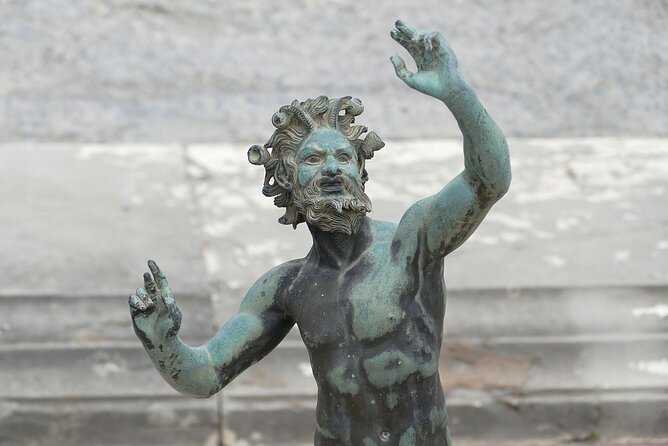
The Temple of Apollo offers another layer. Apollo’s worship reached Italian populations through the Greek world, but by the period just before the eruption, Jupiter’s Capitolium had become more important. Bronze statues of Apollo as an archer and the goddess Diana are visible in the area.
These stops move quickly, but together they show how religion, law, public money, and politics occupied the same civic center. I find that combination more useful than treating each temple as an isolated monument.
The granaries and the practical side of ancient trade
The granaries area now holds materials found during excavations, but it once served as a market for cereals and legumes. The absence of plaster led archaeologists to think the structure may not have been finished when the eruption struck.
The most revealing feature is the ponderary table. It held the tools used to check measurements and convert the different units used by merchants from across the empire into the units accepted in Pompeii.
This is a small but memorable detail. Temples and statues tell you about public ideals. A measurement table tells you how commerce actually worked. It also reminds you that Pompeii was connected to a wider Roman economy, with merchants bringing different systems of weight and measure into the same marketplace.
The granaries are easy to overlook if you focus only on dramatic buildings. The guide’s explanation gives the area a purpose and helps you see why excavated objects were gathered there. It is a fitting final note for a tour that keeps returning to daily life.
Guide quality, group size, and timing
The guide is the heart of this experience. Grace is described as funny, highly informed, and able to make two hours pass quickly. Frederica is singled out for careful explanations and humor. Vincenzo is praised for keeping the group included, explaining each site clearly, and making Pompeii’s people and routines feel relatable. Igor is described as very well prepared, engaging, and professional.
Those names matter because guide quality can vary from day to day. The overall format is strong, but you are not guaranteed one particular guide unless the operator confirms that in advance. The English-language tour is the listed option.
The maximum group size is 35. That is manageable inside a major archaeological site, but it is not intimate. You may need to stand near the guide, especially in the Lupanar, on Via Stabiana, or around the Forum. A group of this size can also slow down at narrow entrances.
Timing deserves attention. The official departure is 10:30 am, yet one booking had a conflicting pickup time and another group did not begin until 11:30. I would check the confirmation carefully and arrive early at the InStazione help desk. If you are connecting from Naples, extra help with trains and directions may be available, but the tour price does not list transport or lunch as included.
Who should book this Pompeii tour
I would choose this walk if you want a clear first look at Pompeii and prefer an expert to organize the site for you. It suits first-time visitors, history fans who want Roman daily life explained, and anyone with a limited morning in the area.
It is also a good fit if you care about more than the headline ruins. The theaters are here, but so are the baths, shops, household spaces, market equipment, and street design. That balance gives you a fuller picture of the town.
I would think twice if you want a private experience, a slow photography walk, or time in every major building. A group of up to 35 and a two-hour limit mean you will cover ground at a steady pace. You also need to arrange your own lunch.
Free cancellation is available if you cancel at least 24 hours before the local start time. The activity may also be moved or refunded if poor weather or low enrollment causes cancellation. Most people can participate, and service animals are allowed.
Should you book it?
Book this tour if you want Pompeii explained rather than simply entered. At $42.05, the combination of admission and a guided route is good value, especially when the guide brings out details such as the ancient measurement table, the removable courtroom staircase, and the sidewalks along Via Stabiana.
The best reason to book is the quality of the guiding. Grace, Frederica, Vincenzo, and Igor are all associated with the kind of clear, good-humored storytelling that helps a large ruin site make sense. Just confirm the start time, arrive at the InStazione help desk early, and view the two hours as a well-chosen introduction rather than the final word on Pompeii.
FAQ
Where does the Pompeii walking tour start?
The tour starts at the InStazione help desk in Pompei, Italy. After registration, you go with the guide to the Porta Anfiteatro entrance of the archaeological park.
What time does the tour depart?
The scheduled departure is 10:30 am every day. Because timing confusion has occurred, check your confirmation and meeting instructions carefully.
How long is the Pompeii tour?
The guided visit lasts approximately two hours.
Is the Pompeii entrance ticket included?
Yes. The price includes the entrance ticket and guided tour.
Is lunch included?
No. Lunch is not included in the tour price.
What language is the tour offered in?
The tour is offered in English.
More Ancient Sites near Pompeii
- Guided Tours of Pompeii Excavations Historical and Cultural Itineraries
★ 5.0 · 56 reviews - Naples: Street Art & History Tour in the Spanish Quarters
★ 4.9 · 540 reviews - Naples: Historic Center and Sansevero Chapel Walking Tour
★ 4.8 · 208 reviews - 360 ° Naples. THE historic center of the city
★ 5.0 · 85 reviews
Just added around Pompeii
- Wine Tasting and Winery Tour in Vesuvio National Park with Lunch★ 4.5 · 3 reviews
- Mt. Vesuvius Wine Tasting and Lunch Experience from Pompeii★ 4.5 · 20 reviews
- Wine tasting in the Vesuvius national park★ 5.0 · 3 reviews
- Traditional Neapolitan Dinner in Pompei – Villa Franca – Family Restourant★ 5.0 · 8 reviews
- Private Guided Tour and VR Headsets in the Ancient Pompeii★ 5.0 · 3 reviews
- Visit Pompeii with a local expert guide★ 5.0 · 10 reviews
- Tour Mount Vesuvius with Entry Tickets and Round Trip Transfer Included★ 3.5 · 4 reviews
- Vesuvius tour entrance to the crater and return bus★ 4.5 · 9 reviews
Walking Tours in Pompeii, compared.
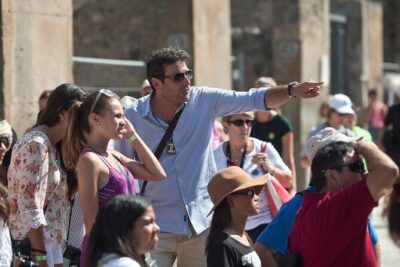
Pompeii 3 Hours Walking Tour Led by an Archaeologist
Read our review →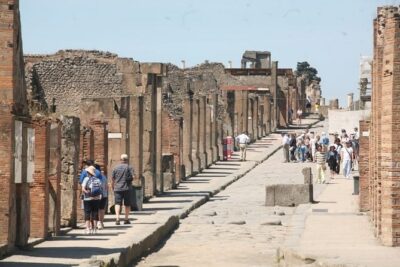
Explore Pompeii: 2-Hour Guided Walking Tour with Included Ticket
Read our review →
walking tour with 3D glasses and with entrance ticket
Read our review →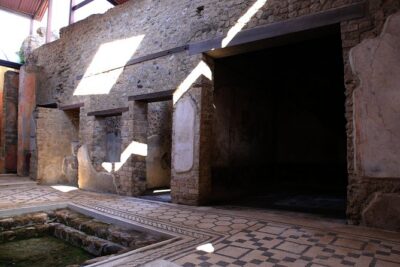
Small Group Guided Walking Tour of Ancient Pompeii Highlights
Read our review →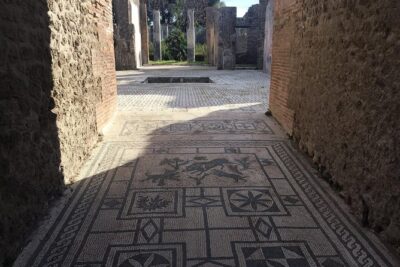
3-Hours Private Walking Tour in Pompeii with an Archaeologist
Read our review →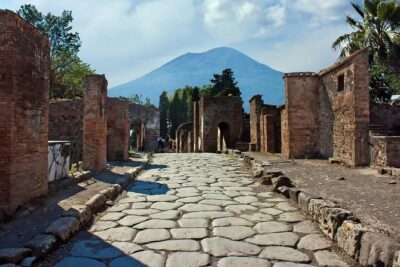
2 Hours Private Walking Tour in Pompeii with an Archaeologist
Read our review →Browse the lists this tour appears in