
Reviewed · POMPEII TOURS FROM NAPLES
Pompeii: Skip-the-Line Entry Ticket with Audio Guide or Tour
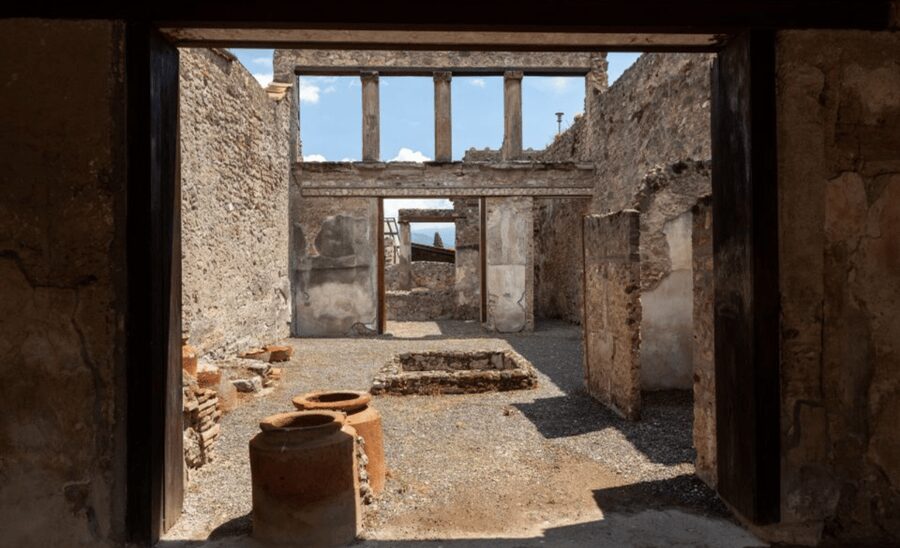
Pompeii is not a small archaeological stop you can check off in half an hour. It is a buried Roman city of streets, homes, temples, theaters, fountains, and shops, with Mount Vesuvius often visible behind the ruins. I especially like the fast-track entry and the freedom to choose between a phone-based audio guide and a live art historian.
I also like the easy ticket pickup at Piazza Esedra, right by the entrance, and the chance to stay inside after a two-hour guided visit. The main caution is the audio guide: it can be useful and concise, but automatic playback and GPS locating have not always worked smoothly, so bring a map, headphones, and a charged phone.
Key points to know before booking
- Fast-track entry: Collect your official ticket at the Vox City point in Piazza Esedra, then avoid the main ticket-buying queue.
- Two ways to explore: Choose a flexible audio guide or a live tour in English, Spanish, or Italian.
- A huge ancient city: Pompeii covers roughly 44 square hectares, so two hours gives you highlights, not every corner.
- Bring your own equipment: Headphones and a charged smartphone are required for the digital audio guide.
- Important limitation: Your ticket does not include the suburban villas, including the Villa of the Mysteries.
- Strongest advantage of the live tour: A guide can steer you through crowded areas and explain what matters without making you hunt through an app.
What the Pompeii ticket really gives you
For $37 per person, this experience combines admission with fast-track access and either a digital audio guide or a live guided tour, depending on the option you select. The price is higher than Pompeii’s basic admission alone, but you are paying for convenience, booking support, and added interpretation.
That extra cost makes the most sense during busy periods, when the ticket queue can eat into your day. It also helps if you want to arrive with an entry plan already arranged rather than sorting everything out at the archaeological site.
The experience is sold as a two-hour activity, but the ticket does not require you to leave when a guided visit ends. A two-hour tour can introduce the main areas, and you may continue exploring afterward if the site is open and you still have energy. Several hours is a more realistic amount of time if you want to see Pompeii properly.
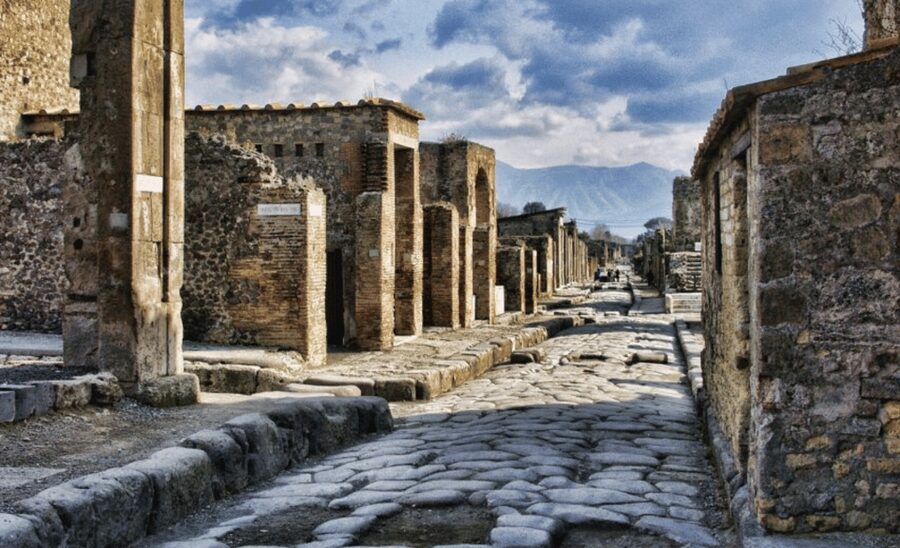
This matters because the ruins are spread across a large area. You are not simply walking around one forum and a single villa. You are crossing an ancient city, often on uneven stone streets, while stopping to look into houses and public buildings.
More ways to see Pompeii:
- From Naples: Pompeii Ruins & Mount Vesuvius Day Tour
★ 4.3 · 11,459 reviews - Naples or Sorrento: Full-Day Pompeii and Mount Vesuvius Tour
★ 4.6 · 4,235 reviews - Pompeii & Mt.Vesuvius Day Tour from Naples with Pizza Lunch
★ 4.0 · 2,901 reviews
Picking up your ticket at Piazza Esedra
The meeting point is the Vox City information point in Piazza Esedra, in front of Hotel Vittoria. It is close to the excavation entrance, which makes the arrangement fairly simple once you are in the right square.
You exchange your voucher for the official Pompeii entry ticket at the information point. Have the voucher ready on your phone and arrive a few minutes early, especially if you booked the live tour. Staff have also helped with the audio guide download when visitors had trouble getting the app working.
The ticket collection is one of the better parts of this arrangement. You are not wandering around a distant office, and the entrance is nearby. Parking is reported across the street, though the information provided does not promise a parking space or a particular price, so treat that only as a possible convenience.
The main thing to understand is that this is not always a mobile ticket you scan directly at the gate. You normally collect the official ticket first. That extra step is easy, but do not walk straight to the entrance assuming your booking voucher alone is the admission ticket.
Choosing between the audio guide and live tour
The self-guided option suits you if you dislike being tied to a group. You can stop for photographs, skip rooms that interest you less, and spend longer at the House of the Faun, the Forum, or the temples. The audio commentary is available in English, French, Spanish, German, and Italian.
The digital map lets you select points of interest on your phone. Some sections are short and easy to absorb, which works well for families or anyone who does not want a long lecture at every building. You can also use the map to choose your own route rather than following a fixed itinerary.
The trade-off is that the app requires more attention than a traditional guide. You may need to select each location manually, and some users have found that the site names do not match the labels they see on the ruins. The automatic location feature is intended to start commentary as you reach a point, but it has not worked consistently for everyone.
Download the audio guide before you arrive. The QR code is provided on the voucher, and the site’s internet connection may not be reliable enough for a rushed download. Bring headphones, a fully charged phone, and a power bank if you plan to stay several hours.
The live guided option is the better choice if Pompeii feels overwhelming or if you want a clear story rather than separate snippets about individual buildings. Tours are offered in English, Spanish, or Italian, and they leave at the booked time.
Named guides praised in the supplied information include Grace, Mario, and Maria. Grace was described as warm, quick-witted, and clear in English. Mario was singled out as an engaging guide, while Maria was praised for keeping the explanations lively. One particularly experienced guide had spent 45 years at Pompeii, a useful reminder that the quality of the live option can add real value.
A live tour also helps with crowds. One guide was reported to navigate queues and busy sections while fitting a great deal into two hours. That is a strong argument for paying extra during high season.
Walking through the Forum with Vesuvius behind you
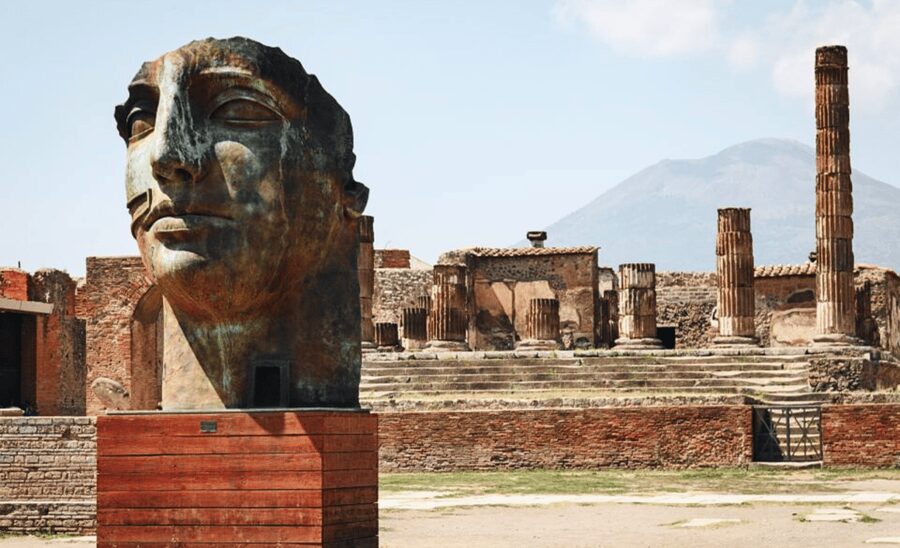
The Forum is the natural place to understand Pompeii as a city rather than a collection of ruins. This broad public area once served religious, political, and commercial purposes. From here, the scale of the settlement becomes clear, especially with Vesuvius in the background.
The mountain is not just scenery. Its presence connects the daily life of Pompeii with the eruption in 79 C.E. The same volcano that gives the view its drama also buried the city under ash and volcanic material, preserving details that would otherwise have vanished.
Take your time here before rushing into the smaller buildings. The Forum helps you see how the temples, markets, streets, and homes relate to one another. If your audio guide offers too many points at once, use the Forum as your anchor and branch out from there.
More Skip-the-Line Tickets in Naples:
- Herculaneum: Skip-the-Line Guided Tour with Archaeologist
★ 4.8 · 3,439 reviews - Mount Vesuvius: Skip-the-Line Ticket and Smart Digital Guide
★ 4.2 · 2,780 reviews - From Naples: Pompeii Skip-the-Line Entry Ticket and Tour
★ 4.4 · 2,753 reviews - From Naples: Pompeii Guided Tour with Skip-the-Line Tickets
★ 4.8 · 1,171 reviews
Temples, theaters, and public buildings
The temples of Venus, Apollo, and Jupiter give the visit a strong religious focus. Their surviving columns and foundations show the importance of public worship, while their positions around the city help you read Pompeii’s layout.
The theaters offer a different kind of connection. They remind you that Pompeii was not only a place of politics and religion but also of entertainment. The grand theater area is a good place to pause, especially if you are tired from walking the stone streets.
You can also look for the aqueducts and fountains that supplied water around the city. These remains are less immediately dramatic than a painted villa, but they explain how ordinary residents managed daily life before the eruption.
The public baths are another rewarding stop. Intricate mosaics and surviving architectural details show that bathing was a social and public activity, not simply a practical chore. Your guide may give only a short description here, so a live guide is helpful if you want to understand how the buildings worked.
Houses, mosaics, and Pompeii’s everyday details
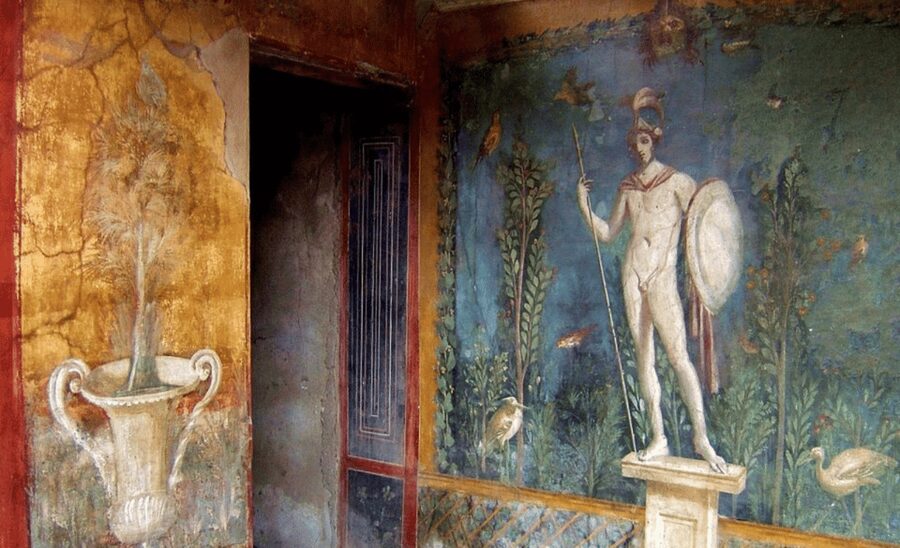
The House of the Faun is one of the essential residential sights. Its size and decoration give you a sense of how wealthy Roman households displayed status. Look beyond the grand rooms and imagine the work required to maintain such a home.
Other residences reveal smaller, more personal details. Sirico’s house is known for the inscription Salve lucru, meaning Welcome, profit. That brief message has the dry humor of a business owner who wanted money coming through the door.
Wine jars labeled Vesuvinum offer another memorable detail. The name plays on Vesuvius and vinum, the Latin word for wine. Small discoveries like this keep Pompeii from feeling like a silent collection of broken walls. They show how people joked, traded, decorated, and advertised.
The marketplaces add another layer. You may find counters, storage areas, and traces of commercial activity that make it easier to picture the city before the eruption. The site is at its best when you move between grand monuments and ordinary objects.
The plaster casts and the eruption of 79 C.E.
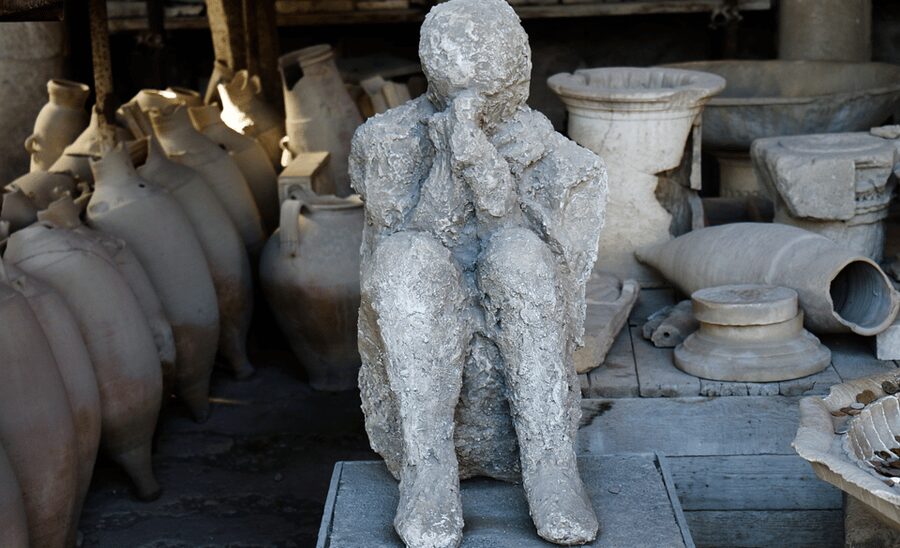
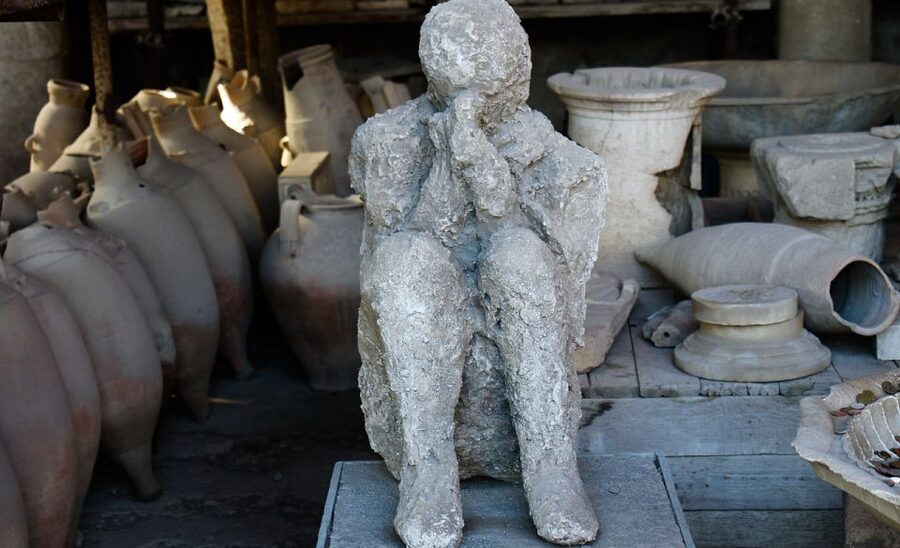
The plaster casts are among Pompeii’s most affecting sights. They preserve the shapes of victims caught during the eruption, making the disaster personal in a way that walls and columns cannot.
Give these casts the time and respect they deserve. They are not simply dramatic photo stops. They show the sudden human cost of the eruption and explain why Pompeii can feel both fascinating and unsettling.
The city was devastated, yet the ash also preserved streets, homes, paintings, inscriptions, and household objects. That strange balance is the central idea of the visit. Pompeii gives you a glimpse of Roman life because destruction sealed so much of it in place.
A live guide can explain this context as you move through the site. An audio guide can provide the facts, but you will need to connect the separate recordings yourself.
Why two hours may not be enough
The advertised duration is two hours, and that is enough for a focused introduction. It is not enough to see every important area at a leisurely pace, particularly if you stop often for photographs or if some buildings are temporarily closed.
The archaeological area covers roughly 44 square hectares. Even a fast walker will spend time crossing from one part to another, and the uneven streets can slow you down. The information supplied also describes the site as covering about 50 hectares, but either way, the practical message is the same: Pompeii is large.
If you choose the live tour, use the two-hour route as an overview. Afterward, continue independently to the places you missed. This combination gives you the guide’s structure without sacrificing the freedom to explore.
If you choose the audio guide, set a personal limit before you start. The app contains many points of interest, and trying to hear every recording can turn the visit into a checklist. Pick the Forum, one or two major houses, the temples, the theater, the baths, and the casts first.
Heat, rain, batteries, and sensible planning
Pompeii has little shelter in many open areas. Summer heat can make the site tiring, even when the forecast suggests mild weather. Bring water, especially if you plan to stay beyond the two-hour activity.
Rain creates a different problem. Wet stone streets can be uncomfortable, and heavy rain may shorten your visit. Check the forecast and bring suitable clothing rather than assuming the weather will hold.
Your phone is central to the audio option, so battery power matters. The audio guide includes many locations, and repeated GPS use can drain a phone. Headphones are not included, and neither is a mobile device.
You should also carry the map. Some people found the audio map helpful, but others had trouble understanding the route or locating the correct building. A paper map from the site may help, though the supplied information notes that one purchased map was not very useful.
Who gets the most value from this experience
I would choose the audio option if you want independence, short explanations, and the ability to move at your own speed. It works best when your phone is charged, your audio guide is downloaded in advance, and you are willing to check the map rather than rely entirely on automatic location.
I would pay extra for the live guide if this is your first visit, you have limited time, or you want the story of Pompeii to connect from one sight to the next. The live option is also a sensible choice for anyone who finds apps frustrating.
Families may appreciate the short audio segments, since children can move on before attention fades. Older relatives without smartphones may need a different arrangement, because the included guide depends on your own phone and headphones.
The experience is less suited to someone expecting a fully planned route through every major building. The audio guide offers many points but does not always identify the most important ones. You need to make some decisions yourself.
Booking, cancellation, and the final decision
You can cancel up to 24 hours before the activity for a full refund, and the reserve-now, pay-later option gives you some flexibility. The listed price is $37 per person, with booking fees included.
I would book this option when avoiding the ticket queue matters, especially in a busy season or when you have a train, lunch, or other timed plan afterward. The nearby ticket pickup and fast entry remove much of the uncertainty at the start of the day.
I would not choose it solely for the audio guide. That part can be useful, but the app has had download, GPS, autoplay, and labeling problems. If interpretation is important to you, select the live guide and arrive five minutes early for the scheduled departure.
Should you book the Pompeii skip-the-line ticket?
Yes, if you want a simple way into Pompeii and value fast-track access. The ticket pickup is close to the gate, the site is extraordinary, and you can continue exploring after the two-hour guided portion.
Choose the live tour for the clearest introduction, particularly in crowded conditions. Choose the audio guide for flexibility, but prepare it before arrival and bring your own map, headphones, and backup battery.
At $37, this is not the cheapest way to enter Pompeii. It can still be good value when the queue is long or your time is tight. Just remember that Pompeii is a full ancient city, not a quick attraction, and plan your visit around the size of the site rather than the advertised two-hour duration.
FAQ
Where do I collect the Pompeii entry ticket?
Collect your official ticket at the Vox City information point in Piazza Esedra, in front of Hotel Vittoria. The point is close to the archaeological site entrance.
Does the ticket skip the entrance line?
Yes. The ticket includes skip-the-line access to the ticket queue, allowing you to avoid waiting to buy admission at the site.
How long does the activity last?
The booked activity lasts two hours. You may usually remain inside Pompeii after a guided tour and continue exploring, and visitors commonly spend two to four hours at the site.
Is a live guide included?
A live guide is included only if you select the guided tour option. Guided tours are available in English, Spanish, or Italian.
Which languages are available for the audio guide?
The audio commentary is available in English, French, Spanish, German, and Italian.
Do I need my own phone and headphones?
Yes. You need a charged smartphone and headphones for the digital audio guide. Headphones and a mobile device are not included.
How do I download the audio guide?
Scan the QR code on your voucher and download the audio guide before arriving. Downloading it in advance is wise because the internet connection at the meeting point or archaeological site may be unreliable.
Does the ticket include the Villa of the Mysteries?
No. The ticket does not include access to the suburban villas, including the Villa of the Mysteries, Villa of Diomedes, and Villa Regina.
Can I cancel the booking?
Yes. You can cancel up to 24 hours in advance for a full refund. The reserve-now, pay-later option lets you hold the booking without paying immediately.
More Audio Tours in Naples
- Naples: Royal Palace Entry Ticket with Digital Audio Guide
★ 4.1 · 146 reviews - Vesuvius National Park Skip-The-Line Ticket and Audio Guide
★ 3.4 · 141 reviews - Interactive audio guide for the historic center of Naples
★ 5.0 · 43 reviews - Mount Vesuvius Skip the Line Ticket + Multilingual Audio Guide
★ 4.0 · 32 reviews
More Self-Guided Tours in Naples
- Herculaneum: Skip-the-Line Entry Ticket with Audio Guide
★ 4.3 · 870 reviews - Naples: National Archaeological Museum Ticket & Audio App
★ 4.4 · 617 reviews - Naples: Pompeii Self Guided Audio Tour
★ 3.9 · 211 reviews - Naples: National Archaeological Museum audio guide
★ 4.0 · 155 reviews
Just added around Naples
- Wine tasting in the Vesuvius National Park★ 3.5 · 4 reviews
- Naples: Guided Walking Tour★ 4.7 · 63 reviews
- Naples: Pompeii and Vesuvius Skip-the-Line Day Trip★ 3.8 · 32 reviews
- Visit the Museum MANN with a professional guide★ 5.0 · 3 reviews
- Walking-tour of Naples hystorical Centre★ 4.4 · 4 reviews
- Vesuvius – Herculaneum – Pompeii Excavations Tour★ 4.2 · 9 reviews
- Pompeii: Vesuvius at Sunset★ 3.5 · 31 reviews
- Vesuvius and Herculaneum from Naples★ 3.7 · 29 reviews
Pompeii Tours from Naples, compared.

Pompeii Small Group Tour with an Archaeologist
Read our review →

Pompeii & Mt.Vesuvius Day Tour from Naples with Pizza Lunch
Read our review →

Pompeii & Mt Vesuvius All-Inclusive Small Group w/ Lunch
Read our review →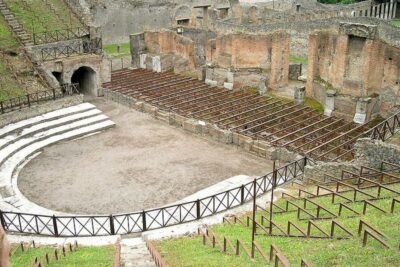

Pompeii & Amalfi Coast Full-Day Trip with Lunch
Read our review →Browse the lists this tour appears in