
Reviewed · PRIVATE TOURS IN POMPEII
Half-Day Exclusive Private Tour of Pompeii and Herculaneum
The clever part of this private Pompeii and Herculaneum tour is the comparison. Pompeii gives you a broad Roman town, with streets, shops, public buildings, and homes. Herculaneum gives you a closer look at domestic life, including delicate objects preserved by volcanic material. Seeing both makes each site easier to understand.
I like the skip-the-line admission and the private format. You avoid spending precious time at entrance queues, then get one guide’s full attention as you move through two large archaeological parks. I also like the included transfer from Pompeii to Herculaneum, since arranging that short hop yourself would cut into a four-hour visit.
The main drawback is the price: $4,655.67 per person is a serious splurge, even with group discounts mentioned. Four hours is also a brisk schedule, and the price makes the most sense for a private group that values flexibility, not for a solo visitor watching every euro.
Key points at a glance
- Two very different Roman towns: Pompeii shows the plan and public life of a major commercial center, while Herculaneum preserves more fragile household remains.
- Two hours at each site: The schedule covers the major areas, but leaves little room for a slow, wandering visit.
- Private guide, private group: Your guide can adjust explanations and breaks to suit your interests and pace.
- Carla is one guide named in the tour details: She has helped families with children and teenagers stay engaged, and built the visit around their interests.
- Transport connects the sites: The transfer from Pompeii to Herculaneum is included, with the tour ending at Herculaneum.
- Flexible cancellation: You can cancel for a full refund up to 24 hours before the start time.
Why seeing Pompeii and Herculaneum together works
Pompeii and Herculaneum were both buried by the eruption of Mount Vesuvius in AD 79, but they offer different kinds of archaeological drama. Pompeii spreads across a much larger area and helps you picture how a Roman town worked. Herculaneum is smaller and often feels more intimate, with better-preserved building materials and household details.
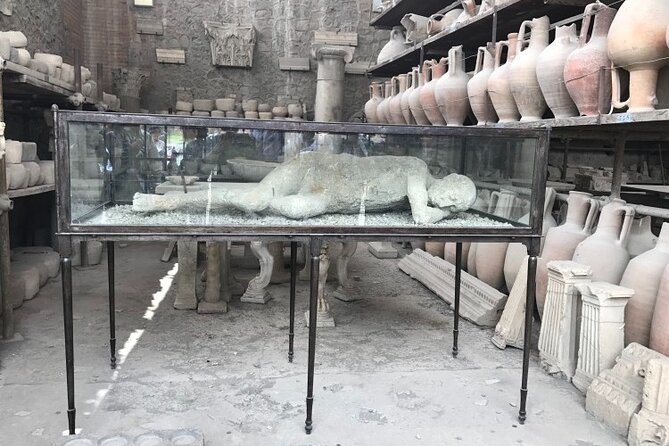
I like this pairing because it prevents Pompeii from becoming a blur of old walls. At Pompeii, your guide can point out how roads were mapped, how homes were arranged, how sewage systems worked, and how shops lined the streets to attract passing trade. Then Herculaneum gives those systems a human scale. You see the rooms where people lived, the baths they used, and materials that usually vanish over two thousand years.
The four-hour format is built around this contrast. You spend about two hours at each site, with admission included. That is enough time for a guided introduction to the main sights, but not enough to inspect every corner. If you want a slow archaeological study, book separate visits. If you want a clear first look at both sites in one day, the plan is sensible.
More Private Tours in Pompeii
- Pompeii private tour with an Official Guide
★ 5.0 · 631 reviews - Pompeii Private Tour with an Archaeologist and Skip The Line – 3 hours
★ 5.0 · 564 reviews - Visit in Pompeii – Pompeii Private Tour with Ada
★ 5.0 · 436 reviews
Starting at Pompeii’s Via Villa dei Misteri entrance
The tour begins at Via Villa dei Misteri, 1, in Pompeii. Your guide meets you there and takes you directly into the archaeological park with skip-the-line entry. This matters most during busy periods, when an entrance queue can quickly eat into a half-day visit.
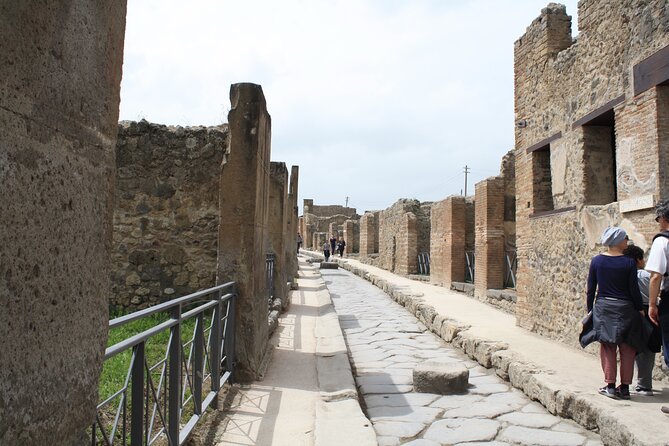
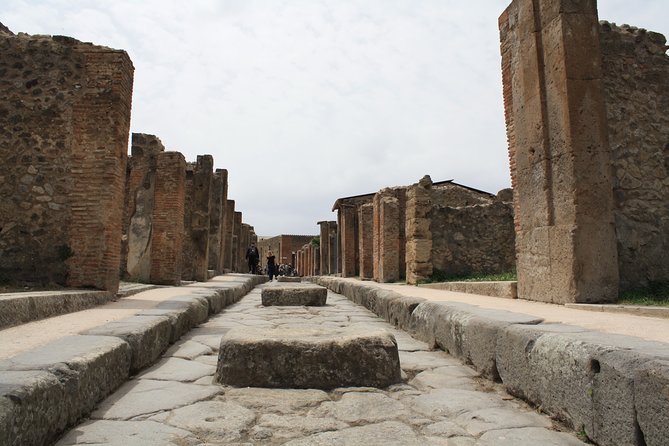
Pompeii was not just a collection of grand villas. It was a working town and an important commercial center. As you walk, your guide explains the practical systems behind daily life: street planning, residential areas, drainage, and the shops that opened onto the roads.
That kind of explanation is where a private guide earns the fee. Without context, an ancient street can look like a line of stones and broken walls. With a guide, the placement of a doorway, the width of a road, or the remains of a storefront begins to tell you how the town functioned.
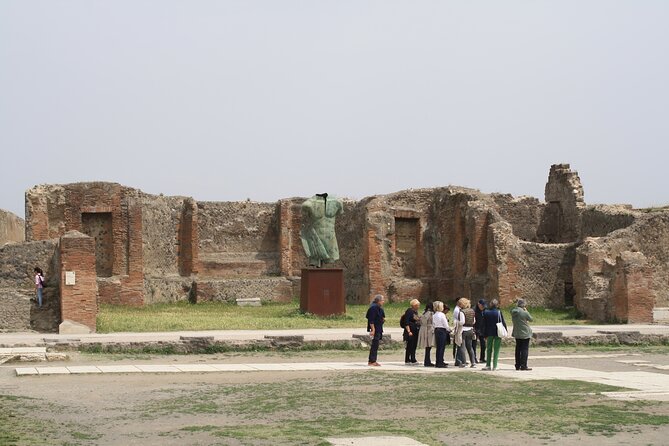
The visit includes the Forum of Pompeii, the city’s main civic and religious center. This was the place for public business, worship, and commercial activity. You also pass the basilica, a major public building whose architectural form later influenced Christian basilicas. The tour presents it as part of Pompeii’s civic life, not just as another photogenic ruin.
The residential neighborhoods add a different mood. Here, you hear about private routines, family life, and the way people lived and loved behind the street-facing shops. That shift from public space to private space is useful. It gives you more than a list of buildings. You begin to see Pompeii as a town of workers, merchants, families, and officials.
What two hours at Pompeii can realistically cover
Two hours sounds generous until you remember that Pompeii is a large archaeological park. A private guide can keep you moving toward the most useful areas, but the clock still matters. You will not have unlimited time for every house, side street, and exhibit.
The advantage is focus. Your guide can explain the urban plan while you are standing in it, then connect that plan to the Forum, basilica, shops, and residential quarters. You can ask questions as they arise instead of waiting for a group tour to catch up.
The possible tradeoff is that the route may feel brisk. Some visitors want time to stop at every mosaic or photograph each doorway. This tour is better for building a strong overview than for checking every detail at leisure.
That is especially true for families. Carla, one of the guides associated with this experience, has worked with a family of five that included preteens and teenagers. She reportedly adjusted explanations to their age, asked about their interests, and made time for bathroom and snack breaks. That detail matters because Pompeii can test young attention spans. A guide who changes pace and finds points of interest for each person can make the same ruins work for adults and children.
The transfer from Pompeii to Herculaneum
After Pompeii, the tour includes transportation to Herculaneum, about five miles southeast of Naples. The transfer is a small but valuable part of the package. You do not have to work out the connection between two archaeological parks during a tightly timed afternoon.
The tour ends at the Archaeological Park of Herculaneum, Corso Resina, 187, Ercolano. That end point is worth noting before you book. This is not a round-trip experience that returns you to the Pompeii meeting point. You finish in Herculaneum, and the supplied details do not specify a return transfer beyond that point.
The end location can be useful if Herculaneum is your last stop or if you are continuing from Ercolano. It is less convenient if you need to return to Pompeii immediately. Check your onward plans before committing, especially if you are using trains or have luggage.
More Herculaneum tours:
- Pompeii and Herculaneum Small Group Tour with an Archaeologist
★ 5.0 · 1,350 reviews - Private Day Tour to Vesuvius, Herculaneum & Pompeii with Pick Up
★ 5.0 · 279 reviews - The Ultimate Ruins of Pompeii and Herculaneum Private Day Trip
★ 5.0 · 103 reviews - Naples: Pompeii & Herculaneum Day Trip – Small Group Tour
★ 4.5 · 72 reviews
Herculaneum’s preserved homes and household details
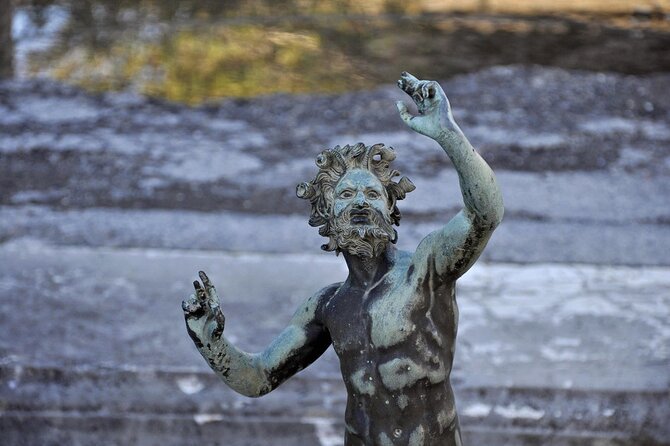
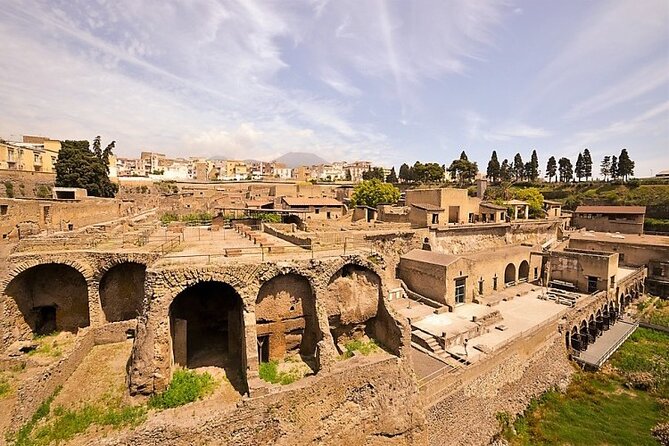
Herculaneum is often described as better preserved than Pompeii, and the reason is the volcanic material that covered it. That material protected parts of buildings and objects that would normally decay, including wood and other natural materials.
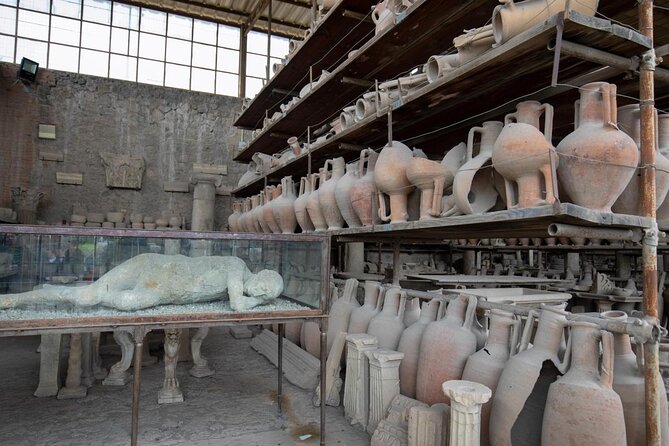
This changes the feel of the visit. Pompeii gives you the shape of a complete town. Herculaneum can give you the texture of individual rooms. You might see preserved wooden beds, food remnants, mosaic floors, and building elements that make ancient domestic life feel unusually close.
The route can include the House of Galba, the Thermal Baths, the Samnite House, and other buildings. The exact selection may depend on the route and conditions on the day, so treat these as possible stops rather than a guaranteed checklist.
The Thermal Baths and mosaics are especially useful for understanding the care given to public and private spaces. The Samnite House offers another look at domestic architecture. At Herculaneum, your guide can help you read the rooms rather than simply admire the surviving decoration.
This site is smaller than Pompeii, but smaller does not mean effortless. Uneven ancient surfaces and the amount of information on display can still make two hours feel full. Comfortable shoes and water are practical choices, even though the supplied tour details do not set out a specific clothing list.
How the private guide changes the experience
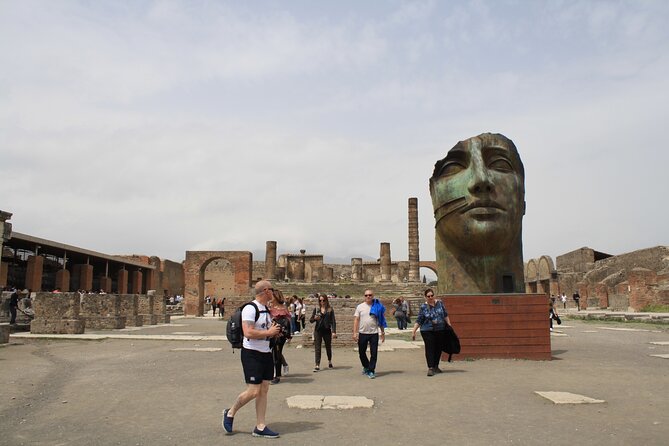
The central benefit is not simply having someone point out famous buildings. It is having a person shape the visit around your group. A private guide can spend more time on Roman engineering if that interests you, or focus on homes, shops, and everyday routines if that is what brings the ruins to life for you.
The tour is offered in English, and the included guide is described as a local professional with archaeological expertise. Carla is specifically named in the supplied information, but you should not assume she will lead every departure. If having her matters to you, ask the provider when booking.
Private touring also helps with questions. In a large group, you may hesitate to interrupt or lose track of an explanation. Here, you can ask why the streets were arranged a certain way, how the sewage systems worked, or what a particular room was used for. That back-and-forth is particularly helpful at Pompeii, where the remains can otherwise feel scattered.
The private format is also useful for mixed-age groups. A family can keep younger children moving without holding up strangers. Adults can ask more detailed questions while the guide looks for ways to keep children involved. The guide can also make space for bathroom and snack breaks, as Carla did for one family.
Still, private does not mean leisurely by default. The schedule is fixed at roughly four hours, with two hours per site. Tell your guide early what matters most so the limited time goes to your priorities.
The price and who gets real value from it
At $4,655.67 per person, this is a luxury-priced tour. The supplied information also mentions group discounts, but it does not give the discount amount or explain how the final total changes with group size. Ask for a clear group quote before booking.
The value comes from several bundled services: a private guide, admission to both parks, skip-the-line access, and the transfer from Pompeii to Herculaneum. You are paying for saved time and personal attention, not just entry tickets.
For a large family or a group celebrating a special trip, that convenience may be worth a great deal. A guide who can keep several age groups interested and adapt the route can spare you the work of planning two major sites. The included connection between parks also removes one logistical chore.
For a solo visitor or a couple on a tight budget, the calculation is harder. The experience lasts about four hours, and the price per person is high. You may prefer visiting one site with a guide and the other independently, or choosing a shared tour if your main goal is historical context at a lower cost.
The strongest reason to pay this much is flexibility. One family was able to start later than many other tours, and their guide waited when a local train problem made them 45 minutes late. That kind of patience can matter when you are coming from Sorrento, where train delays can disrupt a carefully timed morning. It is not a promise that every late arrival will be handled the same way, so contact the provider if transport trouble affects you.
Timing, meeting point, and practical planning
The tour starts at Via Villa dei Misteri, 1, in Pompei. Confirmation is provided at booking, and the meeting area is near public transportation. Because the experience starts at a specific archaeological entrance, allow time to reach the meeting point rather than cutting it close.
The four-hour duration is approximate. Your time is divided between Pompeii and Herculaneum, with transportation in between. The experience ends at Corso Resina, 187, at the Archaeological Park of Herculaneum.
Most people can participate, according to the supplied information, but the ruins contain historic streets and building surfaces. If anyone in your group has particular mobility needs, ask the provider for current route details before booking. The information does not provide a detailed accessibility assessment.
Admission tickets to both sites are included, and entry is skip-the-line. The tour is private, so only your own group participates. It is offered in English.
Cancellation is free up to 24 hours before the local start time. Canceling or changing the booking less than 24 hours ahead does not qualify for a refund.
Who should book this private half-day visit
I would consider this tour for a family that wants a guide who can adjust the pace, a group with limited time in the Naples area, or anyone who wants to compare Pompeii and Herculaneum without arranging the connection between them.
It also suits repeat visitors who have seen Pompeii before but want a more focused explanation. A private guide can steer you toward details you missed and use your interests to shape the route.
I would think twice if you want to wander slowly, spend a full day among the ruins, or keep costs low. The four-hour schedule is efficient, but it is not relaxed. The very high listed price also needs to be weighed against the size of your group and the value you place on personal attention.
Should you book it?
Book this tour if your priority is one focused morning or afternoon covering both sites, with a private English-speaking guide, fast entry, and transport between Pompeii and Herculaneum. The guide’s ability to explain Roman streets, homes, shops, and engineering in a way that works for adults and children is the strongest part of the experience.
Skip it if the price per person feels out of proportion to your trip budget or if you want time to explore every corner. In that case, choose one site with a guide and give yourself more time there. For a private group that values flexibility, family-friendly pacing, and a clear comparison between two remarkable archaeological parks, this can be money well spent.
FAQ
How long does the tour last?
The experience lasts approximately four hours, with about two hours at Pompeii and two hours at Herculaneum.
Are admission tickets included?
Yes. Admission to both Pompeii Archaeological Park and the Archaeological Park of Herculaneum is included, along with skip-the-line entry.
Is transportation between Pompeii and Herculaneum included?
Yes. The tour includes a transfer from Pompeii to Herculaneum.
Where does the tour begin?
The meeting point is Via Villa dei Misteri, 1, 80045 Pompei, Italy.
Where does the tour end?
The tour ends at the Archaeological Park of Herculaneum, Corso Resina, 187, 80056 Ercolano, Italy.
Is this a private tour?
Yes. Only your group participates in the activity.
What is the cancellation policy?
You can cancel for a full refund up to 24 hours before the experience start time. Cancellations and changes made less than 24 hours before the start time are not accepted for a refund.
More Ways to See Pompeii
- Pompeii Small Group Tour with an Archaeologist
★ 5.0 · 6,593 reviews - Discover the Ancient Ruins of Pompeii: Day Trip from Rome
★ 3.5 · 2,247 reviews - Skip the Line Guided Tour of Pompeii led by an Archaeologist
★ 5.0 · 703 reviews - Pompeii Ticket + Tour with Optional Tasting Experience at Pompeii
★ 5.0 · 663 reviews
Just added around Pompeii
- Wine Tasting and Winery Tour in Vesuvio National Park with Lunch★ 4.5 · 3 reviews
- Mt. Vesuvius Wine Tasting and Lunch Experience from Pompeii★ 4.5 · 20 reviews
- Wine tasting in the Vesuvius national park★ 5.0 · 3 reviews
- Visit Pompeii with a local expert guide★ 5.0 · 10 reviews
- Traditional Neapolitan Dinner in Pompei – Villa Franca – Family Restourant★ 5.0 · 8 reviews
- Private Guided Tour and VR Headsets in the Ancient Pompeii★ 5.0 · 3 reviews
- Tour Mount Vesuvius with Entry Tickets and Round Trip Transfer Included★ 3.5 · 4 reviews
- Vesuvius tour entrance to the crater and return bus★ 4.5 · 9 reviews
Private Tours in Pompeii, compared.

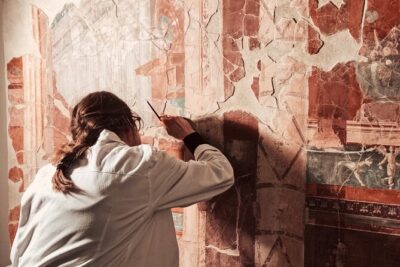
Pompeii Private Tour with an Archaeologist and Skip The Line – 3 hours
Read our review →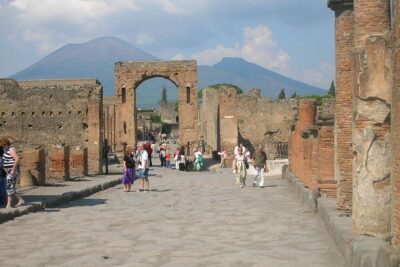
Visit in Pompeii – Pompeii Private Tour with Ada
Read our review →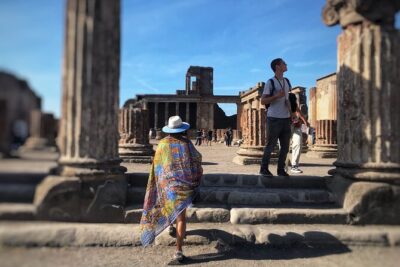
Pompeii Private Tour with an Archaeologist and Skip The Line
Read our review →
Pompeii Vineyard Escape: Private Wine Tasting & Lunch
Read our review →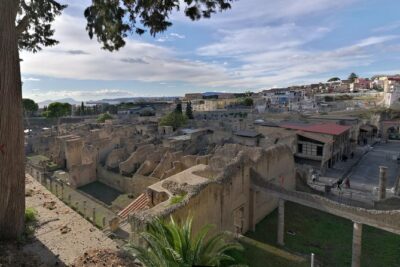
Private Day Tour to Vesuvius, Herculaneum & Pompeii with Pick Up
Read our review →
Guided Small Group Tour Max 6 People with Private Option
Read our review →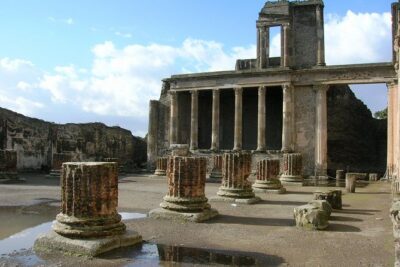
2 Hour Private Tour with an Archeologist Guide
Read our review →Browse the lists this tour appears in