
Reviewed · HERCULANEUM TOURS FROM NAPLES
Skip the Line Herculaneum Ruins Ticket
Herculaneum feels less like a scattered ruin and more like a Roman neighborhood paused in time. Volcanic mud and dust sealed its homes, mosaics, timber, and wall paintings during the AD 79 eruption of Mount Vesuvius. With this ticket, you enter the excavations in Ercolano and explore at your own pace.
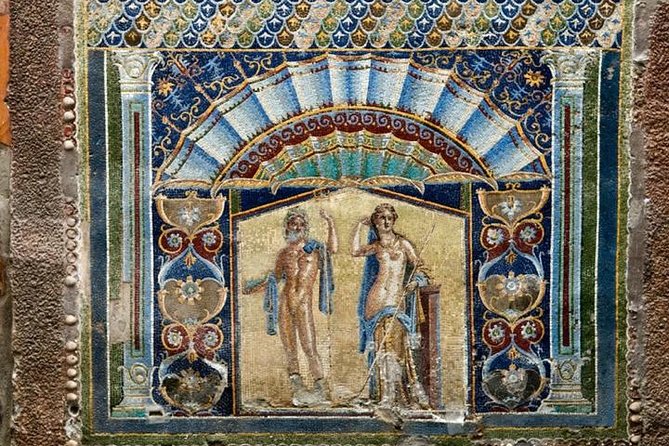
I like the chance to see some of the finest surviving Roman interiors, especially the House of Neptune and Amphitrite and the House of the Wooden Partition. I also like the smaller scale compared with Pompeii, which makes it easier to focus on individual houses rather than march through one enormous site.
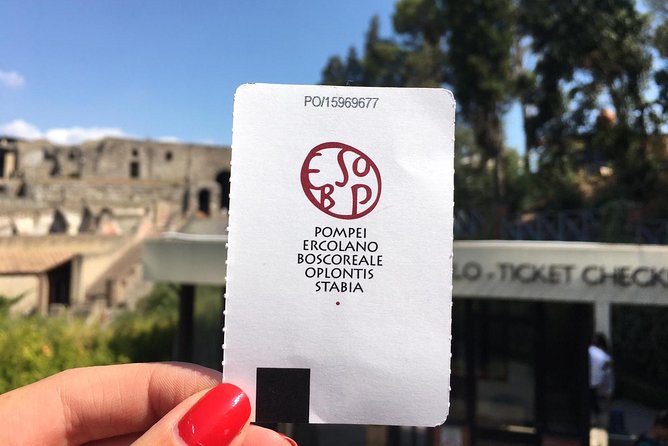
The main catch is the phrase skip the line. Your ticket may not always take you straight through the gate. Some visitors had to exchange an electronic voucher for a paper ticket, and the barcode scanner did not always read phone screens. You also receive no guide or transport for the $25 price.
What this Herculaneum ticket does well
- Preserves the best Roman interiors: Mosaics, frescoes, courtyards, and wooden details give the ruins a strong sense of daily life.
- Covers the essential houses and public buildings: The route includes the House of the Deer, Central Thermae, College of the Augustales, and House of the Skeleton.
- Offers a quieter alternative to Pompeii: The site is smaller and often feels more personal and atmospheric.
- Lets you set your own pace: You can follow the suggested stops or pause longer at the rooms that interest you.
- Works well with a guidebook: Since no guidance is included, a map, printed guide, or audio guide can make a major difference.
- Includes flexible cancellation: Cancel at least 24 hours before the start time for a full refund.
Why Herculaneum feels different from Pompeii
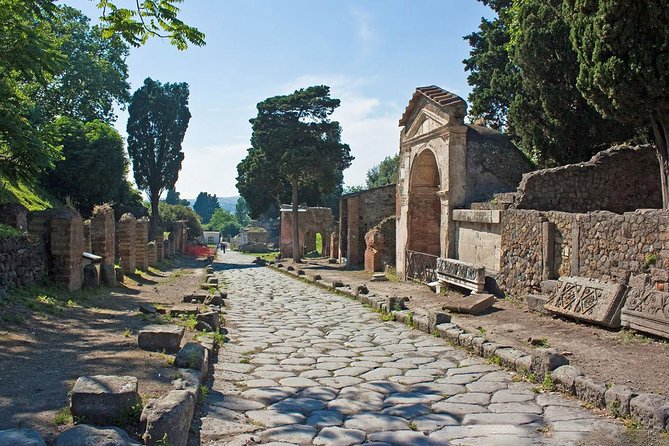
Both towns were overwhelmed by the eruption of Mount Vesuvius in AD 79, but Herculaneum was buried under a mass of volcanic mud and dust. That material protected many fragile features that would usually disappear, including wood, mosaics, wall decoration, and household details.
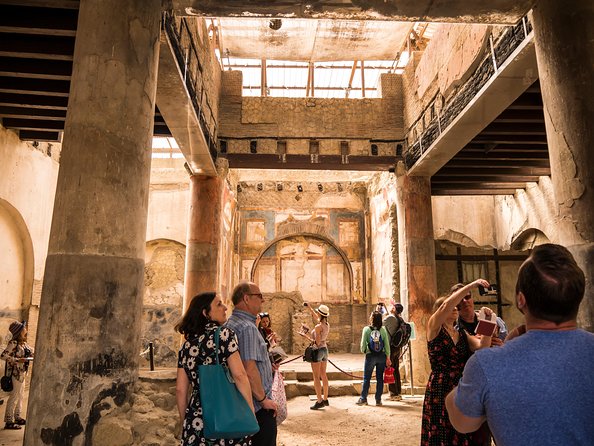
You notice the difference as soon as you begin walking through the houses. Pompeii gives you breadth, streets, and a larger sense of a Roman city. Herculaneum gives you closer views of domestic life. The preserved rooms can feel intimate, almost like stepping into a house whose owners left only moments ago.
The site is also easier to take in during a half-day. The advertised duration is about four and a half hours, but the actual walk can be shorter if you move directly between the main buildings. One person found about an hour enough for a basic visit, while a slower visit with reading and photography can take much longer.
I would not rush it. The value is not simply in counting ruins. It comes from stopping to look at the pattern of a mosaic floor, the layout of a courtyard, or the surviving timberwork that makes these houses feel occupied rather than merely archaeological.
More Herculaneum tours:
- Herculaneum: Skip-the-Line Guided Tour with Archaeologist
★ 4.8 · 3,439 reviews - Herculaneum Small Group Tour and Ticket With an Archaeologist
★ 5.0 · 994 reviews - Herculaneum: Skip-the-Line Entry Ticket with Audio Guide
★ 4.3 · 870 reviews
Entering at Corso Resina
The meeting point is at the excavations on Corso Resina 187 in Ercolano. The scheduled start time is 10:00 a.m., and the activity ends back at the same meeting point. Transportation is not included, but the site is near public transportation.
Bring your voucher and check your email carefully after booking. The first confirmation may be followed by the actual site entry ticket. The electronic voucher and entry document are not always the same thing, so keep both available on your phone and, if practical, print them.
Allow extra time for ticket processing. The ticket is marketed as fast access, but the practical benefit depends on how the entry system is operating that day. A barcode may need to be exchanged for a paper ticket, and the absence of a dedicated fast-access desk can reduce the time saved.
This is also one reason I would avoid arriving at the last possible minute. Staff have helped late arrivals join the visit, but you should not count on that. An early arrival may also mean a shorter queue, though one morning visitor found no regular ticket line at all.
House of Neptune and Amphitrite
Begin with the House of the Mosaic of Neptune and Amphitrite, one of the most rewarding stops on the route. Its name comes from the striking mosaic decoration of the sea god Neptune and the sea nymph Amphitrite.
Allow about 15 minutes here. Look closely rather than simply taking a quick photograph. This house shows why Herculaneum is so valued: the decoration remains vivid enough to suggest the taste and status of the people who lived here.
The house is a good first stop because it gives you an immediate sense of how different Herculaneum is from a bare stone ruin. You are seeing rooms designed for living, display, and entertaining.
Terrace of M. Nonio Balbo
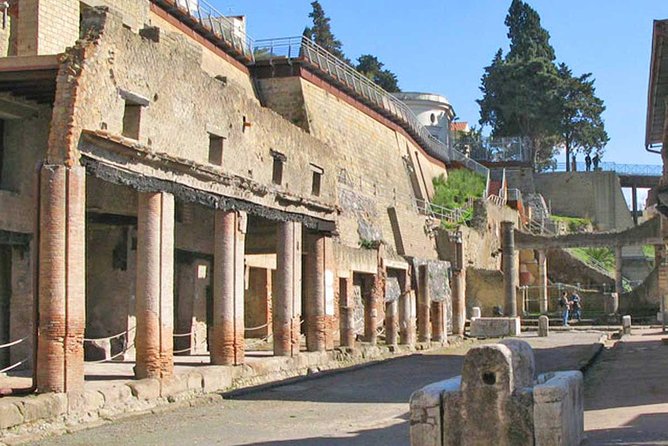
The Terrace of M. Nonio Balbo takes about 10 minutes. This is a public memorial space connected with Marcus Nonius Balbus, an important local figure.
It offers a change from the private houses. Instead of reading a home through its rooms and decoration, you see how the town honored public identity and civic status. It is a short stop, but useful for understanding that Herculaneum was more than a collection of villas.
More Skip-the-Line Tickets in Naples:
- Mount Vesuvius: Skip-the-Line Ticket and Smart Digital Guide
★ 4.2 · 2,780 reviews - From Naples: Pompeii Skip-the-Line Entry Ticket and Tour
★ 4.4 · 2,753 reviews - Pompeii: Skip-the-Line Entry Ticket with Audio Guide or Tour
★ 4.1 · 1,364 reviews - From Naples: Pompeii Guided Tour with Skip-the-Line Tickets
★ 4.8 · 1,171 reviews
House of the Relief of Telephus
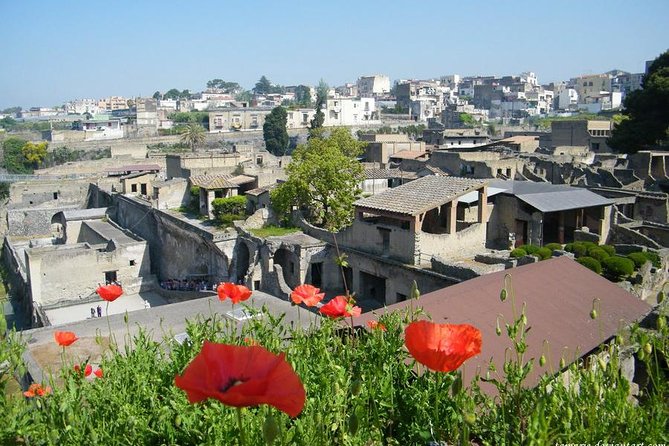
The House of the Relief of Telephus deserves about 15 minutes. Its name refers to a relief depicting Telephus, a figure from Greek mythology.
This is another place where a guidebook helps. Without context, the artwork can become one more attractive wall or panel among many. With a little explanation, you can connect the decoration to the Roman habit of using Greek myths to signal education, taste, and wealth.
The scale and decoration make this house one of the stronger stops for anyone interested in Roman art and domestic design.
House of the Wooden Partition
The House of the Wooden Partition, also called Casa del Tramezzo di Legno, is particularly important because of its surviving timber feature. Allow about 15 minutes.
Wood rarely survives at ancient sites, so a wooden partition gives you a rare look at the practical side of Roman interiors. It also helps you imagine how rooms were divided and how privacy worked inside a wealthy home.
This is exactly the sort of detail that can be missed if you race through the site. Stop to consider the contrast between the delicate wood and the heavy volcanic material that buried the city.
House of the Deer
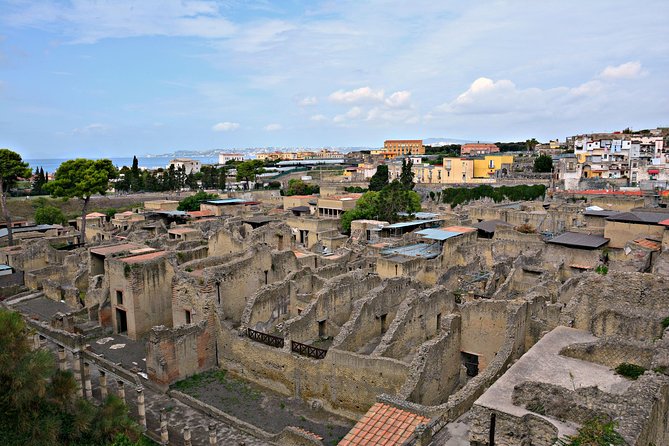
Set aside 15 minutes for the House of the Deer. It is famous for its decoration and for the deer sculptures associated with the property.
The house helps show how Roman homes could combine living space with carefully designed views and ornament. You may find the sculptures and formal rooms especially useful for picturing how owners presented themselves to visitors.
Herculaneum rewards close looking here. You are not only seeing walls and floors, but the remains of a home arranged around status, leisure, and display.
College of the Augustales
The College of the Augustales takes about 15 minutes. This public building was connected with the worship of the emperor and the local Augustales, a group involved in civic and religious life.
It gives you a look at the political side of Roman society. The private houses show how people lived, while this building shows how public loyalty and religious ceremony fitted into town life.
If you have a guidebook, read about the building before you enter. The name alone does not tell you much, and the historical purpose adds the needed context.
House of the Black Salon
Allow about 10 minutes for the House of the Black Salon, also identified as the Salon of Nero. Its dark decorative scheme makes it different from the brighter rooms elsewhere on the route.
This is a short stop, but it helps you compare interior styles. Roman homeowners were not using one standard design. Color, wall panels, floor patterns, and room proportions could change from one space to the next.
The room is most useful when you slow down enough to notice how the dark walls frame the remaining decoration.
House of the Skeleton
The House of the Skeleton is one of the more memorable stops and merits about 15 minutes. Its name comes from human remains found inside, a stark reminder that the eruption was not simply a disaster that damaged buildings. It ended lives.
The stop adds emotional weight to the polished mosaics and elegant rooms elsewhere in Herculaneum. You can admire the art while still remembering the suddenness of the catastrophe that preserved it.
This is also a good place to keep your visit respectful. The archaeological site is visually fascinating, but it is also the remains of a town and its people.
Samnite House
The Samnite House takes about 15 minutes and points to the older cultural roots of Herculaneum. Its layout and architectural features help show that the town was shaped by more than one period of history.
You may find this stop less immediately dramatic than the best-preserved mosaics, but it helps place the Roman buildings in a longer story. Look for the way the rooms are organized and how the house differs from later, more elaborate residences.
Central Thermae
The Central Thermae, or central baths, is a 15-minute stop. Roman baths were not just places to wash. They were social and civic spaces where people spent time as part of ordinary town life.
The baths add balance to the visit because they move you from private homes to a shared public facility. Look at how the spaces were arranged and imagine the daily routine that once filled them.
This is a good section for visitors who want more than grand villas. It shows the practical infrastructure behind Roman urban life.
House of the Fine Courtyard
The House of the Fine Courtyard takes about 15 minutes. Its courtyard is the main reason to pause here.
Courtyards helped bring light and air into Roman homes while also providing a central organizing space. In a site filled with wall paintings and mosaics, the open arrangement of a house can be just as revealing as its decoration.
You can use this stop to compare domestic layouts. Notice how the courtyard relates to the surrounding rooms and how the house differs from residences built around more formal display.
House of Galba and the House of the Grand Portal
The route lists both the House of Galba and the House of the Grand Portal, with about 15 minutes assigned to each. The repeated wording can be confusing, but these are presented as separate stops in the suggested visit.
The House of the Grand Portal, also called the House with the Large Doorway, is notable for its entrance. A large doorway says something about access, status, and the way a house met the street.
These stops are useful near the latter part of your visit, when the overall pattern of Herculaneum has begun to make sense. By then, you can compare grand entrances, private courtyards, decorative rooms, and practical household spaces.
Salon of the Boat
Finish with the Salon of the Boat, a shorter stop of about 10 minutes. The name points to its boat decoration and gives you one more example of the sea-related imagery found in Herculaneum.
It is a fitting final room because marine themes appear elsewhere in the town’s art, including the House of Neptune and Amphitrite. By the end, you will have seen homes, civic spaces, religious buildings, baths, and decorative programs linked by the town’s coastal setting.
What $25 buys you
At $25, the ticket is reasonable if it saves you a long wait or helps secure entry at a busy time. You are paying for admission and access to the site, not for a guided tour, transportation, food, or drinks.
The value drops if you assume a guide is included. It is not. Some experiences associated with Herculaneum may include an audio guide or a person called Luciano, who has led informative visits, but this ticket specifically lists guidance as excluded. Do not book it expecting a guide to meet you at the entrance.
For the best value, bring a good map or guidebook. An audio guide can also help, but confirm that it is part of the product you are buying before you pay. The site has enough detail to reward independent exploration, but a little explanation brings the rooms to life.
The 4.6 rating from 29 reviews and 93 percent recommendation suggest a strong overall experience, though the practical complaints matter. Ticket handling, unclear directions, and the real meaning of skip the line are the weak points.
Who should book this experience?
I would choose this ticket if you want a flexible visit and are comfortable guiding yourself. It suits people who prefer to stop for photographs, read at their own pace, and spend extra time in the houses that interest them most.
It also works for families, since children must be accompanied by an adult and most people can participate. Service animals are allowed, and the site is near public transportation.
I would look for a different product if you want a historian, a fully organized route, or transport from Naples. A guided option may be worth the extra cost for anyone who finds ancient architecture difficult to read without explanation.
Should you book the Herculaneum ticket?
Book it if Herculaneum is high on your list and you want a straightforward entrance ticket at a fixed price. The mosaics, timber, baths, courtyards, and preserved homes make this one of the most rewarding ancient sites near Naples, and the quieter feel can be a welcome contrast to Pompeii.
Do not book it solely for the words skip the line. Check the final entry ticket in your email, arrive with time to spare, and be ready for a paper-ticket exchange. If the site is quiet when you arrive, buying directly may be cheaper and quicker.
For a self-guided visit, the ticket is a sound choice at $25. Bring a map, use the suggested stops as a framework, and let the preserved rooms do most of the talking.
FAQ
Where does the Herculaneum experience start?
It starts at the excavations on Corso Resina 187, 80056 Ercolano, near Naples, Italy.
What time does the activity start?
The stated start time is 10:00 a.m.
How long does the visit last?
The approximate duration is 4 hours and 30 minutes. The actual time inside can be shorter or longer depending on how many stops you make and how much time you spend reading and taking photographs.
Is transportation included?
No. Transportation to and from the archaeological site is not included.
Is a guide included?
No. Guidance is not included with this ticket. You can explore independently, and bringing a guidebook or map is useful.
What does the ticket include?
It includes skip-the-line admission tickets for the Herculaneum archaeological site.
Are food and drinks included?
No. Food and drinks are not included.
Can children take part?
Yes, but children must be accompanied by an adult.
What is the cancellation policy?
You can cancel for a full refund if you cancel at least 24 hours before the experience start time. Cancellations or changes made within 24 hours are not accepted for a refund.
Just added around Naples
- Naples: Guided Walking Tour★ 4.7 · 63 reviews
- Wine tasting in the Vesuvius National Park★ 3.5 · 4 reviews
- Naples: Pompeii and Vesuvius Skip-the-Line Day Trip★ 3.8 · 32 reviews
- Visit the Museum MANN with a professional guide★ 5.0 · 3 reviews
- Walking-tour of Naples hystorical Centre★ 4.4 · 4 reviews
- Vesuvius – Herculaneum – Pompeii Excavations Tour★ 4.2 · 9 reviews
- Pompeii: Vesuvius at Sunset★ 3.5 · 31 reviews
- Vesuvius and Herculaneum from Naples★ 3.7 · 29 reviews
Herculaneum Tours from Naples, compared.
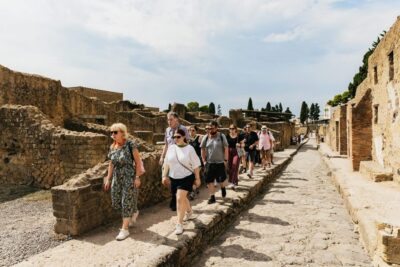
Pompeii and Herculaneum Small Group Tour with an Archaeologist
Read our review →
Herculaneum Small Group Tour and Ticket With an Archaeologist
Read our review →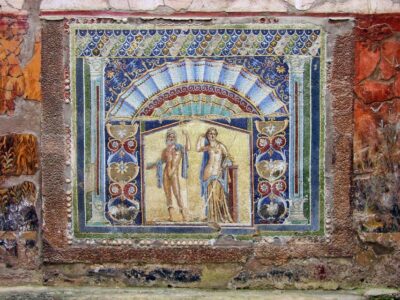
Pompeii & Herculaneum with Archaeologist Guide
Read our review →
Pompeii, Herculaneum, & Vesuvius Full-Day Tour
Read our review →
Herculaneum Entry Ticket with Optional Audio Guide
Read our review →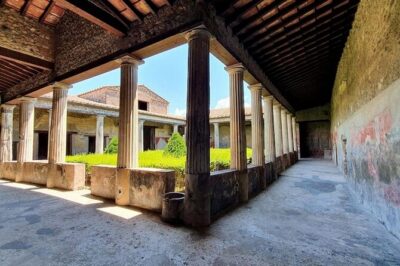
Day Trip of Pompeii, Herculaneum and Vesuvius from Naples
Read our review →Browse the lists this tour appears in