

Reviewed · HERCULANEUM TOURS FROM NAPLES
Pompeii and Herculaneum day trip
Pompeii and Herculaneum tell two very different stories of the eruption of Mount Vesuvius. Pompeii is vast and theatrical, with its forum, theaters, shops, baths, brothel, and grand houses spread across a city that takes real effort to understand. Herculaneum is smaller, quieter, and often more striking because wood, furnishings, and building details survived under a different volcanic covering.
I like this trip for two clear reasons: a private driver removes the transport headache, and you can shape the day around your group instead of following a fixed coach schedule. Guides such as Antonino, Tony, and Anna are available depending on the option and arrangements, and the strongest feedback praises their clear explanations, patience with children, and ability to adjust the pace.
The main drawback is cost. At $429.69 per person, this is a serious purchase before adding entrance fees and possibly a guide. The day is also ambitious. You get both sites, but you will not study every street and house in Pompeii at leisure.
Key points to know before booking
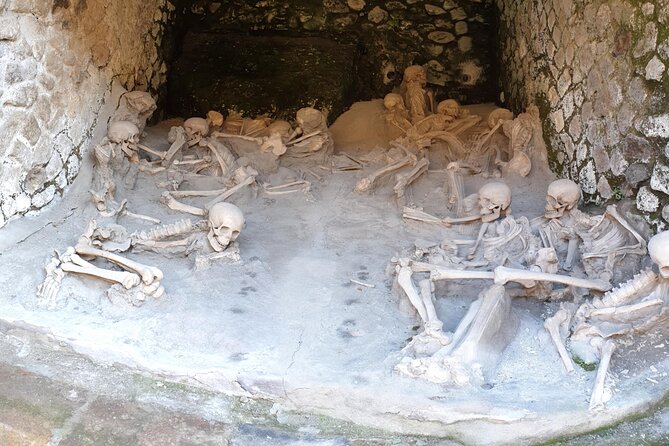
- Pompeii and Herculaneum in one day: You see the grand scale of Pompeii and the better-preserved domestic details of Herculaneum.
- Private Naples pickup: Collection is offered from hotels, cruise ports, the train station, and the airport, subject to road access.
- Choose your level of help: Explore independently with your driver’s support, or select an option with a professional guide at the ruins.
- Guides make a real difference: Antonino, Tony, and Anna receive especially warm praise for clear English, historical insight, and family-friendly explanations.
- Entrance fees are extra: The stated site charges are €18 and €16, with admission free for visitors under 18. Confirm exactly how these apply to your booking.
- Allow for a full, active day: The tour lasts about 6 to 7 hours and includes walking across uneven ancient streets and open archaeological areas.
Why seeing both ruins in one day works

Pompeii and Herculaneum are often paired, but they reward different kinds of attention. Pompeii gives you the city. Herculaneum gives you the house.
At Pompeii, the scale can be hard to grasp at first. The forum, main streets, entertainment buildings, private residences, and public baths are spread across a large site. You get a strong sense of ordinary Roman routines: shopping, bathing, worship, political business, dining, and entertainment all took place within the same urban grid.
Herculaneum covers less ground, which makes it easier to focus on individual buildings. The volcanic material that buried the town preserved details that are less common at Pompeii, including wooden features and objects associated with daily life. The contrast makes the second stop feel worthwhile rather than like a smaller repeat of the first.
That said, this is not a slow archaeological study tour. The listed stops include many short visits of five to twenty minutes, with roughly two hours allocated to the main Pompeii visit. Your time at each location may depend on the guide option, crowd levels, site conditions, and the needs of your group.
More Herculaneum tours:
- Herculaneum: Skip-the-Line Guided Tour with Archaeologist
★ 4.8 · 3,439 reviews - Herculaneum Small Group Tour and Ticket With an Archaeologist
★ 5.0 · 994 reviews - Herculaneum: Skip-the-Line Entry Ticket with Audio Guide
★ 4.3 · 870 reviews
Starting at Pompeii’s Porta Marina
The Pompeii portion begins at Porta Marina, one of the principal access points to the ruins. If you select the guided option, you meet your licensed guide after purchasing tickets and enter the ancient town together.
This is where a guide can save you time and confusion. Pompeii is not simply a collection of picturesque walls. Without context, it is easy to walk past a public building, house, or street without understanding its original purpose. A good guide helps you read the remains as a working city.
The entrance fee is not included. The stated price is €18 per person at Porta Marina, while the general exclusions also list €18 and €16 in access charges, totaling €34 per booking, with admission free for visitors younger than 18. Because the wording is not perfectly clear, confirm the exact ticket arrangement before paying.
The forum, Via dell’Abbondanza, and public life
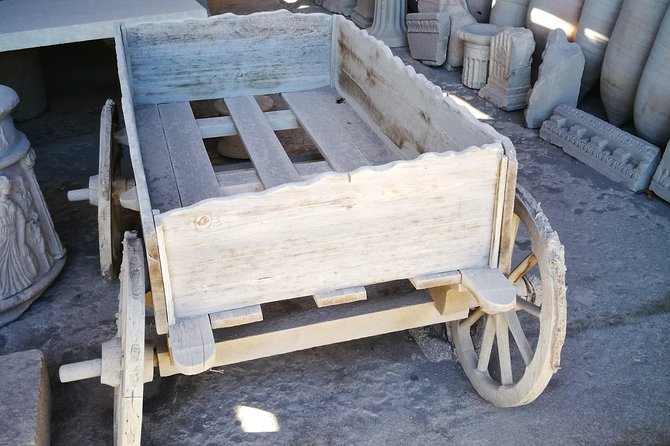
The Civil Forum was the heart of Pompeii’s public life. Administration, justice, commerce, markets, and civic worship all centered here. The stop is listed as brief, but its importance is much larger than the clock suggests.
I would pay close attention to the relationship between the forum and the surrounding streets. This is the place that helps you understand Pompeii as a city rather than as a set of isolated ruins. A guide can point out how public buildings faced this central space and how different parts of civic life came together.
Via dell’Abbondanza, the Street of Abundance, gives you a more everyday view. It was one of the city’s most prosperous streets, and walking along it helps connect the forum with homes, businesses, and neighborhood activity. Pompeii’s streets are uneven, so comfortable shoes matter more here than stylish ones.
The theaters, House of Menander, and Stabian Baths
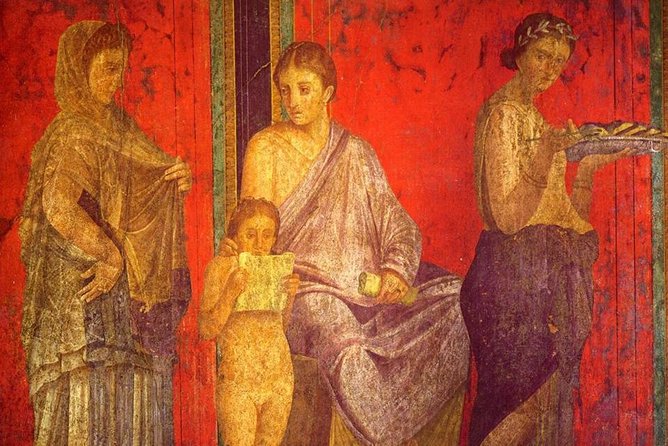
The Teatro Grande area contains the Large Theatre, the Odeon, and the Quadriporticus. Together, these buildings formed an entertainment and meeting center. The short scheduled visit gives you an outline, but not much time for a long look at every architectural feature.
The House of Menander is one of Pompeii’s grandest private homes. It covered about 1,800 square meters and is notable for its architecture, decoration, and contents. This is an important stop if you want to see how the wealthy lived, not just how the public moved through the city.
The Stabian Baths offer another useful comparison. They are described as the oldest and largest of Pompeii’s five public bath complexes. Even a short visit helps show that bathing was a public social activity as well as a practical one.
These stops also reveal the tradeoff of the itinerary. You see a broad range of Pompeii, from civic buildings to entertainment spaces and private homes, but the schedule favors variety over long, quiet inspection.
More ways to see Pompeii:
- From Naples: Pompeii Ruins & Mount Vesuvius Day Tour
★ 4.3 · 11,459 reviews - Naples or Sorrento: Full-Day Pompeii and Mount Vesuvius Tour
★ 4.6 · 4,235 reviews - Pompeii & Mt.Vesuvius Day Tour from Naples with Pizza Lunch
★ 4.0 · 2,901 reviews - From Naples: Pompeii Skip-the-Line Entry Ticket and Tour
★ 4.4 · 2,753 reviews
The Lupanar and Antiquarium
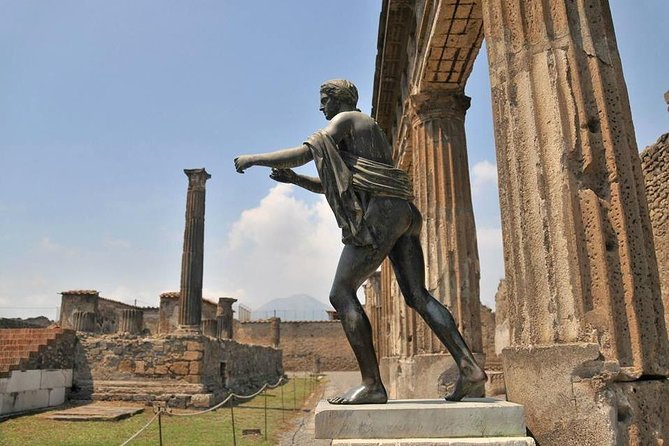
The Lupanar, Pompeii’s purpose-built brothel, is one of the site’s most talked-about buildings. Its erotic wall paintings draw attention, but the building is also useful for understanding the less polished side of Roman urban life. It can be a sensitive stop for families, so keep that in mind when deciding how much explanation younger children need.
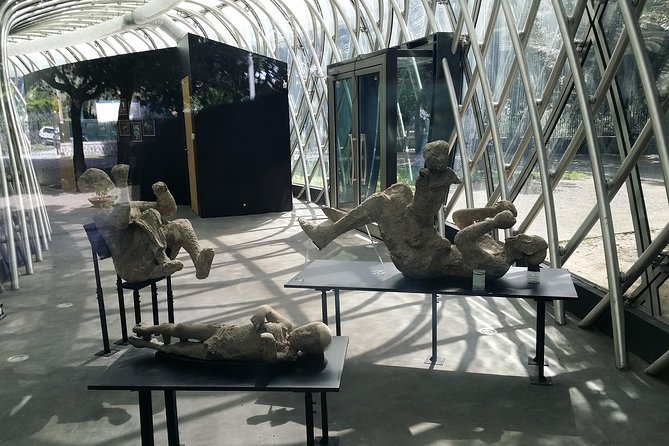
The Antiquarium adds material evidence to the streets and walls outside. Displays include archaeological finds linked to daily life, casts of victims of the eruption, and information about Pompeii’s settlement before it became a thriving Roman city.
For many people, this museum visit helps the site make more sense. Ruins show structure, while objects show use. The combination gives you a clearer idea of the people who lived in the city, rather than leaving you with only a dramatic picture of the disaster.
Herculaneum’s smaller, better-preserved streets
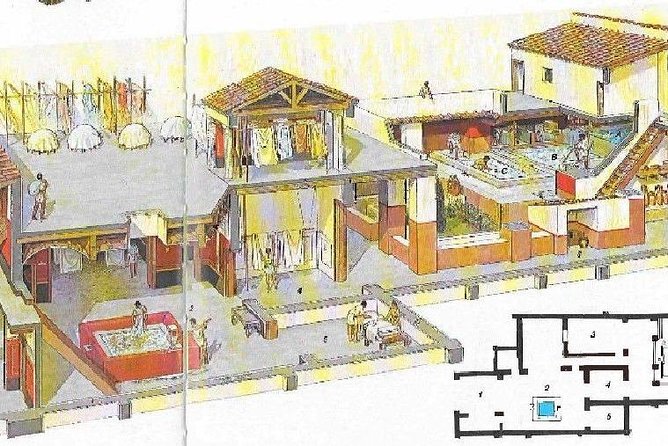
After Pompeii, the private vehicle takes you to the archaeological area of Herculaneum, also called Ercolano. The site was buried in AD 79 along with Pompeii, Stabiae, and Oplontis, but the volcanic materials covering it preserved some features differently.
Herculaneum is smaller and less famous than Pompeii. That is part of its appeal. You can focus more closely on individual buildings, and the shorter distances make the site feel less demanding after Pompeii.
The initial visit is listed as a short stop, but the archaeological area contains several important buildings. Your actual time inside will depend on the tour plan and the option you book. Make sure your confirmation clearly states whether Herculaneum admission is included, since the general information lists some entrance charges as extra while several individual stops show admission included.
Houses that preserve domestic detail
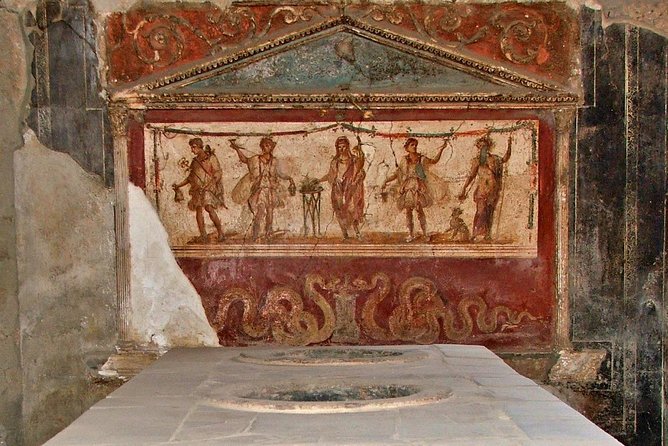
The House of the Hotel is presented as the remains of a large home for a wealthy owner. It gives you another look at Herculaneum’s upper-class domestic life and works well after Pompeii’s larger urban scenes.
The House of the Wooden Tramezzo is especially unusual. Built in the pre-Roman period, around the first century BC, it has a patrician facade with seats where clients could wait to see the owner. Inside, a wooden partition divided rooms in the atrium. The wood was charred by the eruption, but its shaped doors and large bronze rings survived.
This is exactly the sort of detail that can make Herculaneum memorable. A broad ruin can tell you where a room was, but a surviving wooden feature suggests how people moved through it and how the home functioned. A guide who explains those small details adds real value.
The main street, Augustales, and public baths
The Decumanus Maximus is one of Herculaneum’s main streets. Like Via dell’Abbondanza at Pompeii, it gives structure to the visit and helps you understand how homes and public buildings related to one another.
The College of the Augustales was built near the end of the first century BC, probably around 14 BC, during the Augustan period. It was funded by brothers A. Lucius Proculus and A. Lucius Iulianus. An inscription records a banquet held at the building’s inauguration for the Augustales and local officials.
The Suburban Baths provide the public counterpart to the private houses. They were a public bathhouse, and the stop helps round out the picture of Herculaneum as a functioning town rather than a collection of wealthy residences.
The scheduled visits here are short, often five minutes. If you are especially interested in architecture or inscriptions, tell the guide early. A private tour gives you more room to express that preference than a large group excursion.
The Antiquarium and objects from the eruption
The Antiquarium di Ercolano holds objects found near the skeletons, along with other material from the site. This museum visit can be emotionally heavier than the houses and streets because it connects the eruption directly with the people caught in it.
I find the museum particularly useful at the end of Herculaneum. You have already seen rooms, streets, and public buildings. The objects then add a human scale to what you have been viewing. The result is more affecting than simply walking through empty structures.
The itinerary gives the Antiquarium ten minutes. That is enough for an introduction, but not for a detailed museum visit. If the museum matters greatly to you, ask how much time can be assigned before the day begins.
What the private driver changes
The air-conditioned private vehicle is the backbone of this experience. Pickup and drop-off are offered at Naples hotels, the cruise port, train station, and airport, although narrow streets may require you to walk to the nearest place the vehicle can reach.
You avoid arranging separate trains, taxis, and transfers between two archaeological sites. That matters in Naples, especially if your time is tied to a cruise departure or a flight. The return can be to the pickup point or another requested drop-off in the excursion area.
A private driver also gives you some breathing room. The itinerary can be adjusted for your group, and the driver can help you manage the transition between sites. The vehicle includes bottled water, which is a small but welcome touch during a warm day of walking.
Do not confuse the driver with the archaeological guide. A professional guide at the ruins is included only if you select the guide option. If you choose to explore independently, you have more freedom but less explanation on site.
Guides, families, and different walking needs
Antonino is repeatedly praised for making Roman history understandable and for adjusting the experience to a group that included visual and hearing impairments. He is also described as patient with children and good at using anecdotes to keep young people involved.
Tony is another name associated with strong English explanations and a clear passion for Pompeii. Anna is praised as a Pompeii guide, while Pepino is noted as a prompt driver and good communicator. Because the provider may assign different people, treat these names as examples rather than a guarantee.
The tour is private, so only your group participates. That is useful for families, adult children traveling together, or anyone who wants to ask many questions without holding up a large party. Most people can participate, and service animals are allowed, but the ruins still involve substantial walking over ancient surfaces.
Is $429.69 per person good value?
The price makes sense mainly for people who value convenience, privacy, and control. You are paying for private transportation from Naples, an air-conditioned vehicle, bottled water, and a day built around your group. If you are traveling from a cruise ship or have limited time in Naples, that convenience can be worth a lot.
The value is weaker if you are comfortable using public transportation, do not need pickup, and prefer to explore with an audio guide or printed information. Admission is not fully covered, and lunch is not included. Add the site fees and the possible cost of a professional guide when comparing this with other options.
A group discount is offered, but no specific discount amount is provided. Since the price is listed per person, ask how the final total changes with your party size.
Booking details and cancellation terms
This experience is offered daily in English and usually receives bookings around 12 days before the date. Confirmation arrives at booking, and pickup is available from an accommodation, port, station, or airport when the vehicle can reach it.
Free cancellation is available up to 24 hours before the local start time. Changes or cancellations inside that 24-hour window are not accepted for a refund. A minimum number of participants is required, and if the provider cancels because that minimum is not reached, you are offered another date or experience, or a full refund.
There is also a note requiring mouth masks in the private vehicle under the stated Italian pandemic rules. Check the current requirement before departure, since health rules can change.
Should you book this Pompeii and Herculaneum trip?
Book it if you want both major ruins in one organized day, need reliable private transport from Naples, or are traveling with family members who benefit from a flexible pace. The strongest reason to choose it is the combination of a private vehicle and an optional guide, especially if you can arrange a guide such as Antonino, Tony, or Anna.
Think twice if your budget is tight or you want a slow, detailed Pompeii visit. The $429.69 price is before lunch, admission, and possibly guiding, and the six to seven hour schedule covers a lot of ground.
For most first-time visitors with limited time in Naples, I see the appeal. Pompeii gives you the scale of an ancient city, while Herculaneum supplies the close-up domestic details. Just confirm the ticket costs, guide inclusion, pickup point, and amount of time at each site before booking.
FAQ
How long does the Pompeii and Herculaneum tour last?
The experience lasts approximately 6 to 7 hours.
Where does pickup take place?
Pickup is offered from Naples hotels, ports, the train station, and the airport. If the vehicle cannot reach your accommodation because of street access, pickup is arranged at the closest accessible point.
Is transportation private?
Yes. The experience includes private transportation in an air-conditioned vehicle, and only your group participates.
Is a guide included?
A professional guide at the ruins is included only with the option that includes guiding. You can also choose to visit the sites independently.
Are entrance tickets included?
The supplied details state that access fees are not generally included. The listed charges are €18 and €16, with admission free for visitors younger than 18. Porta Marina is also listed with an €18 entrance fee, so confirm the exact ticket arrangement before booking.
Is lunch included?
No. Lunch is not included in the tour price.
Can I be dropped off somewhere different from the pickup point?
Yes. Drop-off can be at the pickup point or another requested location in the area of the excursion.
Is the experience offered every day?
Yes. The tour is offered daily and operates in English.
What is the cancellation policy?
You can cancel up to 24 hours before the experience start time for a full refund. Cancellations or changes made less than 24 hours in advance are not accepted for a refund.
More 1-Day Tours in Naples
- From Naples: Amalfi Coast Full-Day Trip
★ 4.5 · 4,354 reviews - From Naples: Pompeii & Amalfi Coast Full-Day Trip with Lunch
★ 4.5 · 2,155 reviews - From Naples or Sorrento: Amalfi Coast Full-Day Trip
★ 4.7 · 2,043 reviews - Naples: Pompeii & Mt. Vesuvius Day Trip with Tickets & Lunch
★ 4.7 · 1,208 reviews
Just added around Naples
- Naples: Guided Walking Tour★ 4.7 · 63 reviews
- Wine tasting in the Vesuvius National Park★ 3.5 · 4 reviews
- Naples: Pompeii and Vesuvius Skip-the-Line Day Trip★ 3.8 · 32 reviews
- Visit the Museum MANN with a professional guide★ 5.0 · 3 reviews
- Walking-tour of Naples hystorical Centre★ 4.4 · 4 reviews
- Vesuvius – Herculaneum – Pompeii Excavations Tour★ 4.2 · 9 reviews
- Pompeii: Vesuvius at Sunset★ 3.5 · 31 reviews
- Vesuvius and Herculaneum from Naples★ 3.7 · 29 reviews
Herculaneum Tours from Naples, compared.
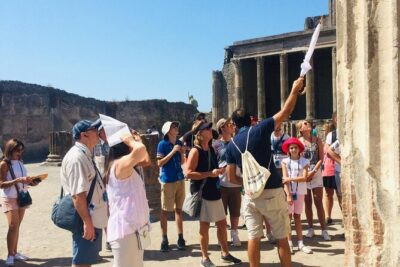
Pompeii and Herculaneum Small Group Tour with an Archaeologist
Read our review →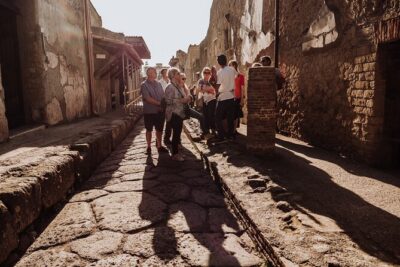
Herculaneum Small Group Tour and Ticket With an Archaeologist
Read our review →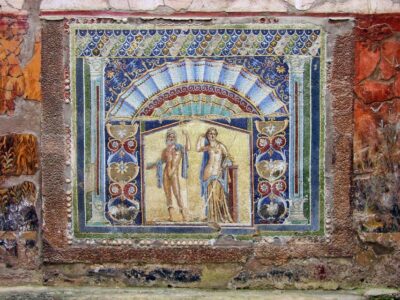
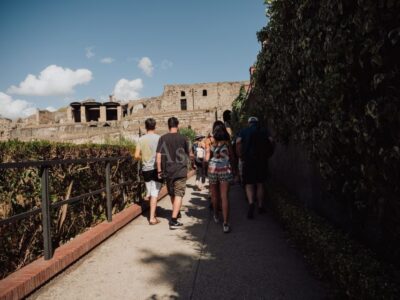
Pompeii & Herculaneum with Archaeologist Guide
Read our review →
Pompeii, Herculaneum, & Vesuvius Full-Day Tour
Read our review →
Herculaneum Entry Ticket with Optional Audio Guide
Read our review →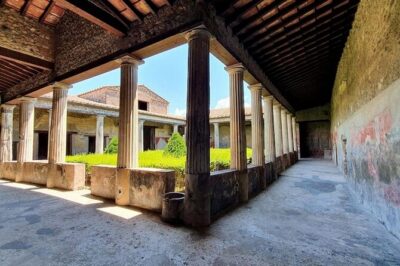
Day Trip of Pompeii, Herculaneum and Vesuvius from Naples
Read our review →Browse the lists this tour appears in