
Reviewed · HERCULANEUM TOURS FROM NAPLES
Private Herculaneum Tour – Top Experience with Local Guide
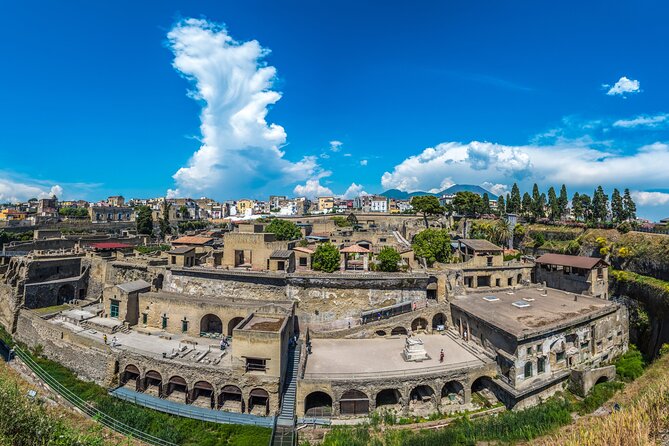
Herculaneum feels less like a field of ruins than a Roman town caught in mid-sentence. Volcanic heat preserved wooden doors, furniture, wall paintings, wine signs, and even boats. With a private guide, you can stop for questions and spend more time on the details that interest you.
I like the calm scale of the archaeological park and the personal pace. I also like the choice of adding hotel pickup and a Vesuvian winery lunch, which turns a two-hour site visit into a fuller day near Naples. The main drawback is cost: at $142.82 per person, this is a serious spend if you only want a quick look at the ruins.
Key points to know
- Herculaneum is smaller and better preserved than Pompeii, making it easier to explore in a short visit.
- Wooden furniture, partitions, writing tablets, and boats reveal ordinary Roman life in unusual detail.
- Private guiding makes the difference, especially at the baths, villas, shrines, and waterfront boat houses.
- Fabrizio and Paulo are among the guides praised for clear, friendly explanations and strong local knowledge.
- Pickup from Naples or Sorrento is optional, while the walking-only version begins at the archaeological park.
- The winery add-on includes a vineyard visit, tasting, lunch, and Bay of Naples views, but it adds about 90 minutes.
Why Herculaneum deserves its own day near Naples
Pompeii gets the fame, but Herculaneum can be the more rewarding ancient site for many people. The town was smaller, wealthier in parts, and buried under a hot volcanic surge that preserved materials usually lost to time.
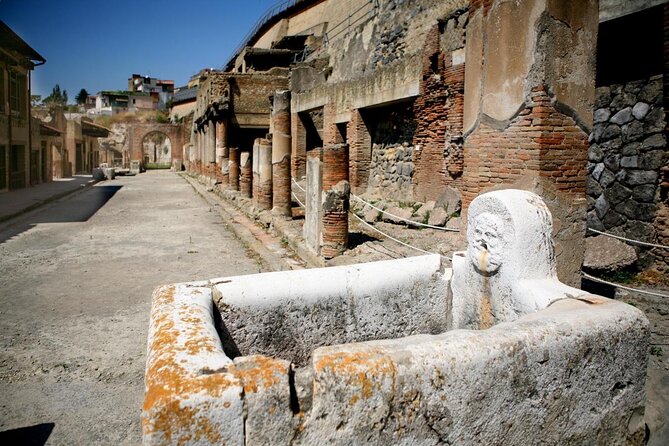
At Pompeii, you often read a building through its foundations and painted walls. At Herculaneum, you can see carbonized wood, upper-story elements, household objects, and traces of rooms that still feel furnished in the mind. The result is more intimate.
This private tour is built around that strength. Your guide does not simply point out a street and name a building. The better guides connect a mosaic to dining customs, a bath to Roman engineering, and a wooden partition to the way a household managed guests and privacy.
The site visit is listed at about two hours, though the full experience can run from two to six hours depending on transportation and the winery option. Two hours gives you a focused introduction. If you want to examine many houses and ask plenty of questions, plan for more time.
More Herculaneum tours:
- Herculaneum: Skip-the-Line Guided Tour with Archaeologist
★ 4.8 · 3,439 reviews - Herculaneum Small Group Tour and Ticket With an Archaeologist
★ 5.0 · 994 reviews - Herculaneum: Skip-the-Line Entry Ticket with Audio Guide
★ 4.3 · 870 reviews
Entering the archaeological park at Ercolano
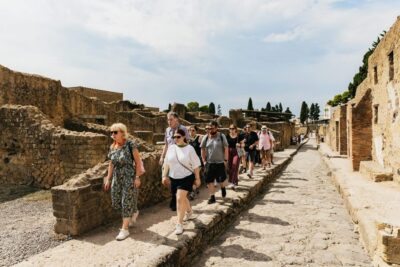
The walking-only tour begins at the Archaeological Park of Herculaneum on Corso Resina. You meet your guide there, then descend into the excavated town. The change in level helps you understand one of the site’s basic facts: the modern town and ancient town do not sit at the same height.
Wear comfortable shoes. The visit involves a moderate amount of walking, and ancient streets are not designed for modern feet. You will want enough comfort to pause rather than rush from one building to the next.
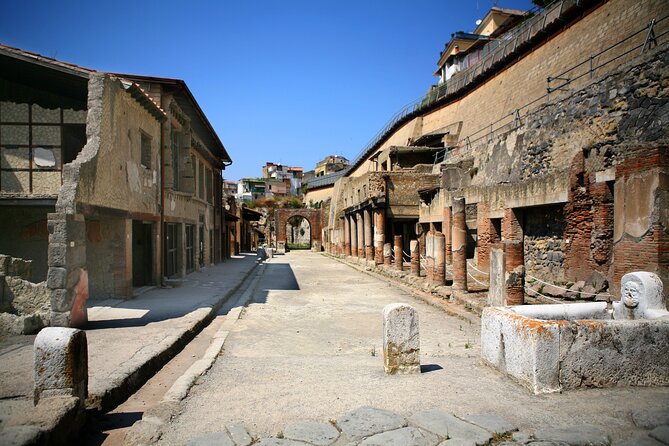
The guide is especially useful at the start, when the exposed walls can seem like a maze. Once you understand the grid of streets and the relationship between homes, shops, baths, and the waterfront, each stop becomes easier to read.
The Boat Pavilion and the ancient shoreline
Begin at the Boat Pavilion for one of Herculaneum’s strongest scenes. Carbonized boats and waterfront structures show that this was a working seaside town, not just a collection of grand houses.
The vessels likely served fishermen, merchants, and officials. Their remains help explain how people used the shore for trade and transport. They also bring the eruption close to hand, since many residents gathered near the water hoping to escape by sea.
This is an emotional stop, so a guide’s tone matters. The best approach is not a long speech, but a clear explanation of what the remains can and cannot tell us. You get both the scientific evidence and the human story.
The Antiquarium, a useful introduction before the streets
The Antiquarium helps you understand the town before you tackle its buildings. Here you can see statues, inscriptions, household objects, personal belongings, and charred timbers.
The wooden remains matter because Roman buildings are often imagined as stone-only places. In fact, wood played a large role in doors, balconies, furniture, partitions, and upper floors. Herculaneum preserves that side of Roman construction unusually well.
I would pay close attention to how the guide links the objects in the museum to the houses outside. Without that connection, the Antiquarium can feel like a separate display. With it, the objects become clues to the people who lived along these streets.
A few more Naples outings worth a look
- From Naples: Pompeii Ruins & Mount Vesuvius Day Tour
★ 4.3 · 11,459 reviews - From Naples: Sorrento, Positano and Amalfi Full-Day Tour
★ 4.6 · 10,988 reviews - From Naples: Sorrento, Positano & Amalfi Coast – Small Group Tour
★ 5.0 · 8,643 reviews - Naples: Catacombs of San Gennaro Entry Ticket & Guided Tour
★ 4.6 · 7,941 reviews
The ancient beach and the town’s final moments
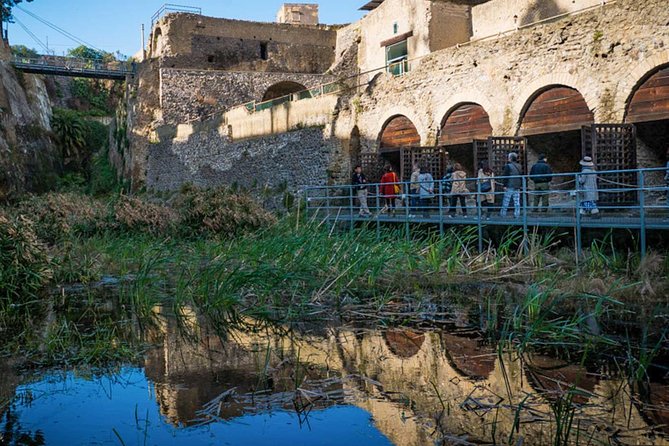
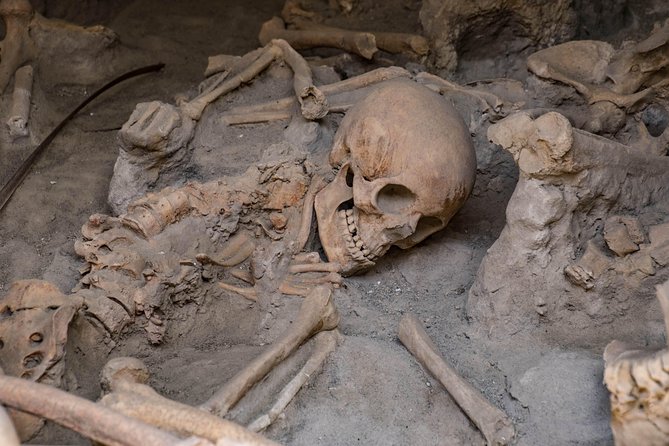
At the ancient beach, vaulted boat houses line what was once the shore. Archaeologists found the skeletons of hundreds of people here, gathered in hope of rescue.
This is the most sobering part of the visit. The remains are not abstract evidence of a disaster. They show families and individuals caught in a desperate moment. You may find this stop difficult, but it gives the rest of Herculaneum a human scale.
The beach also corrects a common modern impression. The present shoreline is not where ancient residents saw it. The site helps you picture a town much closer to the sea and understand how quickly the pyroclastic surge overtook the waterfront.
Casa dei Cervi and seaside wealth
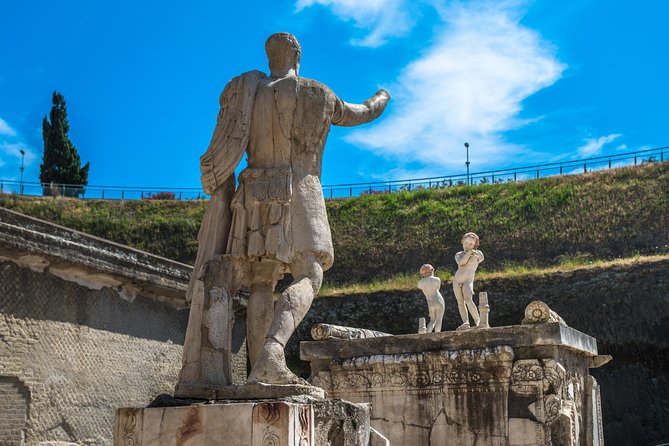
Casa dei Cervi offers a look at the comfortable end of Roman life. Marble floors, a colonnaded garden, decorated rooms, and a terrace facing the bay point to a wealthy household.
The house takes its name from marble statues showing stags attacked by hunting dogs. Those statues were found in the garden and are now displayed separately. Ask your guide to explain how the garden, sculpture, and sea view worked together as a display of status.
This is one place where a private tour earns its keep. A quick group visit can reduce the house to a list of features. Your guide can explain how architecture shaped social life, from formal reception areas to outdoor spaces meant to impress visitors.
The Palestra and Roman civic life
The Palestra was a large training and social complex. Its open courtyard and surrounding porticoes suggest a place for exercise, education, and public identity.
You may picture young men training, wrestling, or resting in the shade. The building also reminds you that Roman cities were not only made of private houses. Civic spaces helped form the habits and status of young residents.
The scale can be hard to grasp without explanation, so listen for the guide’s help in reading the courtyard and porticoes. This stop adds balance to the villas and shops. It shows Herculaneum as a community with shared institutions.
Casa di Nettuno e Anfitrite and its brilliant mosaic
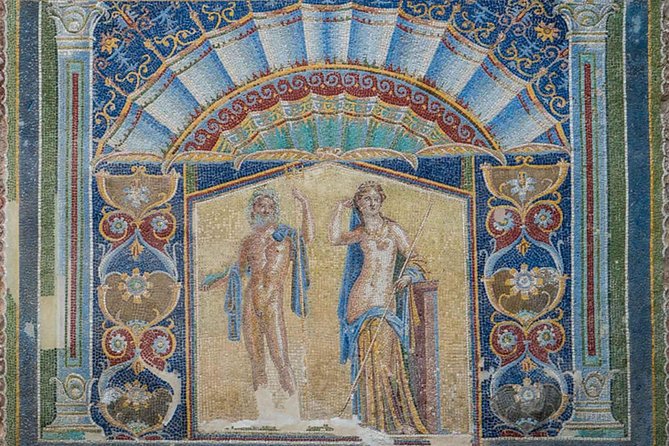
Casa di Nettuno e Anfitrite contains one of the site’s most memorable decorations. A wall mosaic of Neptune and Amphitrite uses tiny glass pieces in blue and gold, surrounded by sea motifs.
The color is still striking after nearly two thousand years. Around it, a private dining room and a decorated nymphaeum show how art, water, dining, and social status came together in a Roman home.
Look for the water channels and traces of the decorative setting. The point is not simply that the house had a pretty mosaic. Its design gave the owner a way to display taste, money, and connections while entertaining guests.
The Women’s Baths and Roman engineering
The Women’s Baths offer a close look at daily routines rather than grand public display. You pass through a changing room and heated spaces built with hollow floors and wall pipes that carried hot air.
Marble benches, mosaic floors, geometric patterns, and marine decoration show that bathing involved comfort and conversation as well as washing. The baths were social places, and their decoration reflects that importance.
This stop is easy to rush through, but do not. Ask your guide to explain the heating system and the movement from one room to another. Roman engineering becomes much easier to understand when you can see how the floor and walls carried heat.
Ad Cucumas and the ancient wine business
Ad Cucumas is a small but wonderfully human detail. The name refers to a tavern sign painted directly onto the wall, advertising wine by the jug and listing prices for different quantities.
It is the sort of evidence that makes the town feel familiar. Romans bought drinks, compared prices, and used clear advertising to attract customers. The wall inscription brings commerce down to street level.
This is also a good reminder that Herculaneum is not only about wealthy villas. Shops and taverns reveal the practical concerns of ordinary urban life. A short explanation from the guide can turn a painted sign into a story about business and customers.
Casa del Bicentenario and a household with legal affairs
Casa del Bicentenario is one of the town’s notable urban homes. Vivid wall paintings, wooden partitions, marble thresholds, and a small shrine show how family life, reception, and religious practice shared one address.
The house also yielded carbonized wooden writing tablets tied to property and inheritance disputes. That is rare evidence of the legal concerns that shaped Roman households.
Archival photographs connect the present ruins with early twentieth-century excavation. The house once had a prime position near the ancient shore, and its arrangement helps you picture both domestic life and the value of seaside property.
Sacello degli Augustali and loyalty to Rome
The Sacello degli Augustali adds a public and political dimension. This small temple-like building served the imperial cult, where local elites honored the emperor as a symbol of Roman unity and authority.
Fresco fragments show Hercules alongside members of the imperial family. The pairing links local mythology with imperial power, a useful reminder that even a provincial town was tied to the wider Roman system.
It is a quiet stop, but an important one. After seeing homes, baths, and taverns, you can now see how status and loyalty worked in public life. Herculaneum was not an isolated seaside resort. It was part of Rome’s political world.
Casa del Tramezzo di Legno and the value of privacy
The Casa del Tramezzo di Legno is famous for its carbonized wooden folding partition. The wall separated a reception area from more private parts of the home.
That simple feature says a lot. Roman houses had social choreography: guests entered certain rooms, business happened in visible areas, and family life could retreat behind a screen. The layout makes ancient ideas about privacy feel surprisingly current.
Look for upper-story elements, furnishings, and decorative traces. This house often makes the past feel close because the objects are not only monumental. They are domestic and practical.
Casa dello Scheletro and the human cost
Casa dello Scheletro carries a darker mood. Skeletal remains found inside give the house its name and remind you that this was a lived-in town interrupted without warning.
Fresco fragments, room divisions, and flooring still hint at ordinary routines around that terrible moment. The building asks you to slow down. No amount of decoration can soften the fact that people died in their homes.
Your guide can provide context, but this is also a stop for quiet reflection. It may be the point you remember most clearly after leaving the park.
Adding Cantina del Vesuvio to the ruins
If you choose the longer option, continue to Cantina del Vesuvio, a family-run winery on the slopes of Mount Vesuvius. The estate has been operated by the Russo family since 1930.
An enologist explains how volcanic soil affects local grape varieties used for Lacryma Christi. You then have a tasting and relaxed lunch with local dishes. From the terrace, you can look across the Bay of Naples toward Vesuvius.
The winery works well after Herculaneum because it connects ancient life with a continuing local tradition. Wine was part of Roman daily life, and the volcanic soil remains central to agriculture in the area.
The add-on lasts about 90 minutes. It is a good choice if you want a slower day and a meal with a view. It is less useful if your main goal is to spend every available minute inside the archaeological park.
What the $142.82 price buys you
At $142.82 per person, the tour is not the budget way to see Herculaneum. You are paying for a private English-speaking guide, admission to the archaeological park, and the freedom to shape the pace around your group.
That value is strongest for first-time visitors, families, history fans, and anyone who found Pompeii hard to interpret without help. It is also useful if you have already seen Herculaneum and want to understand newer discoveries and overlooked details.
The price makes less sense if you are happy to walk independently, read basic signs, and spend only a short time at the site. A private tour is about interpretation, not simply entry.
Transportation changes the calculation. You can meet at the park, or select an option with private transport from anywhere in Naples or Sorrento. Pickup saves planning time and makes the winery add-on easier, though the transport option may affect the final cost.
Practical details before you book
The activity is offered in English, and only your group participates. People under 18 enter free with valid identification. Service animals are allowed.
Confirmation is normally sent at booking. If you book within one day of the visit, confirmation arrives as soon as possible and depends on availability. Free cancellation is available up to 24 hours before the start time. After that, the amount paid is not refunded, and late changes are not accepted.
Past guide assignments have included Fabrizio and Paulo, with Fabrizio also arranging transport when a booking problem arose on short notice. Names are not guaranteed, but the important point is the guide-led format. The strongest part of this experience is the clear, personal explanation of what you are seeing.
Who should book this private Herculaneum tour
Book it if you want Herculaneum to make sense rather than simply want to photograph old walls. The private format suits couples, families, and small groups with different interests or walking speeds.
It is especially good as a companion to Pompeii. Pompeii gives you a huge city and broad range of public spaces. Herculaneum gives you close views of homes, woodwork, shops, baths, and waterfront life.
Skip it if your budget is tight or if you prefer independent archaeological visits. You can still see the site on your own, and the two-hour park visit is short enough to fit into a busy Naples schedule.
Final verdict
I would book this tour for a focused, personal visit to Herculaneum, especially with the private pickup option if you are staying in Naples or Sorrento. The strongest reasons are the preserved wood, the waterfront remains, and a guide who can explain why an ordinary wine sign or household partition matters.
Choose the winery only if you want a relaxed meal and a broader Vesuvian day. Choose the park-only visit if ancient buildings are your priority. At this price, the guide is the main value, so book it when interpretation and personal attention matter more to you than keeping costs low.
FAQ
Where does the walking-only tour begin?
It begins at the Archaeological Park of Herculaneum, Corso Resina 187, Ercolano.
Can I arrange pickup from Naples or Sorrento?
Yes. The private transportation option offers pickup anywhere in Naples or Sorrento.
Is admission to Herculaneum included?
Yes, admission to the archaeological park is included.
How long does the tour last?
The experience lasts about two to six hours, depending on the selected format. The Herculaneum visit is listed at about two hours, and the winery visit adds about 90 minutes.
Is the tour private?
Yes. Only your group participates.
Is the tour offered in English?
Yes, the tour is offered in English.
Are children under 18 charged admission?
People under 18 enter free when they show valid identification.
What should I wear?
Wear comfortable shoes. A moderate amount of walking is involved, and the tour requires a moderate level of physical fitness.
Just added around Naples
- Naples: Guided Walking Tour★ 4.7 · 63 reviews
- Wine tasting in the Vesuvius National Park★ 3.5 · 4 reviews
- Naples: Pompeii and Vesuvius Skip-the-Line Day Trip★ 3.8 · 32 reviews
- Visit the Museum MANN with a professional guide★ 5.0 · 3 reviews
- Walking-tour of Naples hystorical Centre★ 4.4 · 4 reviews
- Vesuvius – Herculaneum – Pompeii Excavations Tour★ 4.2 · 9 reviews
- Pompeii: Vesuvius at Sunset★ 3.5 · 31 reviews
- Vesuvius and Herculaneum from Naples★ 3.7 · 29 reviews
Herculaneum Tours from Naples, compared.
Pompeii and Herculaneum Small Group Tour with an Archaeologist
Read our review →
Herculaneum Small Group Tour and Ticket With an Archaeologist
Read our review →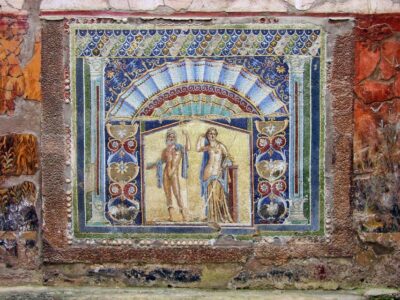
Pompeii & Herculaneum with Archaeologist Guide
Read our review →
Pompeii, Herculaneum, & Vesuvius Full-Day Tour
Read our review →
Herculaneum Entry Ticket with Optional Audio Guide
Read our review →
Day Trip of Pompeii, Herculaneum and Vesuvius from Naples
Read our review →Browse the lists this tour appears in