
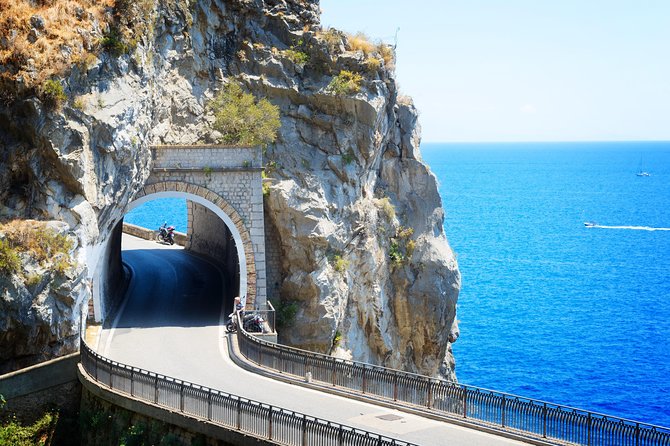
Reviewed · POSITANO TOURS FROM NAPLES
Transfer from Naples to Positano with 2 hours Private Tour in Pompeii
Pompeii is the real reason to choose this transfer. Instead of spending a precious Naples-to-Positano travel day only on the road, you stop among Roman streets, villas, baths, and theaters before continuing to the Amalfi Coast. I like the private format, which keeps the pace focused on your group, and the fact that Pompeii admission and a guide are included.
I also like the pickup choices: Naples Airport, Central Station, or your accommodation. That makes this useful after a flight or train arrival. The main caution is luggage. One booking used a sedan instead of the advertised minivan, and six bags required careful packing, so confirm the vehicle before you go.
Key points to know before booking
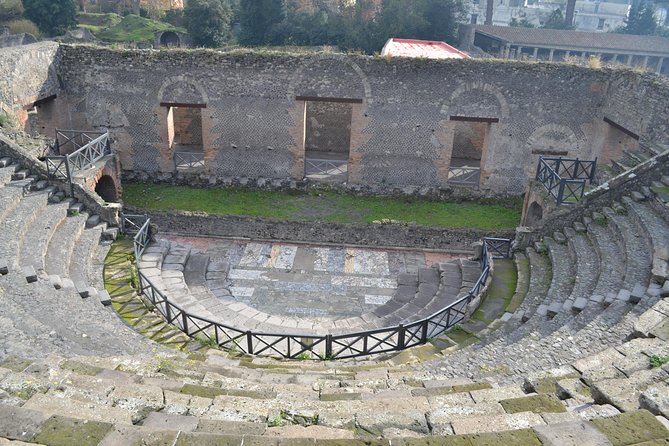
- Pompeii is the centerpiece: Expect about two hours inside the archaeological area, with major public buildings, homes, baths, theaters, and plaster casts.
- Your route ends in Positano: This is a one-way transfer, not a round trip, with hotel drop-off included.
- A private guide leads the ruins visit: You meet at Porta Marina Superiore, the main entrance, rather than wandering the vast site alone.
- The pickup is flexible: Collection is available from Naples Airport, Central Station, or your Naples accommodation.
- Luggage deserves attention: Ask whether your vehicle will be a minivan or sedan, especially if you have large suitcases.
- The price buys convenience: At $467.63 per person, the value depends heavily on your group size and how much you value saving a separate Pompeii visit.
Why this Naples to Positano transfer makes sense
The road from Naples to Positano is more useful when it includes Pompeii. This experience combines transportation, admission, and a guided visit into one four-hour arrangement, giving you a practical way to connect two major destinations without arranging several separate bookings.
I like this setup for a short stay in Italy. You can leave Naples, see one of the country’s most important archaeological sites, and arrive at your Positano accommodation later the same day. The plan is especially handy if your schedule does not allow a full Pompeii excursion from Naples.
The arrangement is private, so only your group takes part. That means you avoid being folded into a large walking party and can receive assistance from both the driver and Pompeii guide. It also keeps the transfer direct after the ruins visit.
Still, four hours is a tight window for both transportation and Pompeii. The listed stop times add up to roughly two hours inside the ruins, leaving the rest for pickup, driving, and drop-off. You should see the main highlights, but this is not the right choice if you want a slow, detailed examination of every house and street.
More Positano trips:
- From Naples: Sorrento, Positano and Amalfi Full-Day Tour
★ 4.6 · 10,988 reviews - From Naples: Sorrento, Positano & Amalfi Coast – Small Group Tour
★ 5.0 · 8,643 reviews - Naples: Boat Tour to Positano, Amalfi and Ravello
★ 4.3 · 4,000 reviews
Starting at Porta Marina Superiore
Your driver collects you at Naples Airport, Central Station, or your accommodation. Look for a vehicle with your name displayed on a sign. The exact pickup point matters, especially at the airport or station, where several entrances and waiting areas can create confusion.
You meet your Pompeii guide at Porta Marina Superiore, the main entrance to the archaeological area. The first ten minutes are used for the entrance and orientation, with admission included in the price.
This meeting arrangement gives you a clear handoff from driver to guide. You do not need to search for a ticket office or work out which path leads into the ruins. After the guided visit, the driver takes you onward to Positano and drops you at your hotel.
The vehicle detail deserves more attention than it might first seem. The tour description specifies a private, air-conditioned minivan, but one customer found a sedan waiting instead. Six pieces of luggage did fit, though only with careful positioning. If you are carrying several suitcases, ask Askos Tours to confirm the vehicle type before departure.
The Basilica and Pompeii’s central Forum
The Basilica is one of the first important stops. In ancient Pompeii, it served as an open portico where merchants conducted business and other public activities took place. It was not a church in the modern sense, despite the name.
This is a useful early lesson in how Pompeii worked. You begin with a public building tied to commerce and civic life, rather than seeing only private homes. Your guide can help connect the surviving layout to the city’s daily business.
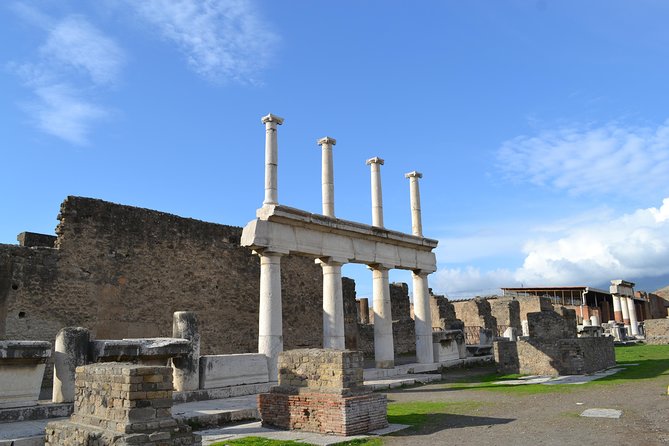
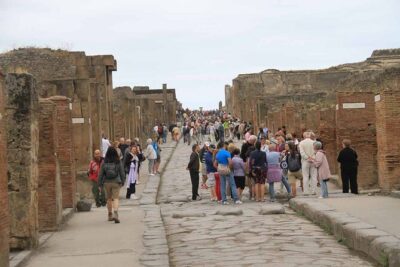
Next comes the Forum, the ancient city’s main square. The open space once formed the center of public life, and its scale helps you understand how the streets and major buildings were organized around it.
I like having a guide here because bare stone walls can be hard to interpret on your own. A professional guide can point out the purpose of the surrounding structures and explain how the square fit into Roman city life. The visit is brief, so listen closely and ask your most important questions early.
Walking the main street to the Forum granary
You then walk along one of Pompeii’s main streets. The route gives you a sense of the city as a place where people moved between homes, shops, public buildings, and entertainment venues.
Pompeii is not a polished museum. You are walking through an open archaeological area, and the streets can feel uneven underfoot. The supplied details do not specify walking conditions or special equipment, so sensible shoes are a good idea, even though most participants can take part.
At the Forum granary, you see marble tables and the stone basins once used for fountains at house entrances. The building also contains casts connected with victims of the eruption, including a dog and a tree.
This can be one of the more sobering sections of the visit. The casts make the disaster personal rather than abstract. They also need to be viewed with care. The experience is not simply about grand Roman architecture; it shows the sudden human cost of the eruption.
More ways to see Pompeii:
- From Naples: Pompeii Ruins & Mount Vesuvius Day Tour
★ 4.3 · 11,459 reviews - Naples or Sorrento: Full-Day Pompeii and Mount Vesuvius Tour
★ 4.6 · 4,235 reviews - Pompeii & Mt.Vesuvius Day Tour from Naples with Pizza Lunch
★ 4.0 · 2,901 reviews - From Naples: Pompeii Skip-the-Line Entry Ticket and Tour
★ 4.4 · 2,753 reviews
Casa del Menandro and the Stabian Baths
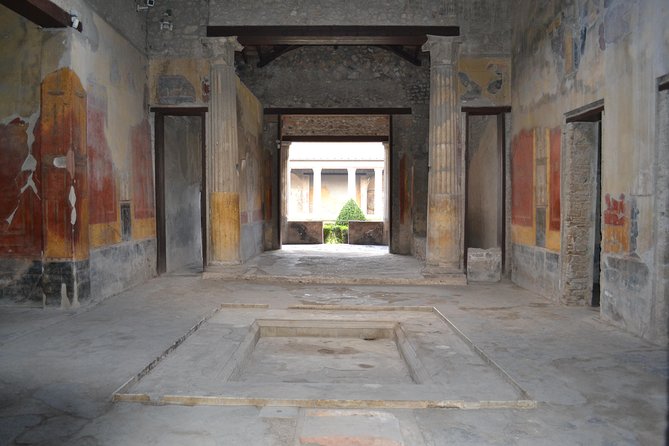
Casa del Menandro is one of Pompeii’s grandest private residences. Its architecture, decoration, and contents give the guide plenty to explain about domestic life among wealthy residents.
I would pay attention to the contrast between this house and the public buildings seen earlier. The Basilica and Forum show how the city operated in public, while Casa del Menandro offers a look at status, taste, and private space. The visit lasts about 15 minutes, so you will get an overview rather than a room-by-room study.
The Stabian Baths cover a broad area between the Brothel lane, the Holconius crossroads, and Via Stabiana. They are described as the oldest thermal complex in Pompeii.
This stop helps explain the place of bathing in Roman urban life. The baths were not merely practical washing facilities. They were public spaces tied to routine and social activity. Again, your guide is important, since the remaining walls and rooms are easier to understand when their original use is explained.
The itinerary gives the baths about 15 minutes. That is enough to see the main spaces, but not enough to linger over every architectural detail. If Roman bathing is your main interest, you may find the pace brisk.
The Lupanar and Casa del Fauno
The Lupanar is Pompeii’s most famous brothel. Its inclusion makes the route more complete because it presents a less polished side of Roman life than the large villas and public squares.
The stop is brief, and the site’s subject matter may not suit every group. Still, it is an important part of the city’s surviving street life, and the guide can place it within the wider pattern of commercial activity.
Casa del Fauno is one of the largest and most impressive private residences in Pompeii. Its size provides a strong contrast with the smaller homes and working spaces encountered along the streets.
For me, the appeal of Casa del Fauno is the chance to see how scale and decoration reflected wealth. It also helps you picture Pompeii as a functioning city, not just a collection of ruins. The house receives about 15 minutes, so expect key points rather than an exhaustive tour of the entire property.
The theaters, the House of the Tragic Poet, and the plaster casts
The route also takes in Pompeii’s Teatro Piccolo, or Small Theater, before continuing to the Teatro Grande. The larger theater was the city’s most important theater, and its size gives the final part of the tour a lively change of mood after the homes and baths.
Theaters reveal another side of Roman public life. They were places for shared entertainment and civic gatherings, and their surviving form helps you understand how crowds were arranged around a performance space.
You will also see the House of the Tragic Poet and the famous plaster casts. These final sights bring together several themes from the visit: private life, art, public culture, and the violence of the eruption.
The plaster casts can be among the most memorable sights at Pompeii, but they may also be emotionally difficult. The experience is not light sightseeing from start to finish. You are seeing evidence of real deaths, presented in a way that makes the ancient event feel close.
The entire Pompeii section lasts about two hours. That is a good introduction to the essential areas, especially if you have never visited before. If you already know Pompeii well, or want to explore less familiar neighborhoods, this route may feel too limited.
What the guide adds to a short visit
The experience includes assistance from a professional Pompeii guide, and the driver also provides support during the transfer. The guide’s role matters most because Pompeii can otherwise become a long walk through disconnected ruins.
One guide named Maria has 26 years of guiding experience and is described as engaging and personable. She is not guaranteed for every departure, but if she leads your visit, you can expect a guide who brings substantial experience to the site and keeps the presentation approachable.
That personal connection is valuable in a private tour. You can ask about a house, building, or detail that catches your eye instead of following a fixed speech meant for a large crowd. The trade-off is that the quality of the day depends partly on which guide is assigned, since no specific guide is promised.
Is $467.63 per person a fair price?
At $467.63 per person, this is not a budget transfer. You are paying for private transportation, hotel drop-off in Positano, a professional Pompeii guide, admission, taxes, and the convenience of combining everything in one booking.
The value improves when several people share the private vehicle, although the listed price is per person. It is also easier to justify if your time in Italy is short and you would otherwise need to arrange transport to Pompeii, entrance tickets, a guide, and a separate ride to Positano.
The price is harder to defend if you are traveling on a tight budget or have plenty of time. Pompeii can be visited through other arrangements, and this experience gives you only a short introduction to the site. Before booking, compare the total cost for your full group and check the vehicle size.
The inclusion of meals is not part of the package, so plan for food separately. The supplied information does not specify a meal stop, and the schedule is already compact. You should not count on a long lunch break during the four-hour experience.
Who should choose this experience?
I would choose this transfer if you want the simplest connection from Naples to Positano and consider Pompeii a must-see. It fits people who value a private ride, direct hotel drop-off, and a guided introduction rather than a full day at the ruins.
It also suits families and small private groups who prefer not to join a larger party. Car seats are available on request, and service animals are allowed. Most people can participate, though the information does not give detailed accessibility conditions for every part of the archaeological area.
I would think twice if you have a great deal of luggage. A sedan may be substituted, and six bags already required careful packing in one case. I would also choose a longer Pompeii visit if archaeology is your main interest.
The tour is offered in English. Confirmation arrives at booking, which helps with planning a time-sensitive arrival from the airport or station. Free cancellation is available until 24 hours before the start time. Changes or cancellations inside that window are not accepted for a refund.
Should you book this Naples to Positano route?
Book it if you want to turn a necessary transfer into a useful sightseeing day. The route covers Pompeii’s Forum, Basilica, granary, major houses, baths, brothel, theaters, and plaster casts, then delivers you to your Positano accommodation.
The strongest reasons are time saved, included entry, and private transport. The main cautions are the high price, the short Pompeii visit, and the need to confirm the vehicle if your luggage takes up serious space.
For a first look at Pompeii between Naples and Positano, this is a practical choice. For a slow archaeological study, choose a longer visit and arrange your luggage and transport separately.
FAQ
Where does the transfer begin?
Pickup is available at Naples Airport, Naples Central Station, or your accommodation in Naples. The driver holds a sign with your name.
Where does the transfer end?
The one-way transfer ends with drop-off at your hotel in Positano.
How long does the experience last?
The total duration is approximately four hours, including the transfer and the Pompeii visit.
How long is the Pompeii tour?
The guided Pompeii visit takes about two hours.
Where do I meet the Pompeii guide?
You meet the guide at Porta Marina Superiore, the main entrance to the Pompeii ruins.
Is Pompeii admission included?
Yes. Admission fees to Pompeii’s archaeological area are included.
Is the transportation private?
Yes. This is a private activity for your group only, with private air-conditioned transportation.
Are meals included?
No. Meals are not included.
Can I cancel for a full refund?
Yes, if you cancel at least 24 hours before the experience start time. Cancellations or changes made less than 24 hours before the start time are not refunded or accepted.
More 2-Hour Experiences in Naples
- Naples Archaeological Museum 2-Hour Guided Private Tour
★ 5.0 · 51 reviews - Naples: Capodimonte Museum 2-Hour Guided Private Tour
★ 4.5 · 15 reviews - Naples: 2-Hour Walking Tour w/ Food Tasting Experience
★ 4.4 · 15 reviews - 2-Hour Authentic Italian Pizza Making Class in Naples
★ 4.5 · 14 reviews
More Private Transfers in Naples
- From Naples: Mount Vesuvius Transfer with Entry Tickets
★ 4.3 · 1,247 reviews - Private Amalfi Coast Tour – Enjoy it with our local english speaking driver
★ 5.0 · 475 reviews - Private Transfer from Naples to Positano or Amalfi or vice versa
★ 5.0 · 265 reviews - Private Transfer from Naples to Sorrento or from Sorrento to Naples
★ 5.0 · 254 reviews
Just added around Naples
- Naples: Guided Walking Tour★ 4.7 · 63 reviews
- Wine tasting in the Vesuvius National Park★ 3.5 · 4 reviews
- Naples: Pompeii and Vesuvius Skip-the-Line Day Trip★ 3.8 · 32 reviews
- Visit the Museum MANN with a professional guide★ 5.0 · 3 reviews
- Walking-tour of Naples hystorical Centre★ 4.4 · 4 reviews
- Vesuvius – Herculaneum – Pompeii Excavations Tour★ 4.2 · 9 reviews
- Pompeii: Vesuvius at Sunset★ 3.5 · 31 reviews
- Vesuvius and Herculaneum from Naples★ 3.7 · 29 reviews
Positano Tours from Naples, compared.

Sorrento, Positano and Amalfi Full-Day Tour
Read our review →
Sorrento, Positano & Amalfi Coast – Small Group Tour
Read our review →


Positano, Amalfi & Ravello Group Tour with Optional Boat Ride
Read our review →
Day Trip of Pompeii, Sorrento and Positano from Naples/Salerno
Read our review →
Private Day Tour: Sorrento, Positano, Amalfi, Ravello from Naples
Read our review →Browse the lists this tour appears in