
Reviewed · POMPEII TOURS FROM NAPLES
Private Tour: Pompeii Half-Day Trip from Naples
Pompeii is not a ruin you simply look at. You walk its basalt streets, step across ancient stepping-stones, and peer into houses where daily Roman life ended in a single violent afternoon. This private trip pairs a private ride from Naples with about two hours inside the archaeological park, where you can see the Forum, House of Vetti, thermal baths, theaters, and Lupanare.
I like the door-to-door transport from a Naples hotel, station, or cruise terminal, and I like having a private guide who can adjust the pace and answer your questions. Guides named Erica, Lily, Paula, Sofia, Francesca, and Margherita have all been praised for strong explanations and family-friendly pacing. The main drawback is cost: the €20 Pompeii admission fee is extra, and the transport-only version can feel like an expensive taxi.
Key Points to Know Before Booking
- Private pickup from Naples: Choose a hotel, bed-and-breakfast, Airbnb meeting point, Naples Central Station, or cruise terminal.
- About two hours inside Pompeii: The visit covers major sights, but some people may find the pace too quick.
- Guide option matters: A private guide adds context to the Forum, houses, baths, brothel, and eruption.
- Admission costs extra: Budget €20 per person for entry to the Pompeii Archaeological Park.
- Morning or afternoon departure: Choose the time that fits your ship, train, or Naples plans.
- Transport-only is a different experience: Your driver takes you to Pompeii and waits while you explore independently.
Why Pompeii Works So Well as a Half-Day Trip
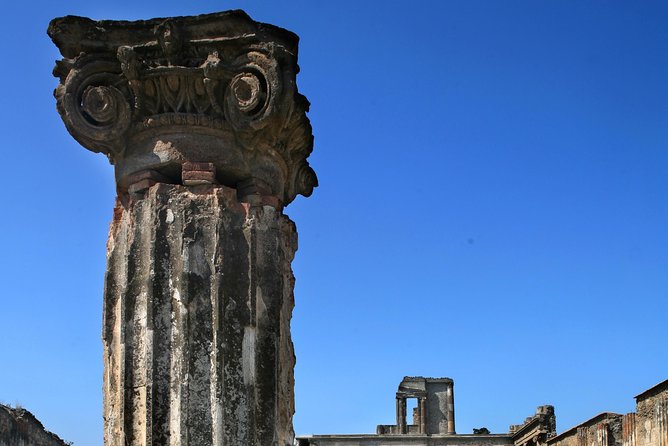
The appeal of Pompeii is its unusual closeness to ordinary Roman life. The eruption preserved streets, election notices, shops, homes, fountains, public buildings, and wall paintings under layers of ash and pumice. You are not just looking at broken columns. You can see how people moved through the city and how they used its public spaces.
This tour gives you roughly four hours from Naples and back, with about two hours at the site. That makes it a practical choice if you are on a cruise stop, catching a train later, or fitting Pompeii between other Naples plans. It is also easier than arranging separate transport and a guide yourself.
The tradeoff is depth. Pompeii is huge, and two hours only gives you a strong introduction. You will see many important places, but you will not have time to inspect every street or wander far from the main route. If you want a slow archaeological day, choose a longer visit. If you want the main story without giving up a full day, this format makes sense.
More ways to see Pompeii:
- From Naples: Pompeii Ruins & Mount Vesuvius Day Tour
★ 4.3 · 11,459 reviews - Naples or Sorrento: Full-Day Pompeii and Mount Vesuvius Tour
★ 4.6 · 4,235 reviews - Pompeii & Mt.Vesuvius Day Tour from Naples with Pizza Lunch
★ 4.0 · 2,901 reviews
Pickup from Hotels, Stations, and Cruise Ships
Your driver can collect you from your Naples accommodation, Naples Central Station, or the cruise terminal. If a vehicle cannot reach your exact address, you may be given a nearby meeting point. That is especially important in Naples, where narrow streets and pedestrian-only lanes can prevent a car from reaching the front door.
Cruise passengers need to confirm the correct pickup point. At Stazione Marittima, the meeting place is outside the terminal exit near the blue Stazione Marittima sign. At Pier 21 in Molo Carlo Pisacane, pickup is just outside the exit gate beside the ship. The driver or guide carries a sign with the booking name.
Allow a little patience at the port. One pickup was reported as about 20 minutes late, and another group lost time because the driver and passengers had different meeting points. The operator can be reached through the booking platform, but direct communication before the tour has not always been quick. I would keep your phone charged, have the local contact details ready, and confirm the pickup point before departure.
The drive to Pompeii takes about 30 minutes according to the tour details, though traffic can affect the actual time. Some drivers speak limited English, so the guide in Pompeii becomes the main source of historical information.
Entering Pompeii and Meeting Your Guide
At Pompeii, the guide meets you near the vehicle and gives an introduction before you enter the archaeological park. The private format means the tour is reserved for your group, rather than combined with a large coach party.
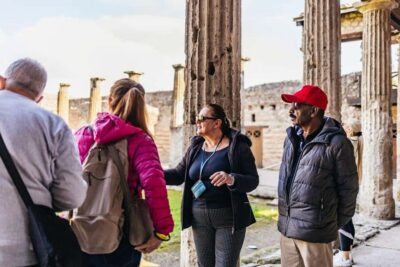
That privacy is useful here. Pompeii can be crowded, and a good guide can steer you around larger groups, position you where you can hear, and adjust the explanation for children or older family members. Guides such as Paula and Margarita have been praised for handling mixed-age groups well. A guide also helps you connect scattered ruins into a clear picture of Roman life.
The quality of the experience depends heavily on the individual guide. Several guides have been described as friendly, patient, and lively, while one or two were criticized for a flat delivery and little interest in engaging the group. That is a fair risk with any guide-based experience. The private format gives you a better chance to ask questions, but it does not guarantee a particular personality.
The tour is available in English. Some guides have also offered Spanish, including Margherita, who was praised for fluent Spanish and a strong command of the subject.
Porta Marina, City Walls, and the First View of Pompeii
The visit begins near the city walls and Porta Marina, one of Pompeii’s old entrances. The gate once connected the city with its harbor, giving your guide a useful way to explain Pompeii’s place in the Roman world.
The walls also help you understand the scale of the settlement. Pompeii was not a single villa or isolated temple. It was a working city with homes, markets, religious buildings, entertainment venues, public baths, and commercial streets.
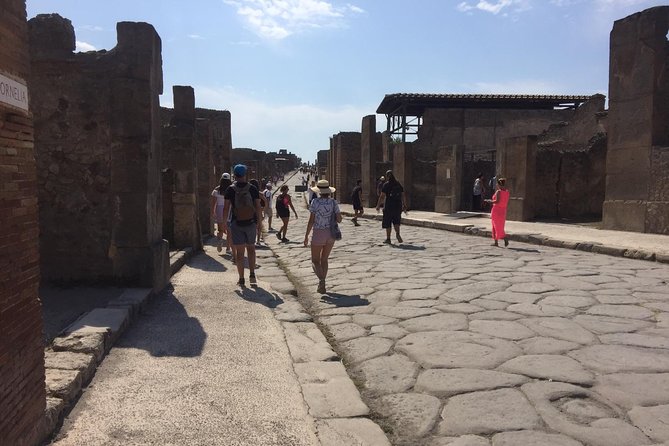
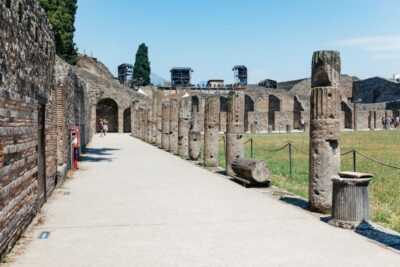
You will quickly notice the paving. The basalt blocks are uneven, polished by ancient feet and modern visitors alike. Raised stones cross the roads at intervals. These served as stepping-stones when streets were wet or dirty, while wagon wheels passed through the gaps. It is a small detail, but it makes Roman infrastructure feel practical rather than distant.
Wear sturdy shoes. The route is a walking tour over old paving, and rain can make the surface more difficult. The tour can accommodate many participants, and several groups found their guides helpful with mobility needs, including a wheelchair user, but the site itself remains an ancient archaeological area with uneven ground.
A few more Naples outings worth a look
- From Naples or Sorrento: Pompei Half-Day Tour
★ 4.4 · 2,645 reviews - Explore Naples & Pompeii in One Day – Guided Half-Day Tour
★ 4.5 · 253 reviews - Half-Day Trip to Mt. Vesuvius from Naples
★ 4.0 · 137 reviews - Naples Private Half-Day Tour with a Local – Flexible Meet-Up
★ 4.5 · 95 reviews
The Forum, Temple of Apollo, and Macellum
The Forum is one of the most important stops. This broad public space was the center of political, religious, and commercial life. Here, your guide can explain how the city was organized and how Roman public life worked.
The nearby Temple of Apollo adds an older religious layer to the city. The Macellum, or market building, shows another side of Pompeii, where food and daily commerce shaped the rhythm of urban life. Public weighing scales help explain how goods were measured and sold.
These stops are valuable because they give structure to the rest of the visit. Without a guide, you can certainly see the ruins, but it is easy to miss why one open space mattered more than another. A good explanation turns walls and columns into a city with rules, trade, worship, and local politics.
The guide may also point out the large containers used for storing food in an ancient Roman equivalent of a fast-food shop. It is one of the most memorable details for families because it links the site to an everyday need that has hardly changed: finding something quick to eat.
Houses, Frescoes, and the House of Vetti
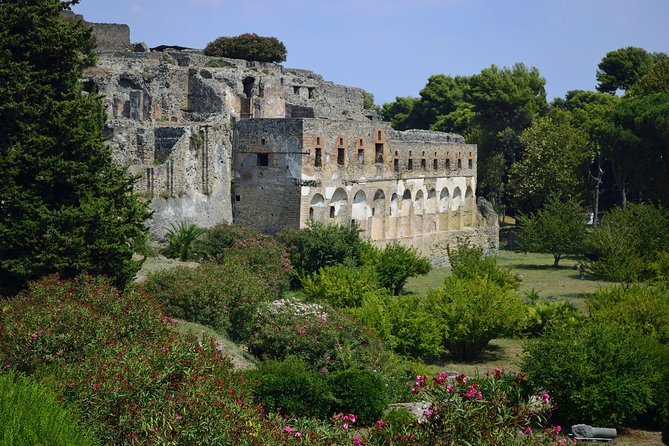
The House of Vetti is a major highlight. This wealthy home is known for its frescoes, which offer a glimpse into Roman taste, status, and domestic decoration. Even when rooms are closed for preservation or restoration, the house helps show how a Roman elite residence was arranged around interior spaces.
You may also visit other houses and villas along the route. Their value lies in the details: thresholds, wall paintings, courtyards, kitchens, storage areas, and the contrast between public rooms and private corners.
Pompeii is often described as frozen in time, but that phrase can give the wrong impression. Not every building is open, and many artifacts have been moved into museums or protected behind glass. The preserved city is still powerful, but it is a managed archaeological site, not a perfectly untouched town.
Your guide can help separate what is original from what was reconstructed or protected. Ask questions. On a private tour, you do not have to follow a fixed group script.
Thermal Baths and the Lupanare
The thermal baths show how much Roman society depended on public facilities. Baths were places to wash, exercise, socialize, and conduct business. The remains reveal a planned sequence of rooms and heating systems, making this more than a collection of broken walls.
The Lupanare, Pompeii’s brothel, is another well-known stop. Its small rooms and erotic paintings attract plenty of attention, but the site is also useful for understanding the commercial and social life of the city. The subject may not suit every young child, so families should decide in advance how they want the guide to handle it.
A private guide can adjust the explanation. That is one of the strongest reasons to choose the guided option instead of relying only on an audio guide. The audio guide is available at an additional cost for the transport-only option, but it cannot respond to your questions or change the route for your group.
Theaters and the Daily Life of a Roman City
Pompeii’s ancient theater gives the tour a cultural dimension. Performances took place here, and the building helps show how entertainment fit into Roman public life.
Along the streets, you will pass squares, shopfronts, houses, and public buildings. The city feels unusually readable because so many walls and road lines remain in place. Your guide may point out how the different parts worked together, from commercial spaces to civic buildings and residential areas.
This is where the private format can be most useful. A guide can stop for a quick explanation, take group photos, answer a child’s question, or move on when your attention starts to fade. One guide even helped with photographs and allowed extra time when a special market was taking place.
Still, watch the clock. The advertised site visit is about two hours, but some groups finished early or felt rushed. One group had no time to stop for water and souvenirs before returning to the port. If you want more time, ask at the start how much free time is actually planned after the guided portion.
The Casts of the Victims
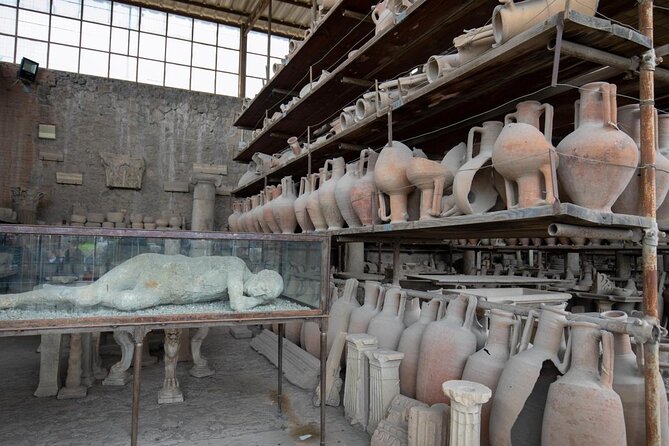
The casts of people and animals caught in the eruption are among Pompeii’s most disturbing sights. They were created from cavities left in the ash after organic material decayed. Plaster was poured into those spaces, preserving the shapes of bodies and clothing.
The casts can be emotionally difficult. They are not simply archaeological curiosities. They show the human cost of the disaster and make the eruption personal in a way that streets and buildings cannot.
The exact display areas can change as the site works to protect its finds. Some objects are sealed behind glass or kept in protected spaces. Your guide can explain what you are seeing and why preservation affects access.
What You Pay, and What You Actually Get
The listed price is $129.76 per person. It includes pickup and drop-off, a private vehicle, and a private guide if you select the driver and guide option. Pompeii admission is not included, and the stated entrance cost is €20 per person.
That extra fee is easy to miss, so include it in your budget. One complaint came from a visitor who expected entry to be covered. The tour details do state that the admission fee is separate, but you should still read the option and inclusions carefully before paying.
The price is easier to justify for a family, cruise group, or party that values direct pickup and a private route. It can also work well for people who do not want to navigate Naples transport, find a taxi, and arrange a guide at Pompeii.
The transport-only option is harder to recommend at this price unless convenience is your main goal. You receive private round-trip transportation, and the driver waits while you explore for a couple of hours. But the experience becomes little more than a private ride to the ruins. If you choose transport only, add the audio guide or arrange your own plan in advance.
The listed per-person rate is based on 11 adults per vehicle, so check how the total is calculated for your actual party. For a large group, the cost may compare more favorably with several taxis or separate guided admissions.
Timing, Weather, and Pace
You can choose a morning or afternoon departure. Morning is the safer choice during hot weather and usually gives you a better chance of avoiding the heaviest crowds. December can bring cooler weather and fewer people, though rain remains possible.
The tour operates in wet weather, and at least one group still had a good visit in the rain. Bring water, sun protection, and a light rain layer. Pompeii has open streets with limited shade, and the combination of heat, uneven paving, and steady walking can wear you down.
The pace has received mixed reactions. Some families appreciated a clear, efficient two-hour route. Others felt the visit ended 20 minutes to an hour earlier than expected. If you move quickly, ask for a little free time at the end to revisit a house, buy water, or take photographs.
Who Should Book This Pompeii Tour?
I would choose this tour if you are arriving by cruise ship, staying outside central Naples, traveling with children, or managing mobility concerns and want a private vehicle. It is also a good fit if your group wants a guide who can explain the site without forcing you into a large bus tour.
The tour suits first-time visitors who want the main sights: the Forum, temples, market, baths, brothel, houses, theater, and victim casts. It also works for families with children around 11 and older, especially when the guide keeps the story moving.
I would think twice if you want a long, slow archaeological visit, or if you are comfortable taking the train and finding your own way around. In that case, compare the total cost of transport, entry, and a guide at the site. The transport-only option offers convenience, but not much interpretation.
Should You Book It?
Book the guided version if door-to-door convenience and private attention matter more than getting the lowest price. The best guides make a major difference, and the private setting lets you ask questions, slow down for mobility needs, and keep children involved.
Before booking, confirm your pickup point, remember that €20 admission is extra, and ask how much time you will spend inside the park. If the operator confirms the details and your group values ease, this is a sensible half-day way to see Pompeii from Naples.
Skip the transport-only version unless you specifically want a private car and are happy exploring on your own. For most people, Pompeii is worth the added guide fee because the ruins make much more sense when someone explains how the city functioned.
FAQ
How long does the Pompeii trip take?
The full experience lasts about four hours, including travel from Naples and back. The visit inside the archaeological park is planned for about two hours.
Where can I be picked up in Naples?
Pickup is available from your Naples hotel, bed-and-breakfast, Airbnb meeting point, Naples Central Station, or Naples cruise terminal. If a vehicle cannot reach your exact address, a nearby meeting point may be arranged.
Is Pompeii admission included in the tour price?
No. The Pompeii Archaeological Park entrance fee is listed separately at €20 per person.
Can I choose transport without a private guide?
Yes. The transport-only option provides private round-trip transportation from Naples. The driver waits while you explore Pompeii independently, and an audio guide is available at an additional cost.
Is this a private group tour?
Yes. Only your group participates in the private activity. The price is shown per person based on 11 adults per vehicle.
Are morning and afternoon departures available?
Yes. You can choose either a morning or afternoon tour.
Can I cancel for a full refund?
You can cancel at least 24 hours before the experience start time for a full refund. Cancellations or changes made less than 24 hours before departure are not accepted for a refund.
More 1-Day Tours in Naples
- From Naples: Amalfi Coast Full-Day Trip
★ 4.5 · 4,354 reviews - From Naples: Pompeii & Amalfi Coast Full-Day Trip with Lunch
★ 4.5 · 2,155 reviews - From Naples or Sorrento: Amalfi Coast Full-Day Trip
★ 4.7 · 2,043 reviews - Naples: Pompeii & Mt. Vesuvius Day Trip with Tickets & Lunch
★ 4.7 · 1,208 reviews
Just added around Naples
- Naples: Guided Walking Tour★ 4.7 · 63 reviews
- Wine tasting in the Vesuvius National Park★ 3.5 · 4 reviews
- Naples: Pompeii and Vesuvius Skip-the-Line Day Trip★ 3.8 · 32 reviews
- Visit the Museum MANN with a professional guide★ 5.0 · 3 reviews
- Walking-tour of Naples hystorical Centre★ 4.4 · 4 reviews
- Vesuvius – Herculaneum – Pompeii Excavations Tour★ 4.2 · 9 reviews
- Pompeii: Vesuvius at Sunset★ 3.5 · 31 reviews
- Vesuvius and Herculaneum from Naples★ 3.7 · 29 reviews
Pompeii Tours from Naples, compared.

Pompeii Small Group Tour with an Archaeologist
Read our review →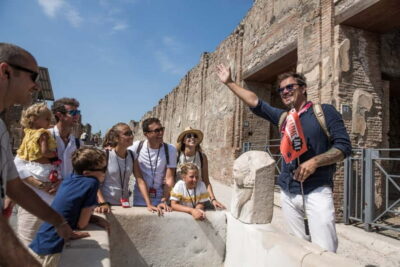

Pompeii & Mt.Vesuvius Day Tour from Naples with Pizza Lunch
Read our review →

Pompeii & Mt Vesuvius All-Inclusive Small Group w/ Lunch
Read our review →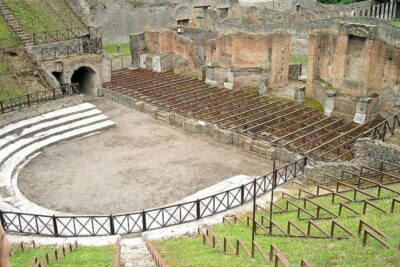
Pompeii & Amalfi Coast Full-Day Trip with Lunch
Read our review →Browse the lists this tour appears in