
Reviewed · POMPEII TOURS FROM NAPLES
Pompeii Tour & Admission included in a Small Group
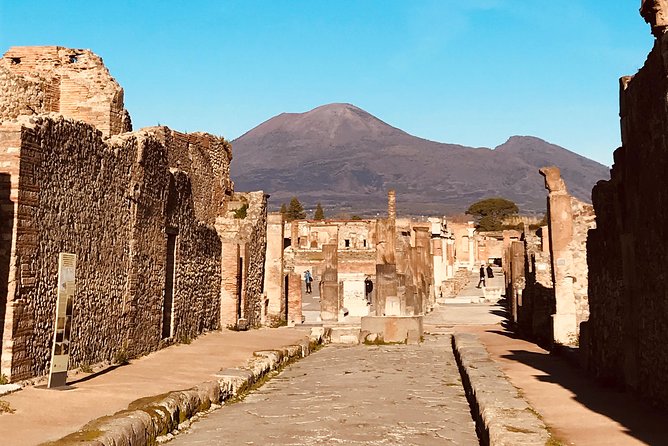
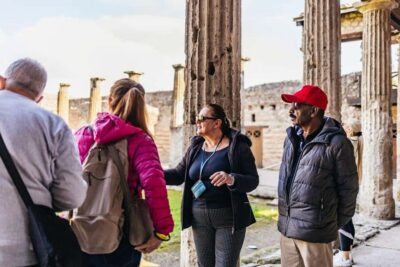
Pompeii is far larger and more physical than many first-time visitors expect. This two-hour guided walk gives you a clear route through the city’s Forum, temples, baths, shops, homes, and theaters, with Mount Vesuvius in view and an archaeologist or authorized guide to explain what you are seeing.
I like that admission is included, so you do not need to sort out a separate park ticket. I also like the use of headsets when the site is crowded. The main drawback is pace: two hours is enough for major sights, but not for every street, house, or excavation detail.
Key points at a glance
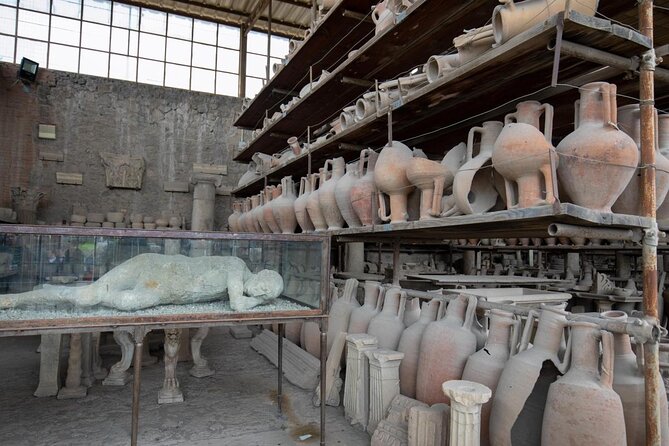
- A focused route through Pompeii’s essential sights: See the Forum, Basilica, temples, baths, shops, plaster casts, homes, and theaters.
- Entry is included in the $66.01 price: You pay for the park ticket, guided visit, headset when needed, and a paper map in one booking.
- Small group format: The stated maximum is 15 people, though one unusually busy day reached 16 during a strike.
- Guides bring strong Roman-life context: Guides such as Livio, Riccardo, Antonio, Ornella, Annalisa, and Angelo have been praised for clear explanations and lively storytelling.
- Expect uneven walking: Ancient paving, curbs, and raised stepping stones make good shoes important.
- Some houses and protected areas can close: The House of the Faun and House of the Vettii are subject to seasonal opening, and some sites may close by 6 PM.
Why two hours can make Pompeii easier to understand
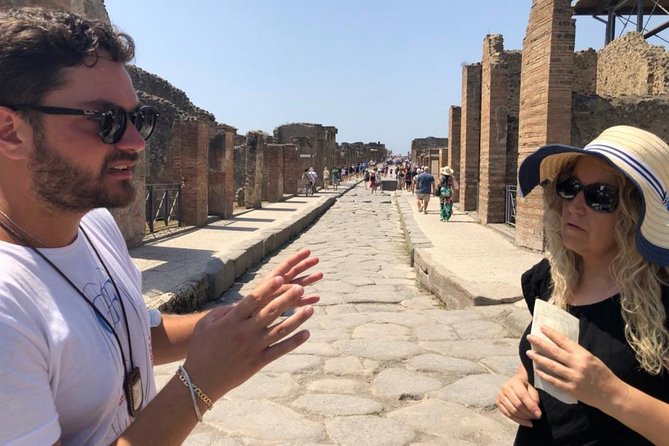
Pompeii can feel confusing without a plan. Ancient streets lead in many directions, buildings often look like low stone walls at first glance, and the scale of the site makes it easy to spend too much time in one corner. A guide gives you a framework before the details start to blur together.
This tour begins around the Porta Marina area, with Vesuvius rising behind the ruins. You learn about the eruption of 79 AD, the city’s final moments, and the long process of uncovering Pompeii. The focus is not only on disaster. The route also shows how people worked, worshipped, shopped, bathed, watched theater, and lived at home.
The format is brisk. Each major stop is allocated roughly 10 minutes in the published route, so you should think of this as a guided introduction rather than a full-day archaeological study. You will see the major landmarks and get useful context, then have a better sense of where to spend extra time if you remain in the park.
More ways to see Pompeii:
- Pompeii Small Group Tour with an Archaeologist
★ 5.0 · 6,593 reviews - Discover the Ancient Ruins of Pompeii: Day Trip from Rome
★ 3.5 · 2,247 reviews - Pompeii and Herculaneum Small Group Tour with an Archaeologist
★ 5.0 · 1,350 reviews
Entering from Porta Marina and seeing Venus first
The walk takes you through Pompeii’s main public center, beginning with the area around Porta Marina and the Temple of Venus. Venus was the city’s patron goddess, and the temple’s position gives it a natural link to Pompeii’s public and religious life.
This opening also sets the tone for the visit. You are not simply looking at scattered ruins. You are following the way ancient streets connected the city gate to its political, religious, and commercial heart.
The description places the meeting point at Villa of the Mysteries, on Via Villa dei Misteri, 2, while the route itself begins at or around Porta Marina. Since meeting and route details can be easy to mix up at a large site, read the confirmation carefully and look for the guide’s instructions before setting off.
The Basilica, Apollo, and Pompeii’s Forum
The Basilica was one of the most important buildings in the Forum. It served business and legal purposes, making it a useful reminder that the Forum was not only a ceremonial square. It was where public administration, commerce, and civic life met.
The nearby Sanctuary of Apollo is among Pompeii’s oldest places of worship. Its position along the road from Porta Marina toward the Forum shows how carefully the city’s religious spaces were tied to movement through town.
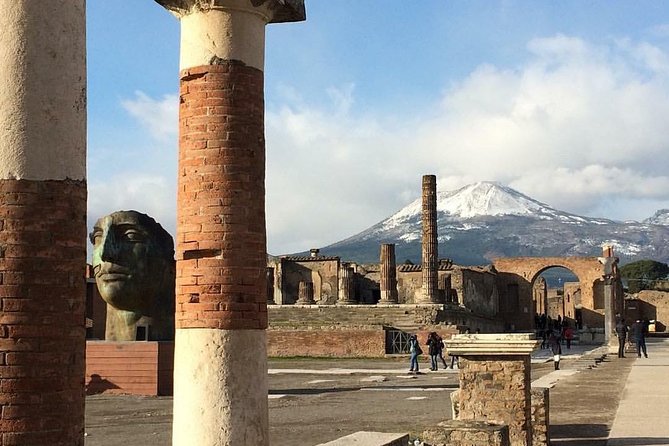
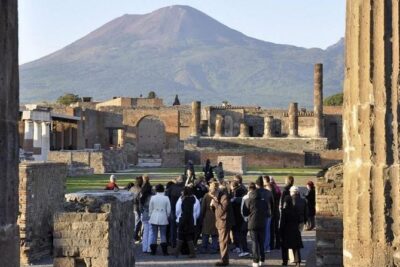
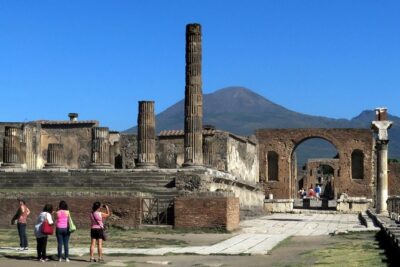
Then comes the Forum itself, Pompeii’s main public square. This is where the city’s daily life came together, and it is one of the moments when the site’s scale becomes clear. From here, the Temple of Jupiter dominates the northern end, with Vesuvius behind it.
I especially like this section for first-time visitors because it connects the ruins to a functioning city. You can see where public decisions were made, where religious ceremonies took place, and where ordinary movement through Pompeii met the city’s most important buildings.
Food, bodies, and the difficult human story
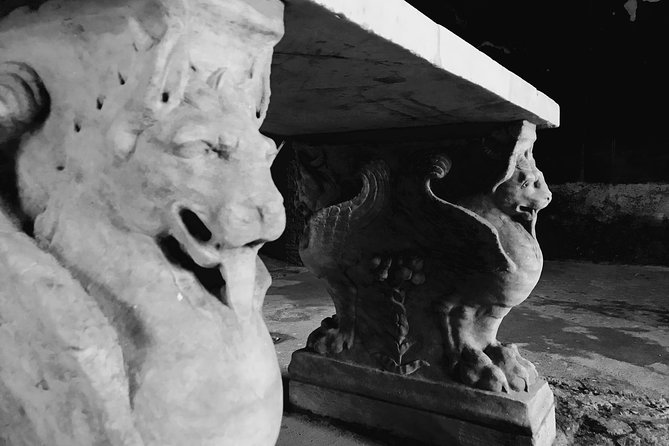
The Macellum was a large market building used for food and everyday goods. It helps correct the common idea that Pompeii is only a city of grand villas and temples. Much of the archaeological interest lies in ordinary business, food, and street life.
Plaster casts can also be seen in this area. They were made by filling the spaces left in hardened ash where human bodies had decomposed. The result preserves the forms of people caught during the eruption. This is one of the most moving parts of Pompeii, and the subject deserves a respectful explanation rather than a sensational presentation.
The guides on this tour are expected to discuss the eruption with care. One guide, praised for an especially thoughtful approach, connected the eruption to the way Vesuvius and the surrounding area changed afterward. That kind of explanation gives the casts a human context and keeps the focus on the people who lived in the city.
A few more Pompeii outings worth a look
- Skip the Line Guided Tour of Pompeii led by an Archaeologist
★ 5.0 · 703 reviews - Pompeii Ticket + Tour with Optional Tasting Experience at Pompeii
★ 5.0 · 663 reviews - Pompeii private tour with an Official Guide
★ 5.0 · 631 reviews - Pompeii Private Tour with an Archaeologist and Skip The Line – 3 hours
★ 5.0 · 564 reviews
The Forum Baths and a Roman diner
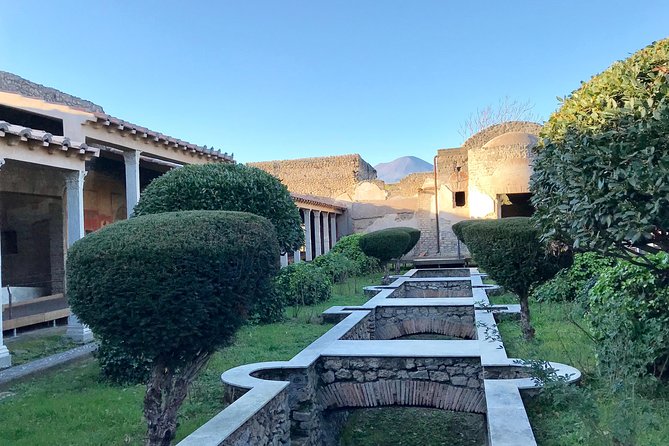
The Forum Baths are among Pompeii’s best-preserved public buildings. The male and female sections had separate entrances, and the remains reveal how bathing was organized as part of urban life.
A visit here is valuable because the baths are easy to misunderstand if you only see them as attractive walls and rooms. Your guide can point out how the building functioned and how public bathing fit into the rhythm of the city.
The Thermopolium of Vetuzio Placido offers a different view of daily life. This was an old diner or refreshment shop, a place where people could buy food and drink. Its presence adds a useful bit of street-level detail to the more formal buildings around the Forum.
The nearby bakeries and shops mentioned along the route continue that theme. You see Pompeii as a place where people bought meals, worked, traded goods, and moved through crowded streets, not just as a collection of elite houses.
Houses, mosaics, and the limits of seasonal openings
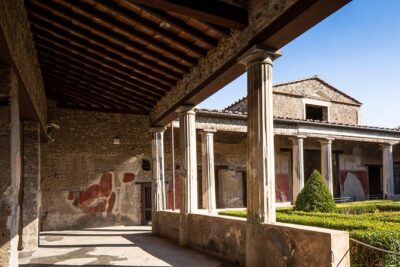
The House of the Faun is one of Pompeii’s largest residences. Its entrance carries the Latin welcome inscription HAVE, and its size gives you a sense of how much space wealthy families could command within the city.
The House of the Vettii is another major residence, known as one of Pompeii’s richest and most famous homes. It is associated with Priapus, a god linked to prosperity. These houses can add a great deal to the visit because domestic architecture often reveals social class, taste, household organization, and private beliefs.
There is an important catch. The House of the Faun and House of the Vettii are subject to seasonal opening and closure. Other protected sections can also close during the day. One visit was affected by sites closing at 6 PM, so do not treat every named building as guaranteed access on every date.
The guide can still explain the buildings and their place in Pompeii even if a doorway is closed. Still, if seeing a particular house is your main reason for booking, confirm current opening conditions and choose your timing carefully.
Walking Via dell’Abbondanza
Via dell’Abbondanza was the ancient city’s main street, often identified with the Decumanus Maximus. Walking along it gives you a feel for Pompeii’s street plan and links many of the stops together.
This is also where the physical side of the visit becomes clear. Pompeii’s paving is uneven, and you may encounter raised stepping stones and sidewalk curbs. Those stones helped people cross streets while allowing water to pass through, but they are not smooth modern sidewalks.
Wear shoes with a secure sole, take care on the raised surfaces, and do not expect a gentle stroll. The route is manageable for most people, but the combination of distance and rough paving can be tiring. The guide generally sets a steady pace, and one guide was especially helpful to a family by keeping children interested.
The theaters and Gladiators’ Barracks
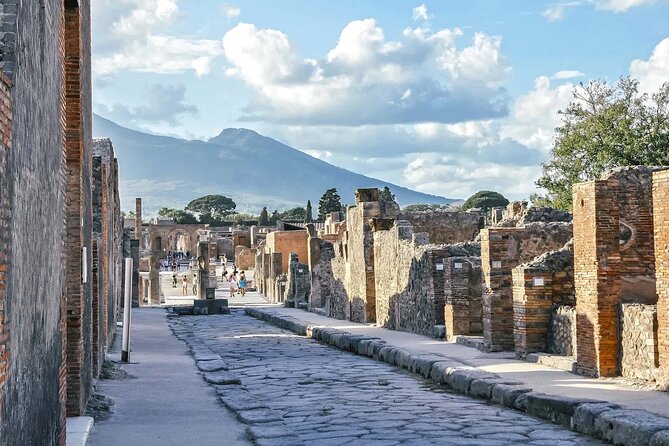
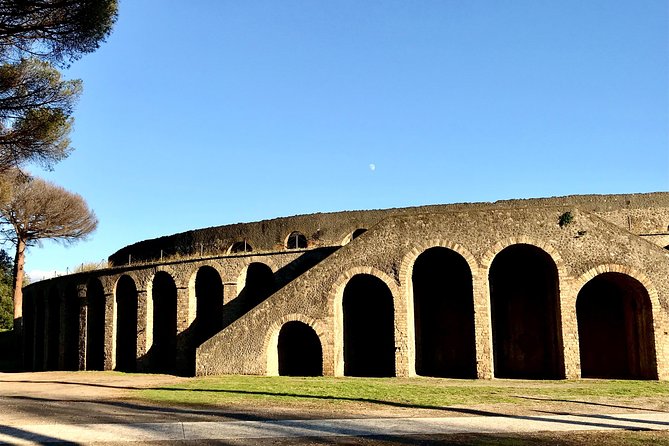
The Large Theater hosted comedies and tragedies in the Greco-Roman tradition. It is one of the best places on the route to think about Pompeii as a city of entertainment, not only politics and commerce.
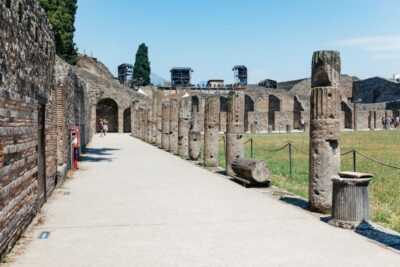
The tour also includes the Small Theater and the Gladiators’ Barracks. Together, these sites show the planning behind public performances and the infrastructure that supported them. Theaters were not just decorative buildings. They were part of the city’s social life.
The route description lists the theaters among the major stops, but the entire visit is still limited to about two hours. You will get an informed look at them, rather than time to study every architectural feature or sit quietly in each space.
What the guides add to the ruins
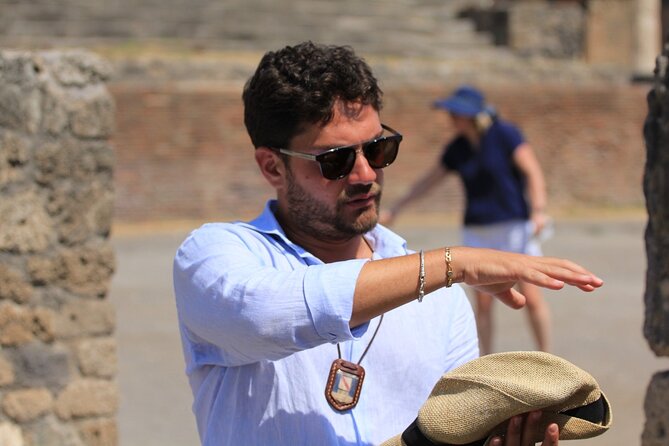
The human guide is the main reason to choose this tour instead of entering Pompeii alone. The strongest guide experiences described for this activity combine architecture, ancient city life, and the eruption rather than reciting dates.
Livio has been praised for an enthusiastic and informative approach. Riccardo, also referred to as Ricardo in one account, is noted for linking Pompeii’s architecture and culture to modern terms. Antonio has been singled out for passionate explanations of facts and historical detail. Ornella and Annalisa have also been praised for clear teaching and attention to small details of Roman life.
Your guide will vary, so you cannot book a specific person based on the information provided. The important point is the type of visit: an English-speaking guide leads the route, and a headset may be supplied if the site is crowded. That helps you hear without having to stay shoulder to shoulder with the group.
A paper map is included too. Keep it after the walk if you plan to continue on your own, since Pompeii’s size makes it easy to lose your bearings.
Group size, timing, and practical value
The stated maximum is 15 people. That is small enough for questions and much easier to manage than a large coach group, though it does not mean a private visit. One unusually difficult day, affected by a strike, brought the group to 16 after some people were allowed to reschedule.
At $66.01 per person, the value depends on how you would otherwise visit Pompeii. The price includes the park admission, authorized guide or archaeologist, headset when needed, and paper map. You do not have to buy an entrance ticket separately or pay for a guide on arrival.
For a short visit, that package makes practical sense. Pompeii is large, and a well-organized route can prevent you from spending your limited time wandering between major buildings. The tradeoff is that the tour cannot cover every corner, and a self-guided visitor who wants several hours alone may prefer more freedom.
Bring water. Bottled water is not included, and the route takes place outdoors across uneven ancient streets. The activity is near public transportation, and most people can participate, but the physical demands should not be overlooked.
The tour ends back at the meeting point. If you need to catch a ship, bus, or train, allow time for the route to finish and for the walk to your onward transport. One group had to leave early for a bus, and the guide made sure the participants knew how to reach the exit. That kind of help matters because Pompeii’s exits and internal streets are not always obvious at a glance.
Who should book this Pompeii tour
I would choose this tour if you have about two hours, want the entrance ticket handled, and prefer a guide to explain the ruins as you walk. It suits first-time visitors, families who benefit from a steady pace, and anyone who wants the major sights without planning a route through the entire park.
It is also a good fit if ancient Roman daily life interests you. The Forum and temples are important, but the thermopolium, bakeries, baths, houses, and street crossings make the visit feel more complete.
I would look elsewhere if you want a slow archaeological study, extended time in individual houses, or complete control over the route. You may also want extra planning if your schedule depends on seeing a particular building, since seasonal closures and early closing times can affect access.
Should you book it?
Book this Pompeii tour if you value clear storytelling, included admission, and a compact route through the city’s main sights. The strongest part is the guide-led explanation of Roman life and the eruption, supported by headsets, a map, and a group capped at 15 under normal conditions.
Go in with realistic expectations. Two hours is a useful introduction, not a complete exploration, and uneven ground is part of the experience. If that sounds right for your schedule, $66.01 is a fair price for a guided first look at Pompeii.
Free cancellation is available up to 24 hours before the start time for a full refund. Changes or cancellations made less than 24 hours before the experience are not accepted.
FAQ
Is Pompeii admission included in the tour price?
Yes. The Archaeological Park of Pompeii entrance ticket is included in the $66.01 price.
How long does the Pompeii tour last?
The tour lasts approximately two hours.
Where does the tour meet?
The stated meeting point is Villa of the Mysteries, Via Villa dei Misteri, 2, 80045 Pompei, Italy. The route description begins around Porta Marina, so check your booking confirmation for the guide’s exact meeting instructions.
Is the tour offered in English?
Yes. The experience is offered in English.
How many people can join the group?
The stated maximum is 15 people. On one unusual day affected by a strike, the group reached 16.
What is included besides admission?
The tour includes an authorized guide or archaeologist, a headset if the site is crowded, and a paper map of Pompeii. Bottled water is not included.
Just added around Pompeii
- Wine Tasting and Winery Tour in Vesuvio National Park with Lunch★ 4.5 · 3 reviews
- Wine tasting in the Vesuvius national park★ 5.0 · 3 reviews
- Mt. Vesuvius Wine Tasting and Lunch Experience from Pompeii★ 4.5 · 20 reviews
- Traditional Neapolitan Dinner in Pompei – Villa Franca – Family Restourant★ 5.0 · 8 reviews
- Private Guided Tour and VR Headsets in the Ancient Pompeii★ 5.0 · 3 reviews
- Visit Pompeii with a local expert guide★ 5.0 · 10 reviews
- Tour Mount Vesuvius with Entry Tickets and Round Trip Transfer Included★ 3.5 · 4 reviews
- Vesuvius tour entrance to the crater and return bus★ 4.5 · 9 reviews
Pompeii Tours from Naples, compared.
Pompeii Small Group Tour with an Archaeologist
Read our review →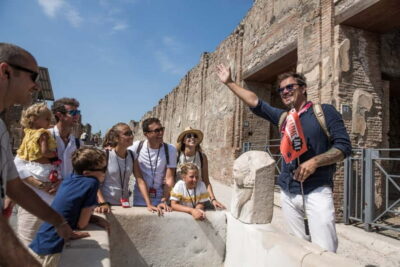
Pompeii & Mt.Vesuvius Day Tour from Naples with Pizza Lunch
Read our review →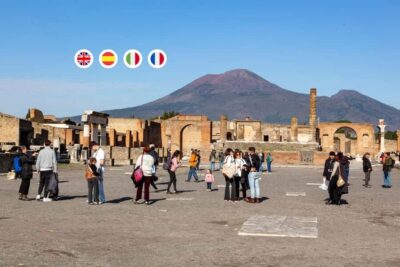
Pompeii & Mt Vesuvius All-Inclusive Small Group w/ Lunch
Read our review →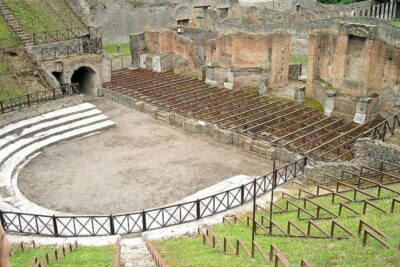
Pompeii & Amalfi Coast Full-Day Trip with Lunch
Read our review →Browse the lists this tour appears in