
Reviewed · MOUNT VESUVIUS TOURS FROM NAPLES
Pompeii and Mount Vesuvius Small Group Tour
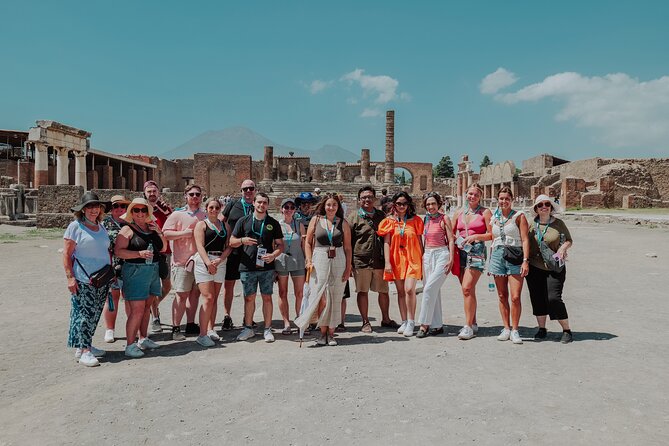
Pompeii and Mount Vesuvius make a natural pair: one shows you the Roman city destroyed by the volcano, and the other lets you look into the force that caused it. This tour packs both into one day, with an archaeologist-led Pompeii visit followed by a minivan ride and a hike toward the crater.
I especially like the practical setup. Admission to Pompeii and Vesuvius is included, and the minivan saves you from sorting out mountain transport. I also like the quality of the guiding, with archaeologists such as Teresa, Anna, Benedetto, and Raffaela bringing the ruins to life, while guides such as Mario handle the volcano walk with patience and clear explanations.
The tradeoff is the pace. Two hours in Pompeii gives you an excellent introduction, but not enough time to see the enormous site at leisure. Add the uphill volcanic trail, summer heat, and possible fog or rain, and this is a full, active day rather than a gentle sightseeing outing.
Key points to know before booking
- Two major sights in one day: Visit Pompeii and Mount Vesuvius without arranging separate admission or mountain transport.
- Archaeologist-led Pompeii tour: Expect explanations of Roman homes, baths, theaters, streets, politics, and current excavations.
- A real uphill walk: The final 500 meters to the crater are steep, with loose volcanic ground in places.
- Small groups, but two group sizes: Pompeii guidance allows up to 20 people, while the minivan transfer allows up to 14.
- Weather affects the volcano visit: Fog, rain, wind, or official closures can limit the crater experience or bring a change to Herculaneum.
- Plan your food carefully: Meals and drinks are not included, and the break between sections may be short.
Why this Pompeii and Vesuvius combination works
At $119.77 per person, this is not the cheapest way to see Pompeii. But the price covers the Pompeii and Vesuvius admission fees, two separate forms of guiding, and transport between the archaeological site and the mountain. If you want both sights and would otherwise need to arrange a bus, tickets, and a second guide, the package offers fair value.
The biggest benefit is time. Pompeii is easy to reach by train, but Mount Vesuvius requires a separate trip up winding roads. Here, you meet at Pompeii, walk through the ruins, and then transfer directly to the volcano. At the end, you return to the Pompeii entrance.
Some departures have also finished with a drop-off near Napoli Centrale, although that is not presented as a guaranteed part of the advertised service. If returning to Naples matters to you, confirm the arrangement before setting out.
The tour is sold as roughly eight hours, though some schedules run closer to six hours and others take longer. The order can change. You might climb Vesuvius first and visit Pompeii later, or begin with the ruins. That flexibility helps the operator respond to heat, traffic, and mountain conditions, but you should not expect every departure to follow the same clock.
More trips up Mount Vesuvius:
- Pompeii Guided Tour & Horse Riding on Vesuvius with Lunch
★ 5.0 · 419 reviews - Private Day Tour to Vesuvius, Herculaneum & Pompeii with Pick Up
★ 5.0 · 279 reviews - Mount Vesuvius Tour from Pompeii Led by an Expert Guide
★ 5.0 · 185 reviews
Meeting your guide at Porta Marina Superiore
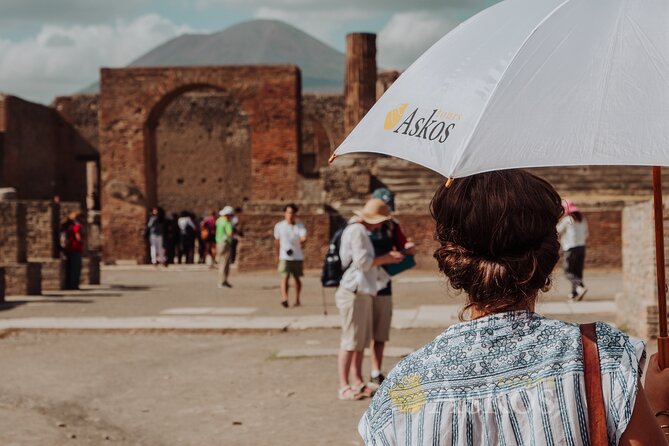
The meeting point is at Via Villa dei Misteri, 2, near Pompeii’s main entrance, Porta Marina Superiore. Look for the Askos Tours sign. This detail matters because Pompeii has several entrances, and arriving at the wrong one can cost you valuable time.
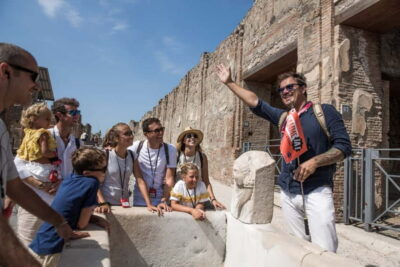
The Pompeii guide usually takes the group inside for about two hours. The tour has a maximum of 20 people for this portion, though the wider activity is capped at 14 travelers according to the operating details. Group size can therefore feel different during the archaeological walk and the minivan transfer.
Headsets have not always worked well for every group, so stay close to the guide when possible. A guide who is easy to hear makes a major difference among the broad streets and open courtyards.
Pompeii’s Forum gives you the city’s framework
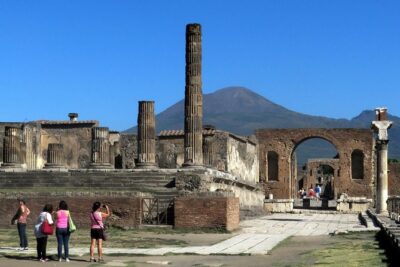
The visit generally begins with the Forum, Pompeii’s main public square. This is the right place to start because it gives you a sense of how the city functioned. From here, your guide can connect temples, public buildings, shops, and political life before leading you into the more personal spaces.
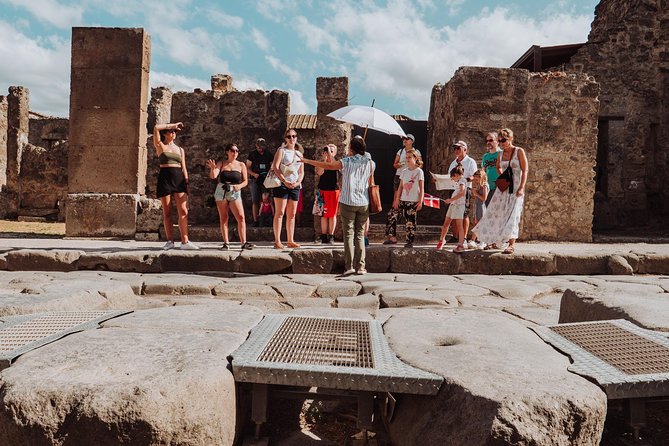
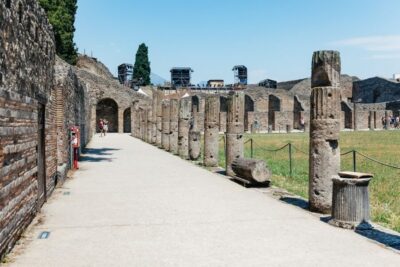
You then walk along one of Pompeii’s main streets. The ancient paving stones, raised sidewalks, and wheel tracks help you picture daily movement through the city. Pompeii is not just a collection of ruined walls. The street plan still explains how homes, businesses, baths, theaters, and public life fitted together.
A guide is particularly useful here. Without help, you may see broken columns and walls without understanding their purpose. Archaeologists such as Anna Sorrento, who was described as active in excavation work, and Benedetto, who had spent years working on the site, can explain what current digging means and how the interpretation of Pompeii continues to change.
Granaries, casts, and the human cost of the eruption
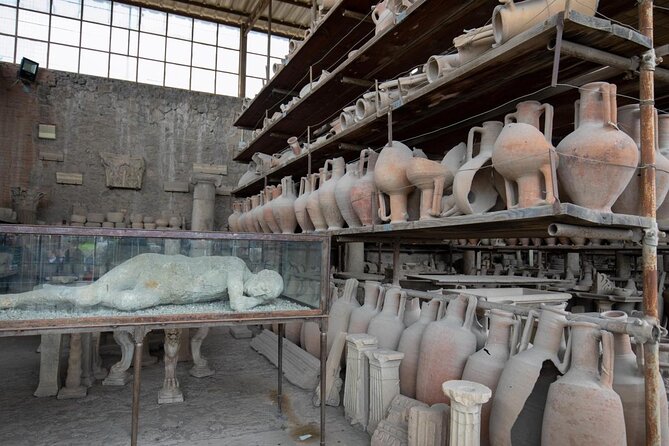
The Forum granaries offer one of the most powerful stops. You can see marble tables and fountain baths that once decorated the entrances of homes, along with casts of victims, a dog, and a tree.
These casts are not simply dramatic sights. They show the sudden physical effect of the eruption and put a human scale on what can otherwise feel like an abstract ancient disaster. Your guide can help explain what the objects reveal about Pompeii’s homes and public spaces.
This stop can be emotionally difficult. If you prefer a slower visit at sensitive displays, remember that the group schedule may not allow much lingering.
More ways to see Pompeii:
- Pompeii Small Group Tour with an Archaeologist
★ 5.0 · 6,593 reviews - Discover the Ancient Ruins of Pompeii: Day Trip from Rome
★ 3.5 · 2,247 reviews - Pompeii and Herculaneum Small Group Tour with an Archaeologist
★ 5.0 · 1,350 reviews - Skip the Line Guided Tour of Pompeii led by an Archaeologist
★ 5.0 · 703 reviews
House of Menander and the Stabian Baths
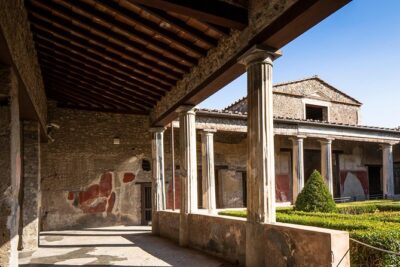
The House of Menander was among Pompeii’s grandest residences, with elaborate architecture, decoration, and contents. It helps you see the difference between a modest urban home and an elite Roman household.
You may notice how the house is not just a set of rooms. Its layout reflects status, hospitality, work, and private life. The guide’s interpretation is what turns the visit from a quick look at painted walls into a lesson about how wealth shaped Roman domestic space.
The Stabian Baths are another strong stop. They occupy a large area near the Brothel lane, the Holconius crossroads, and Via Stabiana. They are considered Pompeii’s oldest thermal complex, making them useful for understanding the importance of bathing in Roman society.
The baths also break up the tour nicely. After seeing a private house, you move into a public institution used for exercise, washing, social contact, and routine. The two-hour route gives you a sample of both private and civic Pompeii.
The Lupanar and the House of the Faun

The Lupanar is Pompeii’s most famous brothel. Its small rooms and surviving decorations attract plenty of attention, but the value of the stop is broader than its sensational reputation. It shows that commercial sex was part of the city’s public and economic life, and it adds an everyday, less polished side to the picture of Roman society.
The House of the Faun provides a sharp contrast. This was one of the largest and most impressive private residences in Pompeii. Moving from the Lupanar to this grand home shows the social range of the city, from small commercial spaces to vast elite residences.
You should not expect to see every room or every major building in Pompeii. The archaeological park is huge, and two hours is a guided introduction rather than a complete visit. A useful strategy is to treat the tour as your orientation. After the guide leaves, you may have some time to continue exploring, but the amount of free time depends on the day’s schedule and the transfer to Vesuvius.
Pompeii’s theaters complete the guided route
The Teatro Piccolo, or small theater, offers a glimpse of a more intimate performance space. The Teatro Grande, Pompeii’s main theater, gives you a larger sense of public entertainment and civic culture.
These theaters are easy to appreciate with a guide because the remaining stone does not always make their original use obvious. Your guide can point out how the spaces handled audiences, performances, and movement.
The Pompeii portion is often the most praised part of the day because the archaeologist guides explain more than dates and names. Guides such as Daniela, Nicoletta, Giulia, Antonella, and Teresa have been singled out for clear storytelling, humor, and enthusiasm. The actual guide is assigned by the operator, so you cannot count on a particular person, but the archaeological focus is a real strength of this activity.
The minivan ride to Vesuvius
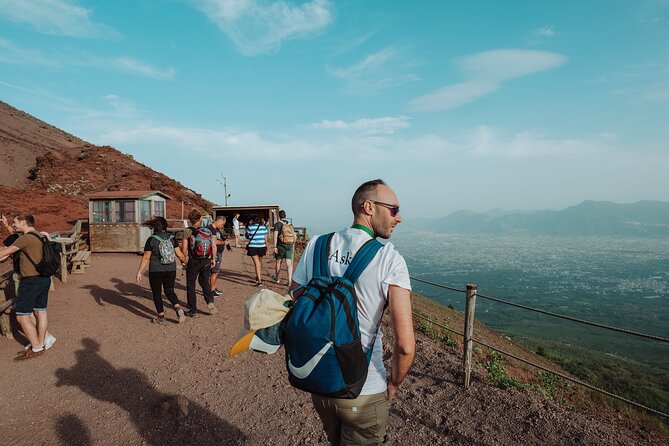
After Pompeii, you transfer by modern minivan toward Vesuvius National Park. The drive climbs through winding mountain roads, so the vehicle transfer is more than a small convenience. It removes a substantial planning chore and gets you close to the upper access point.
The transfer is designed for up to 14 people. It is not a luxury coach service, and one account noted that air conditioning was not always needed or available during a mild season. Still, the minivan is the practical choice for a combined day.
Food is not included. Breaks have varied from roughly 10 or 15 minutes to about an hour, depending on the schedule and order of visits. Cafes near Pompeii can provide sandwiches and drinks, but do not rely on a long restaurant meal. Bring water and consider buying food before the transfer.
Hiking the final 500 meters to the crater
The Vesuvius section includes a licensed hiking guide. From the drop-off point, you walk uphill toward the crater, with the final 500 meters described as particularly steep. The full walk can feel like roughly 2 to 3 hours when you include the crater path, stops, and return.
This is not technical mountaineering, but it is a serious uphill walk. Loose volcanic sand can make the descent slippery, especially in dry summer weather. Wear closed walking shoes with a firm sole. Comfortable trainers may work for some people, but flimsy shoes are a poor choice.
At the crater edge, you may see small wisps of smoke and volcanic features. The guide can explain the eruption, the volcano’s structure, its effect on Pompeii and Herculaneum, and the current risks to the surrounding area. Some groups have also met a volcanist at the summit, though that should be viewed as an occasional addition rather than a promise.
The views can reach across the Bay of Naples toward Capri, Ischia, and the Sorrento coast. On a clear day, this is the visual reward for the climb. In cloud, rain, or strong wind, you might see almost nothing, even when you are standing beside the crater. A light jacket is sensible because the summit can turn chilly and windy, even in warm weather.
Mario has guided many departures and is frequently praised for setting a comfortable pace, giving rest breaks, and helping people with different fitness levels. That matters here. The climb is much more enjoyable when the group moves steadily instead of racing to the top.
Weather can change the second half of your day
Vesuvius is exposed, and access depends on conditions and park decisions. Dense fog, heavy rain, high winds, and poor visibility can make the crater unsafe or remove the views that motivated you to book the tour.
If Vesuvius cannot be accessed because of force majeure, the planned alternative is Herculaneum. That can be an excellent substitute. Herculaneum is smaller and more intimate than Pompeii, with unusually well-preserved details that give you another view of Roman life before the eruption.
Still, the alternative is not the same experience. If the volcano portion is canceled, ask clearly how unused admission costs will be handled. The supplied information includes conflicting experiences about refunds when weather stopped the climb, so do not assume that a partial refund will happen automatically. Clarify the policy with the operator or booking platform before departure.
Who should book this tour?
I would choose this tour if you want a guided introduction to Pompeii, want to see Vesuvius on the same day, and value having transport arranged for you. It is especially useful for families and first-time visitors who want the ancient streets to make sense rather than wandering with only a basic map.
You should have moderate physical fitness. The operator does not allow children under six, and the activity is not recommended for people with mobility limitations or walking impairments. Heat, uneven ancient paving, steep volcanic paths, and loose ground all add up.
If Pompeii is your main priority, a stand-alone Pompeii tour may suit you better. Two hours is enough to see important highlights, but not enough for a relaxed look at the whole archaeological park. If the volcano is your main goal, a separate Vesuvius outing may give you more freedom to choose a weather window.
Cancellation is free up to 24 hours before the local start time. Changes or cancellations inside that window are not accepted for a refund.
Final verdict: a strong day for active sightseers
I would book this for the convenience, the archaeological guiding, and the chance to connect Pompeii with the volcano that destroyed it. The best parts are the human stories in the Forum granaries, the contrast between Pompeii’s homes and public buildings, and the steady climb beside Vesuvius with a guide such as Mario.
I would skip it if you need an easy, flexible day or if you want to explore Pompeii in great detail. Weather can also reduce the value of the volcano portion, and the day may feel rushed around lunch.
For most fit visitors with one day in the area, though, this is a practical and memorable pairing. Wear proper shoes, carry water, bring sun protection and a light jacket, and treat the Vesuvius views as weather-dependent. You will get the most from it by accepting that the schedule is designed to cover two major sights, not to exhaust either one.
FAQ
How long does the Pompeii and Mount Vesuvius tour take?
The advertised duration is about eight hours. Some departures have taken closer to six hours, while weather, transport, and the order of visits can affect the total time.
Where does the tour begin?
The meeting point is Via Villa dei Misteri, 2, 80045 Pompei, near Pompeii’s Porta Marina Superiore entrance. Look for the Askos Tours sign.
Where does the tour finish?
The activity ends back at the Pompeii meeting point. Some departures have also dropped people near Napoli Centrale, but you should confirm that option before the tour.
Are Pompeii and Vesuvius admission fees included?
Yes. The Pompeii admission and Mount Vesuvius admission are included in the tour price.
Is food included?
No. Food and drinks are not included. You may have a short or longer break to buy a sandwich and drink, depending on the schedule.
How difficult is the Mount Vesuvius walk?
The final 500 meters to the crater are steep, and the full visit includes uphill walking on volcanic ground. A moderate fitness level and closed, comfortable walking shoes are required.
Are children allowed on the tour?
Children under six years old are not allowed to join this activity.
Is the tour suitable for someone with mobility problems?
No. The tour is not recommended for people with mobility or walking issues because of the uneven Pompeii site and steep Vesuvius trail.
What happens if Vesuvius is closed because of weather?
If Vesuvius is not accessible because of force majeure, the tour is scheduled to include Herculaneum instead.
Can I cancel for a full refund?
You can cancel at least 24 hours before the local start time for a full refund. Cancellations or changes made less than 24 hours before the start are not accepted for a refund.
Just added around Pompeii
- Wine Tasting and Winery Tour in Vesuvio National Park with Lunch★ 4.5 · 3 reviews
- Mt. Vesuvius Wine Tasting and Lunch Experience from Pompeii★ 4.5 · 20 reviews
- Wine tasting in the Vesuvius national park★ 5.0 · 3 reviews
- Visit Pompeii with a local expert guide★ 5.0 · 10 reviews
- Traditional Neapolitan Dinner in Pompei – Villa Franca – Family Restourant★ 5.0 · 8 reviews
- Private Guided Tour and VR Headsets in the Ancient Pompeii★ 5.0 · 3 reviews
- Tour Mount Vesuvius with Entry Tickets and Round Trip Transfer Included★ 3.5 · 4 reviews
- Vesuvius tour entrance to the crater and return bus★ 4.5 · 9 reviews
Mount Vesuvius Tours from Naples, compared.
Pompeii & Mt.Vesuvius Day Tour from Naples with Pizza Lunch
Read our review →
Pompeii & Mt Vesuvius All-Inclusive Small Group w/ Lunch
Read our review →
Pompeii & Mt. Vesuvius Day Trip with Tickets & Lunch
Read our review →
Skip-the-Line Pompeii & Mt. Vesuvius Day Trip from Naples
Read our review →Browse the lists this tour appears in