
Reviewed · POMPEII TOURS FROM NAPLES
Pompeii Archaeological Small-Group tour for 15 people
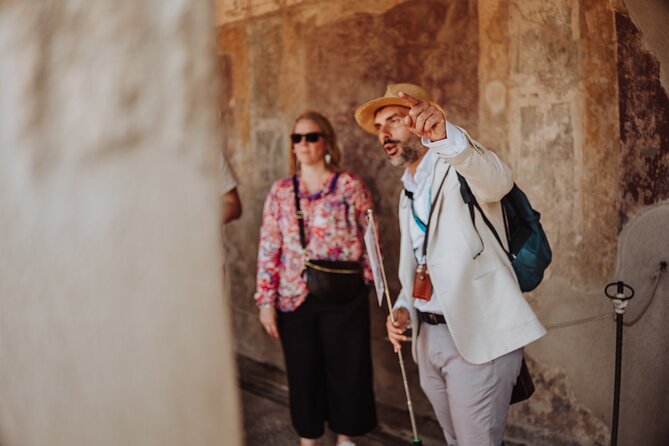
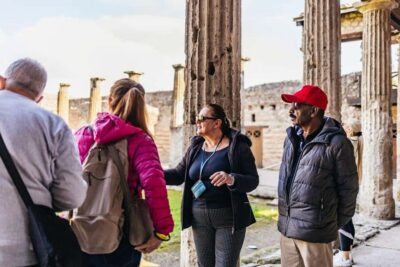
Pompeii comes alive fastest when someone explains what you are looking at. This two-hour guided walk takes you from the Forum and its granaries to grand homes, public baths, the Lupanar, and Teatro Grande, with time afterward to continue exploring alone.
I like the small group capped at 15 and the fact that the guide has an archaeological background. I also like the route’s mix of public spaces, domestic rooms, everyday plumbing, plaster casts, and entertainment sites. The main drawback is time: two hours gives you a useful framework, but Pompeii is far too large for a complete visit.
- Archaeologist-led context: Guides such as Antonella, Camillo, Teresa, Mario, and Nicoletta are praised for clear explanations and strong storytelling.
- A useful first look: The route covers Pompeii’s Forum, homes, baths, brothel, theater, and main street.
- Plaster casts included: The Forum granaries contain casts of eruption victims, a dog, and a tree.
- Group size matters: No more than 15 people, with headsets provided for groups of 10 or more.
- You can keep exploring: The tour ends inside the ruins, leaving you free to continue toward the Amphitheatre, necropolis, or other areas.
- Check the meeting details: The information gives both Porta Marina Superiore and Via Villa dei Misteri 2 as starting references, so confirm the exact spot before setting out.
Why two hours works as a Pompeii introduction
Pompeii is not a tidy museum with a single route. It is a large ancient town spread across streets, courtyards, shops, shrines, houses, baths, and theaters. Without help, you can spend an hour admiring a doorway and miss the larger story around it.
This tour gives you that larger story first. You walk through the main street, stop at the Forum, enter some of the city’s best-known buildings, and finish at Teatro Grande. The route is concentrated rather than exhaustive, which is useful if you want an orientation before exploring on your own.
I would treat the two hours as a strong opening chapter, not a full Pompeii day. One account used the guided time as a starting point, then rested at the on-site café and continued independently to the Amphitheatre and necropolis. That is a sensible plan.
The $77.06 price includes the Pompei Express entrance ticket, a licensed guide, assistance for the full tour, and headsets for groups of at least 10. For a first visit, the cost can make sense because you are paying for both admission and interpretation rather than wandering among ruins without context.
Finding the group at Porta Marina
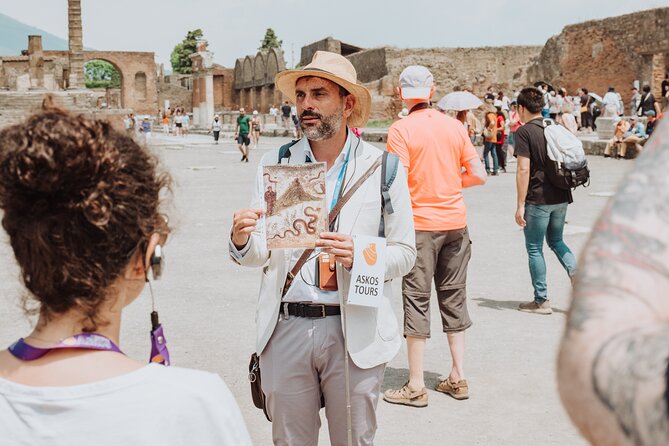
The itinerary directs you to the main archaeological entrance called Porta Marina Superiore, in front of the Hortus Bar & Restaurant. The guide is expected to hold an Askos Tours sign.
However, the meeting information also gives Via Villa dei Misteri 2 in Pompei as the start address. Those details do not read as identical, so I would confirm the exact meeting point with Askos Tours before the day of the visit. This is the sort of small check that prevents a rushed start at a sprawling archaeological site.
The route ends at Piazza Esedra inside the ruins. That matters because you are not returned to the entrance after the final stop. You can carry on visiting, but you should plan your onward route before leaving the group.
The archaeological site is near public transportation, and the activity allows service animals. Most people can take part, though you should expect a walking tour over an ancient urban site rather than a seated presentation.
More ways to see Pompeii:
- Pompeii Small Group Tour with an Archaeologist
★ 5.0 · 6,593 reviews - Discover the Ancient Ruins of Pompeii: Day Trip from Rome
★ 3.5 · 2,247 reviews - Pompeii and Herculaneum Small Group Tour with an Archaeologist
★ 5.0 · 1,350 reviews
The Forum and Pompeii’s civic center
The first major stop is the Basilica on Vicolo delle Terme. In ancient Pompeii, the Basilica was an open portico that sheltered merchants and other activities. It is a good early lesson in how much public life took place outdoors, under colonnades and around busy civic spaces.
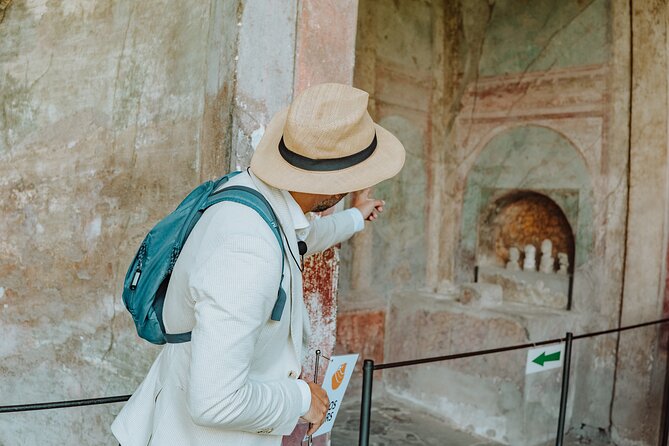
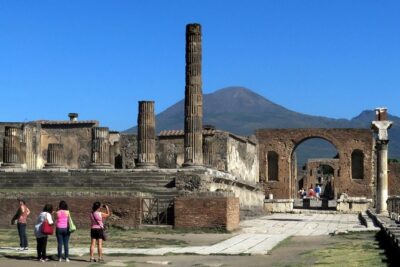
From there, you reach the Forum, the city’s main square. This is one of the places where a guide adds real value. The Forum is visually impressive, but its role can be hard to read from broken columns and partial walls. An explanation helps you understand it as the civic heart of Pompeii, not simply a field of stones.
The stop is listed at about 10 minutes, so do not expect a long, slow examination of every building around the square. You will get a focused explanation and a sense of how the city was organized.
The granaries and the plaster casts
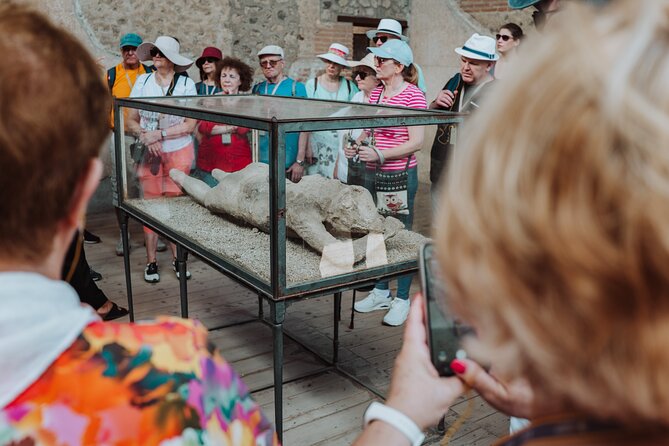
The Forum granaries provide one of the tour’s most striking stops. You can see marble tables and baths used for fountains, along with decorative pieces that once adorned house entrances.
You can also see plaster casts of victims from the eruption, including a dog and a tree. These are emotionally difficult objects, and a good guide can give them context without turning the moment into spectacle. Antonella, one of the guides associated with this tour, is specifically praised for explaining current excavations in Pompeii and nearby areas, which adds a link between the preserved past and ongoing archaeological work.
The visit here is brief, around 10 minutes. If the casts are a main reason for your visit, you may want to ask how much time is available before the group moves on. The route is designed to keep moving.
Walking Pompeii’s main street
Between the featured buildings, you walk along Pompeii’s main street. This is important because the city makes more sense when you see how the houses, businesses, public buildings, and crossings fit together.
The street itself is part of the lesson. You are not jumping from isolated highlight to isolated highlight. You are moving through an ancient town, with the route connecting private homes to public baths, entertainment, and civic space.
The two-hour schedule means the pace may feel purposeful. If you prefer to stop at every doorway or study every wall painting, you may find the group format limiting. If you want a clear route through the main sights, it saves time and decision-making.
A few more Pompeii outings worth a look
- Skip the Line Guided Tour of Pompeii led by an Archaeologist
★ 5.0 · 703 reviews - Pompeii Ticket + Tour with Optional Tasting Experience at Pompeii
★ 5.0 · 663 reviews - Pompeii private tour with an Official Guide
★ 5.0 · 631 reviews - Pompeii Private Tour with an Archaeologist and Skip The Line – 3 hours
★ 5.0 · 564 reviews
House of Menander and Roman private life
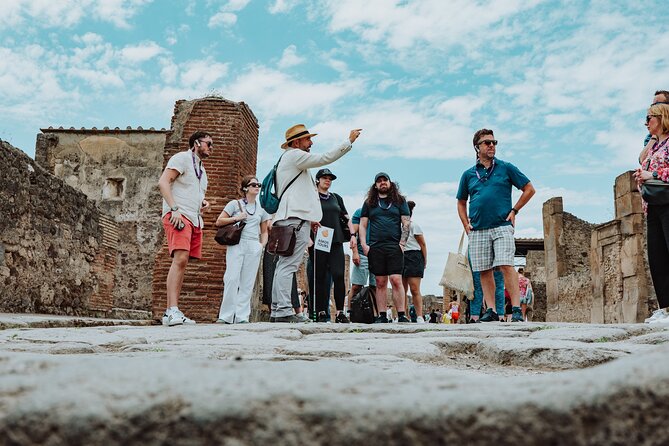
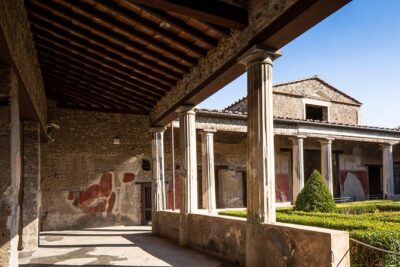
The House of Menander is described as one of Pompeii’s most impressive homes, both for its decoration and its contents. The stop lasts about 15 minutes, making it one of the longer pauses on the route.
This is where Pompeii shifts from public life to household life. Large Roman homes were not simply private sleeping quarters. Their design, decoration, courtyards, and reception areas reflected wealth and social position.
A guide can help you read the house as more than an attractive ruin. Look for the relationship between the home’s scale, its decoration, and the people who would have used its different spaces. The name Menander also points toward the taste for Greek culture in Roman elite life, although the exact emphasis will depend on the guide.
The best feedback about this tour repeatedly centers on explanation. Mario Celebtano is praised for thoughtful insight, while Teresa is credited with linking ancient details to the present and using anecdotes to make the setting easier to picture.
The Stabian Baths and ancient public services
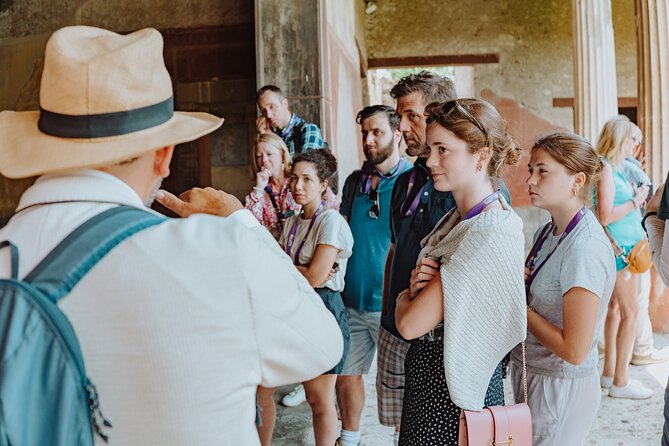
The Stabian Baths occupy a broad area between the Brothel Lane, the Holconius crossroads, and Via Stabiana. They are described as the oldest thermal complex in Pompeii.
This stop gives you a look at one of the city’s key public institutions. Roman baths were places for washing, exercise, social contact, and routine public life. Even if you are less interested in ancient architecture, the baths help explain how people spent ordinary parts of their day.
The scheduled time is about 15 minutes. That is enough for an overview, but not enough to inspect every room in detail. I would listen closely to the explanation of how the complex worked, since the remains can otherwise look like a sequence of walls and chambers.
The Lupanar and a more awkward side of Pompeii
The Lupanar is Pompeii’s most famous brothel and one of its most talked-about stops. Its inclusion makes the tour more complete because Pompeii was not only temples, villas, and public squares. It was also a working town with ordinary and less respectable businesses.
The stop lasts about 10 minutes. Expect a concise visit rather than an extended discussion. The site can attract attention because of its subject, but the practical value lies in seeing another part of urban life within the same street network.
This may not be the best stop for very young children, and the tour’s archaeological level may also suit teenagers and adults better than small children. One family found the material especially strong for teenagers and older, which is useful guidance when deciding who should come.
House of the Faun and Pompeii’s grandest homes
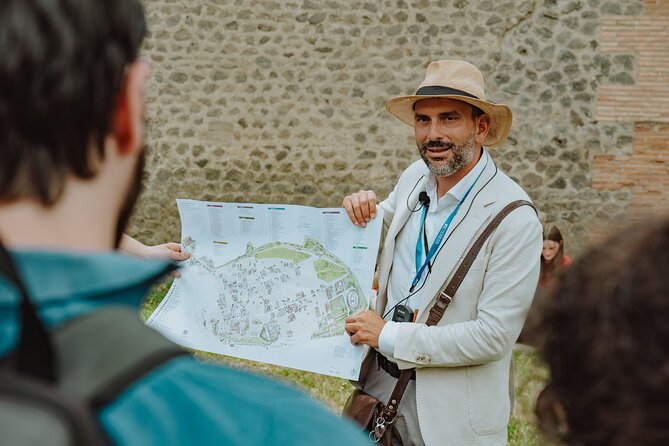
The House of the Faun was one of Pompeii’s largest and most impressive private residences. It is another 15-minute stop and gives you a second chance to compare elite domestic architecture with the House of Menander.
The two houses help show that Pompeii was not socially uniform. Some residences were modest, while others occupied enormous plots and used decoration to signal status. A focused guide can point out how scale and design shaped the experience of entering and moving through these homes.
I would pay attention to the layout rather than rushing only toward the most famous decoration. Pompeii rewards a sense of place. The House of the Faun is valuable because it lets you grasp the size and ambition of a major Roman residence.
Teatro Grande and the tour’s final view
The final listed stop is Teatro Grande, Pompeii’s most important theater. The visit lasts around 10 minutes.
After the homes, streets, baths, and Forum, the theater completes the picture of Pompeii as a city where people worked, worshipped, conducted business, socialized, and watched performances. It is a fitting final stop because it shows the public side of leisure and culture.
The guide may finish inside the ruins at Piazza Esedra rather than escorting you back out. That is convenient if you want to keep exploring, but it means you should not assume the tour ends at the same place where you entered.
Guides, headsets, and the group experience
The tour is offered in English and uses a licensed guide with an archaeological background. The guides named in the supplied information include Mario Celebtano, Raffaelle, Antonella, Camillo Sorrentino, Nicoletta, and Teresa. Their strengths are consistent: clear explanations, archaeological detail, useful anecdotes, and a friendly manner.
There is also an account of a German-language tour led by Hugo that lasted about two and a half hours. Since the stated offering for this experience is English, I would confirm the language and duration if either point is especially important to you.
The maximum group size is 15. That is small enough to feel more manageable than a large coach group, though it is not a private tour. Headsets are supplied when the group has 10 or more people, which should make it easier to hear while standing in open spaces or moving along the streets.
Crowds can affect the experience. On a national holiday, the site became very busy and the tour time was moved earlier. The guide still managed the route, but this is a reminder to check Italian holidays and busy dates when possible.
Who gets the best value from this tour
I would choose this tour if you are visiting Pompeii for the first time and want a clear route through the essential areas. It suits people who prefer explanation over self-guided wandering and want an archaeological perspective without booking a private guide.
It is also a good fit if you want to continue alone afterward. The tour gives you a map in your head: civic center, streets, wealthy homes, baths, brothel, and theater. You can then spend your remaining time on the Amphitheatre, necropolis, or places not covered by this route.
I would be more cautious if your main aim is a slow, detailed study of paintings, inscriptions, or every individual building. Two hours passes quickly, and the group must keep moving.
The tour may also be better for teenagers and adults than for very young children. The subject matter at the Lupanar and the amount of archaeological explanation may not hold every child’s attention.
Practical value at $77.06
At $77.06 per person, this is not the cheapest way to enter Pompeii. The value depends on how much guidance you want.
The price includes admission, a licensed guide, assistance throughout, and headsets for larger groups. For someone who would otherwise spend hours trying to identify the Forum, baths, and major houses alone, that package can be worthwhile.
The price is less compelling if you already have strong knowledge of Pompeii and plan to spend a full day reading on-site information at your own pace. You would still receive the entry ticket, but the guided portion would cover only a selected route.
Food, drinks, and private transportation are not included. Since the tour ends inside the ruins, you can arrange your own break or continue at your own speed. The cancellation policy allows a full refund when you cancel at least 24 hours before the start time. Changes or cancellations made later are not accepted for a refund.
Should you book it?
I would book this tour for a first visit, especially if you want the Forum, plaster casts, House of Menander, Stabian Baths, Lupanar, House of the Faun, and Teatro Grande explained in a compact route.
The strongest reason to choose it is the guide quality. Names such as Antonella, Camillo, Teresa, Mario, and Nicoletta are linked with clear, engaging archaeological explanations, while the small group keeps the experience more personal than a large walking tour.
Before booking, confirm the exact meeting point and language. Then plan at least some extra time after the tour. The guided two hours should help you understand Pompeii, but the ruins deserve more time than the route alone can provide.
FAQ
How long does the Pompeii tour last?
The tour lasts approximately two hours. One supplied account describes a tour lasting about two and a half hours, so the exact duration may vary.
What is the maximum group size?
The group is limited to a maximum of 15 people.
What language is the tour offered in?
The stated language is English. A separate account describes a German-language tour with Hugo, so confirm the language when booking if this matters to you.
Is the Pompeii entrance ticket included?
Yes. The Pompei Express entrance ticket is included in the tour price.
Are headsets provided?
Headsets are provided for groups of 10 or more.
Where does the tour meet?
The itinerary directs you to Porta Marina Superiore, in front of the Hortus Bar & Restaurant, where the guide will hold an Askos Tours sign. The meeting information also lists Via Villa dei Misteri 2, so confirm the exact meeting point before arrival.
Where does the tour end?
The tour ends inside the ruins at Piazza Esedra. You are free to continue exploring independently.
Are food, drinks, or private transportation included?
No. Food, drinks, and private transportation are not included.
Can I cancel for a full refund?
Yes, if you cancel at least 24 hours before the experience start time. Cancellations or changes made less than 24 hours beforehand are not refunded or accepted.
Just added around Pompeii
- Wine Tasting and Winery Tour in Vesuvio National Park with Lunch★ 4.5 · 3 reviews
- Mt. Vesuvius Wine Tasting and Lunch Experience from Pompeii★ 4.5 · 20 reviews
- Wine tasting in the Vesuvius national park★ 5.0 · 3 reviews
- Traditional Neapolitan Dinner in Pompei – Villa Franca – Family Restourant★ 5.0 · 8 reviews
- Private Guided Tour and VR Headsets in the Ancient Pompeii★ 5.0 · 3 reviews
- Visit Pompeii with a local expert guide★ 5.0 · 10 reviews
- Tour Mount Vesuvius with Entry Tickets and Round Trip Transfer Included★ 3.5 · 4 reviews
- Vesuvius tour entrance to the crater and return bus★ 4.5 · 9 reviews
Pompeii Tours from Naples, compared.

Pompeii Small Group Tour with an Archaeologist
Read our review →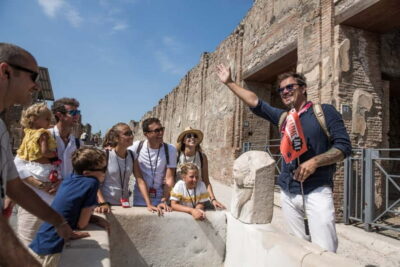
Pompeii & Mt.Vesuvius Day Tour from Naples with Pizza Lunch
Read our review →
Pompeii & Mt Vesuvius All-Inclusive Small Group w/ Lunch
Read our review →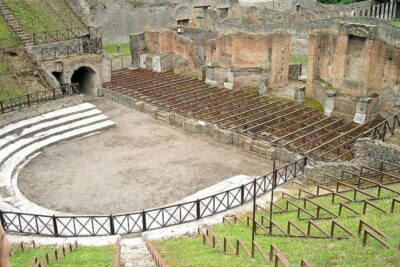
Pompeii & Amalfi Coast Full-Day Trip with Lunch
Read our review →Browse the lists this tour appears in