
Reviewed · POMPEII TOURS FROM NAPLES
Pompeii Archaeological Area Entrance Ticket
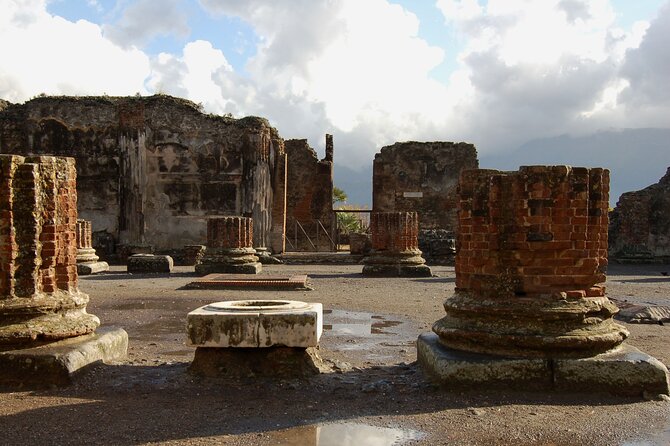
Pompeii gives you something few ancient sites can: an entire Roman city laid out under your feet. You can walk its paved streets, peer into homes, and see the Forum, theatres, shops, and frescoed Lupanare at your own pace. The eruption of Mount Vesuvius in 79 AD buried the city so quickly that daily life remains unusually easy to picture.
I like the freedom to set your own route, especially if you want to linger over a mosaic or skip a crowded building. I also like the chance to use the complimentary map inside the gate, which helps turn a huge, confusing excavation into a manageable visit.
The main drawback is that this is only an entrance ticket, not a guided tour. Pompeii is enormous, the signs can be hard to follow, and some ticket holders have lost time trying to locate the correct entrance or redeem their voucher.
Key points to know before you go
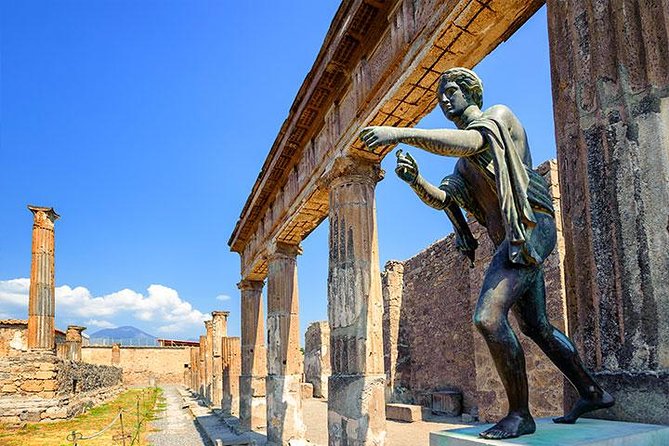
- A full Roman city awaits: Pompeii covers about 66 hectares, or 163 acres, so two hours is enough for a brisk highlights visit, not a complete look.
- You explore independently: No guide, transportation, food, or hotel pickup is included.
- Important sights are spread out: The Forum, House of the Faun, Amphitheater, Great Theater, Garden of the Fugitives, and Lupanare are not clustered in one compact area.
- The map matters: Collect the complimentary site map at the entrance and use it to plan a route before walking far.
- Wear sensible shoes: The ancient paving stones are uneven, and a moderate level of fitness is recommended.
- Check your ticket carefully: The voucher is for the archaeological park, not the museum, and advance-ticket procedures may require extra attention.
Pompeii is an ancient city, not a single monument
Many archaeological sites give you one grand temple or a handful of ruins. Pompeii is different. You enter a whole city, with streets, houses, public offices, bathhouses, shops, religious buildings, theatres, and working spaces spread across a vast open-air site.
That scale is the great strength of this experience, but it is also the reason a short visit can feel rushed. The advertised duration is about two to three hours, yet you can easily spend five hours here if you want to follow several routes and stop often. One visitor used a map and a self-guided phone app, then stayed almost five hours. That is a useful warning: do not assume you will see everything in one morning.
The ash from the eruption of Mount Vesuvius buried Pompeii in 79 AD. The city was rediscovered in 1748, and excavation has continued in stages. As you walk, you are not simply looking at isolated ruins. You are moving through a Roman town whose roads, property lines, public spaces, and private rooms still make sense.
You may see casts of people who died in the disaster. These are among the site’s most striking and difficult sights. They put a human face on an event often reduced to a date in a history book.
More ways to see Pompeii:
- Pompeii Small Group Tour with an Archaeologist
★ 5.0 · 6,593 reviews - Discover the Ancient Ruins of Pompeii: Day Trip from Rome
★ 3.5 · 2,247 reviews - Pompeii and Herculaneum Small Group Tour with an Archaeologist
★ 5.0 · 1,350 reviews
Choosing your route through the entrances
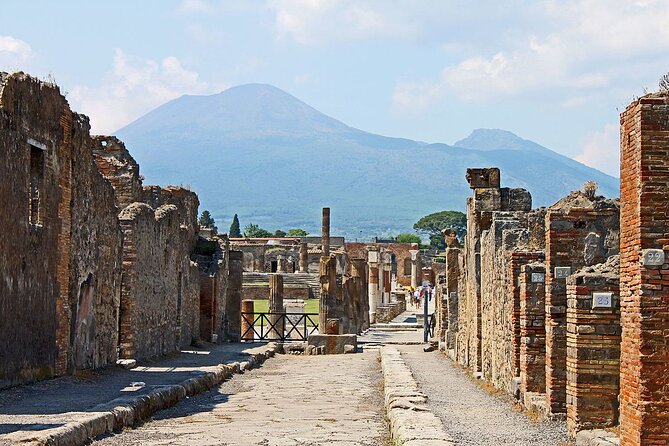
The suggested routes begin at three areas: Porta Marina, Piazza Esedra, and Piazza Anfiteatro. Your actual route may depend on which gate you use and which buildings are open during your visit.
Porta Marina is a strong starting point for the civic heart of Pompeii. Here you can see the ancient gate and city walls before walking toward the Temple of Apollo, the Basilica, public administration buildings, and the Building of Eumachia.
The Basilica was an important public building used for business and legal matters. The Forum, nearby, was the city’s main public square. Even when individual structures are partly ruined, the scale of the open space helps you understand how Pompeii functioned as a political, commercial, and religious center.
Piazza Esedra leads toward a collection of domestic and commercial buildings. The Forum Baths show the role of public bathing in Roman life. The Temple of Fortuna Augusta reflects the religious world of Pompeii, while the House of Pansa and House of the Tragic Poet offer a look at private homes and decorative design.
You will also find a thermopolium, a place where hot food was sold. It is one of the best stops for imagining everyday life. Pompeii was not only a city of wealthy villas and official buildings. It was a working town where people bought meals, washed clothes, traded goods, and conducted business.
The House of the Faun is one of the major residences. Its size and decoration show how wealthy families used courtyards, colonnades, gardens, and elaborate floors to display status. The House of Cecilio Giocondo, House of the Citharist, and Fullonica Stephanus add more detail to the picture of home life and local industry.
The Amphitheater route and the city’s entertainment district
Piazza Anfiteatro is especially useful if you have limited mobility. The site advises people with mobility concerns to enter here and limit their visit to the area around the Amphitheater. That keeps the route closer to one of Pompeii’s major landmarks and avoids some of the longer walks across uneven streets.
Near this side of the excavation, you can visit the Necropolis of Porta Nocera and the gate and walls of Porta Nocera. A necropolis, or cemetery, outside the city walls gives you another reminder that Pompeii was a lived-in community with space for both the living and the dead.
The Garden of the Fugitives is one of the most emotionally powerful stops. It is associated with victims who tried to escape the eruption. The House of the Garden of Hercules, House of Octavius Quartio, and House of Venus in the Shell show several different approaches to domestic design, gardens, wall paintings, and outdoor space.
The Amphitheater is one of the site’s major highlights. Its size and shape make it easy to understand how public entertainment worked in Roman Pompeii. Unlike a museum display, the building remains in its original urban setting, surrounded by the streets and neighborhoods that supported it.
Nearby, you can continue to the Small Theater, also called the Odeion, and the Great Theater. The two venues help show that Pompeii’s entertainment life included more than one kind of performance. Their open stone seating and stage areas also provide a welcome change from the tighter lanes and enclosed houses.
The Temple of Isis and the Triangular Forum add religious and architectural variety. The Doric Temple is another important stop, especially if you enjoy comparing different building styles and sacred spaces.
The Forum, houses, and shops worth prioritizing
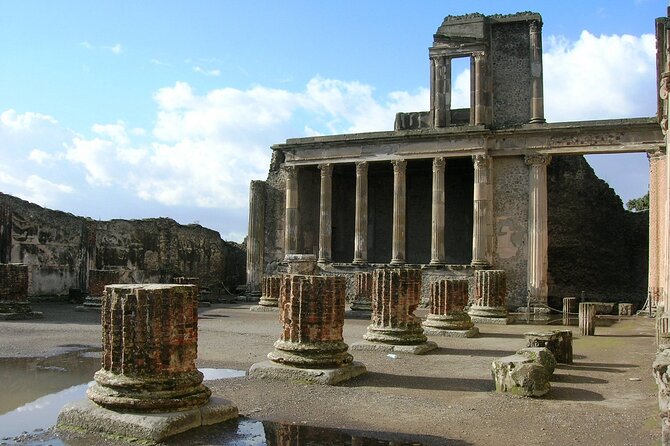
If you have only two or three hours, I would make the Forum a priority. It is central, visually impressive, and essential for understanding how the rest of Pompeii fits together. From there, choose a few houses and public buildings rather than trying to check every item off a list.
The House of the Faun deserves extra time because of its scale. Its rooms and courtyards show how a wealthy Roman residence could be arranged around open space. The House of the Tragic Poet is smaller but important for its decorative features and the way it represents domestic architecture.
The thermopolium is a good stop for anyone interested in ordinary routines. You can picture residents buying something hot to eat rather than preparing every meal at home. The Fullonica Stephanus, a cloth-launderer’s establishment, offers a similar glimpse into work and trade.
The Building of Eumachia and the public administration buildings help balance the private houses. They remind you that Pompeii was a functioning city with civic institutions, commercial activity, religious practice, and social rank.
The Lupanare, or brothel, is famous for its erotic frescoes. It is a small, two-story building, and its narrow rooms can become crowded. The wall paintings are direct and explicit, so families may want to prepare children for what they will see. The building is valuable not because it is sensational, but because it shows a part of Roman urban life that formal monuments often leave out.
A few more Pompeii outings worth a look
- Skip the Line Guided Tour of Pompeii led by an Archaeologist
★ 5.0 · 703 reviews - Pompeii Ticket + Tour with Optional Tasting Experience at Pompeii
★ 5.0 · 663 reviews - Pompeii private tour with an Official Guide
★ 5.0 · 631 reviews - Pompeii Private Tour with an Archaeologist and Skip The Line – 3 hours
★ 5.0 · 564 reviews
What the free map can and cannot do
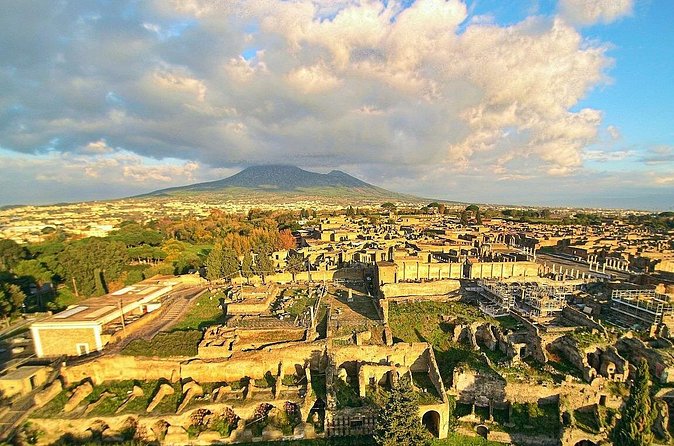
A map is available inside the entrance, and you should collect it before setting off. Pompeii’s streets can look simple at first, but the site covers a large area and not every building is equally easy to find.
Use the map to choose a route based on your priorities. For a short visit, you might connect the Forum, House of the Faun, Lupanare, Great Theater, and Amphitheater. For a longer visit, add the Garden of the Fugitives, city gates, cemetery, bathhouses, and more private homes.
The map is useful for direction, but it does not replace explanation. This ticket does not include a guide, and the site’s signage can be inconsistent. One independent visitor found the ruins and road signs difficult to follow, then used a written guide to fill in the missing context.
You can bring your own reading material or self-guided app if you want more background. The ticket works best for people who enjoy exploring at their own speed and are comfortable making choices. If you want every building explained as you walk, book a separate guided tour instead.
Ticket value at $54.44
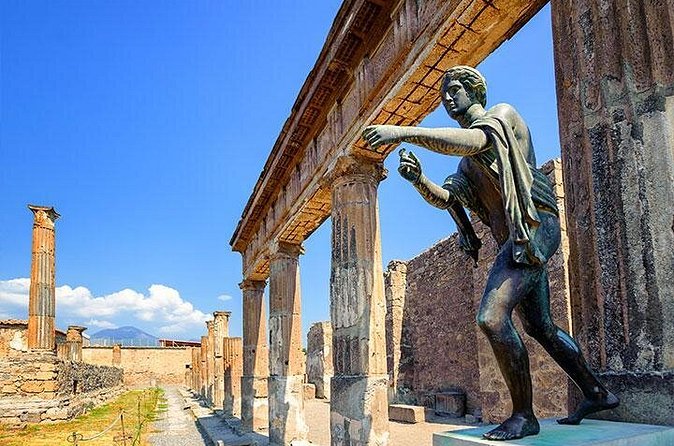
At $54.44 per person, this is not the cheapest way to enter Pompeii. The value depends on what the ticket actually saves you: time, uncertainty, and the chance to reserve a preferred entrance period.
The appeal is simple. You book an entry time, make your own way to the site, and explore without being tied to a group. That can be worthwhile if your day in the Naples area is carefully planned and you want to avoid a long ticket queue.
But the skip-the-line promise needs a practical qualification. Some ticket holders have still had to exchange a voucher at a ticket booth, and in certain cases the process took longer than buying a ticket directly at the gate. Another person lost about an hour of a short visit while trying to locate the ticket in the app and obtain a usable copy.
The safest approach is to check your booking confirmation before leaving for Pompeii. Make sure you know where the ticket is stored, what form of ticket is accepted, and which entrance you should use. Do not assume that every entrance recognizes an advance voucher in the same way.
The voucher is not for museum admission. It is intended for the archaeological area. If staff direct you away from a gate, ask clearly where advance ticket holders should enter before joining a line.
Timing, heat, and the physical side of Pompeii
The listed experience lasts about two to three hours, but that is a minimum planning figure rather than a natural limit. Pompeii is too large for a relaxed complete visit in that time.
If your schedule allows, plan at least half a day. One person found that even half a day was not enough to see everything, and another spent nearly five hours using a map and self-guided app. You do not need to stay that long, but you should know that the site can easily absorb more time than expected.
Heat is a serious factor. Much of the experience takes place outdoors on exposed ancient streets, and there may be limited shade along parts of your route. The supplied information specifically notes the heat as a challenge. Bring water and pace yourself, although food and drinks are not included with the ticket.
Flat-soled shoes are recommended. Ancient paving stones can be uneven, and you should walk carefully near excavation edges. Do not climb walls or stop on the edges of excavated areas. Bulky bags, backpacks, and umbrellas should be left at the wardrobe.
There is a picnic area near Porta Nola. Smoking is not allowed inside the archaeological area. You may also encounter stray dogs that have entered the excavation zone, so keep your distance and use care.
Access, transport, and the right type of visitor
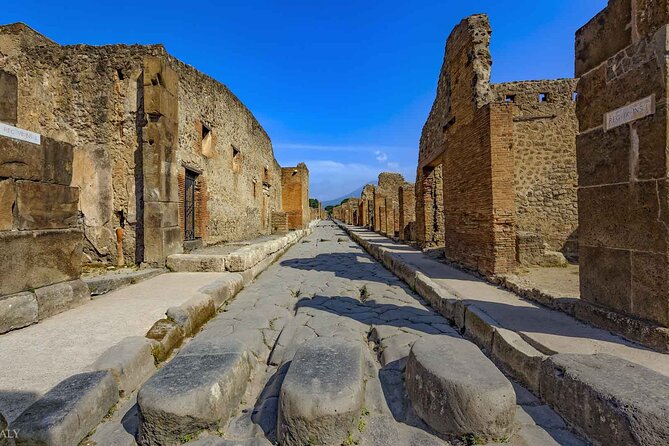
Pompeii is near public transportation, but this ticket does not include transport to or from the site. You must arrange your own way there and return afterward. It also does not include hotel pickup or drop-off.
The experience suits independent visitors who want control over their pace. It is a good fit if you already know the basic story of Pompeii, enjoy reading signs and maps, or plan to use your own guidebook or phone app.
It is less suitable if you want a tour leader, detailed commentary at every stop, or help navigating from the moment you leave your hotel. The ticket also requires a moderate level of physical fitness, particularly if you plan to cover several districts.
People with limited mobility should use the Piazza Anfiteatro entrance and keep their visit around the Amphitheater, according to the site guidance. That is a more realistic plan than trying to cross the entire excavation.
The experience is limited to a maximum of 15 people, but this does not make it a guided small-group tour. You are still exploring independently, and no guide is included.
Booking cautions and cancellation rules
Confirmation is sent within 48 hours of booking, subject to availability. The published opening period is October 27, 2025 through January 26, 2027, with hours listed as Monday through Sunday from 9:00 AM to 1:00 PM. Because that schedule is unusually narrow for a major archaeological park, check the exact date and entry time carefully before booking.
The experience is non-refundable and cannot be changed for any reason. If your plans are uncertain, this is an important disadvantage. A cancellation connected with a trip to Naples would not automatically produce a refund.
The provider is Weekend in Italy. Since no guide is included, there is no named tour leader to expect at the gate. You should treat this as an independent admission product, not as a guided Pompeii visit.
Should you book this Pompeii ticket?
Book it if you want an independent visit, have a firm schedule, and value a reserved entry time more than personal guidance. It works best when you arrive prepared with the ticket, a route plan, comfortable shoes, and enough time to stay longer than two hours.
Think twice if you are counting on a completely effortless skip-the-line entry. The voucher process has caused confusion, and some people have needed help finding the correct ticket or entrance. You should also avoid it if you want a detailed explanation of Roman life at every building.
For the best experience, plan a half day, collect the map immediately, prioritize the Forum and Amphitheater areas, and add the House of the Faun, Lupanare, theatres, and Garden of the Fugitives as time permits. At $54.44, the ticket offers convenience and independence, but only if you handle the arrival details carefully.
FAQ
Is a guide included with the Pompeii entrance ticket?
No. This is an independent entrance ticket. A guided tour is not included.
How long does the Pompeii visit take?
The approximate duration is two to three hours, but Pompeii is very large. You may want to allow half a day, especially if you plan to see several houses, theatres, temples, and gardens.
What does the ticket cost?
The listed price is $54.44 per person.
Does the ticket include transportation?
No. You must make your own way to Pompeii. Hotel pickup, hotel drop-off, and transportation to and from the attraction are not included.
Is food or drink included?
No. Food and drinks are not included. A picnic area is available near Porta Nola.
Where can I get a map of Pompeii?
A complimentary route map is available inside the entrance. It can help you plan your way through the large archaeological area.
Can I use the voucher to enter the museum?
No. The supplied instructions specifically state that the voucher should not be used to gain access to the museum. It is for the archaeological area.
Is Pompeii suitable for people with limited mobility?
People with limited mobility are advised to enter from Piazza Anfiteatro and limit their visit to the area around the Amphitheater. Flat-soled shoes are recommended, and a moderate level of physical fitness is advised.
Just added around Pompeii
- Wine Tasting and Winery Tour in Vesuvio National Park with Lunch★ 4.5 · 3 reviews
- Mt. Vesuvius Wine Tasting and Lunch Experience from Pompeii★ 4.5 · 20 reviews
- Wine tasting in the Vesuvius national park★ 5.0 · 3 reviews
- Traditional Neapolitan Dinner in Pompei – Villa Franca – Family Restourant★ 5.0 · 8 reviews
- Private Guided Tour and VR Headsets in the Ancient Pompeii★ 5.0 · 3 reviews
- Visit Pompeii with a local expert guide★ 5.0 · 10 reviews
- Tour Mount Vesuvius with Entry Tickets and Round Trip Transfer Included★ 3.5 · 4 reviews
- Vesuvius tour entrance to the crater and return bus★ 4.5 · 9 reviews
Pompeii Tours from Naples, compared.
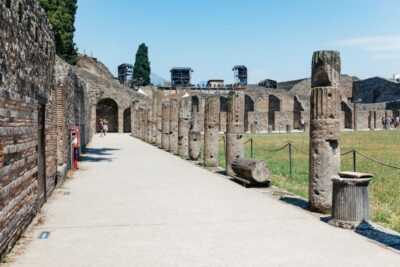

Pompeii Small Group Tour with an Archaeologist
Read our review →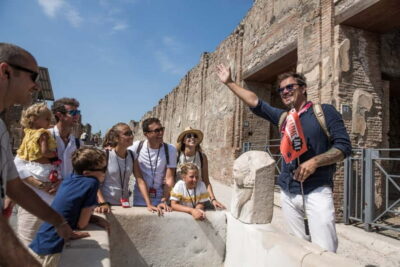
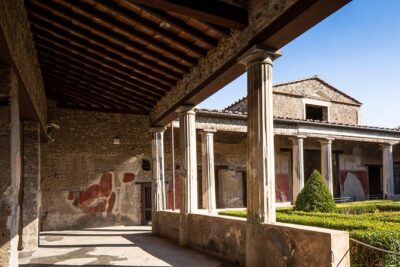
Pompeii & Mt.Vesuvius Day Tour from Naples with Pizza Lunch
Read our review →
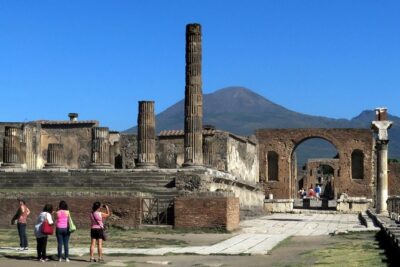
Pompeii & Mt Vesuvius All-Inclusive Small Group w/ Lunch
Read our review →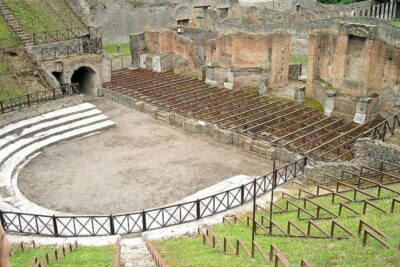
Pompeii & Amalfi Coast Full-Day Trip with Lunch
Read our review →Browse the lists this tour appears in