
Reviewed · WALKING TOURS
Walking Tour of the Neapolitan Superstition
Naples reveals itself through its superstitions: a nose rubbed for luck, restless souls cared for by the living, saints linked to lottery numbers, and household spirits blamed for both mischief and good fortune. This small-group walk turns those customs into a lively story about how sacred belief and daily life meet in the old city.
I like the way the route connects folklore to real streets, churches, shrines, and familiar Neapolitan figures. I also like the addition of a musician and local folklorist, who bring songs, nursery rhymes, and spoken tales into a subject that could otherwise feel like a list of odd customs.
The main drawback is value: $72.56 is a serious price for a 1-hour-45-minute walk with no paid admissions or transport included. You are paying for the guide’s interpretation, the small group, and the live cultural element, not for entry to major sights.
Key details before you book
- Pulcinella’s polished nose: Learn why visitors touch the famous figure’s nose and how this simple gesture became a local good-luck ritual.
- A walk through old Naples: The route runs from Piazza Bellini through San Gregorio Armeno and Spaccanapoli to Piazza San Domenico Maggiore.
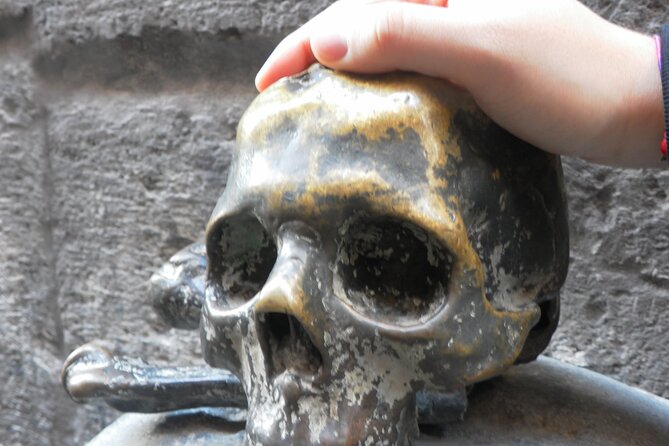
- Pezzentelle souls: Hear about Naples’ unusual relationship with the dead and the custom of caring for neglected souls in Purgatory.
- The munaciello: Discover the little household spirit blamed for unexplained trouble, sudden luck, and domestic mischief.
- Songs and spoken folklore: A traditional musician and local folklorist add performance to the guide’s stories and anecdotes.
- A genuinely small group: The tour accepts no more than 10 people, which matters on narrow streets and during questions.
Why Naples makes such a good setting for superstition
Naples has a special way of placing the sacred beside the ordinary. A church can sit near a row of craft shops. A saint’s image may share a street with a lottery ritual. A skull, a charm, or a painted shrine can carry both religious meaning and practical hope.
That mixture is the heart of this walk. You are not simply being shown old buildings. You are being introduced to the ideas people use to explain luck, illness, death, money, love, and bad behavior.
The experience focuses on popular culture rather than formal church teaching. That makes it a useful choice if you have already seen some of Naples’ major monuments and want to understand the city through its habits and stories.
You begin at Piazza Bellini at 3 pm. The meeting point is in central Naples, near public transportation, and the route ends at Piazza San Domenico Maggiore. Since no private vehicle is used, you should expect a city walk on foot through busy historic streets.
More Walking Tours in Naples:
- Naples: Street Food Walking Tour with Local Guide
★ 4.8 · 4,256 reviews - Naples Spanish Quarters Walking Tour Street Art, Folklore & Sweet
★ 5.0 · 797 reviews - Naples: Old Town Guided Walking Tour
★ 4.8 · 553 reviews
Piazza Bellini sets the tone
The first part lasts about 10 minutes in Piazza Bellini. Here, the guide introduces Neapolitan superstition and explains why charms and rituals still matter as part of the city’s popular culture.
This opening is brief, but it gives the rest of the walk a frame. You will hear about rituals meant to keep negative forces away, the close relationship between the sacred and the profane, and the songs and rhymes that carry these ideas from one generation to the next.
I like this start because it avoids treating superstition as a collection of silly habits. The goal is to show how these beliefs fit into everyday life. That distinction matters in Naples, where humor, devotion, fear, and practical luck often share the same space.
The accompanying musician and folklorist are an important part of the format. The exact names of these cultural presenters are not provided, but the experience includes their songs and spoken folklore alongside the main guide’s explanations.
Touching Pulcinella’s nose
The next stop is the bust of Pulcinella, where you hear why people touch the character’s nose. The stop lasts about five minutes, so do not expect a long lecture here.
Pulcinella is one of the most recognizable figures in Neapolitan popular culture. His crooked humor, mask, and rebellious character make him a natural part of a tour about luck and local beliefs.
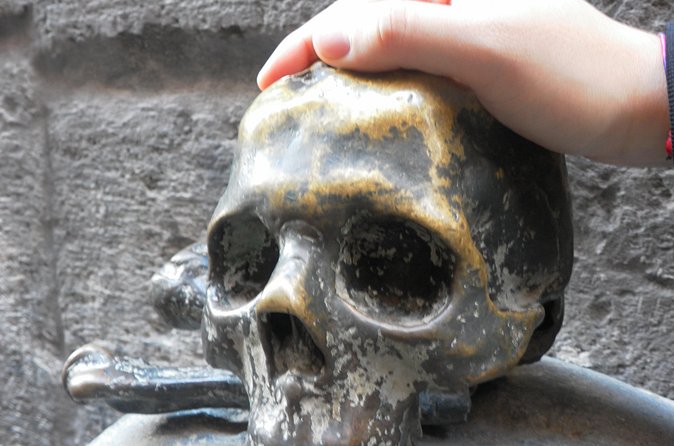
The nose ritual gives you a clear example of how superstition works in practice. A small physical action becomes a shared custom. You can see how a public figure turns into a lucky object, not through an official religious ceremony, but through repeated local use.
This is also one of the tour’s more playful moments. If you prefer folklore that connects to something you can see and touch, this stop offers an easy entry point.
Santa Maria delle Anime del Purgatorio ad Arco and the pezzentelle souls
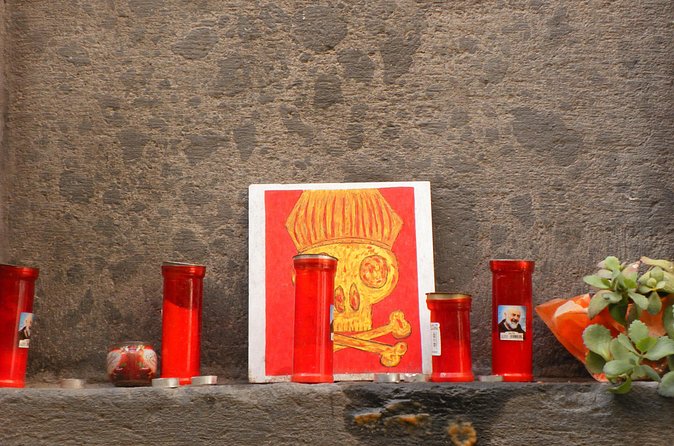
The visit near the Complesso Museale Santa Maria delle Anime del Purgatorio ad Arco lasts about 15 minutes. Here, the subject turns from comic luck to death, prayer, and the care of neglected souls.
The tour explains the church’s role and the cult of the anime pezzentelle, or pezzentelle souls. These are abandoned or forgotten souls in Purgatory. The tradition reflects a striking Neapolitan idea: the living can form a relationship with the dead by remembering them, praying for them, and caring for their memory.
This section gives the walk its strongest emotional weight. Naples’ relationship with death is not presented as distant or abstract. The dead remain part of the city’s moral and spiritual world.
You should approach this stop with respect. The subject includes religious belief, mortality, and customs that may feel intense or unfamiliar. It is also one of the reasons this experience offers more than a standard stroll through central Naples. You are being asked to consider how a city treats people who are no longer present.
The provided information does not state that admission inside the complex is included. The stop is listed as free, but you should think of the tour as an outdoor walking experience with interpretation rather than a ticketed museum visit.
A few more Naples outings worth a look
- From Naples: Pompeii Ruins & Mount Vesuvius Day Tour
★ 4.3 · 11,459 reviews - From Naples: Sorrento, Positano and Amalfi Full-Day Tour
★ 4.6 · 10,988 reviews - From Naples: Sorrento, Positano & Amalfi Coast – Small Group Tour
★ 5.0 · 8,643 reviews - Naples: Catacombs of San Gennaro Entry Ticket & Guided Tour
★ 4.6 · 7,941 reviews
The munaciello and the stories of domestic luck
At another point along the route, the guide introduces the munaciello, one of Naples’ most famous supernatural figures. The itinerary then continues to Piazza San Gaetano, where the story is developed for about 15 minutes.
The munaciello is commonly described here as a small monk-like spirit connected with household events. The stories give him an ambiguous role. He may cause trouble, but he can also be associated with unexpected good fortune.
That uncertainty is part of the appeal. The munaciello is not simply a monster or a saint. He belongs to the gray area between explanation and excuse. When something goes wrong at home, a mischievous spirit offers one answer. When luck arrives unexpectedly, the same figure can take on a more helpful role.
Piazza San Gaetano is a fitting place for this part of the walk because it sits at the center of the ancient city. The guide also tells the story of the beautiful Marianas, another piece of local folklore connected with the square.
This stop shows how place gives power to a story. A tale told in a historic public square feels different from one explained in a classroom. You can look around, follow the route of the old city, and connect the story to the streets beneath your feet.
San Gregorio Armeno, shops, saints, and lottery luck
The walk continues along Via San Gregorio Armeno for about 15 minutes. This street is known for its shops and religious figures, and the experience explains their origin as part of the local story.
The focus then moves to the sanctuary, the dissolution of blood, and San Pantaleone, described as the saint of the lottery. These themes show how formal religious devotion and the hope of sudden luck can overlap.
The blood ritual is an important example of Naples’ sacred world. The tour does not treat the custom as an isolated church practice. Instead, it places it beside the lottery and other ways people search for signs, protection, or a better turn of fortune.
The lottery matters because it turns numbers and personal events into a system of meaning. Naples is famous for linking dreams, deaths, accidents, saints, and daily events with numbers to play. This section gives you a glimpse of that mental world.
Via San Gregorio Armeno can also be a crowded part of the walk. The group limit of 10 helps, but you should still expect narrow streets and people moving around you. Keep your belongings secure and stay close to the guide during explanations.
Walking along Spaccanapoli
From Via San Gregorio Armeno, the route follows Spaccanapoli toward Piazza San Domenico Maggiore. This portion lasts about 15 minutes.
Spaccanapoli is the road that appears to cut Naples in two. It is one of the city’s most useful orientation lines, but on this tour it also becomes a bridge between different kinds of folklore.
As you walk, the route shifts from specific stories to the larger feel of old Naples. Churches, workshops, religious images, and daily street life appear close together. The value of this section is not a single monument. It is the chance to see how the city’s superstitions sit inside ordinary movement.
You should wear comfortable shoes. The tour is short by walking-tour standards, but the streets are urban and the route includes several stops where you may stand while listening. The experience is listed as suitable for most people, with service animals allowed, but the information does not promise step-free access or a flat route at every point.
Ending in Piazza San Domenico Maggiore
The final stop is Piazza San Domenico Maggiore, where the experience ends after roughly 10 minutes. The group finishes with one last superstitious ritual.
Ending here works well because the square gives the tour a clear destination rather than sending you back to the starting point. You finish in a central part of Naples, close to the route through the old city and near other sights, cafés, and streets to explore on your own.
The final ritual provides a neat close to the theme. You have moved from charms and Pulcinella to death, household spirits, saints, lottery customs, and sacred blood. The last gesture brings the subject back to the body and to the everyday actions that keep superstition alive.
The tour does not include private transportation, and the end point differs from the start. That is helpful if you want to continue sightseeing in the historic center, but less convenient if you need to return directly to Piazza Bellini.
What the $72.56 price really covers
At $72.56 per person, this is not a cheap orientation walk. There are no listed admission tickets, meals, or transport included. You receive a mobile ticket, the guided walk, the musical and folklore element, and a typical souvenir gadget.
The value depends on how much you want interpretation. If you only want to see Spaccanapoli, San Gregorio Armeno, and Piazza San Domenico Maggiore, you can visit those places without booking a tour. The price makes more sense if you want the stories tied together by a guide who can explain the customs as part of Neapolitan life.
The maximum group size of 10 is a real benefit. A small group makes it easier to hear songs and anecdotes, ask questions, and keep pace through narrow streets. It also gives the experience a more personal feel than a large city walk.
The musical element adds something you cannot get from a guidebook. A song or nursery rhyme can show the sound and rhythm of a tradition in a way that a short written description cannot. Still, you should book this for cultural explanation and performance, not for a long list of paid attractions.
Timing, weather, and cancellation details
The walk begins at 3 pm and lasts about 1 hour 45 minutes. That afternoon timing can fit well after a morning visit to a museum or archaeological site.
The activity requires good weather. If poor weather causes cancellation, you are offered another date or a full refund. It also requires a minimum number of participants, with the same choice of another date, another experience, or a refund if the minimum is not met.
You can cancel for a full refund up to 24 hours before the start time. Cancellations or changes made within 24 hours are not refunded or accepted, so check your plans before the deadline.
Confirmation arrives when you book. Most people can take part, and service animals are allowed. The experience is offered in English.
Who will enjoy this walk most
I would choose this experience if you are interested in folklore, religious customs, death rituals, oral storytelling, or the parts of Naples that do not fit neatly into a museum label.
It is also a good early-stay activity. The stories can give you a new way to notice shrines, saints, gestures, figures, and lottery references during the rest of your time in the city. Booking it early in your visit lets you use that context as you continue exploring.
Families with older children may enjoy the Pulcinella and munaciello stories, though the material about death and Purgatory may not suit very young children. People who want a fast, focused introduction to Neapolitan popular culture will get more from it than those seeking a broad history tour.
I would not choose it if your main goal is entering major monuments, seeing art collections, or covering a large area by vehicle. It is a short cultural walk, not a general Naples sightseeing tour.
Should you book the Neapolitan superstition walk?
Book it if you want to understand Naples through its rituals and stories rather than only through buildings. The small group, local folklorist, traditional musician, and carefully linked route give the experience a clear identity.
At $72.56, the cost is high for a walk with free stops, so make sure that folklore is your priority. If it is, the tour offers a focused look at Pulcinella, the munaciello, pezzentelle souls, lottery customs, and the sacred life of the old center. If you want only landmarks and photographs, spend your money elsewhere.
FAQ
Where does the tour begin?
The tour begins at Piazza Bellini, 80138 Napoli, Italy.
Where does the tour end?
The walk ends at Piazza San Domenico Maggiore, P.za S. Domenico Maggiore, 80134 Napoli, Italy.
What time does the tour start?
The scheduled start time is 3 pm.
How long does the experience last?
The walking tour lasts approximately 1 hour 45 minutes.
How large is the group?
The tour has a maximum of 10 participants.
What happens if the tour is canceled because of weather?
You will be offered a different date or a full refund if poor weather causes the experience to be canceled.
Just added around Naples
- Naples: Guided Walking Tour★ 4.7 · 63 reviews
- Wine tasting in the Vesuvius National Park★ 3.5 · 4 reviews
- Naples: Pompeii and Vesuvius Skip-the-Line Day Trip★ 3.8 · 32 reviews
- Visit the Museum MANN with a professional guide★ 5.0 · 3 reviews
- Walking-tour of Naples hystorical Centre★ 4.4 · 4 reviews
- Vesuvius – Herculaneum – Pompeii Excavations Tour★ 4.2 · 9 reviews
- Pompeii: Vesuvius at Sunset★ 3.5 · 31 reviews
- From Naples: Vesuvius and Herculaneum Day Trip with Tickets★ 3.8 · 65 reviews
Walking Tours, compared.


Naples Spanish Quarters Walking Tour Street Art, Folklore & Sweet
Read our review →

Naples Walking Tour with Underground Roman Ruins Ticket
Read our review →
Naples Panoramic Walking Tour: From the Hills to the Center
Read our review →
City Walking Tour w/ Underground Roman Ruins Ticket
Read our review →
Historic Center and Sansevero Chapel Walking Tour
Read our review →Browse the lists this tour appears in