
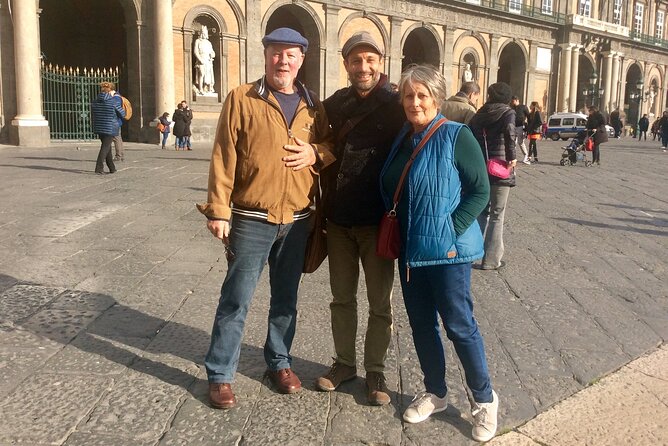
Reviewed · WALKING TOURS
The Perfect Private Walking Tour of Naples with Exclusive Guide
Naples reveals itself best on foot, where royal squares quickly give way to narrow lanes, church façades, street shrines, artisan workshops, and laundry strung above your head. This private three-hour tour connects the waterfront with the old city, covering landmarks such as Castel Nuovo, the Spanish Quarter, Spaccanapoli, and the Chapel of San Gennaro. I like the private format, since your guide can adjust the pace and subject matter. I also like the chance to meet at the cruise terminal, a real help when Naples is your port stop.
The main drawback is the tour’s broad reach. You pass many important places, but most stops receive only about 15 minutes, and admission to the Santa Chiara cloister is not included. At $211.72 per person, this makes the tour most appealing to a small group that values personal guidance and historical context, not to someone seeking a slow, detailed interior tour of every church.
Key points before you book

- The route links Naples’ waterfront and old center: Begin at Piazza del Municipio and finish near Piazza del Gesù Nuovo.
- You get a private Blue Badge guide: Only your own group takes part, with English service available.
- The tour can be customized: You can ask for more attention to history, architecture, churches, local life, or particular sights.
- The focus is the city center, not a full Naples tour: One French-language review found the title too broad for a route centered on the monumental and historic core.
- Several interiors are viewed briefly or optionally: Santa Chiara’s cloister requires an extra admission fee, and the tour does not include private transportation.
- Cruise passengers have a clear meeting plan: Walk outside the cruise terminal, through the short tunnel marked Welcome to Napoli, and look for a guide holding your name.
Starting at the port beside Castel Nuovo

The walk begins at Stazione Marittima on Molo Angioino, the maritime station near the cruise terminal. If you arrive by ship, the instructions are practical: leave the terminal, walk toward the service area, pass through the short tunnel marked Welcome to Napoli, and meet the guide with your nameplate.
That arrangement matters. Naples can feel confusing on a first visit, especially when you have only a few port hours. A guide meeting you at the terminal removes the early guesswork and gets you into the city quickly.
Your first stop is Piazza del Municipio, one of Naples’ major open squares. It sits between the old center and the sea, with Castel Nuovo dominating the view. This is a useful place for the opening talk because Naples’ past is visible in several directions: medieval power, royal ambition, modern traffic, and the waterfront that helped shape the city.
The guide gives you a short account of Naples’ more than 2,500 years of history and explains how the walk will work. Since this is a private tour, use that opening to say what interests you. If you care about architecture, ask for the changes between Greek, Roman, medieval, Baroque, and later periods. If you want daily life, ask the guide to point out how the old center still functions as a neighborhood.
More Walking Tours in Naples:
- Naples: Street Food Walking Tour with Local Guide
★ 4.8 · 4,256 reviews - Naples Spanish Quarters Walking Tour Street Art, Folklore & Sweet
★ 5.0 · 797 reviews - Naples: Old Town Guided Walking Tour
★ 4.8 · 553 reviews
Castel Nuovo and the city’s royal face
The Fountain of Neptune offers a quick introduction to Naples’ relationship with the sea. The sea god at its center recalls the importance of shipping, trade, and the Mediterranean to the city’s fortunes. It is a brief stop, but it helps connect the waterfront to the story of Naples.
Next comes Castel Nuovo, also called Maschio Angioino. The 13th-century fortress has heavy towers and a marble triumphal arch that gives the entrance a grander, more ceremonial look than a simple military gate. The castle recalls the period when Naples was a seat of kings and royal courts.
You should not expect a full castle visit here. The tour uses the exterior as a way to explain Naples’ medieval and royal past, then moves on. That is a sensible use of limited time, though anyone hoping to explore the castle’s interior should plan a separate visit.
Galleria Umberto I and the grand public spaces
From the castle, the walk moves toward Galleria Umberto I. This 19th-century arcade is one of Naples’ most impressive public interiors, with a glass dome and formal architecture built to project royal confidence. It is also a place where the city’s elegant past meets ordinary urban activity.
The gallery makes a good architecture stop. Your guide can help you notice how the scale, light, and decorative details differ from the older streets nearby. You are not simply looking at a shopping arcade. You are seeing how Naples once presented itself as a modern European capital.
Nearby, the San Carlo Opera House carries the same sense of ceremony. It is the oldest continuously active opera house in the world and is known for its acoustics and royal setting. The visit on this walking route is primarily an exterior and historical introduction, so confirm with your guide if you want more time here.
Piazza Trieste e Trento shifts the mood. It is a meeting place bordered by historic buildings and cafés, including Gran Caffè Gambrinus. The square gives you a better feel for how Naples uses public space. People gather, pass through, stop for coffee, and fold the grand setting into daily life.
The Fontana del Carciofo, decorated with sculpted artichokes, adds a playful detail. It is not one of the city’s major monuments, but that is part of its appeal. A good walk through Naples needs room for small oddities as well as famous buildings.
Piazza del Plebiscito and Via Toledo

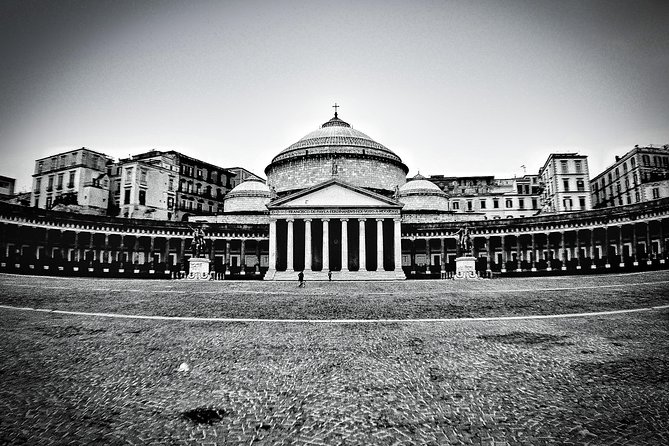
Piazza del Plebiscito is Naples’ great ceremonial square. The Royal Palace occupies one side, while the Basilica of San Francesco di Paola curves around the opposite edge with its broad colonnade. The open space feels very different from the tight lanes you will soon enter.
The Royal Palace recalls Bourbon rule and Naples’ role as a royal capital. Its interiors are not included as part of the tour, so this stop works best if you want a concise explanation of the monarchy and the square’s design. If royal apartments are a priority, you will need additional time and a separate admission.
Via Toledo brings you back into ordinary city movement. Shops, old palaces, and pedestrians fill this major avenue. It is a useful transition from the formal world of the palace to the more crowded streets of central Naples.
A few more Naples outings worth a look
- From Naples: Pompeii Ruins & Mount Vesuvius Day Tour
★ 4.3 · 11,459 reviews - From Naples: Sorrento, Positano and Amalfi Full-Day Tour
★ 4.6 · 10,988 reviews - From Naples: Sorrento, Positano & Amalfi Coast – Small Group Tour
★ 5.0 · 8,643 reviews - Naples: Catacombs of San Gennaro Entry Ticket & Guided Tour
★ 4.6 · 7,941 reviews
The Spanish Quarter, where Naples gets personal

The Quartieri Spagnoli, or Spanish Quarter, is one of the strongest parts of the walk. Narrow streets run uphill from Via Toledo, with laundry overhead, street art, small shops, and everyday life packed close together. The area feels direct and unpolished, which is exactly why it helps you understand Naples beyond its grand monuments.
Your guide can explain how the quarter fits into the city’s past and present, but you should also allow yourself time to look around. The route is not just a march between monuments. It is a chance to see how people live in the historic center.
There is a practical tradeoff here. The lanes can be busy and the walking surface uneven, so a moderate level of fitness is expected. Comfortable shoes are important. The tour is only three hours, but the number of stops and the old streets make it more active than the short duration might suggest.
Gesù Nuovo and the texture of Spaccanapoli

Piazza del Gesù Nuovo is one of the key turning points in the walk. The square is framed by the unusual façade of the Church of Gesù Nuovo and the Santa Chiara complex. It is also the scheduled end point, although the guide can return you to Municipio Square or the port if arranged as part of the experience.
Gesù Nuovo’s façade is covered in a distinctive diamond pattern that makes it unlike almost any other church exterior in Naples. Inside, the Baroque decoration is far more elaborate. The contrast between the severe-looking exterior and ornate interior is one of the city’s memorable architectural surprises.
Spaccanapoli runs through the old center in a long, narrow line. The name refers to the way the street appears to split the historic city. Along it, you see churches, cafés, workshops, and the constant movement of local life.
This is where a private guide earns much of the tour’s value. Without context, the old center can seem like a wonderful but confusing mix of façades and alleys. With a guide, you can connect the street plan, religious buildings, historic layers, and present-day neighborhood life.
Santa Chiara and a quieter pause
The Complesso Monumentale di Santa Chiara offers a change of pace. The church is a Gothic landmark, while the cloister is known for colorful maiolica tilework. The monastery provides a calmer setting after the noise and tight streets around Spaccanapoli.
The cloister visit is available upon request, but admission is not included. Ask early if you want to see it, since a three-hour route leaves little spare time. This is one of the tour’s clearest choices: keep moving to cover more of central Naples, or spend more time at Santa Chiara and reduce the number of quick exterior stops.
For many people, the cloister will be worth the extra ticket. It offers a different side of Naples, with decorative tile, garden space, and a quieter atmosphere. Still, the optional nature of the visit means you should not assume it is part of the base price.
San Domenico Maggiore, nativity makers, and local craft
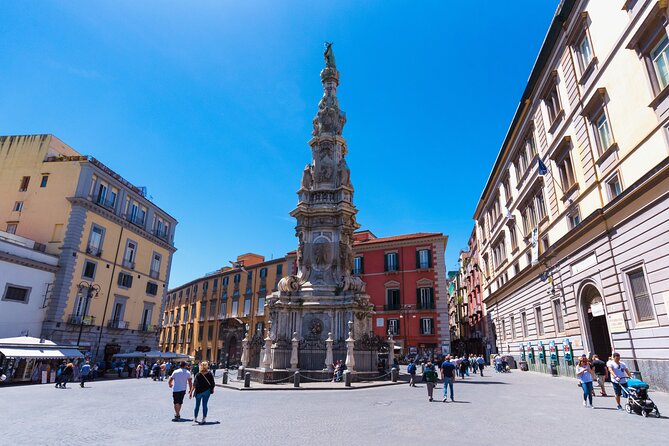
Piazza San Domenico Maggiore brings you to another historic square, dominated by the Church of San Domenico and its tall spire. Religious buildings, art, and local activity meet here, and the square gives the guide another chance to explain how Naples’ churches shaped the city.
Via San Gregorio Armeno is one of the most distinctive stops. It is the center of Naples’ nativity-making district, where artisans create small figures and elaborate scenes. The craft is often associated with Christmas, but the workshops operate as part of the city’s year-round identity.
You can look at the handmade pieces, hear about this minor art from your guide, and have some free time to browse if you wish. This is a good place to slow down and buy something connected to Naples rather than a generic souvenir.
The stop is also a reminder that the historic center is not an open-air museum only. People still make, sell, worship, eat, and work here. That everyday use gives the old streets their particular character.
The Duomo and the story of San Gennaro
The Cathedral of Naples is a 14th-century French Gothic church and the seat of the city’s archdiocese. Inside are the crypt and the Chapel of San Gennaro, Naples’ patron saint.
The chapel is the spiritual center of this part of the route. It is decorated with Baroque paintings, sculptures, and precious relics, and it is linked to the famous blood liquefaction ceremony held three times a year. The guide can explain the importance of San Gennaro to Naples’ religious and civic life.
The Chapel of the Treasure of San Gennaro is especially important for anyone interested in Baroque art or local devotion. It combines grand decoration with a story that remains central to the city. As with several major interiors, ask your guide exactly what you will enter during your chosen route and how much time is available.
Via dei Tribunali provides the route back toward Piazza del Gesù Nuovo. It is lined with churches, old buildings, and traditional pizzerias. The street also gives you a practical ending point, since you can stop for lunch at a restaurant or trattoria recommended by the guide.
How much value do you get for $211.72?
At $211.72 per person, this is not a budget walking tour. Its value depends heavily on the size of your group. Since the tour is private, the price buys flexibility, a guide focused only on your party, and help with port logistics. If several people share the booking, the cost may feel more reasonable than paying for separate private guidance.
The price is harder to justify if you want a slow museum-style visit. Most listed stops are planned for roughly 15 minutes, and optional admission fees are extra. You are paying for a connected introduction to Naples, not a series of long interior tours.
The guide quality also matters. Raffaele was praised for his passion for Naples and for leading a group on a very hot day. Giuseppe helped one group understand the city before visits to Herculaneum and Pompeii, while Corrado was described as prepared and helpful. Those details suggest that the experience can work especially well as a first look at Naples before larger archaeological sites.
The overall rating is 4.7 from seven reviews, a small sample but a strong result. One three-star assessment is useful to keep in mind: the route may feel too limited if you expect a full tour of Naples. Think of it as a guided walk through the monumental and historic center, not a citywide overview by car or scooter.
Meeting, walking, and timing tips
The tour is offered in English and includes a Blue Badge guide. It is a private activity, so only your group participates. Pickup is offered, and cruise passengers can meet at the terminal using the stated tunnel and nameplate instructions.
There is no private transportation included. The experience is built around walking between the port, royal squares, central streets, churches, and old neighborhoods. You need a moderate fitness level, and comfortable shoes will make the route easier.
The usual duration is about three hours. Because the route contains many stops, tell your guide what matters most. You might ask to prioritize:
- The Spanish Quarter and everyday Naples
- Architecture and the city’s changing eras
- Churches and San Gennaro
- Santa Chiara’s cloister
- Nativity workshops on San Gregorio Armeno
- A practical introduction before visiting Pompeii or Herculaneum
The tour can end at Piazza del Gesù Nuovo, in the historic center, or return toward Municipio Square and the port. If you need to board a ship, allow extra time after the walk and confirm the return plan before setting off.
Should you book this Naples walk?
Book it if you want a private orientation to central Naples, especially from a cruise ship. The port meeting point, flexible route, and local guides such as Raffaele, Giuseppe, and Corrado make it a useful first encounter with a city that can be hard to read on your own.
Choose another format if your main goal is a full Naples overview, long church visits, or extensive time inside Castel Nuovo and the Royal Palace. At this price, you should be comfortable with a fast-moving route and extra admission fees.
For a small group that wants history, architecture, street life, and a guide who can adjust the walk, this is a strong choice. Ask for the sights you care about, request Santa Chiara’s cloister if it fits, and treat the tour as your map for exploring Naples further rather than your only look at the city.
FAQ
How long is the private Naples walking tour?
The tour lasts approximately three hours.
Where does the tour begin?
It begins at Stazione Marittima, Molo Angioino, near the Naples cruise terminal.
Where does the tour finish?
The planned ending point is Piazza del Gesù Nuovo. The tour can also end in the historic center or return you to Municipio Square or the port.
How do cruise passengers meet the guide?
Walk outside the cruise terminal to the service area, then pass through the short tunnel marked Welcome to Napoli. The guide will be holding a nameplate with your name.
Is the tour private?
Yes. Only your own group participates.
Is transportation included?
No. This is a walking tour, and private transportation is not included.
Is admission to Santa Chiara’s cloister included?
No. The guide can take you through the cloister upon request, but admission fees are not included.
Just added around Naples
- Naples: Guided Walking Tour★ 4.7 · 63 reviews
- Wine tasting in the Vesuvius National Park★ 3.5 · 4 reviews
- Naples: Pompeii and Vesuvius Skip-the-Line Day Trip★ 3.8 · 32 reviews
- Visit the Museum MANN with a professional guide★ 5.0 · 3 reviews
- Walking-tour of Naples hystorical Centre★ 4.4 · 4 reviews
- Vesuvius – Herculaneum – Pompeii Excavations Tour★ 4.2 · 9 reviews
- Pompeii: Vesuvius at Sunset★ 3.5 · 31 reviews
- Vesuvius and Herculaneum from Naples★ 3.7 · 29 reviews
Walking Tours, compared.


Naples Spanish Quarters Walking Tour Street Art, Folklore & Sweet
Read our review →


Naples Walking Tour with Underground Roman Ruins Ticket
Read our review →
Naples Panoramic Walking Tour: From the Hills to the Center
Read our review →
City Walking Tour w/ Underground Roman Ruins Ticket
Read our review →
Historic Center and Sansevero Chapel Walking Tour
Read our review →Browse the lists this tour appears in