
Reviewed · NAPLES HISTORIC CENTRE WALKING TOURS
Naples Walking Tour: Old Town and Spaccanapoli
Naples reveals itself best on foot, and this two-hour Old Town walk takes you through the city’s ancient street plan, from Piazza Dante to Piazza del Gesù Nuovo. You’ll pass Greek walls, old gates, famous pizzerias, nativity workshops, churches, apartments, and small bars along Spaccanapoli.
I like the route’s clear progression from Greek Neapolis to everyday Naples, and I like the 4 pm start, which leaves your morning free for museums or Pompeii. The included sweet or savory tasting adds a pleasant local touch. The main caution is that your experience depends heavily on the guide’s style. Guides such as Rosa, Ines, Giorgia, and Giovanni have received especially warm praise, but one poor report described repeated commentary and an unwelcome personal tone.
Key points at a glance
- Ancient street plan: Follow the old Decumanus Major and Decumanus Inferior through the center of Naples.
- Greek walls at Piazza Bellini: See surviving fortifications built from compact tufa blocks and dated roughly to the second half of the fourth century BC.
- Naples beyond the monuments: Spaccanapoli offers a look at churches, homes, old buildings, neighborhood life, and small bars.
- A useful afternoon start: Meet at Piazza Dante at 4 pm and finish at Piazza del Gesù Nuovo.
- Small-group format: The tour accepts a maximum of 20 people, with headsets provided from six participants onward.
- Simple local tasting: A sweet or salty food sample is included in the price.
Why this route helps you understand Naples
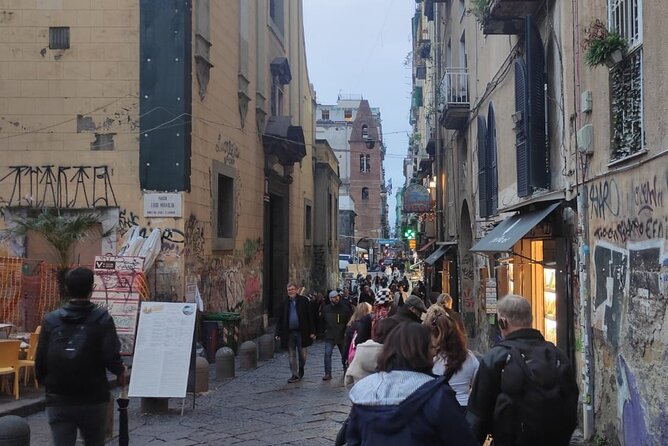
Naples can feel confusing at first. Streets twist, scooters squeeze through narrow gaps, and major churches appear beside ordinary apartment buildings. This walk gives you a basic map of the historic center while explaining why the streets run as they do.
The route follows parts of the ancient Greek and Roman city. That matters because the modern streets are not simply old streets placed at random. Via dei Tribunali follows the Decumanus Major, one of the principal east-west roads of ancient Naples. Spaccanapoli follows the Decumanus Inferior and cuts across the center in a remarkably direct line.
I like tours that give you this kind of framework. Once you understand the old street plan, the crowded lanes become easier to read. You can also return later and explore on your own without feeling that every turn has left you lost.
The tour is conducted in English and lasts about two hours. That is long enough to cover the historic center without taking up an entire day. It is also short enough to pair with dinner, an evening stroll, or a separate visit to a museum.
More walks through the historic centre:
- Naples: Old Town Guided Walking Tour
★ 4.8 · 553 reviews - Naples: Guided Pub Crawl in the Old Town
★ 4.7 · 300 reviews - Naples: Historic Center and Sansevero Chapel Walking Tour
★ 4.8 · 208 reviews
Starting at Piazza Dante and Port’Alba
You meet your guide at Piazza Dante at 4 pm. The square is a practical starting point because it sits at the western edge of the old center and leads directly toward the ancient streets of Neapolis.
The opening section introduces Greek and Roman Naples through the city’s lanes. Do not expect a long museum-style lecture here. The value is in hearing the story while walking through the actual street pattern that survived into modern life.
From Piazza Dante, the route moves toward Port’Alba. This old city gate sits on the left side of the square and acts as an entrance into the historic center. It is a modest structure, but that is part of its appeal. Naples often gives you important pieces of the city in compact, everyday settings rather than on a grand ceremonial scale.
Port’Alba is also linked with the beginning of the Decumanus Major. Your guide can help you see how a small historic passage connects to a major ancient route. This is a good early lesson in the way Naples layers Greek, Roman, medieval, and modern life in a tight area.
You spend about 15 minutes at each of the first two stops. That pace is brisk but sensible. You will hear the essential context without using half the tour before reaching the main streets.
Piazza Bellini and the Greek walls
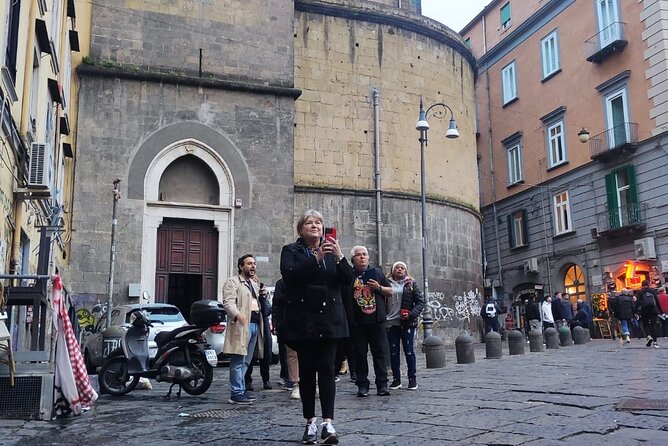
The next stop is Piazza Bellini, one of the most useful places on the route for seeing the city’s Greek foundations. On the western side of the square, remains of the walls of Greek Neapolis are visible.
These fortifications were built from compact blocks of tufa, the volcanic stone used widely in Naples. They are dated roughly to the second half of the fourth century BC. That date gives you a direct link to Naples before Roman rule, long before the churches, palaces, and cafés that now fill the center.
I appreciate this stop because it turns an abstract history lesson into something you can actually see. Ancient walls are easy to overlook when they sit beside modern streets. A guide helps you understand what you are looking at and why the remains matter.
The stop lasts about 15 minutes. Piazza Bellini is also a useful point to notice the city’s changing rhythm. The square connects the old center with a more open public space, while the next part of the walk returns you to the narrow streets.
Via dei Tribunali, the old main artery
Via dei Tribunali is the longest stop, at about 30 minutes, and for good reason. This is the heart of the historic center and the modern expression of the Decumanus Major.
The street combines several sides of Naples at once. You may pass historic businesses, churches, food shops, and famous Neapolitan pizzerias within a short walk. The route also gives your guide room to explain how the city’s main artery connects with smaller historic lanes.
This is where a local guide adds real value. On your own, you can walk Via dei Tribunali and enjoy its noise, food, and architecture. With an explanation of the ancient road beneath the modern one, the street gains a clearer shape.
The route does not include a full meal, and the food tasting is described only as sweet or salty. That is worth keeping in mind if you are booking this as a food tour. It is better understood as a walking tour with a small local bite, not a meal replacement or a dedicated pizza crawl.
The famous pizzerias along Via dei Tribunali make the timing useful for dinner planning. You can note places that catch your eye and return after the tour, rather than trying to eat a full meal while keeping up with the group.
More Walking Tours in Naples:
- Naples: Street Food Walking Tour with Local Guide
★ 4.8 · 4,256 reviews - Naples Spanish Quarters Walking Tour Street Art, Folklore & Sweet
★ 5.0 · 797 reviews - Naples: Panoramic Walking Tour with Funicular
★ 4.8 · 543 reviews - Naples Walking Tour with Underground Roman Ruins Ticket
★ 4.5 · 510 reviews
San Gregorio Armeno and the craft of the nativity scene
From Via dei Tribunali, the route reaches Via San Gregorio Armeno, the famous street of nativity scenes. This narrow lane is known for its workshops and displays connected with Neapolitan presepi.
The street is a lively change of focus. The Greek walls and ancient street plan tell you how the city was built. San Gregorio Armeno shows how local craft traditions still appear in the old center’s daily commercial life.
You spend about 15 minutes here. That gives you time to look at the shop windows and hear why the street is so closely linked with nativity figures. If you want to buy something, ask your guide how much time the group has before stopping to shop. The schedule is fairly tight, so browsing and purchasing may need to wait until after the tour.
This is also one of the stops where a good guide can add folklore and local stories. Ines, for example, was praised for combining history, folklore, and local traditions. That blend suits San Gregorio Armeno better than a list of dates would.
Spaccanapoli and the everyday city
The final major walking section is Spaccanapoli, the picturesque route also known as the Decumano Inferiore. It runs from the Quartieri Spagnoli toward Forcella and cuts across the Neapolitan center.
The name is often understood as the street that splits Naples in two. The route is not just a scenic line through the city. It takes you past churches, old buildings, homes where locals still live, and small bars. This is the section that gives the tour its strongest sense of present-day Naples.
I like that the walk does not stop at formal monuments. You get to see the old center as a place where people live, work, shop, and pass through every day. That can be more revealing than a string of grand interiors.
At the same time, you should be comfortable with an urban walk rather than expecting a quiet historic district. Narrow streets can feel crowded, and the setting is not polished or carefully arranged for sightseeing. That rough edge is part of the character, but it may not suit you if you prefer calm squares and orderly routes.
Spaccanapoli receives about 30 minutes. The time allows your guide to connect the city’s architecture, religious sites, and daily life. It is also a good point to ask practical questions about places you may want to revisit.
Finishing at Piazza del Gesù Nuovo
The tour ends in Piazza del Gesù Nuovo, one of the key squares in Naples’ historic center. The square is surrounded by the Church of Gesù Nuovo, the Basilica of Santa Chiara, and characteristic restaurants.
This is a useful ending because you are not left in an isolated meeting area. You finish near major sights and places to eat. If you still have energy, you can continue exploring the square and nearby streets. If you are ready for dinner, the restaurant setting makes the next step easy.
The end point also gives the tour a logical shape. You begin at Piazza Dante, enter the old center through Port’Alba, follow the main ancient routes, and finish among some of the center’s most recognizable religious buildings.
The guide makes the biggest difference
The tour has a strong overall rating of 4.9 out of 5 from 200 reviews, and 99 percent of customers are recorded as recommending it. The most praised part is not one single monument. It is the guide’s ability to explain Naples clearly and make the walk feel personal.
Rosa is described as offering an intricate, personalized tour and a strong understanding of local history and culture. Another comment calls her passionate in sharing her Naples. Georgia and Giorgia are also praised for clear explanations, care, and strong communication.
Ines received praise for mixing history, folklore, and local traditions. That approach is especially useful in Naples, where a street can carry a religious story, a craft tradition, and an ordinary neighborhood function at the same time. Giovanni was appreciated for speaking slowly and explaining carefully to visitors who were not fully comfortable with English.
These names do not guarantee which guide you will receive. They do give you a useful sense of what to hope for: clear English, local stories, patience, and an ability to answer questions.
The less positive experience is important to consider. One person found the guide repetitive, rude, and too focused on personal opinions, including a comment about religion that felt exclusionary. The provider apologized and said the feedback would be reviewed. A single poor experience does not erase the strong overall record, but it reminds you that guiding is personal and that respectful communication matters.
Price, group size, and what you receive
The price is $30.25 per person. For a two-hour guided walk in central Naples, I consider that a reasonable price if you want historical context and a firm route through streets that can be confusing on your first visit.
You are paying for a local guide, an English-speaking tour, and a small food tasting. Headsets are provided when the group reaches six or more participants, which is useful on noisy streets. The maximum group size is 20 people, so this is not a private walk, but it is also not designed as a huge mass tour.
The value depends on how much explanation you want. If you are happy to stroll through the center using a guidebook, you can see most of these streets without paying an admission fee. If you want the Greek walls, ancient roads, craft traditions, and local stories explained as you go, the price is easier to justify.
The 4 pm start is another practical advantage. You can use the earlier part of the day for a museum, a longer excursion, or a slower lunch. It also places the walk in the late afternoon, when you may be ready for a focused introduction to the center before dinner.
Who should book this walk
I would choose this tour for a first visit to Naples, especially if you want orientation before exploring alone. The route introduces the main historic center without requiring a full day or a demanding excursion outside the city.
It suits you if you enjoy architecture, old streets, food traditions, and stories about ordinary city life. It is also a good match if you want a guide who can connect ancient history with the Naples you see today.
You should think twice if you want extended interior visits. The supplied schedule focuses on streets and squares, and the stops are described as outdoor locations. It is also not the right choice if you want a full food tour, since only one sweet or savory tasting is included.
The walk is suitable for most people, and service animals are allowed. It is near public transportation. Still, you should expect about two hours on city streets and plan for a group pace.
You can cancel for a full refund up to 24 hours before the 4 pm start. Changes made less than 24 hours ahead are not accepted, and late cancellations are not refunded. Poor weather or failure to meet the minimum number of participants can lead to cancellation, with another date or a full refund offered.
Should you book the Naples Old Town walk?
Book it if you want a compact, affordable introduction to Naples that links Greek walls, Roman street planning, famous food streets, craft shops, churches, and ordinary neighborhood life. The route is especially useful early in your stay, when you want to learn the city’s shape before returning to its streets on your own.
I would book with realistic expectations. This is a walking orientation with a tasting, not a meal tour or a series of long monument visits. The guide’s style will shape the experience, but the high rating and repeated praise for Rosa, Ines, Georgia, Giorgia, and Giovanni suggest that the tour often succeeds through strong personal guiding.
FAQ
How long does the Naples walking tour last?
The tour lasts approximately two hours.
What time does the tour start?
The tour starts at 4 pm.
Where does the tour begin?
The meeting point is Piazza Dante, P.za Dante, 80135 Napoli, Italy.
Where does the tour end?
The tour ends in Piazza del Gesù Nuovo in Naples’ historic center.
What language is the tour offered in?
The tour is offered in English.
Is food included?
Yes. One sweet or savory food tasting is included.
Are headsets provided?
Headsets are provided when there are six or more participants.
How many people can join the tour?
The maximum group size is 20 participants.
Just added around Naples
- Naples: Guided Walking Tour★ 4.7 · 63 reviews
- Wine tasting in the Vesuvius National Park★ 3.5 · 4 reviews
- Naples: Pompeii and Vesuvius Skip-the-Line Day Trip★ 3.8 · 32 reviews
- Visit the Museum MANN with a professional guide★ 5.0 · 3 reviews
- Walking-tour of Naples hystorical Centre★ 4.4 · 4 reviews
- Vesuvius – Herculaneum – Pompeii Excavations Tour★ 4.2 · 9 reviews
- Pompeii: Vesuvius at Sunset★ 3.5 · 31 reviews
- Vesuvius and Herculaneum★ 4.8 · 9 reviews
Naples Historic Centre Walking Tours, compared.



Historic Center and Sansevero Chapel Walking Tour
Read our review →



Interactive audio guide for the historic center of Naples
Read our review →Browse the lists this tour appears in