
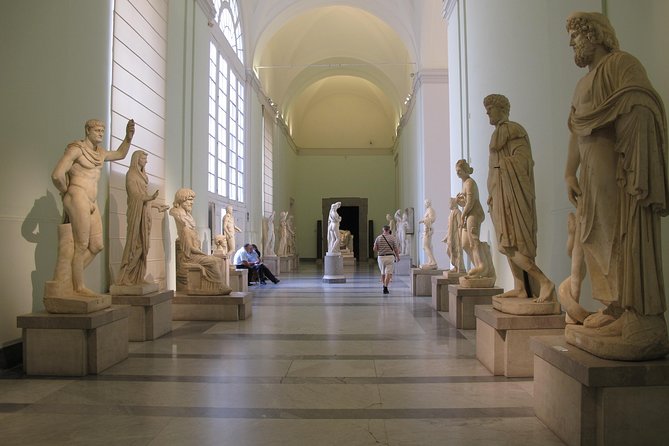
Reviewed · NAPLES NATIONAL ARCHAEOLOGICAL MUSEUM TOURS
Archaeological Museum of Naples Private Tour
The most striking thing here is that you can see everyday Roman life preserved in remarkable detail: Pompeii mosaics, medical instruments, household objects, and artworks rescued from Pompeii and Herculaneum. A private guide helps you get your bearings in a very large museum rather than wandering past the important rooms.
I like the efficient two-hour format, especially if your Naples visit is short. I also like the private setup, which lets your guide shape the visit around your interests, from Pompeii to Greek sculpture. The main drawback is the price: at $195.48 per person, it costs far more than entering on your own, so the value depends on how much you want expert help.
Key points to know
- Pompeii in museum form: See mosaics, medical instruments, and other objects that bring ancient daily life close.
- Farnese masterpieces: The route can include the famous Farnese Bull and Farnese Hercules.
- Private English guidance: Only your group takes part, with guides such as Gennaro, Nicolette, Laura, or Salvatore assigned according to availability.
- A focused two-hour visit: The format is useful when you want the main highlights without trying to cover every gallery.
- Central meeting point: Meet at Museo Archeologico Nazionale di Napoli, Piazza Museo 19.
- Book ahead: This experience is often reserved about 103 days in advance, suggesting that popular time slots can fill early.
Why this museum matters in Naples
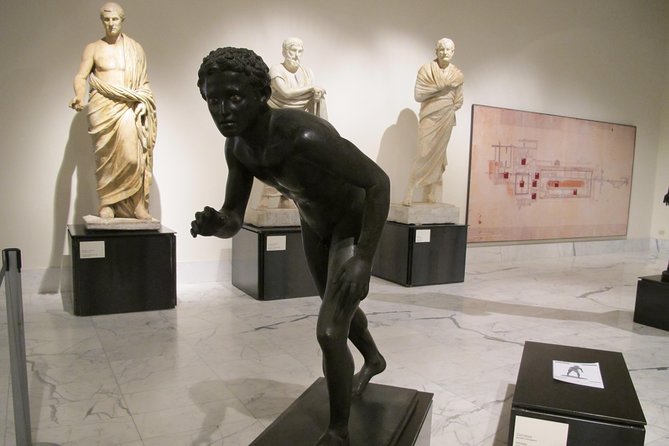
Naples is the natural base for understanding Pompeii and Herculaneum, but the archaeological museum gives you something the ruins cannot: the finest objects removed from those ancient cities, displayed together under one roof.
At Pompeii, you walk through streets, houses, and public buildings. In the museum, you can study the objects closely. A mosaic is easier to appreciate when you can stop in front of it and notice the tiny pieces, patterns, and surviving colors. Medical tools make ancient practice feel surprisingly direct. Household artifacts show that Roman life was not only about emperors and temples.
The collection also reaches beyond Pompeii. You will see art from ancient Greece and Rome, along with works connected to the powerful Farnese collection. This makes the visit useful even if Pompeii is not your main interest.
The museum can be difficult to tackle without a plan. Its scale is part of the appeal, but it also creates a practical problem: two hours is not enough to see everything. A private guide solves that by choosing a sensible route through the major rooms.
More archaeological museum tours:
- Naples: National Archaeological Museum Ticket & Audio App
★ 4.4 · 617 reviews - Naples: National Archaeological Museum of Naples Guided Tour
★ 4.8 · 498 reviews - Naples: National Archaeological Museum Tour & Digital Guide
★ 4.2 · 177 reviews
Starting at Piazza Museo 19
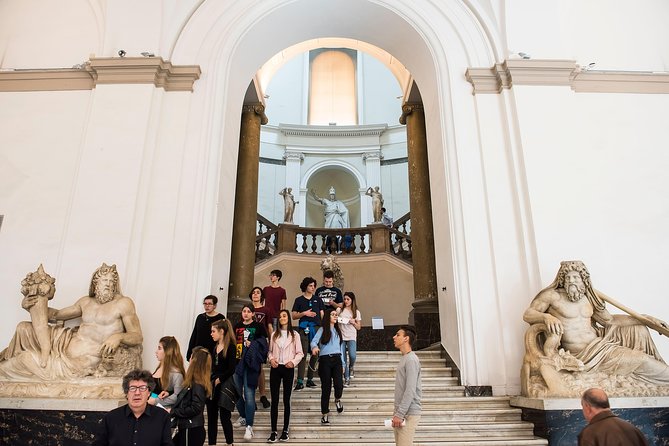
Your meeting point is the Museo Archeologico Nazionale di Napoli at Piazza Museo 19, in central Naples. The tour begins and ends at the museum, and transportation is not included, so you need to make your own way there.
That arrangement is simple. You do not spend part of the tour collecting people from hotels or riding across town. You arrive at the museum, meet your guide, and use your time inside for the collection itself.
Your mobile ticket is useful at the meeting point, and confirmation is provided when you book. The tour is offered in English, which makes it a practical choice if you want detailed explanations rather than relying on labels alone.
I would allow enough time to reach Piazza Museo without rushing. The supplied details confirm that the museum is near public transportation, but no transfer service is part of the experience. This matters if you are fitting the visit between a train, a port arrival, or another Naples activity.
The first galleries: getting oriented fast
The opening part of the tour is likely to be about orientation. You are entering a large institution with collections from several places and periods, so the guide’s first job is to explain what you are looking at and why it is important.
This is where the private format earns its keep. On an unguided visit, you may spend your first half hour figuring out the floor plan and deciding which rooms deserve your limited time. With a guide, you can move quickly toward the major collections.
The guide can also provide a thread linking Greek originals, Roman copies, wealthy Roman homes, and objects recovered from Pompeii and Herculaneum. That connection helps prevent the museum from feeling like a pile of unrelated statues and display cases.
You should not expect a complete tour of every department in two hours. Think of this as a highlights route with room for questions. If you want to spend much longer studying coins, inscriptions, or smaller objects, a self-guided visit may give you more freedom.
Pompeii mosaics and ordinary Roman life
The Pompeii collection is likely to be the emotional center of the visit. These objects came from homes and public spaces that were buried by the eruption of Mount Vesuvius. Inside the museum, you can study them at close range without having to cover the wide ruins of Pompeii first.
The mosaics are a major reason to come. Their condition can be startling, especially when you remember that some were made before the birth of Christ. Look for the fine patterns and the care packed into small pieces of stone and glass.
The important point is not only beauty. Mosaics also tell you how wealthy Romans decorated their homes, what subjects they valued, and how much effort went into the floor beneath their feet. A guide can explain the difference between a decorative pattern and a scene with a larger story.
The collection also includes objects tied to practical life. Medical instruments are especially memorable because they show ancient technology in a direct, physical way. You are not simply reading that Roman doctors had tools. You can look at the tools themselves.
This section suits you if you want more than grand statues. Pompeii’s small objects often create the strongest sense of contact with the past. They show meals, decoration, medicine, and household life rather than only public monuments.
More museums and sites in Naples:
- Naples: National Archaeological Museum audio guide
★ 4.0 · 155 reviews - Capodimonte Museum in Naples
★ 4.0 · 115 reviews - Sant’Aspreno ai Crociferi: Church & Jago Museum Guided Tour
★ 4.9 · 86 reviews - Skip the Line: National Archaeological Museum of Naples Entry Ticket
★ 3.5 · 82 reviews
The Farnese Bull and Farnese Hercules
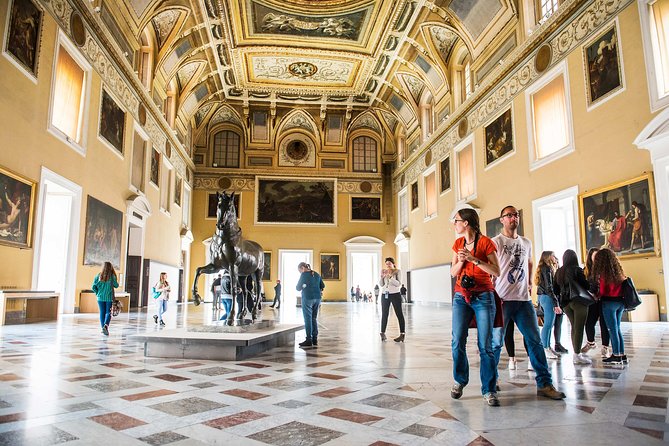
The museum’s grand sculptures provide a sharp change of mood from the Pompeii rooms. The Farnese Bull and Farnese Hercules are among the major works that a guide is likely to point out, and both give you a clear sense of the scale and ambition of ancient sculpture.
The Farnese Bull is a huge sculptural group with several figures and a dramatic subject. It is not the sort of work you can understand in a quick glance. Walk around it if the room allows, notice how the figures connect, and look at the way movement is built into the stone.
The Farnese Hercules presents a different kind of power. The figure is massive, but the pose is not simply a stiff display of strength. The guide can help you read the stance, the anatomy, and the visual choices that made this sculpture so influential.
These works also show why the museum is valuable even if you are planning to visit Pompeii. The ruins offer place and atmosphere. The museum offers close views of major artworks, with enough time to notice scale, technique, and detail.
A private guide can keep this from becoming a rushed photo stop. Gennaro, Nicolette, Laura, and Salvatore have each been praised for clear explanations, strong presentation, or professional preparation. Your assigned guide may be different, but the experience is designed around personal guidance rather than a large group following a flag.
Greek origins and Roman collecting
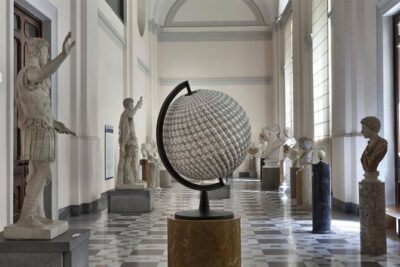
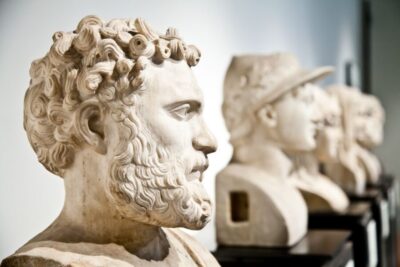
The museum’s Greek and Roman material gives you another useful layer. Ancient Rome admired Greek art, collected it, copied it, and placed it in Roman settings. The museum lets you see that relationship through sculpture and other objects.
This is a good place to ask questions. Which pieces were Greek originals? Which were Roman versions? How did wealthy Roman families acquire art? What changed when a Greek work was placed in a Roman villa?
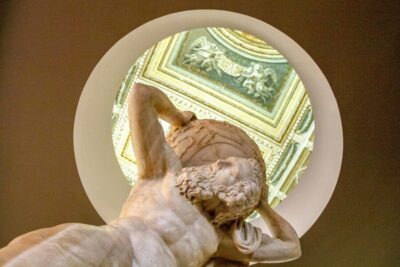
The supplied information also highlights a very large sculpture made from a single block of marble and originally created by the Greeks. That kind of object helps explain the technical challenge behind ancient sculpture. Your guide can place it in the wider story of how Greek works moved into Roman collections and later European museums.
You will get more from this section if you pause to compare the pieces rather than treating every statue as another version of the same subject. A good explanation can point out posture, proportion, surface treatment, and the difference between an idealized body and a recognizable person.
A private tour that stays focused

The private arrangement is the central feature of this experience. Only your group takes part, so you are not sharing the guide with strangers or waiting for a large party to regroup.
That has several practical benefits. You can ask for more Pompeii, spend extra time with the Farnese works, or move on from a room that does not hold your interest. The exact flexibility depends on the guide and the museum’s operation that day, but a private tour normally gives you more control than a standard group visit.
It is also useful for mixed-interest groups. One person may care about sculpture, another about domestic life, and another about engineering or medicine. A personal guide can connect these interests during the same two-hour route.
The downside is cost. The price is $195.48 per person, while the included adult admission is listed as 20 euros. For a solo visitor or a couple on a tight budget, that is a major premium for guidance.
The calculation changes if you are traveling with a small group and can use the available group discount. The experience is still not a bargain museum entry, but the cost may make more sense when split among several people who want a structured visit.
Is two hours enough?
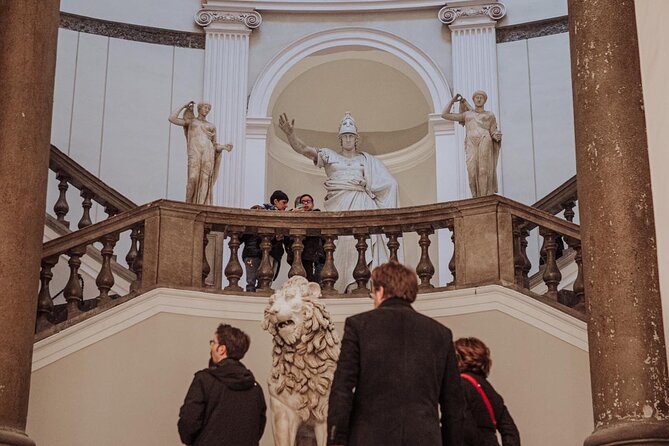
Two hours is enough for a strong introduction, not a complete museum study. You can see major sculpture, important Pompeii material, and selected Greek and Roman works, but you should not expect every gallery.
I like this length for a port day, a short Naples stay, or a first visit before exploring more on your own. It creates a clear beginning and ending, and the guide’s route keeps the visit from becoming tiring or scattered.
If you are passionate about archaeology, two hours may leave you wanting more. The best plan could be to use the private tour as your orientation, then return independently if your schedule permits. Since the admission fee is included in the experience, check the practical terms before assuming a second visit is covered.
Your guide’s pace will matter. Gennaro has been described as thorough while still using the time efficiently. Nicolette has been praised for presenting the history behind the objects. Laura’s route gave special attention to the Pompeii collection, mosaics, medical instruments, Farnese jewelry, and major sculpture. Salvatore has been noted for arriving early and handling the tour professionally.
Those details suggest that guide quality is a major part of the value. Ask questions early so the route can reflect what you care about.
Price, admission, and practical value

The listed cost is $195.48 per person. Entrance to the museum is included, with adult admission given as 20 euros and reduced admission of 2 euros for EU citizens aged 18 to 25.
The guide’s time and the private format account for most of the difference between this experience and ordinary admission. You are paying for selection, explanation, and a route through a large collection. If you prefer to read labels at your own speed, the extra cost may not suit you.
I would recommend the tour most strongly when your Naples schedule is tight or when you want help making sense of ancient art. It is also a sensible choice for a family or small group that does not want to spend the first hour figuring out where to go.
Meals and transportation are not included. That is easy to manage, but remember to budget for them separately. There is no need to build a meal into the two-hour booking itself.
The experience is often booked about 103 days ahead. You do not need to assume that every date fills that early, but the pattern is a useful warning. If you need a particular time, booking ahead is sensible.
Who should book this museum visit?
You should consider it if you want:
- A private English-language tour with no other group members
- A clear route through a large museum
- More context for Pompeii and Herculaneum objects
- Close attention to the Farnese Bull and Farnese Hercules
- A two-hour activity that fits a packed Naples schedule
- Help connecting Greek art, Roman collecting, and daily life
You may want to skip it if you enjoy wandering alone, prefer to spend several hours with one collection, or need the lowest-cost way into the museum.
It is also a good match for anyone who finds labels too brief. The strongest parts of the collection are not always obvious at first glance. A medical tool, mosaic fragment, or sculpture detail can become much more interesting once you understand its purpose and setting.
Should you book the Archaeological Museum of Naples private tour?
Book it if you want to see the museum’s main treasures without guessing where to begin. The Pompeii mosaics, ancient medical tools, Farnese sculptures, and Greek and Roman art give the two hours real substance, and the private format lets you ask questions and adjust the emphasis.
I would be more cautious if $195.48 per person feels high compared with the 20 euro adult admission. In that case, visit independently and accept a slower, less directed experience.
For most short Naples visits, the tour makes sense as a focused introduction. For serious archaeology fans, treat it as a guided first look, not the final word. Free cancellation is available up to 24 hours before the start time, but changes or cancellations inside that window are not accepted for a refund.
FAQ
Where does the Archaeological Museum of Naples private tour start?
It starts at Museo Archeologico Nazionale di Napoli, Piazza Museo 19, 80135 Napoli, Italy.
Where does the tour end?
The activity ends back at the museum meeting point.
How long does the private tour last?
The guided visit lasts approximately two hours.
Is the museum admission included?
Yes. The entrance fee is included. The listed admission is 20 euros for adults and 2 euros for reduced EU citizens aged 18 to 25.
Is transportation or a meal included?
No. Meals and transportation are not included.
Can I cancel for a full refund?
Yes, if you cancel at least 24 hours before the experience start time. Cancellations or changes made less than 24 hours before the start time are not accepted for a refund.
Just added around Naples
- Naples: Guided Walking Tour★ 4.7 · 63 reviews
- Wine tasting in the Vesuvius National Park★ 3.5 · 4 reviews
- Naples: Pompeii and Vesuvius Skip-the-Line Day Trip★ 3.8 · 32 reviews
- Visit the Museum MANN with a professional guide★ 5.0 · 3 reviews
- Walking-tour of Naples hystorical Centre★ 4.4 · 4 reviews
- Vesuvius – Herculaneum – Pompeii Excavations Tour★ 4.2 · 9 reviews
- Pompeii: Vesuvius at Sunset★ 3.5 · 31 reviews
- Vesuvius and Herculaneum from Naples★ 3.7 · 29 reviews
Naples National Archaeological Museum Tours, compared.
National Archaeological Museum Ticket & Audio App
Read our review →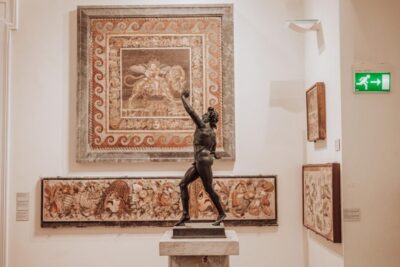
National Archaeological Museum of Naples Guided Tour
Read our review →
National Archaeological Museum Tour & Digital Guide
Read our review →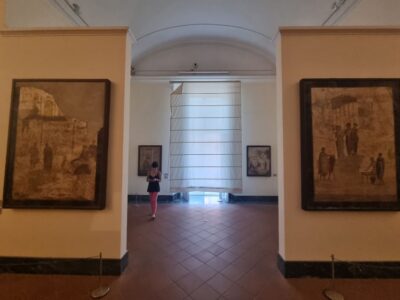
Skip the Line: National Archaeological Museum of Naples Entry Ticket
Read our review →
Naples Archaeological Museum 2-Hour Guided Private Tour
Read our review →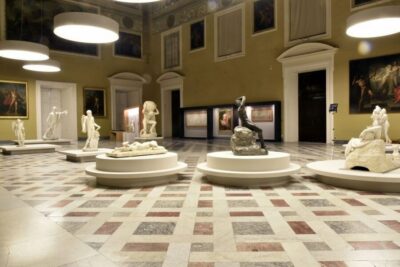
3-Day Pass, Pompeii, & Archeological Museum Included
Read our review →Browse the lists this tour appears in