
Reviewed · WALKING TOURS
Walking Tour of Naples with Traditional Music
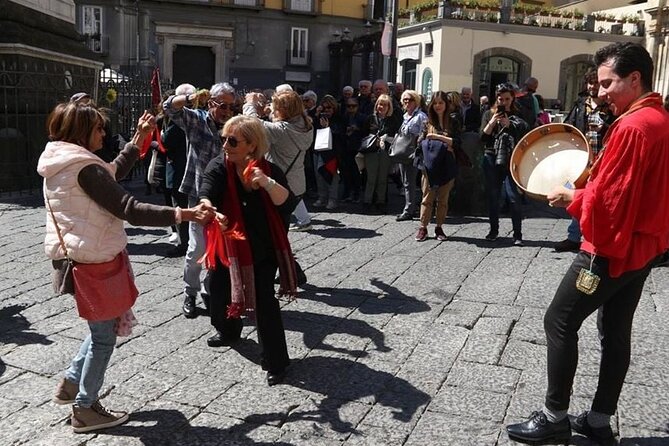
Naples reveals itself through sound as much as stone on this small-group walking tour. You move from Greek walls and Roman street plans to San Gennaro, baroque churches, neighborhood shops, and the unusual cult of the pezzentelle souls, with traditional songs and theatrical moments along the way.
I like the clear old-city route, which links Piazza Bellini, Via dei Tribunali, Spaccanapoli, and Piazza del Gesù without wasting time on transport. I also like the human touch: guides such as Enzo and Salvatore lead the walk, while singers and performers, including Antonella Esposito, add tammorra music and dramatic storytelling.
The main consideration is the price, $83.08 per person, for a 2-hour-15-minute walk where admission to the listed stops is free. You are paying for the guided performance and small-group format, not for museum tickets or a vehicle. The tour also depends on good weather and may require a minimum number of bookings.
Key points at a glance

- Traditional music is part of the walk: Expect Neapolitan songs and tammorra accompaniment, not just a standard talk beside buildings.
- The route follows ancient Naples: Piazza Bellini, Via dei Tribunali, and Spaccanapoli help you understand the Greek and Roman street plan.
- The pezzentelle souls add an unusual angle: At Purgatorio ad Arco, you learn about Naples’ folk devotion to forgotten souls.
- The group is capped at 10 people: That gives the guides more room for questions and performance moments.
- You finish at Piazza del Gesù Nuovo: The route ends near Santa Chiara and one of Naples’ most memorable baroque churches.
- It is a focused afternoon walk: The listed schedule runs Monday to Friday, from 3:00 PM to 7:00 PM.
Why the music changes this Naples walk
Many Naples tours explain churches, streets, and dynasties in a steady stream of facts. This one takes a different route. History is mixed with theatre, personal stories, and traditional music, so the setting becomes part of the performance.
That matters in Naples, where local identity is tied to songs, rituals, legends, and street life. The musical pauses give you a sense of the city that a purely architectural tour can miss. A tammorra, the frame drum used in southern Italian folk music, adds a strong local beat and helps break up the historical explanations.
The performance element also gives the tour a social feel. The guides have been praised for putting groups at ease, answering questions, and creating the feeling of walking with friends. Enzo and Salvatore are among the named guides connected with the experience, and Antonella Esposito is singled out for her theatrical performance.
I would not book this if you want a quiet, academic lecture with long periods inside churches. Book it if you like your history with songs, stories, and a bit of stagecraft.
More Walking Tours in Naples:
- Naples: Street Food Walking Tour with Local Guide
★ 4.8 · 4,256 reviews - Naples Spanish Quarters Walking Tour Street Art, Folklore & Sweet
★ 5.0 · 797 reviews - Naples: Old Town Guided Walking Tour
★ 4.8 · 553 reviews
Piazza Bellini and the first view of ancient Naples
The tour starts at the Greek Walls in Piazza Bellini. This is a good place to begin because Naples did not start as a modern Italian city. Its oldest urban roots reach back to the Greek settlement of Neapolis.
You get about 10 minutes here. That is enough for an introduction to the city’s origins and the broad shape of the old center. The stop is outdoors and admission is free, so the value comes from the guide’s explanation and the way the rest of the route builds on it.
Piazza Bellini also helps you get your bearings. From here, the walk moves into the dense historic center, where ancient street lines still guide modern Naples. Pay attention to the change from open square to narrow urban lanes. The contrast is part of the lesson.
Via dei Tribunali and the Greek-Roman street plan
Via dei Tribunali is one of the key streets in the historic center. It follows the line of a major ancient decumanus, one of the main east-west roads in a Greek-Roman city.
The scheduled stop is short, only about five minutes, but the idea is important. Naples can feel chaotic at street level, yet the old center follows a plan that is centuries old. Once you understand that, later stops on Spaccanapoli and Via San Biagio dei Librai make much more sense.
This is also a place where you should listen closely. The street itself is the exhibit. You are not being led into a large museum with labels and diagrams. The guide helps you read the city’s shape through the buildings, lanes, and surviving street pattern.
Santa Maria Maggiore alla Pietrasanta and Purgatorio ad Arco
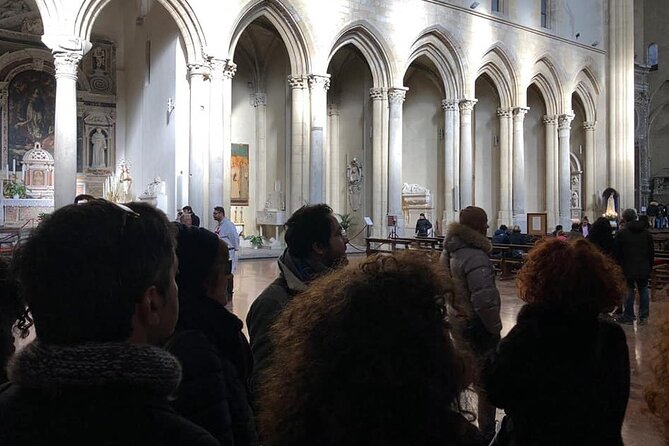
At the Basilica di Santa Maria Maggiore alla Pietrasanta, the tour turns to church history and the bell tower. The stop lasts about 15 minutes, which should give you a compact explanation rather than a long interior visit.
The next stop, the Complesso Museale Santa Maria delle Anime del Purgatorio ad Arco, is one of the most distinctive parts of the route. Here you learn about the church and the Neapolitan cult of the pezzentelle souls.
The phrase refers to souls in need of prayers, especially forgotten or abandoned dead. This tradition gives the stop an intimate and slightly eerie quality. It also shows how religious practice in Naples can combine official church devotion with local custom, family memory, and popular belief.
The theatrical format fits this subject well. Stories of souls, mysteries, and legends are more effective when presented with character and feeling. You should expect a performance-led explanation rather than a dry list of dates.
If you prefer strictly conventional religious history, this section may feel too dramatic. If you want a glimpse of Naples’ folk traditions, it is likely to be one of the most memorable moments.
A few more Naples outings worth a look
- From Naples: Pompeii Ruins & Mount Vesuvius Day Tour
★ 4.3 · 11,459 reviews - From Naples: Sorrento, Positano and Amalfi Full-Day Tour
★ 4.6 · 10,988 reviews - From Naples: Sorrento, Positano & Amalfi Coast – Small Group Tour
★ 5.0 · 8,643 reviews - Naples: Catacombs of San Gennaro Entry Ticket & Guided Tour
★ 4.6 · 7,941 reviews
Piazza San Gaetano and the city below the city
Piazza San Gaetano occupies the site of the ancient city’s agora, the central public square. The stop lasts about 10 minutes and connects the modern street to the civic heart of ancient Naples.
This is a useful pause in the route because it shows how layers of the city sit on top of one another. Greek foundations, Roman planning, Christian churches, and modern neighborhood life all meet in the same small area.
The tour does not list underground access or a separate archaeological admission, so you should not expect an underground visit as part of the experience. Instead, the guide uses the square and its surroundings to explain the ancient layout.
The Duomo and the devotion to San Gennaro
The Duomo di Napoli receives about 15 minutes. The focus is the cathedral and the cult of San Gennaro, Naples’ patron saint.
San Gennaro is not just a name attached to a church. His devotion is closely tied to the city’s identity, and the cathedral gives the guide a natural place to explain how religion, public ritual, and local pride overlap.
The short time here means you will need to keep moving. This is a guided overview, not an extended cathedral visit. If the interior is especially important to you, plan to return on your own, subject to opening conditions. On the tour, the advantage is context: you hear why the Duomo matters before continuing through the old streets.
Spaccanapoli and Via San Biagio dei Librai
Spaccanapoli is the lower decumanus, the long street that appears to split the historic center. The stop itself is listed at five minutes, but the route continues through the area, so you get more than a single roadside explanation.
This is one of the best parts of the walk for understanding Naples as a living city. The ancient road is now lined with churches, apartments, workshops, shops, and daily errands. History is not sealed behind glass. It is built into the route people still use.
Via San Biagio dei Librai receives about 15 minutes. The guide explains the street through its buildings and shops, giving you a closer look at how commerce and architecture share the same narrow corridor.
The street name recalls the old book trade, but the larger point is how a street’s identity can change while its basic role remains. This is where a local guide earns the fee. You can walk down the lane alone, but it is harder to see the connection between the buildings, the shops, and the older city plan without someone pointing it out.
San Gregorio Armeno and the sound of Naples
Via San Gregorio Armeno is known as the way of the shepherds. It is associated with nativity figures and artisan traditions, though the supplied program focuses on the street and its baroque church.
You get about 10 minutes here. That is enough for an introduction to the street’s name, its church, and its place in Naples’ creative traditions. The route’s musical parts work particularly well in this setting, since the walk is already moving from formal history toward local expression.
The song selections are drawn from Neapolitan tradition. You should expect the music to function as part of the storytelling, not as a separate concert. That makes the experience more varied, but it also means the exact balance between walking, explanation, and performance may shift with the group and the location.
Piazza San Domenico Maggiore and the center of Naples today
Piazza San Domenico Maggiore is described as the center of the city today. The tour allows about 10 minutes here, using the square to connect the old route with present-day Naples.
This is a good point to notice how the city’s main spaces serve more than one purpose. A historic piazza can be a place of worship, a public meeting point, a route through the center, and a backdrop for everyday life.
The guides’ theatrical approach helps keep this section from feeling like a list of monuments. Personal stories and short anecdotes add warmth, while the music keeps the walk rooted in local culture.
Santa Chiara and Piazza del Gesù Nuovo
The route then reaches the Complesso Monumentale di Santa Chiara, with about 10 minutes devoted to the Angevin church. Santa Chiara brings the story into the medieval period and introduces the Angevin role in Naples.
The schedule suggests a concise explanation rather than a full visit to every part of the complex. If you have your heart set on the famous cloister or a detailed look inside, check separately whether you want to return. The tour’s purpose here is to place Santa Chiara within the wider story of the city.
The final stop is Piazza del Gesù Nuovo, with 15 minutes devoted to the square and its baroque church. Ending here gives the walk a strong architectural finish. You have moved from Greek foundations and Roman planning through medieval churches, local devotion, folk custom, shops, music, and baroque Naples.
The meeting point is Piazza Bellini, near the Greek Walls, and the walk ends at Piazza del Gesù Nuovo. No private transportation is included, which is exactly what you want for this route. A vehicle could not give you the same sense of the close streets and changing scale of the historic center.
Is $83.08 a fair price?
At $83.08 per person, this is not a bargain walking tour. The route lasts about 2 hours and 15 minutes, and the listed churches and outdoor stops have no admission charge.
The price makes more sense if you value the added format: a maximum of 10 people, English guidance, traditional songs, tammorra music, and theatrical storytelling. You are paying for interpretation and performance rather than transport or ticketed attractions.
I would compare it with a standard Naples history walk before booking. If you mainly need orientation and basic facts, a less expensive tour may do the job. If you want an experience built around music and local performance, this one offers something harder to find in a routine city walk.
Coffee or tea is included, a small but welcome touch during an afternoon on foot.
Who should book this experience?
I would recommend it to you if you enjoy:
- Local music and live performance
- Stories about customs, legends, and religious traditions
- Walking through historic streets rather than riding between sights
- Small groups and room to ask questions
- A first introduction to Naples’ old center
- A tour that feels social and informal
It may be less suitable if you want extensive time inside each church, a private guide, or a fully transport-based sightseeing experience. The tour is offered in English, but the artistic effect depends partly on how comfortable you are with songs, theatrical scenes, and a lively presentation style.
Most people can take part, and service animals are allowed. The meeting area is near public transportation. Since the experience requires good weather and a minimum number of participants, keep some flexibility in your schedule. You can cancel for a full refund up to 24 hours before the start time. Cancellations or changes made later are not refunded or accepted.
Should you book the Naples music walk?
Book this tour if you want Naples explained through sound, story, and street life, not just monuments. The route covers the city’s essential historic center, and the pezzentelle soul tradition gives it an unusual subject that most general walks will not offer.
The strongest reason to choose it is the blend of history with live Neapolitan music and theatre. Enzo, Salvatore, Antonella Esposito, and the other performers bring a personal quality to the route. The main reason to hesitate is cost, especially since no private transport or paid admission is included.
For a first afternoon in Naples, I think the route works best as an introduction. You finish knowing where the ancient streets run, why San Gennaro matters, how Spaccanapoli fits the old plan, and which churches deserve a closer look later.
FAQ
Where does the walking tour start?
It starts at the Greek Walls in Piazza Bellini, Naples, Italy.
Where does the tour finish?
The tour ends at Piazza del Gesù Nuovo.
How long does the experience last?
The walk lasts approximately 2 hours and 15 minutes.
Is the tour offered in English?
Yes. The experience is offered in English.
How many people can join the tour?
The group has a maximum of 10 participants.
What happens if the weather is poor?
The experience requires good weather. If it is canceled because of poor weather, you will be offered another date or a full refund.
Just added around Naples
- Naples: Guided Walking Tour★ 4.7 · 63 reviews
- Wine tasting in the Vesuvius National Park★ 3.5 · 4 reviews
- Naples: Pompeii and Vesuvius Skip-the-Line Day Trip★ 3.8 · 32 reviews
- Visit the Museum MANN with a professional guide★ 5.0 · 3 reviews
- Walking-tour of Naples hystorical Centre★ 4.4 · 4 reviews
- Vesuvius – Herculaneum – Pompeii Excavations Tour★ 4.2 · 9 reviews
- Pompeii: Vesuvius at Sunset★ 3.5 · 31 reviews
- Vesuvius and Herculaneum from Naples★ 3.7 · 29 reviews
Walking Tours, compared.


Naples Spanish Quarters Walking Tour Street Art, Folklore & Sweet
Read our review →


Naples Walking Tour with Underground Roman Ruins Ticket
Read our review →
Naples Panoramic Walking Tour: From the Hills to the Center
Read our review →
City Walking Tour w/ Underground Roman Ruins Ticket
Read our review →
Historic Center and Sansevero Chapel Walking Tour
Read our review →Browse the lists this tour appears in